By Clint Sanchez · Published · Updated · 11 min read
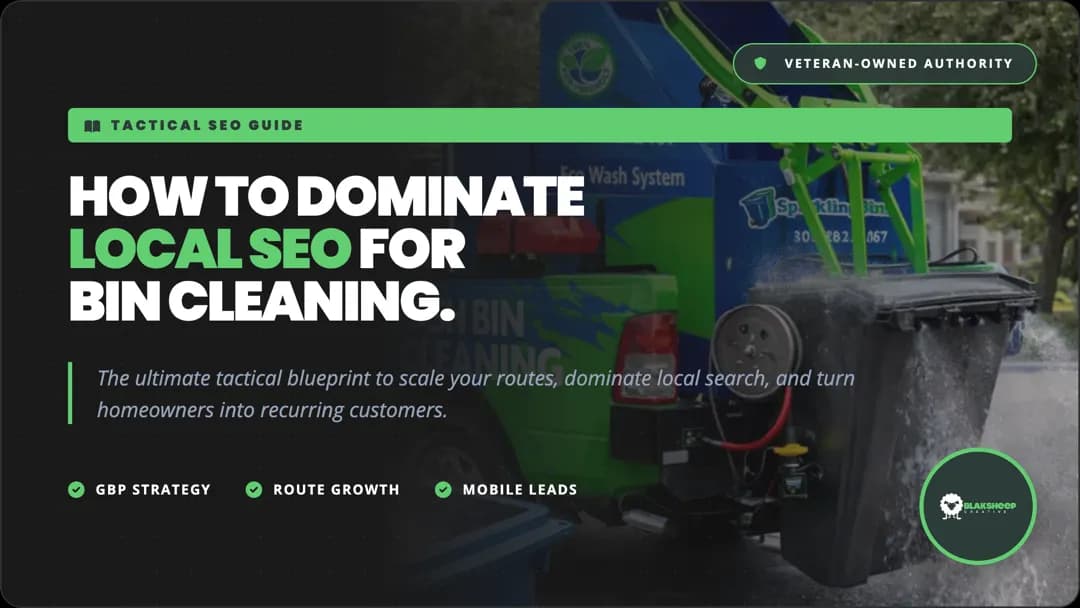
Quick answer
Trash can cleaning companies improve local SEO by defining the service areas their routes actually cover, building service area pages with real local detail, completing Google Business Profile so it matches the website, adding truck and before-and-after photos, earning honest reviews, using LocalBusiness schema, keeping mobile quote forms short, and tracking calls and forms by market so the next route is chosen on lead data.
Key takeaways
- Google ranks local results on relevance, distance, and prominence, so a bin cleaning company struggles in markets far from its base with no proof of activity.
- Google Business Profile allows up to 20 service areas and recommends keeping them within about a two-hour drive of the business.
- A service area page with only the city name swapped is thin content; strong pages carry route days, plans, photos, reviews, and a quote form.
- According to BrightLocal, 97 percent of consumers read reviews online, and real truck and before-and-after photos beat stock images for an unfamiliar service.
- A mobile quote form needs only name, email or phone, address or ZIP, number of bins, and one-time versus recurring.
- LocalBusiness, Service, FAQPage, and BreadcrumbList schema help search engines understand a multi-market service business.
- Track quote forms, click-to-call, booking clicks, and service area leads in GA4 so route expansion follows lead quality.
A bin cleaning route out of Denham Springs can cover Walker, Watson, and Prairieville in a day but not Hammond and Gonzales too, and Google's distance signal reflects that. Build pages for the parishes your truck actually runs, and note the route day: subdivisions with HOA pickup rules and August heat are why people here search for the service in the first place.

Want this handled instead of DIY?
A 15-minute call, no script, no pressure. You leave with a plan either way.
Local SEO for Trash Can Cleaning Companies Starts With Service Area Strategy
Local SEO for trash can cleaning companies should help your business get found in the markets you actually serve across the US. The goal is not to chase every nearby city. The goal is to build clear service area pages, a complete Google Business Profile, mobile quote paths, reviews, local proof, and tracking that turns search traffic into booked routes.
Quick Answer: How Can Trash Can Cleaning Companies Improve Local SEO?
Trash can cleaning companies improve local SEO by defining real service areas, building useful service area pages, completing Google Business Profile, adding real photos, earning reviews, using LocalBusiness schema, building mobile quote paths, and tracking calls and forms by market. The best plan prioritizes profitable routes over random map coverage.
TLDR: Local SEO for Trash Can Cleaning Companies
- Target real service areas, not every ZIP code within reach.
- Use city, county, metro, and route pages only when each page has useful local detail.
- Keep your Google Business Profile accurate by updating services, hours, service areas, photos, reviews, and website links.
- Build mobile quote paths that ask for the few fields needed to price or schedule the job.
- Add service proof: reviews, route details, photos, process steps, FAQs, and recurring plan options.
- Use LocalBusiness schema, internal links, clean title tags, and Core Web Vitals basics.
- Track quote forms, calls, booking clicks, city leads, and interest in recurring plans.
Trash-can cleaning companies across the US often face the same problem: the service is local, recurring, and route-based, but the website reads like a generic cleaning brochure. A good local SEO plan connects search demand to real routes, real service proof, and a simple quote path before the customer gets distracted by literally anything else online.
Need a trash can cleaning website built around real service areas and quote requests?
BlakSheep Creative builds websites for trash can cleaning businesses with service area structure, mobile quote paths, SEO basics, and conversion tracking.
Why Route-Based Local SEO Works Differently
Trash can cleaning is not like selling a product that can ship anywhere. Your truck, route schedule, crew capacity, and customer density all shape which markets are worth chasing.
Google says local rankings are shaped by relevance, distance, and prominence. That matters because a bin cleaning company can have a good site and still struggle in areas that are too far from its base or lack evidence of market activity. Local SEO should help you build density where the route makes sense.
| Ranking Factor | What It Means For Bin Cleaning | Website Action |
|---|---|---|
| Relevance | Google needs to understand that you clean trash cans, bins, carts, dumpsters, or containers. | Use clear service pages, FAQs, titles, headings, and schema. |
| Distance | Searchers near your base or proven service areas may be easier to reach. | Build pages around real routes, not wish list cities. |
| Prominence | Reviews, mentions, links, and brand signals help show credibility. | Add reviews, local proof, business profiles, and partner references. |
Ranking in your service area is just the first step; your website needs to show that your routes are easy to join. Learn how to align your service area pages with recurring plan cards that make signing up for a route a no-brainer for local customers: Optimize Your Plan Page for Conversions
Route-based SEO should serve the business model, not just the keyword list.
Start With Real Service Areas Before You Write Pages
Before writing city pages, map where your company actually cleans bins. This keeps your content useful and helps avoid thin pages with only a swapped city name.
Google’s service area guidance says businesses can list up to 20 service areas and should keep the overall area within about a 2-hour drive from the business base. That does not mean every service area will rank by default. It means the profile should reflect the real area you serve.
| Service Area Type | Example | Content Approach | Risk |
|---|---|---|---|
| Core market | The main city or metro where most customers live. | Build a strong service area page with photos, reviews, plans, and FAQs. | Low |
| Active route market | Nearby city or suburb is already on your schedule. | Add route timing, recurring service options, and local proof. | Low to medium |
| Expansion market | Area you plan to serve soon. | Create planning content or a waitlist instead of pretending the route exists today. | Medium |
| Far market | Area outside the reasonable route distance. | Skip it unless operations can support it. | High |
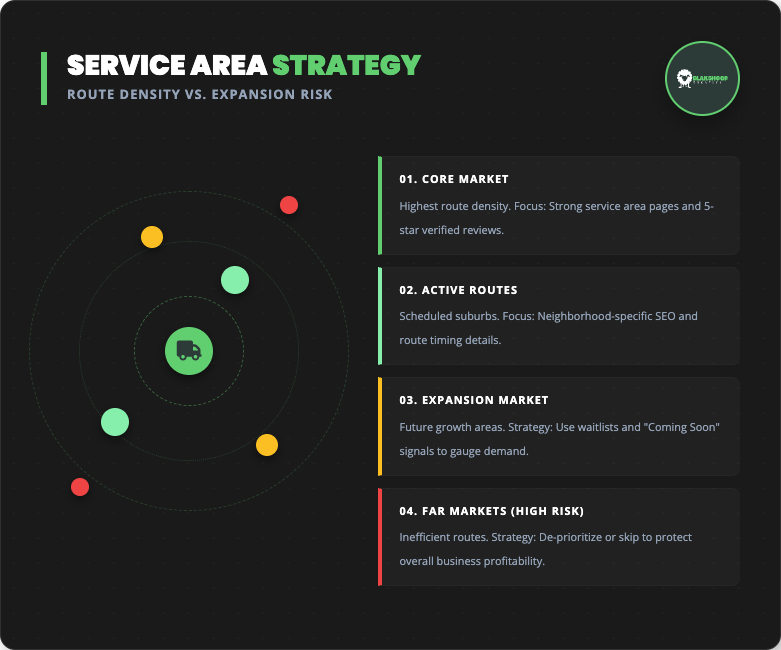
Better service area choices create cleaner pages, cleaner expectations, and cleaner routes.
Google ranks local results on relevance, distance, and prominence, so a bin cleaning company struggles in markets far from its base with no proof of activity.
Build Service Area Pages That Help Customers
Service area pages can work well for trash-can cleaning companies, but only if each page provides the customer with useful details. A city name pasted into recycled copy is not a strategy. It is paperwork with a URL.
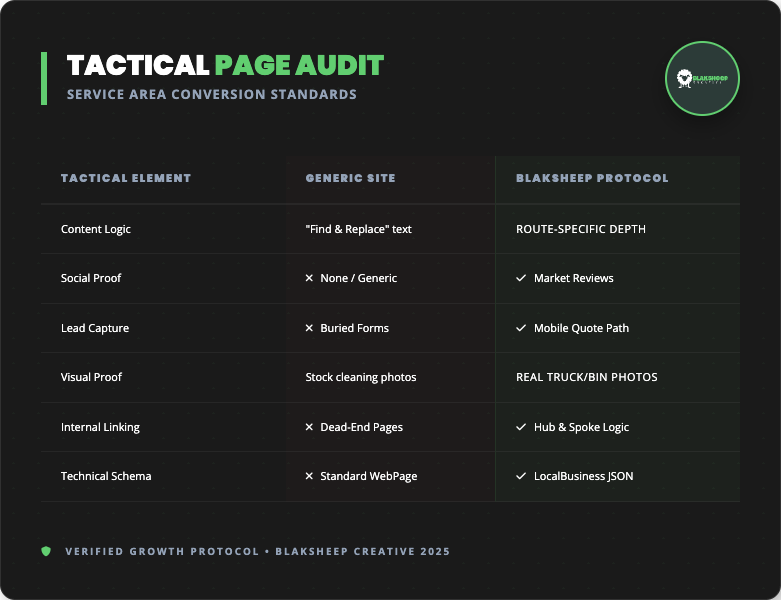
A strong service area page should explain availability, cleaning plans, container counts, scheduling, route days, neighborhood coverage, photos, reviews, and the quote process. It should also link back to your main service page and related FAQs so visitors do not hit a dead end.
For the full-page structure, use our guide to trash-can cleaning service area pages to plan city pages that support real routes, local proof, and quote requests.
| Weak Page | Strong Page |
|---|---|
| Same copy with a different city name. | Specific service details tied to the market. |
| No proof that the company serves the area. | Photos, reviews, route notes, or nearby service context. |
| No clear offer. | One-time cleaning, recurring plans, HOA service, or commercial options. |
| Buried form. | Visible quote CTA with short fields. |
| No internal links. | Links to main service, pricing, process, FAQ, and contact pages. |
Useful local pages reduce doubt and help search engines connect the business to real service demand.
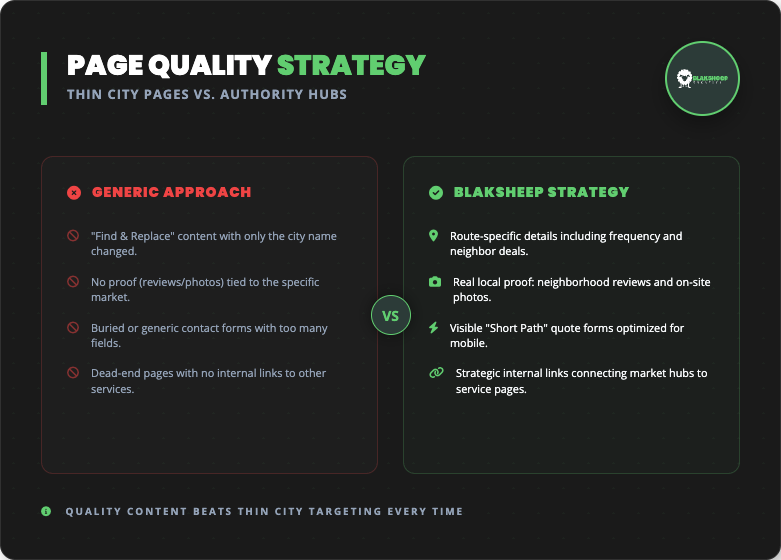
Your service area pages should support routes rather than clutter the site.
Set Up Google Business Profile To Match The Website
Google Business Profile is often the first place a homeowner checks before visiting the website. If the profile, website, and service area pages tell different stories, trust starts leaking before the lead even lands.
Google’s Business Profile setup guidance recommends keeping business details accurate, including hours, website, phone number, location or service area, photos, reviews, and booking or website links. For a trash can cleaning company, those details should match the website, service-area pages, and quote form. If the profile says one thing and the site says another, customers notice. So does Google.
Google also has rules written for a business run from home. A service-area business can list up to 20 service areas and should hide its address, and adding a city to the business name can get the profile suspended.
| GBP Element | What To Do | Why It Matters |
|---|---|---|
| Primary category | Choose the closest eligible category. | Helps Google understand the business type. |
| Services | List bin cleaning, cart cleaning, dumpster pad cleaning, or related services that apply. | Supports service relevance. |
| Service areas | Add accurate cities, ZIP codes, or regions served. | Helps customers understand coverage. |
| Photos | Show real trucks, bins, equipment, before and after work, and crew photos. | Builds proof for an unfamiliar service. |
| Reviews | Ask real customers for honest reviews and reply with care. | Supports trust and prominence. |
| Website link | Send visitors to the strongest quote or service page. | Reduces friction from search to lead. |
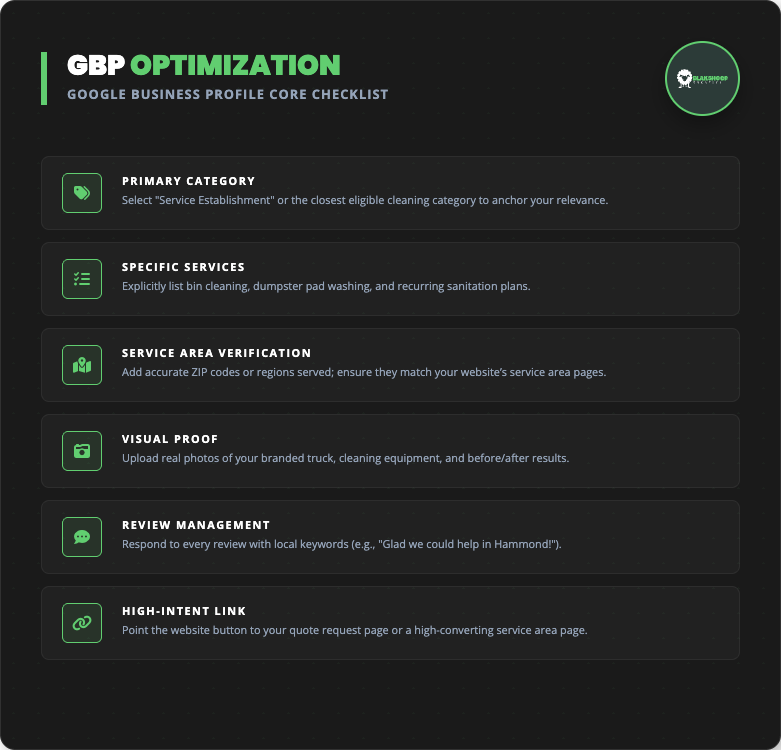
The profile should act like a preview of the same promise the website delivers.
Use Reviews And Photos To Prove The Service
Trash can cleaning is still unfamiliar to many homeowners. They may understand the smell. They may not understand the process, the schedule, or why recurring cleaning makes sense.
Trash can cleaning is visual. Customers understand it faster when they see the truck, the equipment, the before-and-after results, and the team doing real work. Google’s guidance on business photos also recommends adding images that show products, services, team members, and different types of work a business performs.
BrightLocal reports that 97 percent of consumers read reviews online. Google also recommends photos that show products, services, and team members performing different types of work. For trash can cleaning, real proof beats polished stock images of bins that have apparently never seen garbage.
| Proof Asset | Where To Use It | Best Practice |
|---|---|---|
| Customer reviews | Homepage, service pages, service area pages, and quote pages. | Use real review copy and avoid inflated claims. |
| Before and after photos | Service pages and cleaning process sections. | Show clear results without making health claims you cannot back. |
| Truck and equipment photos | About page, homepage, and GBP. | Show that the company is real and prepared. |
| Route or neighborhood mentions | Service area pages. | Use only areas the company serves. |
Proof helps visitors trust the service before they ask for pricing.
“Clint and BlakSheep created a top quality website, quickly at an incredible value literally putting my little startup project on the map. I can’t thank the team enough!”

Make Mobile Quote Requests Easy
Trash can cleaning leads often come from phones. A homeowner notices a smell, sees the truck, scans a QR code, or searches while dragging carts back from the curb, as civilization has failed again.
Google states that it uses the mobile version of the site content for indexing and ranking. That makes mobile usability more than a design preference. The quote path should be fast, readable, and easy to complete with one thumb.
| Form Field | Use It? | Reason |
|---|---|---|
| Name | Yes | Needed for follow-up. |
| Email or phone | Yes | Needed to send quote details. |
| Address or ZIP code | Yes | Needed to confirm route coverage. |
| Number of bins | Yes | Needed to estimate service. |
| One time or recurring | Yes | Helps qualify the lead. |
| Long notes field | Optional | Helpful, but should not block submission. |
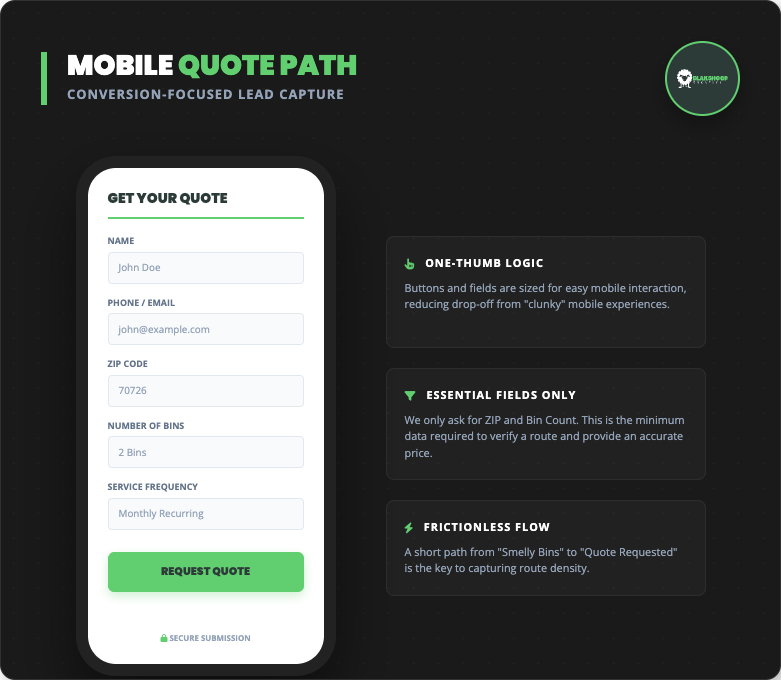
Short forms create more action and better lead qualification.
Add Schema, Internal Links, And Technical SEO Basics
Schema markup will not save weak content, but it can help search engines understand the business, service, pages, and FAQs. That matters when a company serves several markets and offers recurring service plans.
Google says LocalBusiness structured data can describe hours, departments, reviews where eligible, and other business details. For a trash can cleaning company, the site may also use Service, FAQPage, BreadcrumbList, Organization, and WebPage schema when the content supports it.
| SEO Element | Use On Site | Purpose |
|---|---|---|
| LocalBusiness schema | Core business pages. | Clarifies business details. |
| Service schema | Main service pages. | Clarifies the trash can cleaning offer. |
| FAQ schema | FAQ sections that appear on the page. | Supports answer-style content. |
| Breadcrumb schema | All major pages. | Clarifies page hierarchy. |
| Internal links | Homepage, service pages, city pages, and blog posts. | Moves users and search engines through the cluster. |
| Core Web Vitals basics | Mobile templates and landing pages. | Supports usability and page experience. |
Technical SEO should make the site easier to understand, not harder to manage.
Track Leads By Market And Route Value
Ranking reports are useful, but booked recurring customers matter more. A trash can cleaning company should know which markets generate qualified calls, quote forms, and repeat service interest.
Track calls, forms, booking clicks, GBP website clicks, review requests, service area page visits, and recurring plan selections. The point is to see which markets support route growth and which pages attract low-quality traffic.
| Metric | What It Shows | Tracking Setup |
|---|---|---|
| Quote form submissions | Primary lead volume. | GA4 form submit event. |
| Click to call | Mobile lead demand. | GA4 click event and call tracking. |
| Booking clicks | Intent to schedule. | CTA click event. |
| Service area leads | Market quality. | Hidden form field or landing page source. |
| Recurring plan interest | Higher value lead potential. | Form option or CRM tag. |
The best SEO plan helps the owner decide where to build the next route.
Google Business Profile allows up to 20 service areas and recommends keeping them within about a two-hour drive of the business.
How BlakSheep Creative Builds Trash Can Cleaning Website SEO
BlakSheep Creative builds trash can cleaning websites around service area structure, mobile quote paths, local SEO basics, and clear conversion tracking. The site has to sell the service, explain the process, and make the next step easy.
We do not build generic cleaning templates with a trash can photo slapped on top. We map services, routes, customer questions, quote forms, schema, internal links, and tracking so the website supports the business model.
| Phase | What Happens | Client Input Needed |
|---|---|---|
| Planning | Review services, markets, routes, pricing logic, photos, and goals. | Service list, route areas, pricing notes, photos, and current website details. |
| Structure | Map service pages, service area pages, quote paths, FAQs, and internal links. | Approval on markets and page priorities. |
| Build | Create layouts, content structure, SEO basics, forms, and schema. | Feedback, proof assets, and form routing details. |
| Launch | Test mobile layout, forms, links, tracking, metadata, and core pages. | Final review and launch timing. |
| Optimize | Review leads, page performance, service area demand, and content gaps. | Lead quality feedback and new route targets. |
The result is a website structure built for service demand, not decorative marketing noise.
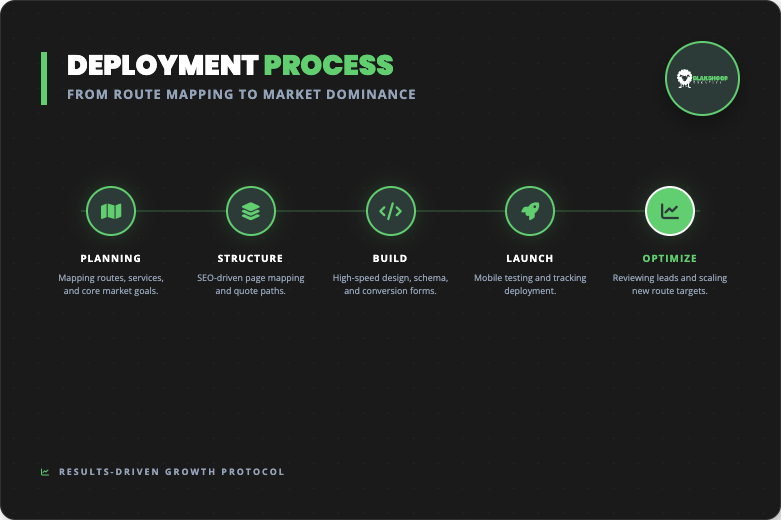
Build a trash can cleaning website around real markets and real leads.
Your website should show where you work, explain how your service works, build trust, and convert local searches into quote requests.
Common Questions About Local SEO for Trash Can Cleaning Companies
Trash can cleaning companies often ask the same questions about service areas, city pages, reviews, and quote forms. These answers keep the strategy practical before the website becomes a directory of places the truck rarely visits.
How do trash can cleaning companies rank in more service areas?
Start with real service areas, a complete Google Business Profile, strong service pages, useful service area pages, reviews, photos, and clear internal links. Ranking in more markets takes proof, useful content, and business signals. It should match actual routes rather than chase every city name on the map.
Should a trash can cleaning company create a page for every city?
No. Build service area pages only for markets the company can serve well. Each page should have useful details, route context, service options, FAQs, proof, and a quote CTA. Thin pages with the city name swapped can hurt trust and waste crawl budget.
Does Google Business Profile help trash can cleaning companies get leads?
Yes, when the profile is accurate and active. Add correct business info, service areas, services, photos, reviews, hours, and a website or quote link. The profile should match the website so customers see a consistent offer from search to form submission.
What should be on a trash can cleaning service area page?
A good service area page should include service availability, cleaning plan options, route notes, photos, reviews, FAQs, process details, pricing guidance if available, and a short quote form. It should link to the main service page and help customers confirm that the company serves their area.
How do reviews help with trash can cleaning local SEO?
Reviews support trust and prominence. They help customers see that the company is real, reliable, and active in the market. Use honest review requests, respond professionally, and place relevant reviews near quote forms. Do not fake reviews or offer rewards that violate platform rules.
Should trash can cleaning companies use booking forms or quote forms?
Use the form that matches the sales process. A simple quote form works well when pricing depends on address, bin count, frequency, or route coverage. Online booking can work when prices and available service windows are clear. Keep the form short either way.
About the Author: This guide was produced by the senior strategy team at BlakSheep Creative. BlakSheep Creative specializes in custom web design, technical SEO, local SEO, content structure, and conversion systems for service businesses across the US.

We build this for trash can cleaning companies.
Fixed quote before we start, and you talk to the people who do the work.
About the author

Founder & Lead Developer · Denham Springs, LA
Clint has built and marketed websites for 26 years, since founding BlakSheep Creative in 2000. He is also a 29-year firefighter and a 23-year member of IAFF Local 557, which is where the bias toward plain answers over sales copy comes from.
- Veteran-owned
- Firefighter-owned
- IAFF Local 557
More Questions About Local SEO for Trash Can Cleaning Companies
Short answers to the questions that come up most on this topic.
What is route-based local SEO?
How many service areas should a bin cleaning company list on Google?
What should a trash can cleaning quote form ask?
Why do photos matter so much for bin cleaning SEO?
What should a bin cleaning company track to measure local SEO?

Your next step, without the guesswork
No surprises, clear next steps, and a fixed price before anything starts.