
By Clint Sanchez · Published · Updated · 21 min read
Quick answer
A useful trash can cleaning service area page answers one question: does this company serve my area, and can I trust it? Each city page needs its own URL with the city in the slug, a city-specific H1 and intro, neighborhoods and the parish named in context, local reviews, an insurance mention, a service area map, city-specific FAQs, and a clear call to action. A copied template with the city swapped is a doorway page.
Key takeaways
- Google's spam policies define doorway pages as pages built to rank for specific queries that add no real value, and city-name-swapped templates fit that definition.
- Every city page needs its own indexable URL with the city name in the slug; a dropdown of cities on one page earns no separate rankings.
- Aim for at least 30 to 40 percent of each city page to be city-specific: H1, opening paragraph, neighborhoods, service days, local reviews, and FAQs.
- Google says local rankings depend on relevance, distance, and prominence.
- Trust signals for every city page: a service area map, local reviews, a license and insurance sentence, and four to six city-specific FAQs.
- Link every city page to the main service page and to adjacent cities in the same cluster, and update at least two existing pages when a new city launches.
- Add LocalBusiness, Service, and FAQPage schema with the city named in areaServed.
A route based in Denham Springs really does run Baton Rouge on one day and Walker, Livingston, and Hammond on others, and a homeowner in Shenandoah or Copper Mill searches for the subdivision, not the metro. The parish matters too: East Baton Rouge, Livingston, and Ascension each have their own pickup schedules, and a page that names the parish and the route day reads like a local company, not a template.

Want this handled instead of DIY?
A 15-minute call, no script, no pressure. You leave with a plan either way.
A useful trash can cleaning service area page answers one question for the person searching: “Does this company serve my neighborhood, and can I trust them?” It includes city-specific content, local proof, a clear call to action, and enough geographic detail to earn relevance without triggering Google’s doorway page filters. Swapping a city name into a copied template is not a service area page. It is filler content that wastes your crawl budget.
TL;DR: What You Need to Know About Trash Can Cleaning Service Area Pages
- Google penalizes thin city pages that exist solely to target a keyword and provide no real value to the user.
- A useful city page includes location-specific content, local trust signals, a service description, FAQs, and a direct CTA.
- Modular content lets you scale to 20+ cities without copying and pasting the same page.
- Parish references, neighborhood names, and zip codes used correctly signal geographic relevance without stuffing.
- Internal linking between city pages and your main service page strengthens your entire site’s local authority.
- Each city page needs its own unique URL with the city name in the slug.
- Trust signals, including local reviews, insurance mentions, and a simple service area map, help visitors trust the page.
If you run a trash-can cleaning route, you already know how spread out the service territory can be. A business based in Denham Springs might serve customers in Baton Rouge, Livingston, Walker, and Hammond.
One operating out of Metairie could cover Kenner, Gretna, and parts of Jefferson Parish. As you push routes north toward St. Tammany or south toward Lafourche, your website needs to reflect that coverage in a way that search engines can parse and customers can trust.
The problem is that most trash can cleaning websites either ignore city pages entirely or build them the wrong way. They copy one page, swap the city name, and call it done. Google has seen that play before. It does not reward it.
What Makes a Trash Can Cleaning Service Area Page Useful vs. a Doorway Page
Google’s guidelines define doorway pages as pages created to rank for specific search queries that add no real value beyond redirecting or funneling users.
For trash can cleaning businesses, the doorway page problem is common and costly. Understanding the difference between a doorway page and a useful service area page is the first step to building something that actually earns rankings.
What Thin City Pages Look Like
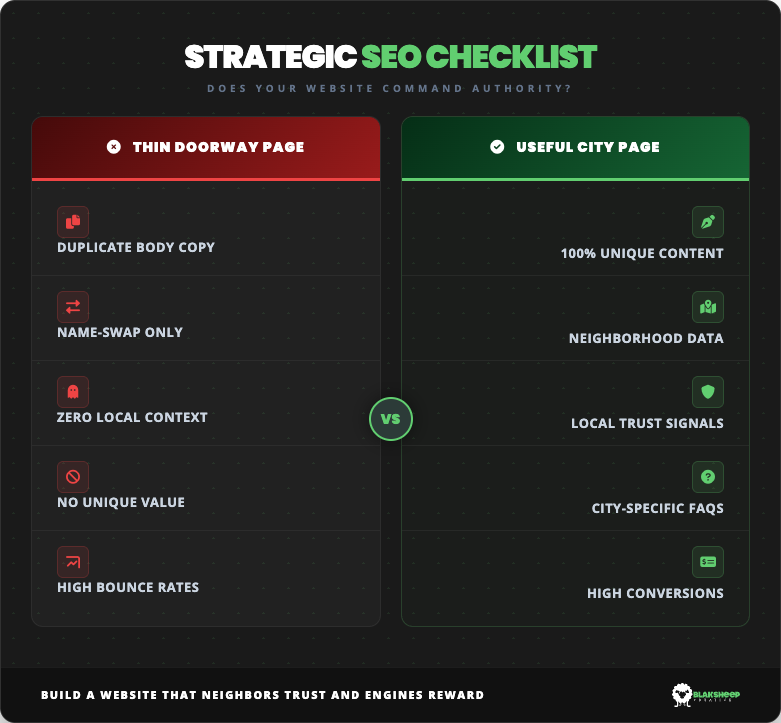
A thin city page for a trash can cleaning business usually follows a predictable pattern.
It opens with a headline like “Trash Can Cleaning in [City Name],” follows with two generic paragraphs that could apply to any location, lists a few services, and ends with a phone number. The body copy is identical, word-for-word, to that of every other city page on the site, except for the city name.
These pages fail for several reasons.
They provide nothing to a user that the homepage does not already provide. They contain no location-specific information.
They have no proof that the business actually serves that area. Google’s crawlers detect near-duplicate content across a site, and when they find a pattern of city-name-swapped pages, those pages either fail to index or fail to rank.
Why These Pages Get Ignored
Beyond Google’s technical filters, thin city pages fail with users, too. Someone searching “trash can cleaning Gonzales, LA” is not looking for a generic company description.
They want to know:
- Does this company actually come to Gonzales?
- How much does it cost?
- How do I schedule?
A page that does not answer those questions directly will not convert, and high bounce rates signal to Google that the page is not satisfying the query.
The comparison below shows the practical difference between a thin doorway approach and a useful city page.
| Element | Thin/Doorway Page | Useful City Page |
|---|---|---|
| Headline (H1) | Trash Can Cleaning in [City Name] | Trash Can Cleaning in Baton Rouge, LA – Residential and HOA Service |
| Body Copy | Generic description copied from homepage | City-specific content referencing neighborhoods, service days, and local context |
| Service Details | Vague list identical to every other page | Specific to the city: pricing, frequency options, coverage areas within the city |
| Local Proof | None | Local reviews, neighborhood references, parish name, zip codes served |
| Trust Signals | None or boilerplate | Insurance mention, years serving area, service area map |
| FAQ | Missing | City-specific FAQs (service days in that city, subdivisions covered) |
| CTA | Phone number buried at the bottom | Clear primary CTA above fold and at the end with city-specific context |
| Internal Links | None or random | Links to the main service page, adjacent city pages, and contact page |
| Indexability | Often deindexed or never ranked | Indexed, crawled regularly, and eligible to rank for local queries |
Every row in that table represents a decision you make when building a city page. The right column is not harder to build – it just requires a defined process and a clear template before you start.
Want this handled for you? We build and market websites for Louisiana businesses, and we will tell you honestly if you do not need us.
Once you understand what separates useful from useless, the next step is building a repeatable structure you can deploy across every city in your service area.
The City Page Template for Trash Can Cleaning Businesses
A reliable city page template provides a consistent structure while leaving room for location-specific content, making each page worth building. The goal is not uniformity for its own sake. The goal is a page that ranks for local queries and converts visitors into scheduled customers.
City pages also need to clearly explain frequency, especially when you sell recurring bin-cleaning plans rather than one-time cleanings. Here are the core elements required for your page to link well.
Core Elements Every City Page Must Include
Think of your city page as a landing page that also needs to satisfy a search query. It has to do two jobs at once: earn organic traffic and close the visit.
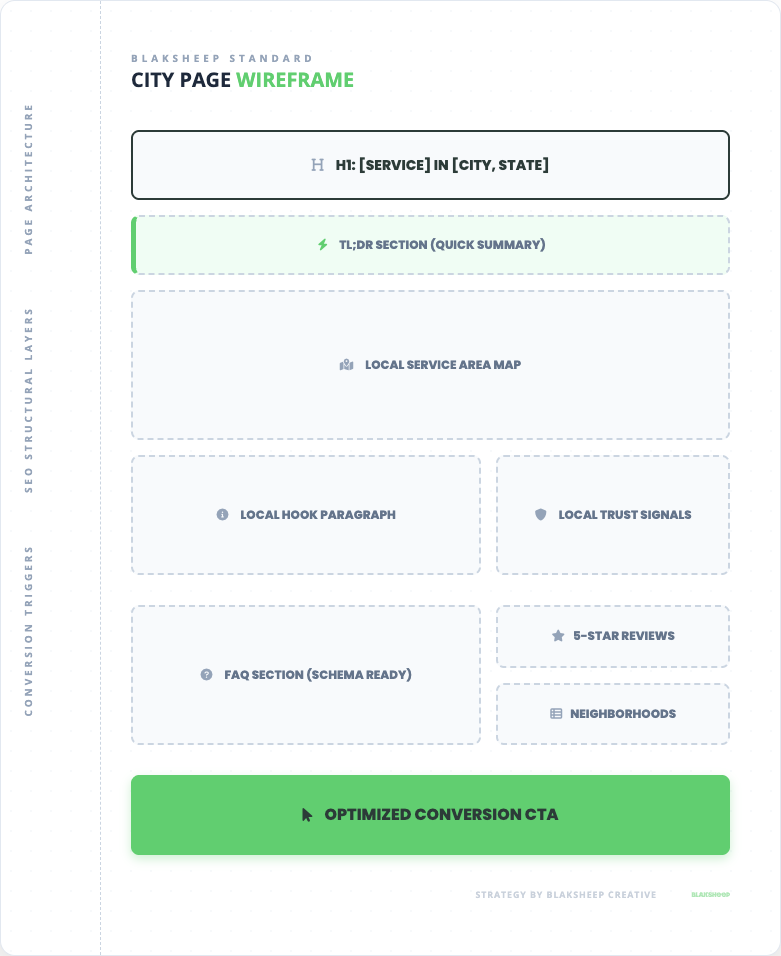
Every element below serves one or both of those purposes.
| City Page Element | Purpose | Example for Baton Rouge, LA |
|---|---|---|
| H1 Tag | Primary keyword signal, user orientation | Trash Can Cleaning in Baton Rouge, Louisiana |
| Opening Paragraph | Direct answer, geographic confirmation, trust hook | “We serve Baton Rouge and East Baton Rouge Parish on a weekly and bi-weekly schedule…” |
| Service Description | What you offer in that city specifically | Residential cart cleaning, HOA route service, and commercial bin cleaning in the Capital City area |
| Service Area Detail | Geographic depth, neighborhood signals | Neighborhoods served: Shenandoah, Prairieville, Central, Zachary, Broadmoor, Mid City. |
| Parish/County Reference | Local relevance, natural language signal | East Baton Rouge Parish, with routes extending into Ascension and West Baton Rouge Parish |
| Pricing or Range | Conversion filter pre-qualifies the visitor | “Monthly single-bin service in Baton Rouge starts at $X.” |
| Local Trust Signals | Proof of service, credibility | Customer review from a Baton Rouge HOA, mentioning years of service in the 70810 zip code area |
| FAQ Section | Answers long-tail queries, reduces friction | “What days do you service the Shenandoah area?” / “Do you serve Prairieville?” |
| Primary CTA | Drives form submission or call | “Schedule your first Baton Rouge trash can cleaning” with a link to the booking form. |
| Internal Links | Site authority, user navigation | Link to the main trash can cleaning service page, the Hammond page, and the Denham Springs page. |
| Schema Markup | Structured data for search engines | LocalBusiness, Service, FAQPage schema with city-specific data |
That table is your minimum viable city page. Every row that is missing is a gap a competitor can fill.
Using Neighborhoods, Parishes, and Zip Codes the Right Way
Parish and neighborhood references are not just for keyword stuffing. They signal to Google that you have specific geographic knowledge of the area you serve.
Mentioning East Baton Rouge Parish is more useful than just saying “Baton Rouge.” Referencing subdivisions such as Shenandoah, The Settlement, or Copper Mill in the 70810 and 70820 zip codes signals to both Google and visitors that you actually know the area.
The right approach is natural integration, not a list of zip codes dropped at the bottom of the page. Reference neighborhoods in context: “We run routes through the Shenandoah and Prairieville areas on Thursdays.” That sentence is both locally specific and readable.
Avoid creating a wall of zip codes or neighborhoods formatted as a keyword dump. That approach may have worked in 2012. It does not work now, and it looks unprofessional to the visitor who is deciding if to trust you with their property.
How to Write Unique Content for Each City Page Without Starting from Scratch
Scaling to 15 or 20 city pages does not require writing 15 or 20 completely original articles.
It requires a modular content approach: identifying which parts of the page are consistent across all cities and which must be customized for each location. Most operators get this backward, making everything a copy-paste or making every page a from-scratch rewrite.
What Stays Consistent Across City Pages
Your company story, your service process, your equipment, and your guarantees do not change city to city. These elements form the backbone of every city page.
Write them once, write them well, and carry them through your template. What changes is the geographic wrapper around that content: the city name, the parish reference, the neighborhoods served, the service days, and any local-specific context.
Think of it like a franchise menu. The burger is the same. What changes is the local context around it – the regional ingredients, the delivery area, the local customer references.
What Changes City to City
- The H1 and page title (always city-specific)
- The opening paragraph (references the specific city and parish)
- Neighborhoods and subdivisions listed
- Service days or route schedules for that city
- Local customer reviews or testimonials
- FAQ answers specific to that city (coverage boundaries, pickup days, HOA programs in that area)
- Internal links to adjacent city pages
Scaling to 20+ Cities Without Duplicate Content Problems
If you serve Hammond, Ponchatoula, Amite, and Kentwood, each of those pages needs its own version of the local content elements above. The challenge is doing this without creating pages so similar that Google flags them as duplicates.
The threshold is not zero overlap. Google expects some shared content across location pages for the same business.
What you want to avoid is pages that are 95% identical, with only the city name different. Aim for at least 30-40% of each page’s content to be genuinely city-specific. With the neighborhood lists, local reviews, parish references, and city-specific FAQs, hitting that threshold is straightforward.
Referencing Louisiana Landmarks and Local Context Naturally
For New Orleans-area pages, you can reference service in the Lakeview, Metairie, or Mid-City neighborhoods. For St. Tammany Parish pages covering Covington and Mandeville, you can reference the Northshore communities. For Baton Rouge pages, the distinction between Mid City and the Zachary/Central corridor is meaningful to locals.
You do not need to force it. If you know the area well enough to run routes there, you already have the material. Write what you know about that city as if you are explaining your service area to a neighbor.
Google's spam policies define doorway pages as pages built to rank for specific queries that add no real value, and city-name-swapped templates fit that definition.
Trust Signals That Belong on Every Trash Can Cleaning City Page
Local search is a trust game. The visitor found your page, which means you cleared the first hurdle. Now the page has to convince them you are legitimate, reliable, and actually present in their area. Trust signals are the elements that do that work without requiring a sales pitch.
Google says local rankings depend on relevance, distance, and prominence, so use its local ranking guidance as the baseline for building stronger city pages.
Service Area Map or Graphic
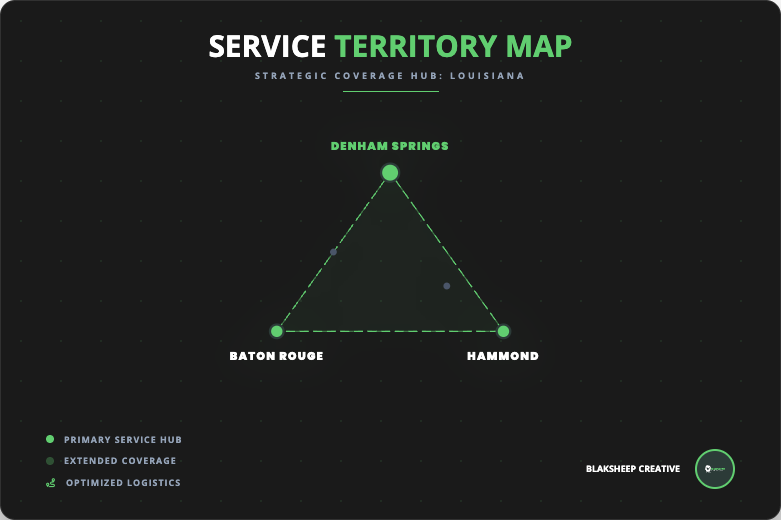
A simple map or graphic of your coverage area lets a visitor see at a glance if they are in range. Treat it as a convenience for the reader, not a ranking lever.
The expert data points the same way. In Whitespark's 2026 Local Search Ranking Factors survey, 47 local search experts ranked an embedded map of a business location 125th of 187 factors for the map pack, while the city and neighborhood wording on the page ranked 2nd for local organic results. We walk through the rest of the evidence, including the one controlled test, in does a map on your city page help you rank.
A static image like the one below does the job without the weight. In our own test, a single Google Maps embed added 69 file requests and about 745 KB to a page.
Local Reviews and Testimonials
A review from a customer in the same city as the page carries more weight than a generic five-star rating.
If you have a testimonial from a homeowner in the Shenandoah subdivision of Baton Rouge, it belongs on your Baton Rouge city page. If you have a review from an HOA in Hammond, that goes on your Hammond page. Keep the attribution as specific as the customer allows.
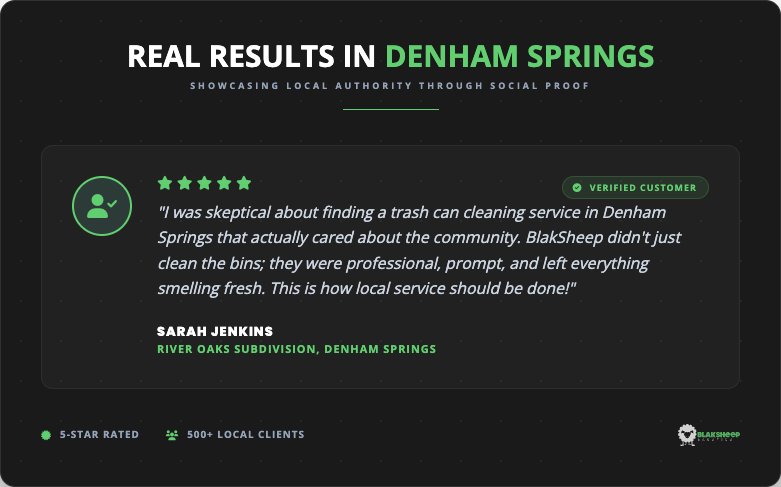
If you are new to a city and do not yet have local reviews, mention your Google Business Profile and encourage early customers to leave reviews. Do not manufacture fake reviews or use generic review widgets without real data behind them.
License and Insurance Mention
Trash-can cleaning businesses operate on or near residential property. Visitors want to know you are covered.
A brief mention of your liability insurance and any applicable business license is a low-effort trust signal that many operators skip. It does not need to be a legal disclaimer – one sentence works: “We are fully licensed and insured to operate in Louisiana.”
FAQ Section Placement
The FAQ section on a city page does double duty. It answers the specific questions people in that city actually have, and it provides structured content that can qualify for FAQ rich results in search.
Place the FAQ toward the bottom of the page, after the main service description and before the final CTA. Use city-specific questions: “Do you service the Prairieville area?” is more useful than “How does trash can cleaning work?”
Internal Links to the Main Service Page
Every city page should link back to your main trash can cleaning service page. This keeps authority flowing through your site structure and gives visitors a path to more information about your full offerings.
A natural anchor text link – “see our full service menu” or “learn about our HOA programs” – works better than a generic “click here.”
Internal Linking Strategy for Trash Can Cleaning Service Area Pages
Internal linking is the connective tissue of your service area site. Done right, it tells Google which pages matter most, passes authority from strong pages to newer ones, and keeps visitors moving through the site rather than bouncing.
Done wrong – or not done at all – it leaves your city pages as isolated islands that search engines deprioritize.
The Silo Structure for a Multi-City Trash Can Cleaning Site
A content silo groups related pages under a single topical umbrella. For a trash-can cleaning business, the silo looks like this: your main service page sits at the top, and every city page links to it.
City pages within the same geographic cluster (such as Baton Rouge, Central, and Zachary) link to one another horizontally. Pages in different clusters (Baton Rouge vs. New Orleans metro) link to each other sparingly – only when there is a logical reason for a visitor to need both.
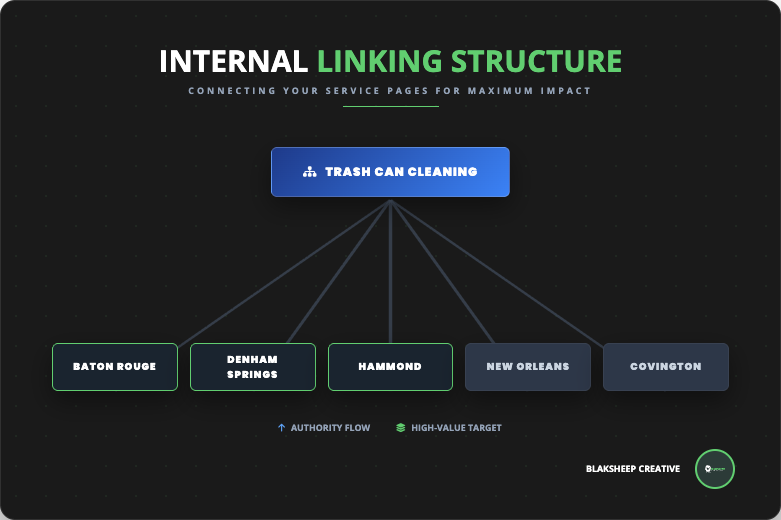
This structure keeps topical relevance tight and prevents Google from seeing your site as a flat pile of pages with no hierarchy.
Anchor Text Guidelines
Use descriptive anchor text that reflects what the linked page is actually about. Linking to your Hammond page with the anchor text “trash can cleaning in Hammond” is better than “click here” or “our Hammond service.”
Vary the phrasing slightly across pages – do not use the exact same anchor text on every internal link pointing to the same page. Natural variation signals organic editorial decisions rather than manipulative linking.
Planning for Future City Pages
If you are currently serving five cities but plan to expand to fifteen, build your link structure for the end state, not the current state.
Create a service area hub page that lists all the cities you serve – including ones where pages are still in progress – with placeholder links you can activate as pages go live.
This approach prevents the structural rework that comes from bolting new city pages onto a site not built to accommodate them.
How Often to Audit Internal Links
Review your internal link structure every time you add a new city page. A new Hammond page should link to your Baton Rouge and Ponchatoula pages, and those existing pages should link back to Hammond.
Each time you add a city, update at least two existing city pages with a contextual link to the new one. This is ongoing site maintenance, not a one-time setup task.
If you are not sure which city pages Google can actually crawl, index, and trust, request a free SEO audit before adding more pages to the pile. Fill out the form below to get one right now!
Building City Pages for Your Trash Can Cleaning Route?
BlakSheep Creative designs high-performing digital assets for local service businesses nationwide. We understand the complex geography, regional search behaviors, and localized SEO mechanics that dictate success for route-based industries across the country.
Wherever your trucks roll, we build city pages structured to dominate local search results and engineered to convert regional traffic into booked customers.
A Real Trash Can Cleaning City Page Example: Baton Rouge, Louisiana
Theory is useful. A working example is more useful. Below is a complete city-page structure for a Baton Rouge trash-can cleaning service. You can adapt this template for any city in your service area by following the same structure and swapping in the city-specific content for each location.
Page URL
/trash-can-cleaning-baton-rouge-la/
H1 Tag
Trash Can Cleaning in Baton Rouge, Louisiana
H2 Tags (Page Sub-Sections)
- Residential Trash Can Cleaning Service in East Baton Rouge Parish
- Neighborhoods and Areas We Serve in Baton Rouge
- Why Baton Rouge Homeowners Use Our Service
- How to Schedule Trash Can Cleaning in Baton Rouge
- Frequently Asked Questions About Baton Rouge Trash Can Cleaning
Opening Paragraph (Example Copy)
“We provide weekly and bi-weekly trash can cleaning service to residential customers throughout Baton Rouge and East Baton Rouge Parish. Our routes cover Mid City, Shenandoah, Zachary, Central, and surrounding areas. We are fully licensed and insured, and we have been serving the Capital Region since [year]. Scheduling is online and takes less than two minutes.”
Service Area Section (Example)
“Our Baton Rouge routes include neighborhoods across East Baton Rouge Parish: Broadmoor, Sherwood Forest, Shenandoah, Zachary, Central, and the Prairieville corridor along Highway 42. We also extend into parts of Ascension Parish and West Baton Rouge Parish on select route days. If you are not sure if your address is on our current schedule, enter your zip code below or call us directly.”
Trust Section (Example)
“Our Baton Rouge customers include individual homeowners, HOA communities in the Shenandoah and Copper Mill areas, and small commercial accounts along the Perkins Road corridor. We are fully insured for liability and property damage. References are available on request.”
FAQ Placement
Place the FAQ section below the main service description and above the final CTA. Include 4-6 questions specific to Baton Rouge: service days, coverage boundaries, pricing for the area, HOA program availability.
CTA Block (Bottom of Page)
“Ready to schedule? Enter your Baton Rouge address to confirm coverage and book your first cleaning.” – followed by a form embed or a direct link to the booking page.
Internal Links in This Page
- Link to main trash can cleaning service page: “See all service options.”
- Link to Denham Springs city page: “Also serving Denham Springs and Livingston Parish.”
- Link to Hammond city page: “Serving customers in Hammond and Tangipahoa Parish.”
- Link to contact page: “Questions? Contact our team.”
Schema on This Page
Include LocalBusiness, Service, and FAQPage schema. The LocalBusiness schema should reference the specific service area (Baton Rouge, East Baton Rouge Parish) in the areaServed property.
This same structure applies to every city in your service area. The H1 changes. The parish reference changes. The neighborhood list changes. The FAQ answers change. The framework stays the same. That is what makes city pages scalable without becoming copy-paste junk.
For the technical markup, follow Google’s Local Business structured data documentation so search engines can read your business details, service area, and page purpose.
“Great designs, excellent service. I was very difficult to make a logo for and he still worked with me. Would definitely recommend!”
Common Mistakes That Kill Trash Can Cleaning City Pages
Most city page problems are avoidable. They happen because operators build fast without a defined process, or because they trust a tool or template that was not built for local service businesses. The mistakes below are the most common, and each one has a straightforward fix.
| Visitors cannot figure out how to book; the page generates traffic but no revenue | Why It Hurts | The Fix |
|---|---|---|
| Copy-paste pages with only the city name swapped | Google detects near-duplicate content; pages fail to rank or get deindexed | Use a modular template with mandatory city-specific content blocks |
| No local proof or geographic specificity | Page has no local relevance signals; users bounce because they cannot confirm coverage | Add neighborhood names, parish references, local reviews, and zip code context |
| Missing or buried CTA | Visitors cannot figure out how to book; the page generates traffic, but no revenue | Place a clear CTA above the fold and repeat it at the end of every city page |
| No internal links to or from the city page | Page is an orphan; search engines deprioritize isolated pages | Link from at least two other site pages to every city page; link city pages to the main service page |
| Poor mobile performance | Most local searches happen on mobile; a slow or broken page loses conversions immediately | Test every city page on mobile before launch; optimize images, minimize render-blocking scripts |
| No FAQ section | Misses long-tail queries and FAQ rich results; does not address visitor hesitation | Add 4-6 city-specific FAQs with structured FAQPage schema on every city page |
| Generic title tag and meta description | Low CTR in search results; missed opportunity to differentiate from competitors | Write a unique title tag and meta description for every city page with the city name and a value prop |
| No schema markup | Misses structured data opportunities; competitors with schema may outperform in rich results | Add LocalBusiness, Service, and FAQPage schema to every city page |
Why BlakSheep Creative Builds Trash Can Cleaning City Pages Differently
Most web agencies do not specialize in route-based local service businesses. They build a generic local business template, drop in your logo and phone number, and call it a website.
That approach may produce a site that looks fine at first glance. It will not produce a site that earns rankings across multiple service cities in a competitive Louisiana market.
What We Actually Do
BlakSheep Creative is based in Denham Springs, Louisiana. We work with local service businesses across the Gulf South and have built service-area page systems for businesses operating in the same markets where your customers search.
We know the difference between Livingston Parish and East Baton Rouge Parish, between the Northshore and the River Parishes, and between a city page that ranks and one that sits idle.
Our process for trash-can cleaning website builds follows five defined steps: discovery, audit, build, launch, and optimize. We do not skip the audit phase.
We do not launch pages without verifying mobile performance, schema validity, and internal link integrity. We do not hand you a site and disappear.
What We Will Not Do
- We will not build you a doorway page factory – 30 city pages that are word-for-word copies with a city name swap.
- We will not use a generic local business template designed for a dentist or plumber and apply it to a trash-can cleaning business.
- We will not promise search rankings we cannot control or guarantee results that depend on factors outside the build.
- We will not lock your content or domain. You own what we build.
What Happens After You Contact Us
You send a message or call (225) 505-3834. Within one business day, you receive a response confirming receipt and outlining next steps.
We schedule a 30-minute discovery call to understand your current site situation, your service cities, and your primary business goal.
From there, we scope the project and send a written proposal with a defined timeline. Most city page builds are scoped, designed, and live within 4-6 weeks, depending on city count and content availability.
What you need to provide: your service city list, a few notes about what makes your business different, photos if you have them, and access to your existing website or hosting account. We handle everything else.
Ready to Build City Pages That Actually Rank?
If you are expanding your trash can cleaning route into new Louisiana markets and your website is not keeping pace, the gap between your coverage area and your online visibility is costing you bookings. BlakSheep Creative builds city pages structured to rank locally and convert visitors into customers.
There is no obligation attached to the first conversation. Request a free website consult, and we will tell you exactly what your site needs and what it will take to build it.
Call us directly: (225) 505-3834 | info@blaksheepcreative.com
Frequently Asked Questions About Trash Can Cleaning Service Area Pages
These are the questions trash can cleaning operators ask most often when planning a city page strategy. The answers are based on current SEO practice and Google’s published guidance on local search and site quality.
How many city pages does a trash can cleaning business need?
Build a city page for every city where you actively run routes and want to attract new customers through organic search. If you serve eight cities, you need eight city pages. There is no minimum or maximum. What matters is that each page is built correctly. Ten well-built pages will outperform fifty thin ones every time.
What makes a city page different from a doorway page?
A doorway page exists solely to target a keyword and funnel traffic elsewhere, with no real value to the user. A useful city page provides location-specific information: neighborhoods served, service schedules, local trust signals, and a direct path to contact. If you remove the city name from your page and the content still makes perfect sense, it is probably a doorway page.
Should each city page have its own URL?
Yes. Every city you serve should have a dedicated URL that includes the city name in the slug. For example: /trash-can-cleaning-baton-rouge-la/ or /service-areas/hammond-louisiana/. A single page with a dropdown or tab selector for multiple cities does not earn separate rankings for each location. Each city needs its own indexable URL.
How do I add local trust signals to a city page?
Include customer reviews from people in that city with neighborhood-level specificity when possible. Reference the parish name. Mention your service days for that area. List the subdivisions and zip codes you cover. Add a license and insurance statement. A simple service area map helps visitors confirm coverage at a glance, though the written details above do more for rankings.
Can I use the same content on multiple city pages?
Some shared content is acceptable and expected. Your company description, service process, and equipment details can carry through. What cannot be duplicated is the city-specific content: the H1, the opening paragraph, the neighborhood list, the local reviews, and the city-specific FAQs. Aim for at least 30-40% unique content per page. Anything less creates a near-duplicate pattern that search engines flag.
How does Google decide which city page to rank?
Google looks at several signals: the geographic relevance of your content, your Google Business Profile for that service area, inbound links from locally relevant sources, on-page signals like the city name in the H1 and URL, and user behavior signals like time on page and bounce rate. No single factor is decisive. All of them together determine your local ranking position.
What should the H1 tag say on a city page?
Your H1 should include your primary service and the city name: “Trash Can Cleaning in [City Name], Louisiana.” Keep it direct. Do not add marketing fluff or multiple keywords, one H1 per page. The H1 should match the intent of the search query you are targeting. For most city pages, that query is “[service] in [city]” or “[service] [city] [state].”
Stop Wasting Crawl Budget on Ghost Towns Build City Pages That Work
Thin, copy-and-paste service area pages don’t fool search engines anymore, and they certainly don’t win the trust of local homeowners. If your trash can cleaning routes are expanding but your website’s local visibility is standing still, you are leaving recurring route revenue on the table for your competitors to scoop up.
At BlakSheep Creative, we eliminate the guesswork. We build high-performing, modular location assets that comply with Google’s guidelines, establish clear geographic authority, and convert neighborhood search traffic into fully booked routes.
Ready to dominate your territory? Let’s map out a strategy that actually scales.
Request your free service area strategy consult today, or connect with our team directly at (225) 505-3834.

We build this for trash can cleaning companies.
Fixed quote before we start, and you talk to the people who do the work.
About the author

Founder & Lead Developer · Denham Springs, LA
Clint has built and marketed websites for 26 years, since founding BlakSheep Creative in 2000. He is also a 29-year firefighter and a 23-year member of IAFF Local 557, which is where the bias toward plain answers over sales copy comes from.
- Veteran-owned
- Firefighter-owned
- IAFF Local 557
More Questions About Trash Can Cleaning Service Area Pages
Short answers to the questions that come up most on this topic.
How do I use zip codes and neighborhoods on a city page without stuffing?
What is a content silo for a multi-city site?
What schema should a city page include?
How should I plan city pages for cities I do not serve yet?
Where should the FAQ section go on a city page?
How long does it take to build trash can cleaning city pages?

Your next step, without the guesswork
No surprises, clear next steps, and a fixed price before anything starts.