
By Clint Sanchez · Published · Updated · 12 min read
Quick answer
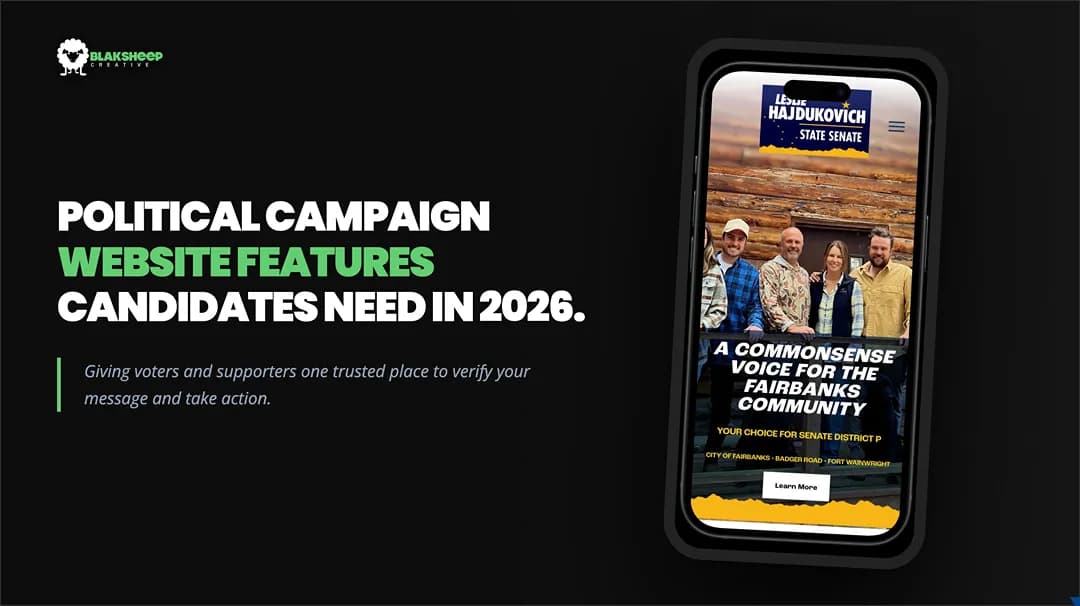
A political campaign website in 2026 needs a clear homepage, a candidate bio, priorities, endorsements, events, volunteer and contact pages, and a donation path where the campaign accepts contributions. It needs trust signals such as service history and press mentions, a mobile-first layout, accessibility basics, SSL and secure forms, SEO and AEO structure with schema and FAQs, social preview images for every key page, and disclaimer language reviewed by the campaign's compliance advisor.
Key takeaways
- According to the Pew Research Center, 73% of U.S. adults saw inaccurate election news at least somewhat often during the 2024 cycle, so a campaign site has to prove its claims.
- Social media is the distribution layer; the website is the source of record that the campaign controls.
- The core pages are homepage, bio, priorities, endorsements, events, volunteer, and contact, with donations only where the campaign type calls for it.
- WCAG 2.2 accessibility basics such as heading order, contrast, keyboard access, and labeled forms make the site usable for more voters.
- Every important page needs its own Open Graph title, description, and image, because campaign links get shared in texts and group chats.
- FEC rules mean political committee websites may require disclaimers; counsel, the treasurer, or a compliance advisor should confirm the wording.
- Short forms convert better: a general contact form needs a name, a message, and optional email or phone, nothing more.
Campaigns in Baton Rouge, Denham Springs, Hammond, and New Orleans run on tight timelines and small teams. A union member opens the site from a text; a firefighter checks the priorities page from a phone in the station kitchen. Louisiana campaign traffic arrives from search, QR codes on mailers, and Facebook shares, so the mobile layout and the social preview image get tested before the message does.

Want this handled instead of DIY?
A 15-minute call, no script, no pressure. You leave with a plan either way.
Political Campaign Website That Supports Trust, Search, and Action
A political campaign website should give voters, supporters, donors, members, media contacts, and volunteers one trusted place to verify your message. It should include your bio, priorities, endorsements, proof points, contact paths, donation or volunteer options, mobile-friendly layouts, accessibility basics, security, analytics, search structure, and legally reviewed disclaimers where required.
Quick Answer: What Should a Political Campaign Website Include?
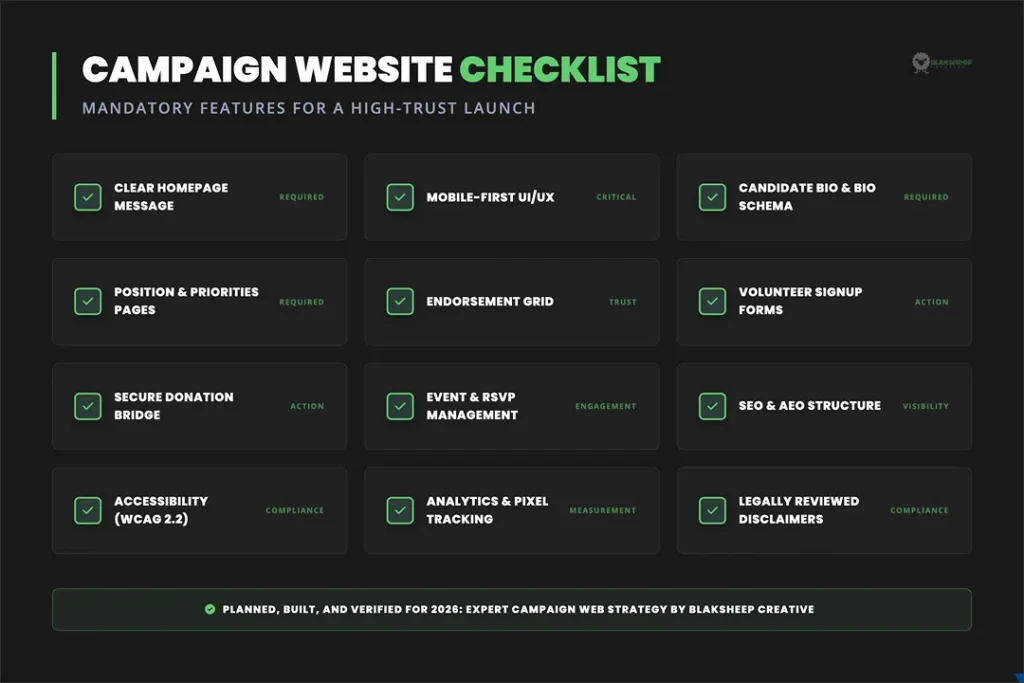
A political campaign website should include a clear candidate or organization bio, campaign priorities, endorsements, action forms, donation or volunteer paths, event information, contact details, mobile-friendly design, SEO structure, social sharing previews, accessibility basics, analytics, and disclaimer language reviewed for the campaign type. The goal is simple: help people trust you and take the next step.
TLDR: Political Campaign Website Checklist
- Use a clear homepage that explains who you are, what you stand for, and what visitors should do next.
- Add bio, priorities, endorsements, events, media, contact, volunteer, and donation or support pages where relevant.
- Build for mobile users first because campaign traffic often comes from search, text messages, QR codes, and social media.
- Use trust signals like service history, endorsements, press mentions, testimonials, and clear contact information.
- Structure the site for SEO and AEO with clear headings, schema markup, FAQs, internal links, and useful metadata.
- Review disclaimers, accessibility, privacy language, and endorsement claims before launch.
- Track form submissions, calls, email clicks, donation clicks, volunteer signups, and campaign event interest.
Campaigns in Baton Rouge, Denham Springs, Hammond, New Orleans, and across Louisiana do not get much room for confusion. A voter may find you through Google. A union member may open your site from a text. A firefighter may check your priorities from a phone in the station kitchen. Your website has to explain the campaign fast before people move on to the next noise machine.
Need a campaign website built with structure, speed, and trust in mind?
Request a political campaign website quote or review our campaign website service details before your next launch deadline turns into a public circus.
Why a Campaign Website Still Matters When Social Media Exists
Social media helps people find your campaign, but it should not be the only place your campaign lives. Platforms change rules, suppress links, break previews, bury posts, and generally behave like rented land with mood swings.
Your website gives the campaign a stable home base. It lets you control the message, organize evidence, clarify priorities, recruit supporters, and provide media contacts with a trusted source. Social profiles should point back to the site rather than replace it.
| Channel | Best Use | Weakness |
| Campaign Website | Trusted hub for message, proof, search, supporter action, and press information. | Needs planning, content, technical setup, and maintenance. |
| Community updates, local sharing, supporter comments, and event promotion. | Posts age quickly, and reach can change without warning. | |
| Photos, reels, campaign moments, endorsements, and human connection. | Not ideal for detailed policy pages or long explanations. | |
| X, Threads, or Bluesky | Fast updates, public statements, and media conversations. | High noise and easy message distortion. |
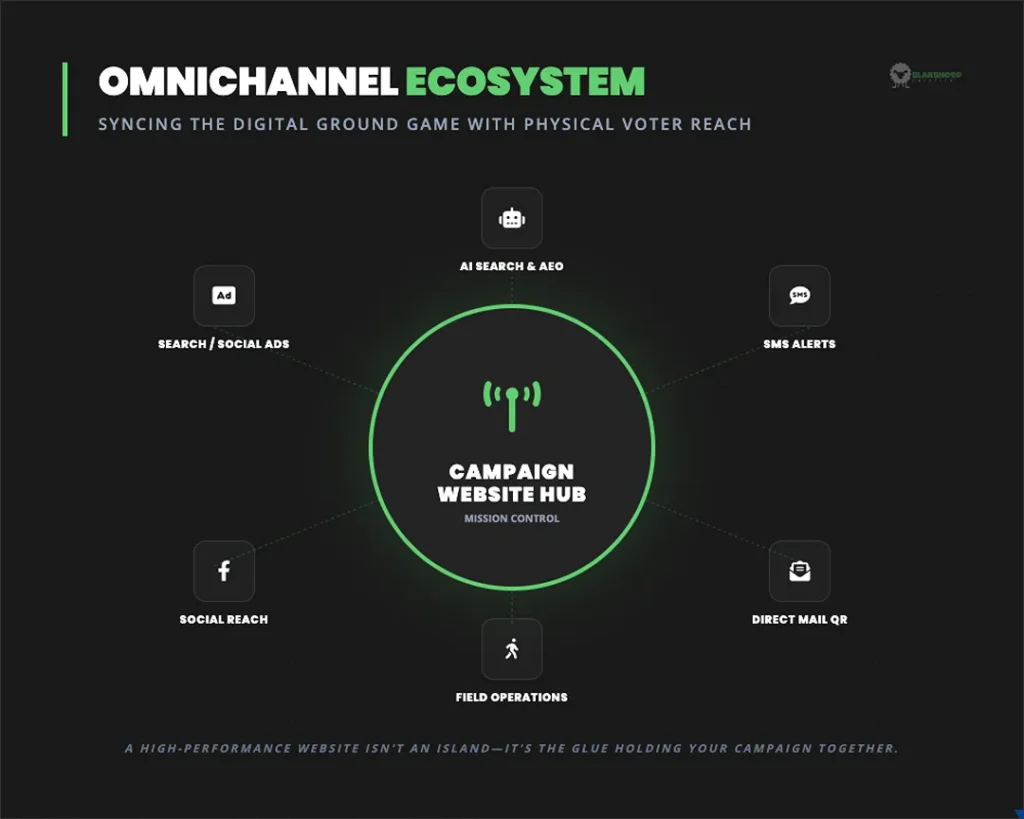
The right setup makes social media the distribution layer and the website the source of record.
The Must-Have Pages for a Political Campaign Website
A campaign website should not become a junk drawer with a flag background. Each page needs a job, and each job should move the visitor toward trust, clarity, or action.
Start lean if the campaign timeline is tight. Add more pages as the race, budget, and supporter base grow. A local union campaign may not need the same page set as a statewide candidate, but both need a clear structure.
| Page | Purpose | Conversion Role |
| Homepage | Summarizes the campaign, message, proof, and next step. | Directs visitors to donate, volunteer, contact, endorse, or learn more. |
| About or Bio | Explains the candidate’s background, service history, and values. | Builds personal trust before asking for action. |
| Priorities or Issues | Shows what the campaign will fight for or represent. | Helps voters and members decide if the message matches them. |
| Endorsements | Lists trusted supporters, organizations, public figures, or testimonials. | Transfers credibility from known names to the campaign. |
| Events | Promotes rallies, fundraisers, meet-and-greets, and union meetings. | Turns passive interest into attendance. |
| Volunteer | Collects people willing to phone bank, canvass, text, share, or help with events. | Turns supporters into campaign labor. |
| Contact | Gives voters, members, media, and supporters a way to reach the campaign. | Reduces friction and builds legitimacy. |
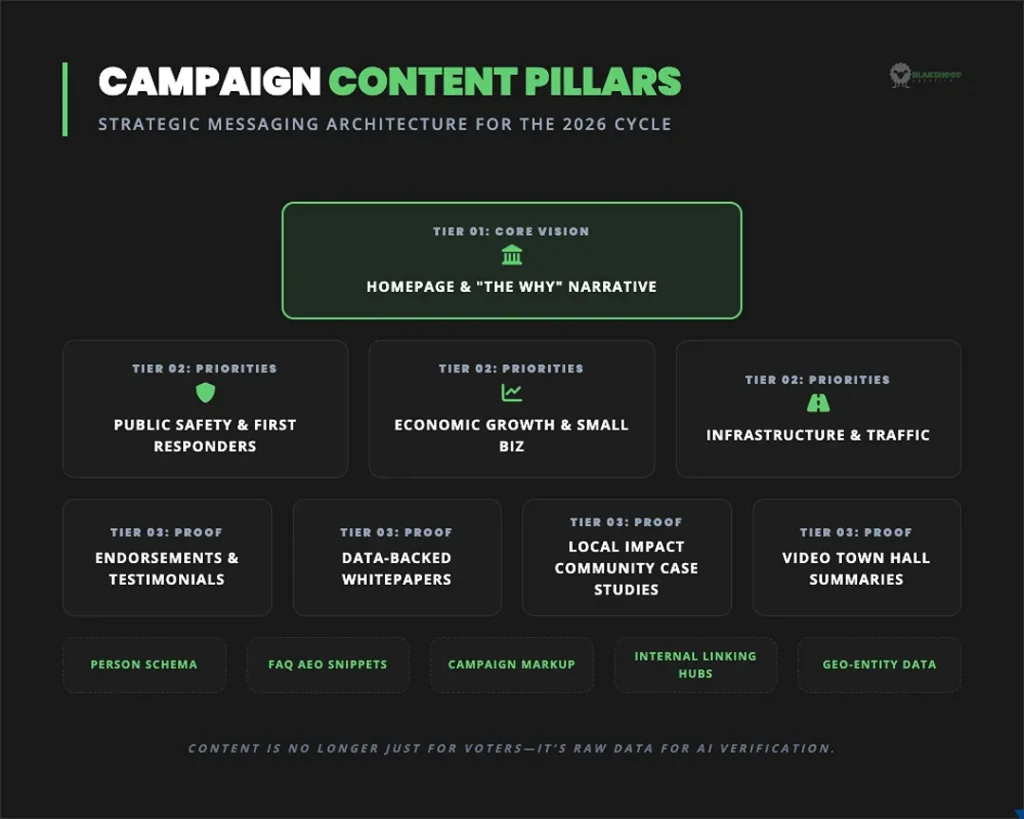
This structure gives every visitor a path, rather than asking them to solve your campaign puzzle for free.
Trust Signals That Help Voters and Members Take You Seriously
People do not trust political claims just because they appear on a website. Pew Research Center reported that 73 percent of U.S. adults saw inaccurate election news at least somewhat often during the 2024 election cycle, so trust has to be earned with proof. People do not trust political claims just because they appear on a website.
Your site should show why the candidate or campaign deserves attention. This does not mean stuffing the page with slogans. It means showing service history, endorsements, experience, local involvement, press mentions, and clear contact details.
| Trust Signal | Example | Why It Matters |
| Service history | Years in public safety, union leadership, military service, civic work, or community roles. | Shows the campaign is tied to real work, not a slogan. |
| Endorsements | Support from unions, community leaders, organizations, or trusted members. | Gives visitors outside validation. |
| Clear contact info | Email, phone, mailing address, or campaign contact form. | Makes the campaign feel accountable. |
| Media resources | Headshots, press contact, bio summary, and approved campaign descriptions. | Helps media and supporters share accurate information. |
| Disclosure and disclaimers | Required disclaimer language reviewed for the committee or campaign type. | Reduces confusion and supports transparency. |
The stronger your proof, the less your site has to beg people to believe you.
Your campaign website should make trust obvious.
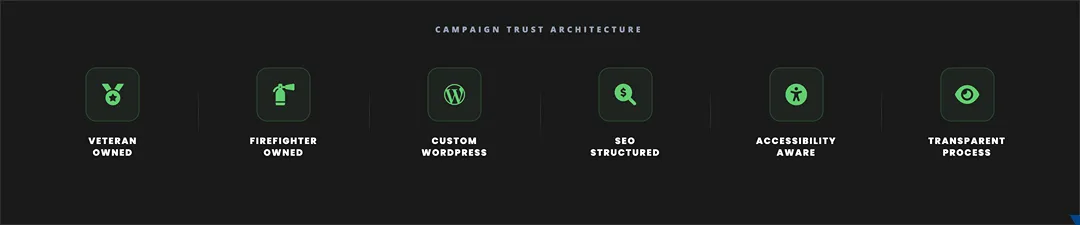
BlakSheep Creative builds campaign sites with clear messaging, proof sections, action paths, mobile structure, and launch review.
Action Paths: Donations, Volunteers, Events, Endorsements, and Contact
A campaign website should not leave motivated visitors asking what to do next. Interest fades fast, especially online, where a person can go from reading your priorities to watching a raccoon steal cat food in about eight seconds.
Every major page should point to the next step. For some campaigns, that step is a donation. For others, it may be a volunteer form, an endorsement request, an email signup, an event RSVP, or a media contact.
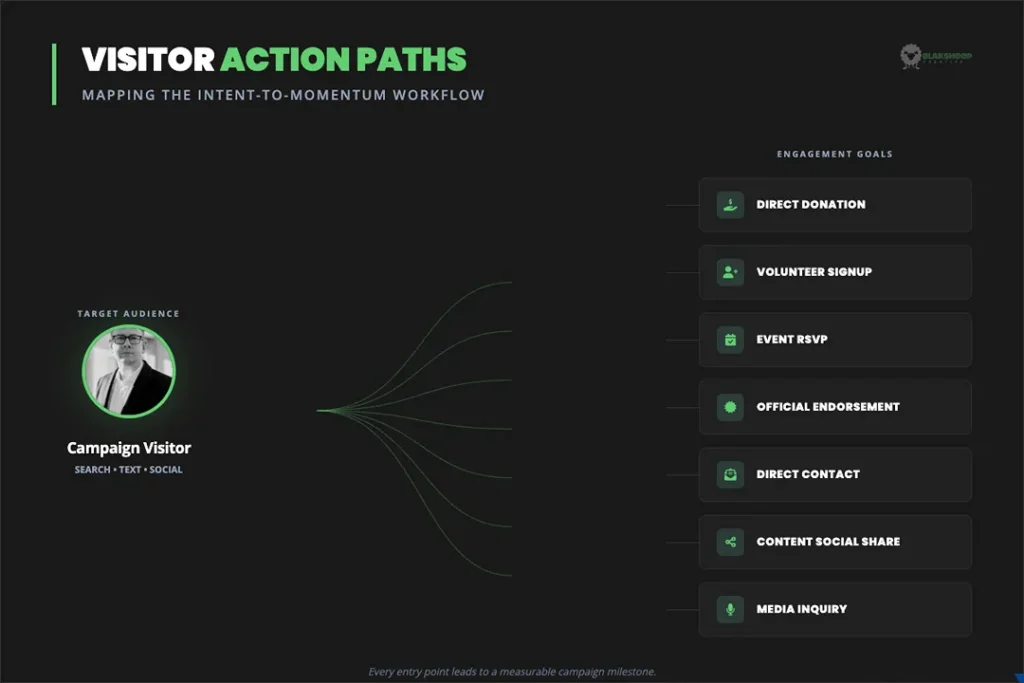
| Visitor Type | Likely Need | Best CTA |
| Voter | Understand the candidate and priorities. | Read priorities or contact the campaign. |
| Supporter | Help the campaign grow. | Volunteer, donate, share, or attend an event. |
| Union member | Verify representation, leadership, and commitments. | View endorsements, priorities, and service history. |
| Media contact | Get accurate information fast. | Download press info or contact the campaign. |
| Potential endorser | Decide if the campaign is credible. | Request endorsement info or contact the campaign. |
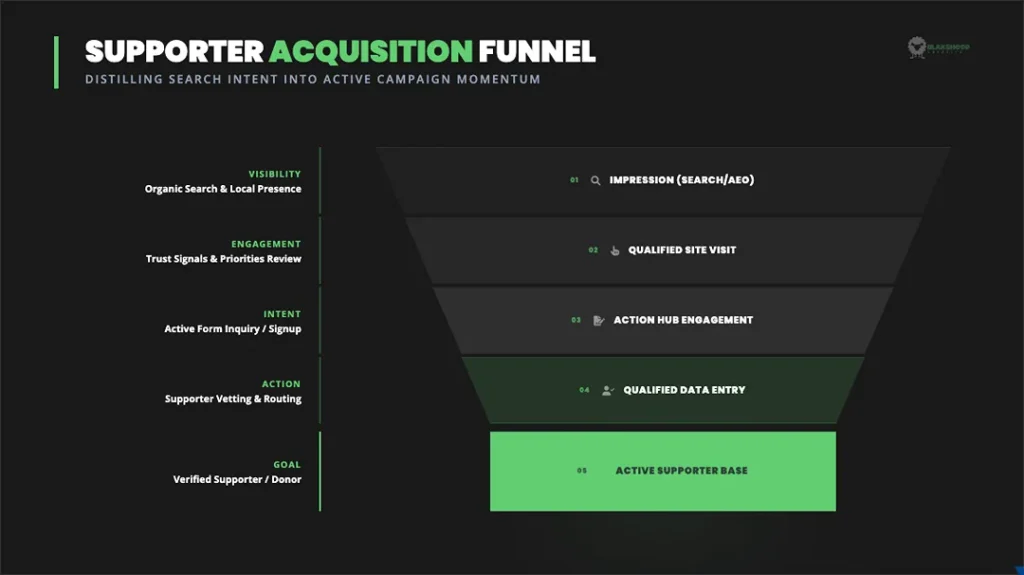
Good action paths turn attention into measurable campaign activity.
Mobile, Speed, Accessibility, and Security Basics
A political campaign website has to work on the phone in someone’s hand, not only on the designer’s oversized monitor. Mobile problems cost attention, trust, and conversions.
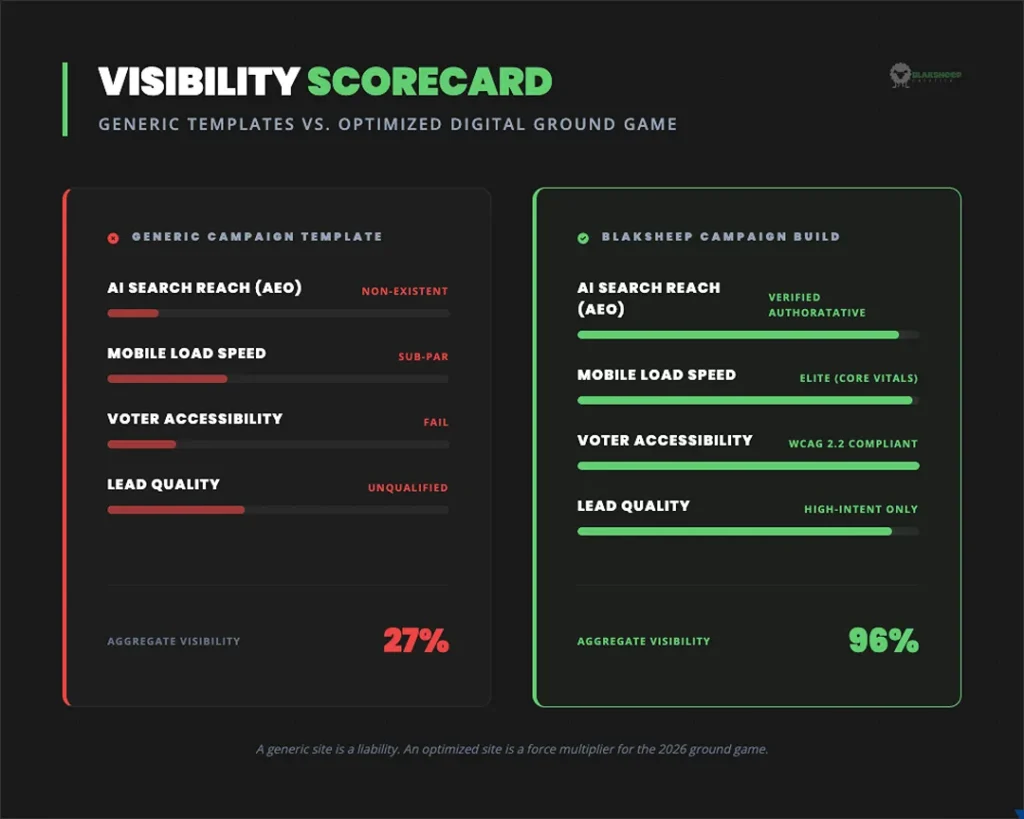
The site should load fast, use readable text, have clear buttons, avoid clutter, and work for people using assistive technology. WCAG 2.2 provides recommendations for making web content more accessible, including people with visual, mobility, hearing, and cognitive disabilities. For campaign sites, that means practical details like heading order, contrast, keyboard access, descriptive link text, and usable forms.
| Technical Area | What to Check | Why It Matters |
| Mobile layout | Readable sections, tap-friendly buttons, simple menus, and no awkward horizontal scrolling. | Most campaign traffic will come from phones via search, social, QR codes, and text messages. |
| Core Web Vitals | Page speed, layout stability, and interaction response. | Slow pages lose users before they read the message. |
| Accessibility | Headings, alt text, contrast, keyboard support, form labels, and readable content. | More people can use the site, and the campaign avoids avoidable barriers. |
| Security | SSL certificate, secure forms, updated software, spam protection, and backups. | Campaign websites can attract bots, spam, and bad actors. |
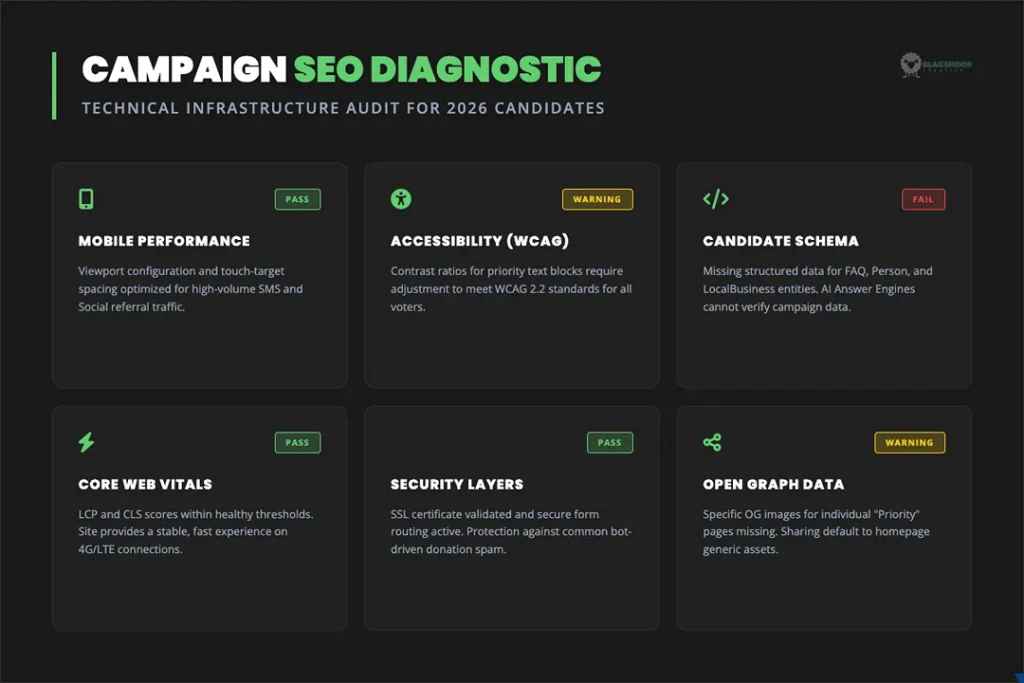
Technical discipline is not glamorous, which is probably why it matters so much.
Social media is the distribution layer; the website is the source of record that the campaign controls.
Campaign Website SEO and AEO Structure
A campaign website should be easy for people and search engines to understand. Google’s SEO Starter Guide explains that SEO helps improve a site’s presence in Search, and Google’s structured data documentation explains that structured data helps Google understand page content.
A campaign website should be easy for people and search engines to understand. Google’s SEO Starter Guide explains that SEO helps improve a site’s presence in Search.
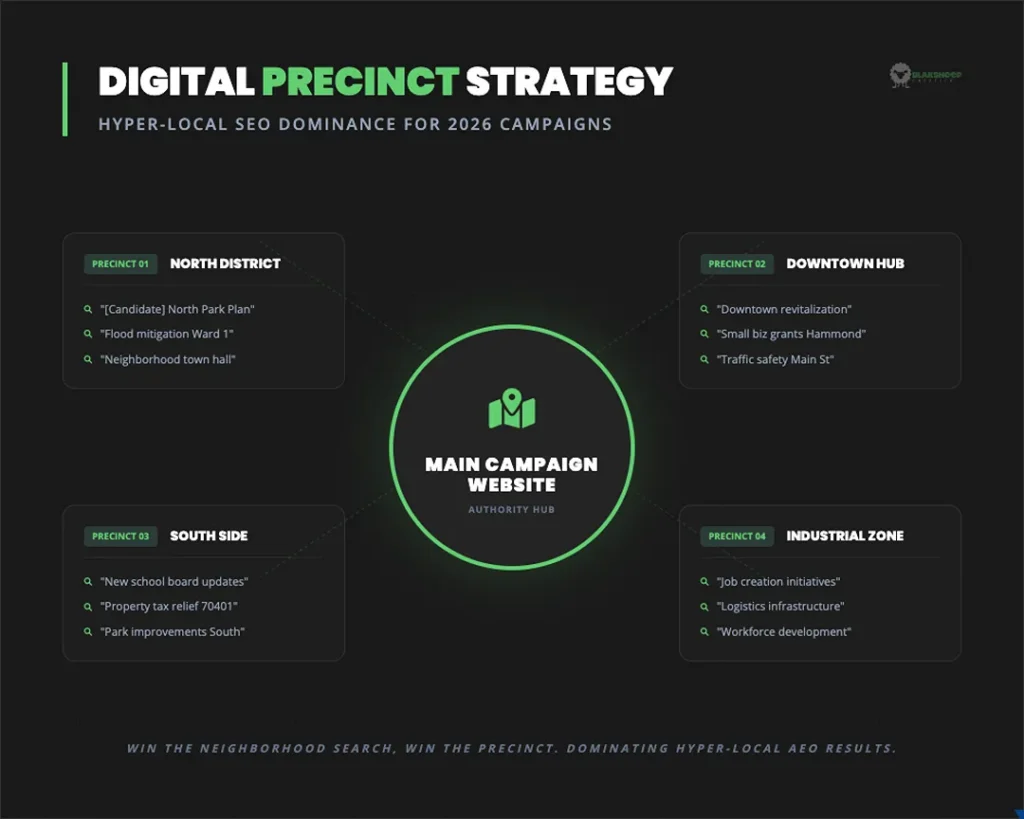
For AEO, the site should answer direct questions clearly. That means plain headings, short answers, FAQ sections, schema markup, entity clarity, and internal links that explain how the campaign connects to people, places, organizations, issues, and events.
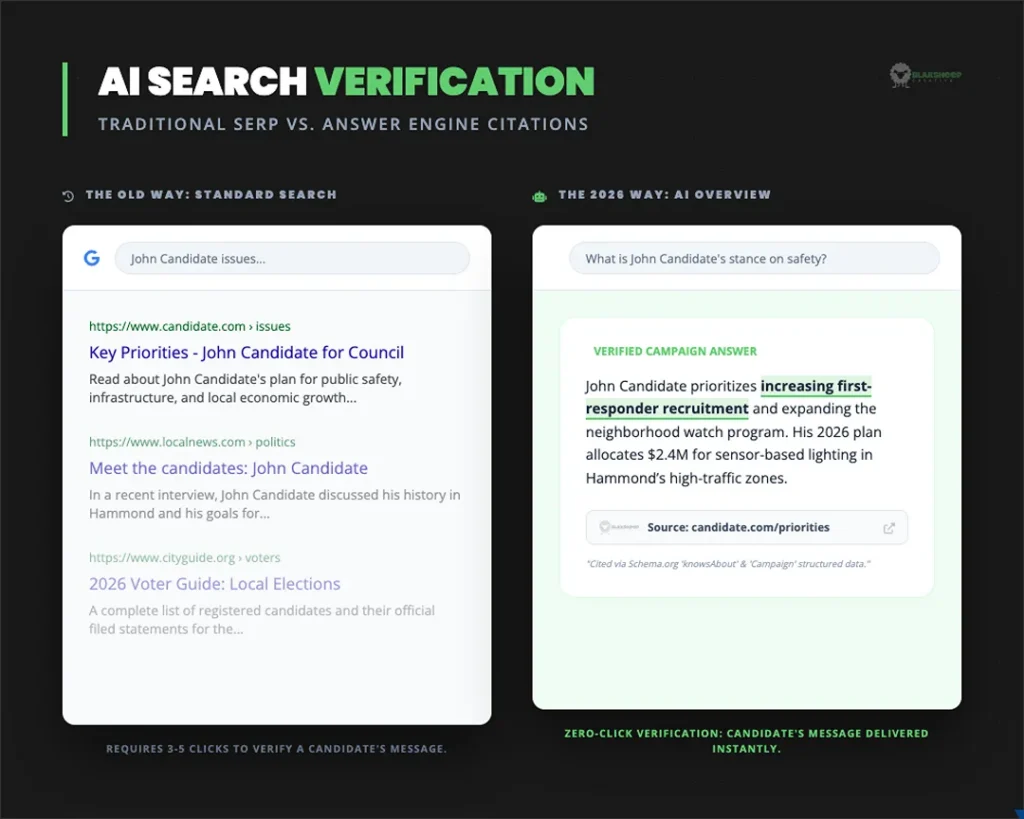
| SEO or AEO Element | Campaign Website Use | Recommended Format |
| Title tags | Help searchers understand each page topic. | Candidate name, campaign role, issue, or location where relevant. |
| Meta descriptions | Improve search click intent. | Clear summary with a reason to click. |
| Headings | Organize content for users and search engines. | One H1, clear H2S, no heading pileups. |
| Schema markup | Clarify WebPage, Article, FAQPage, Organization, and BreadcrumbList data. | JSON-LD added to relevant pages. |
| Internal links | Connect bio, priorities, endorsements, events, and contact pages. | Natural anchor text that helps users move through the site. |
| FAQs | Answer search and voice style questions. | Short answers between 40 and 60 words. |
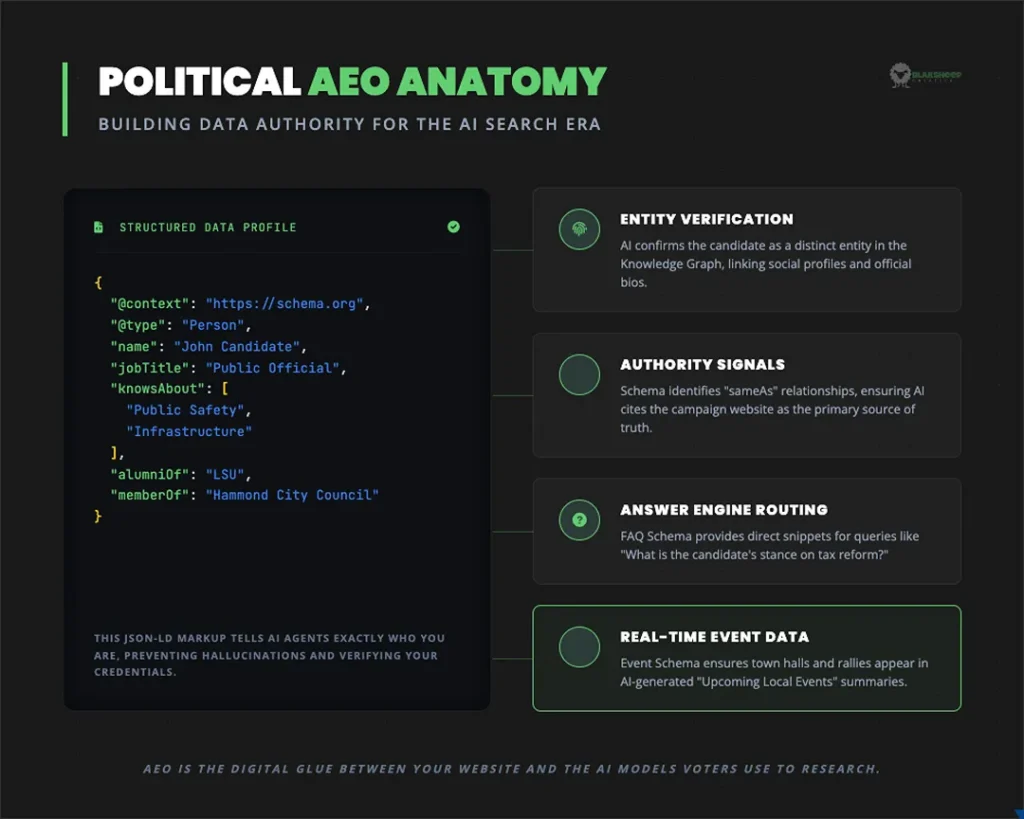
SEO gets the campaign found, and AEO helps the campaign become easier for search engines to cite and summarize.
Social Preview and Sharing Features
Campaign content gets shared in texts, group chats, Facebook posts, union pages, and local community threads. If the preview looks broken, the campaign looks sloppy before anyone clicks.
Each important page should have an Open Graph title, description, and image. The homepage, bio, priorities, endorsement, donation, and event pages each deserve a specific social preview rather than a single generic fallback image.
| Shared Page | Preview Goal | Recommended Image |
| Homepage | Introduce the campaign clearly. | Candidate headshot or campaign brand graphic. |
| Priorities | Signal what the campaign stands for. | Issue-focused campaign graphic. |
| Endorsements | Show public support and proof. | Endorsement collage or clean quote card. |
| Events | Drive attendance. | Event-specific graphic with date and location. |
Social previews are small details until they are wrong in front of thousands of people.
Campaign Website Compliance Basics
This is where the website needs careful review. BlakSheep Creative can build the site structure, but legal disclaimer language should be reviewed by the campaign, counsel, treasurer, or compliance advisor.
The FEC explains that political committee public communications, including certain public websites and internet communications, may require disclaimers. State and local campaigns may also face different rules. The site should also treat endorsements, testimonials, photos, and claims with care, especially when using supporter quotes or paid promotion.
| Compliance Area | Website Item to Review | Who Should Confirm It |
| Disclaimers | Footer, homepage, donation pages, ads, and public campaign communications. | Campaign treasurer, counsel, or compliance advisor. |
| Donations | Contribution limits, donor eligibility language, payment processor setup, and receipts. | Campaign finance professional or platform provider. |
| Endorsements | Names, quotes, logos, photos, permissions, and disclosure needs. | Campaign manager or legal reviewer. |
| Accessibility | Content structure, forms, alt text, contrast, and keyboard use. | Web team with an accessibility review process. |
| Privacy | Forms, supporter data, email signup, cookies, and analytics disclosure. | Campaign leadership and legal reviewer. |
Compliance review may feel boring, but public mistakes rarely stay private in campaign season.
“BlakSheep Creative rocks! Clint was super helpful in putting together our website and offered suggestions that really put us on the right track. If you are looking for help with any of your "creative" needs look no further.”

Form and Friction Guidance for Campaign Websites
Campaign forms should collect enough information to act without asking for everything short of a blood type. Every extra field gives people another reason to leave.
Use shorter forms for low-intent actions and longer forms only when the campaign truly needs the data. A volunteer form can ask for availability and interests. A general contact form should stay lean.
| Form Type | Recommended Fields | Fields to Avoid Early |
| General Contact | Name, email (optional), phone (optional), message. | Address, employer, long dropdowns, and unnecessary required fields. |
| Volunteer | Name, email, phone, city, volunteer interests, availability. | Detailed biography, too many required checkboxes. |
| Event RSVP | Name, email, number attending, phone optional. | Full mailing address unless required. |
| Endorsement Inquiry | Name, organization if applicable, contact info, endorsement type, message. | Long public quote fields before consent are clear. |
Shorter forms usually create more action and cleaner follow-up.
Political Campaign Website Launch Checklist
Before launch, the site needs a plain review process. This catches broken links, missing disclaimers, bad mobile layouts, wrong form routing, weak titles, and images that look like they were assembled during a power outage.
Use this checklist before sending traffic from ads, email, social posts, QR codes, mailers, or press outreach.
| Launch Item | Status Check | Owner |
| Homepage message | The candidate’s or campaign’s purpose is clear in the first screen. | Campaign manager and web team. |
| Mobile QA | Menus, buttons, forms, images, and sections work on phones. | Web team. |
| Forms | Submissions route to the right inbox or CRM. | Campaign manager and web team. |
| SEO basics | Titles, meta descriptions, headings, indexing, and internal links are reviewed. | SEO lead. |
| Schema | WebPage, Article, FAQPage, Organization, and BreadcrumbList markup is tested where relevant. | Technical SEO lead. |
| Disclaimers | The required campaign language has been reviewed and placed where needed. | Campaign compliance reviewer. |
| Analytics | CTA clicks, form submissions, calls, email clicks, and donation clicks are tracked. | Marketing team. |
A clean launch does not happen by accident. It happens because someone checked the details before voters did.
How BlakSheep Creative Builds Campaign Websites
BlakSheep Creative builds campaign websites for candidates, advocacy groups, public safety leaders, union campaigns, and community campaigns that need a clear message and a working digital home base.
We do not treat campaign websites like generic brochure sites. A campaign website needs message clarity, trust proof, action paths, mobile performance, social preview support, and technical SEO. As a veteran-owned and firefighter-owned agency based in Denham Springs, we understand public service, deadlines, and the joyless little details that keep digital systems from falling apart.
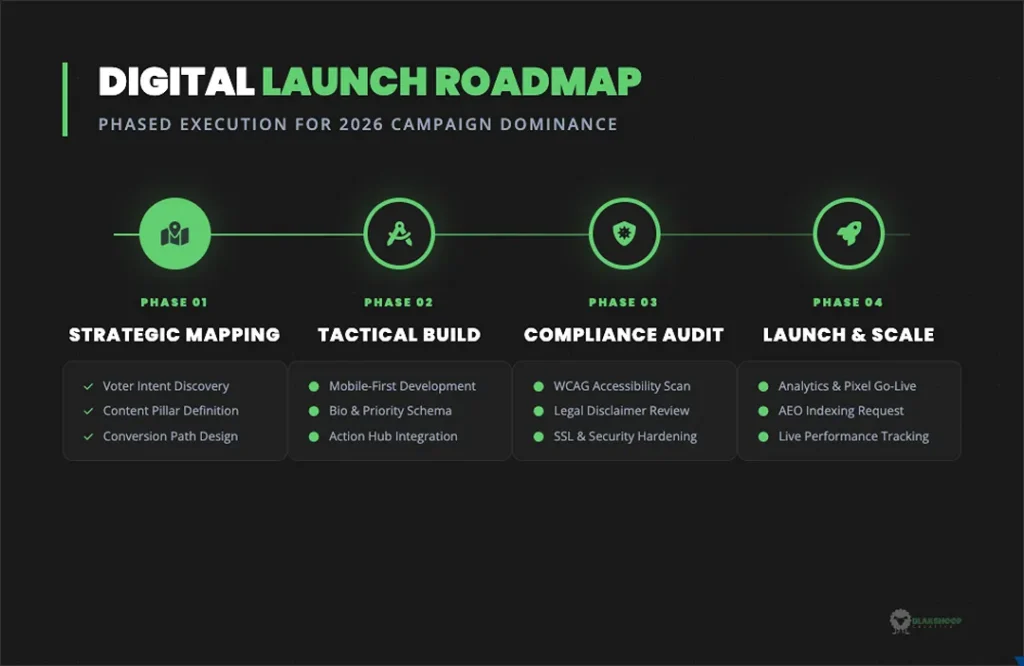
| Project Phase | What Happens | Client Input Needed |
| Discovery | We review goals, timeline, audience, campaign type, content needs, and action paths. | Campaign goals, bio, priorities, photos, links, and deadlines. |
| Structure | We map pages, CTAs, forms, navigation, and internal links. | Approval on the page list and main calls to action. |
| Build | We create the site layout, content structure, SEO basics, responsive design, and form setup. | Feedback, final copy approval, disclaimer language, and assets. |
| Launch | We test mobile layout, forms, links, schema, social previews, analytics, and basic security. | Final approval and launch timing. |
| Optimize | We review traffic, CTA clicks, submissions, and search visibility after launch. | Campaign updates, events, endorsements, and new proof assets. |
The process is built to move fast without turning the site into a fragile mess.
Build a campaign website people can trust.
If your campaign needs a clear website for voters, supporters, members, volunteers, or media contacts, request a quote for a campaign website from BlakSheep Creative. We can help you plan the site, build the structure, and launch with fewer public faceplants.
Common Questions About Political Campaign Websites
Campaign websites raise practical questions about timing, content, legal review, and cost. These answers help candidates and campaign teams plan the site before the deadline starts breathing down everyone’s neck.
How fast can a political campaign website be built?
A lean campaign website can often be built faster than a full political brand system, but the timeline depends on content readiness, page count, forms, donation tools, and approvals. The fastest projects usually start with a clear bio, priorities, headshot, logo, disclaimers, links, and contact details ready before design begins.
Does every campaign website need a donation page?
No. Some campaigns need donations, while others need volunteer signups, endorsement requests, RSVP forms, or member education. The right CTA depends on the campaign type, audience, and compliance requirements. If donations are accepted, contribution rules and payment platform setup should be reviewed by the campaign’s compliance advisor.
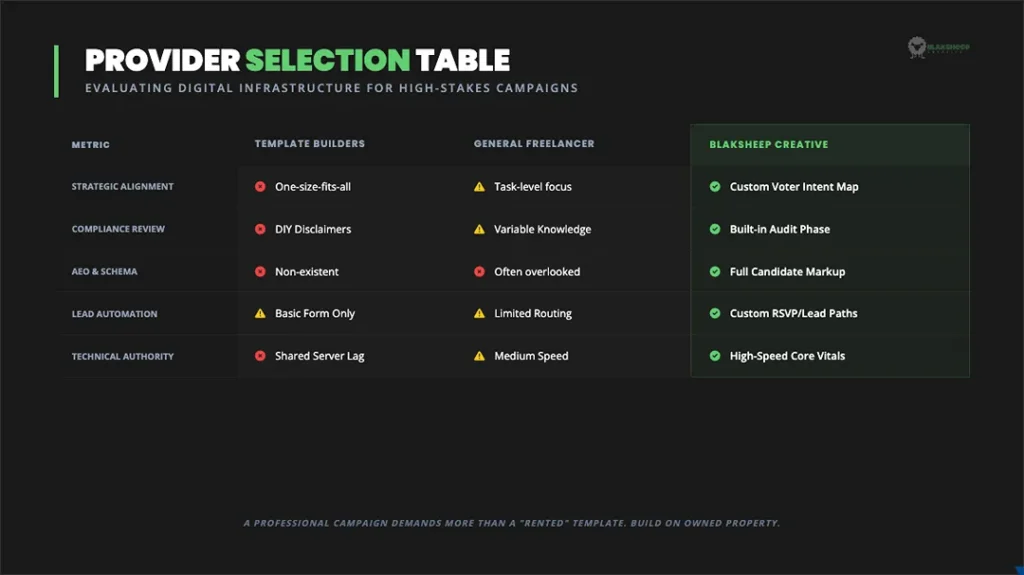
Should a campaign use a template or a custom website?
A template can work for a small campaign with a low budget and simple needs. A custom website makes more sense when messaging, trust proof, SEO, accessibility, social previews, and campaign action paths matter. Templates often save money upfront, but limit control when the campaign needs stronger positioning.
What should a campaign website include for SEO?
A campaign website should include clear title tags, useful meta descriptions, structured headings, internal links, schema markup, optimized images, fast mobile performance, and direct answers to common voter questions. Search visibility also improves when the site has specific pages for bio, priorities, endorsements, events, and contact information.
Do political campaign websites need disclaimers?
Many political committee websites and internet communications may require disclaimer language, but requirements vary by campaign type, committee structure, jurisdiction, and communication. The web team can include approved language, but the campaign should confirm the wording with counsel, the treasurer, or a compliance professional before launch.
Why does accessibility matter for campaign websites?
Accessibility helps more people use the campaign website, including voters and members with visual, mobility, hearing, or cognitive disabilities. It also improves basic usability through better headings, readable contrast, clear labels, keyboard access, and form clarity, the same fixes covered in our guide to website accessibility for small businesses. A campaign asking for public trust should not make the website harder to use than necessary.

We build this for political campaigns.
Fixed quote before we start, and you talk to the people who do the work.
About the author

Founder & Lead Developer · Denham Springs, LA
Clint has built and marketed websites for 26 years, since founding BlakSheep Creative in 2000. He is also a 29-year firefighter and a 23-year member of IAFF Local 557, which is where the bias toward plain answers over sales copy comes from.
- Veteran-owned
- Firefighter-owned
- IAFF Local 557
More Questions About Political Campaign Websites
Short answers to the questions that come up most on this topic.
What pages does a political campaign website need?
How does a campaign website earn a voter's trust?
Why does a campaign need a website if it already has social media?
What should a campaign website do for AEO and search?
What forms belong on a campaign website and how long should they be?
What gets checked before a campaign website launches?

Your next step, without the guesswork
No surprises, clear next steps, and a fixed price before anything starts.