
By Clint Sanchez · Published · Updated · 6 min read

Quick answer
Industrial supply buyers expect a website that helps them find the right product line, review specs and technical documents, compare options, reach the right rep, and request a quote without friction. That means category pages, manufacturer pages, product pages with specs, technical resource pages, quote request pages, and branch or territory pages. Many suppliers need an RFQ workflow more than full e-commerce, and the site has to work on a phone.
Key takeaways
- According to Gartner's 2026 sales survey, 67 percent of B2B buyers prefer a rep-free experience, so the website has to answer questions sales reps used to handle.
- McKinsey found B2B customers now use ten or more channels when dealing with suppliers.
- An industrial supply site needs six page types: category, manufacturer, product, technical resource, quote request, and branch or territory pages.
- Suppliers with account-based pricing, freight complexity, or negotiated terms usually need an RFQ site or a hybrid, not full e-commerce.
- Google and BCG research found mobile drives or influences more than 40 percent of revenue in leading B2B organizations.
- Google uses the mobile version of a site's content for indexing and ranking, so a stripped-down mobile site weakens search visibility.
- Technical documents buried in PDFs with no page context are less useful to buyers and invisible to search engines.
Industrial suppliers along the I-10 and I-12 corridor sell into refineries, chemical plants, and fabrication shops from Baton Rouge to Geismar and Port Allen. The buyer looking for a valve spec or an SDS is usually standing in a plant with a phone, not sitting at a desk, and a site that hides the spec sheet or the local rep's number loses that quote to a distributor whose site does not.

Want this handled instead of DIY?
A 15-minute call, no script, no pressure. You leave with a plan either way.
Industrial supply website design should help buyers find products, compare options, and request quotes fast.
Quick Answer: Good industrial supply website design is not about flashy visuals. It is about helping buyers find the right product line, review specs, compare options, contact the right rep, and request a quote without friction. If your site buries technical information or makes users hunt for answers, it is probably costing you leads.
B2B buyers do a lot of research before they ever talk to sales. According to Gartner’s latest B2B buyer research, 67 percent of B2B buyers prefer a rep-free experience. McKinsey’s B2B omnichannel research also found that B2B customers now use ten or more channels when interacting with suppliers. Your website has to carry more of the workload than it used to.
That shift also affects AI-driven discovery, as explained in our guide to Local AEO.
TLDR;
- Industrial buyers need product pages, technical resources, and fast quote paths.
- Many industrial suppliers need RFQ workflows more than full e-commerce.
- Category structure and manufacturer pages matter for usability and SEO.
- Mobile performance matters because B2B buyers research on phones, too.
- Accessibility, speed, and search UX affect trust and conversion.
- A generic brochure site is usually not enough for industrial supply companies.
Want this handled for you? We build and market websites for Louisiana businesses, and we will tell you honestly if you do not need us.
What makes industrial supply websites different from general business websites
Most general business websites only need to explain services and push a contact form. Industrial supply companies usually need a lot more structure than that. Buyers may be looking for a product family, a manufacturer line, a spec sheet, a safety document, a branch location, or the right sales rep for a certain territory.
That changes the website’s job. It needs to support product discovery, technical review, and next step action. A polished homepage is not enough if the deeper pages are thin, confusing, or hard to navigate. Buyers want fast answers and a clear path to a quote.
That is exactly why generic website advice falls short in this niche. Industrial supply websites need to be built around real buyer tasks, not just brand presentation.
The pages that industrial buyers expect to find
A strong industrial supply website design usually includes more than a home page, about page, and contact page. Buyers expect a site that helps them get to the right information quickly.
| Page Type | Why It Matters |
| Category Pages | Help buyers narrow products by type, application, or use case. |
| Manufacturer Pages | Let users browse by brand and compare trusted product lines. |
| Product Pages | Give specs, photos, part details, and a clear next step. |
| Technical Resource Pages | Support spec sheets, SDS files, certifications, and install details. |
| Quote Request Pages | Make it easier for buyers to move from research to action. |
| Branch or Territory Pages | Help buyers find the right location or rep faster. |
Sites that skip these pages often force users to call too early or leave altogether. That is a problem when many B2B buyers prefer to self-educate first.
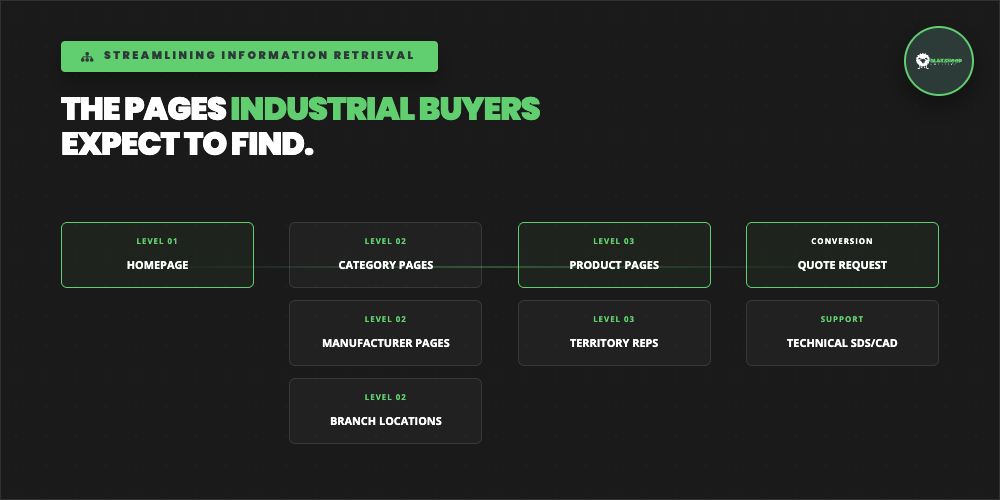
The better your page structure, the easier it is for users and search engines to understand what you sell and where to go next.
RFQ vs. e-commerce vs. hybrid: what most industrial suppliers actually need
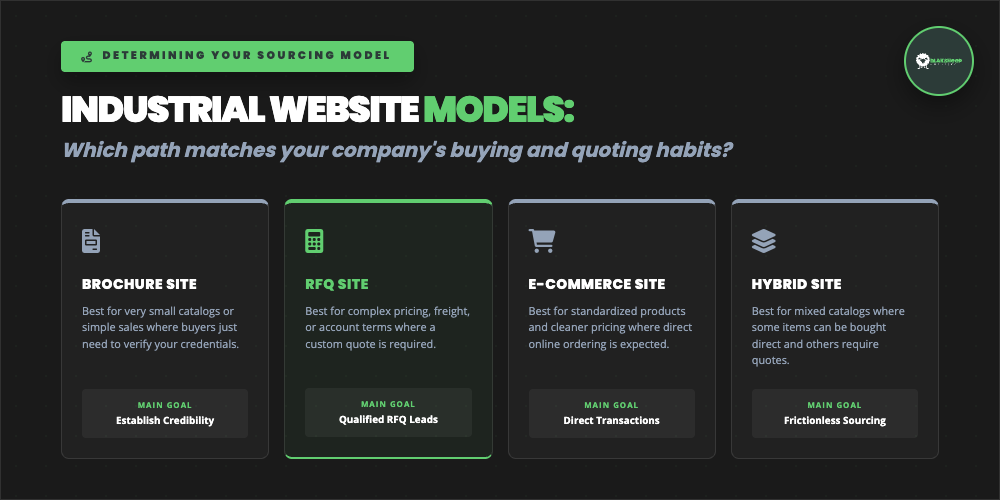
Not every industrial supply company needs a full e-commerce build. Some suppliers have account-based pricing, freight complexity, negotiated terms, or custom ordering workflows that make direct checkout a bad fit. In those cases, a quote-first setup is often the better move.
| Website Model | Best Fit | Main Goal |
| Brochure Site | Very small catalog or simple sales process | Show credibility and contact info |
| RFQ Site | Complex pricing, freight, or account terms | Generate qualified quote requests |
| E-commerce Site | Standardized products and cleaner pricing | Support direct online ordering |
| Hybrid Site | Mixed catalog with some buy now and some quote only products | Support different buyer paths |
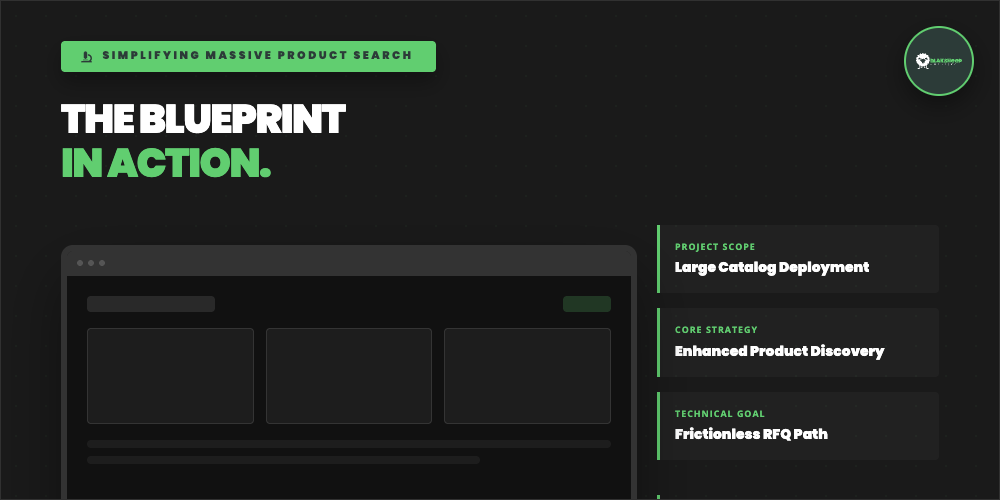
The right answer depends on how your buyers purchase, not on what looks trendy. If you want to see how that can work in practice, this Fort Smith Industrial Supply website project is a useful example. It involved a large product catalog and a structure that made product discovery easier across a much larger inventory.
That decision point matters because the wrong website model creates friction before buyers ever reach out.
According to Gartner's 2026 sales survey, 67 percent of B2B buyers prefer a rep-free experience, so the website has to answer questions sales reps used to handle.
Search, filters, and technical content do more heavy lifting than design trends.
Industrial buyers usually do not land on a website hoping to admire the typography. They want answers. If your site search is weak, filters are thin, or technical files are missing, users hit friction fast.
That is where structure matters. Baymard’s B2B UX research shows how often websites create avoidable friction in navigation, search, and product discovery. Industrial supply companies should care about that because product-heavy sites are especially vulnerable to messy architecture and poor findability.
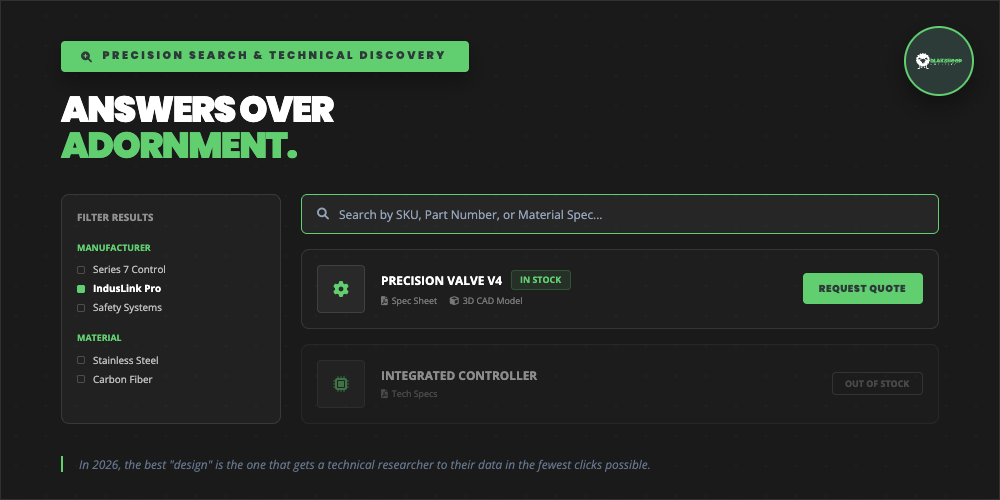
Technical resources also matter for trust. Buyers may want dimensions, tolerances, materials, certifications, SDSs, installation details, or maintenance guidance. If that information is buried in PDFs with no page context or missing entirely, the site becomes less useful to both users and search engines.
That is one of the easiest ways a site can look polished on the surface and still fail underneath.
Mobile UX matters more than many industrial suppliers think
Mobile is not just for consumer retail. People research suppliers on phones in trucks, warehouses, plants, and job sites. That means your site has to load fast, keep core information visible, and avoid broken mobile experiences.
According to Google and BCG’s research on mobile in B2B, mobile drives or influences more than 40 percent of revenue in leading B2B organizations. On the technical side, Google’s mobile-first indexing documentation makes it clear that Google uses the mobile version of a site’s content for indexing and ranking.
So if your mobile site hides product information, strips out content, or turns navigation into a headache, you are hurting users and weakening your search visibility at the same time.
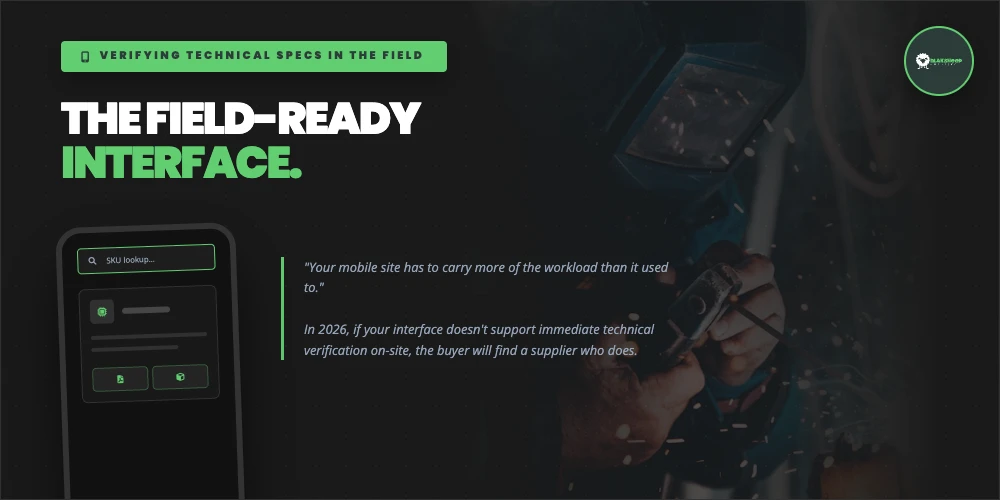
That makes mobile UX a sales issue, not just a design issue.
Speed, accessibility, and trust signals still matter
Industrial supply websites can get heavy fast. Product images, technical files, scripts, and bloated templates all add up. That is why performance cannot be an afterthought.
Google’s guidance on Core Web Vitals recommends strong loading, interactivity, and visual stability to improve the user experience. Accessibility matters too. W3C’s WCAG accessibility guidance and the current WCAG 2.2 standard cover the latest recommendations for making web content more accessible.
In plain terms, buyers should be able to read the content, navigate the site, and complete actions without having to fight the interface. That includes readable contrast, accessible forms, clear headings, logical navigation, and buttons that work well on touchscreens.
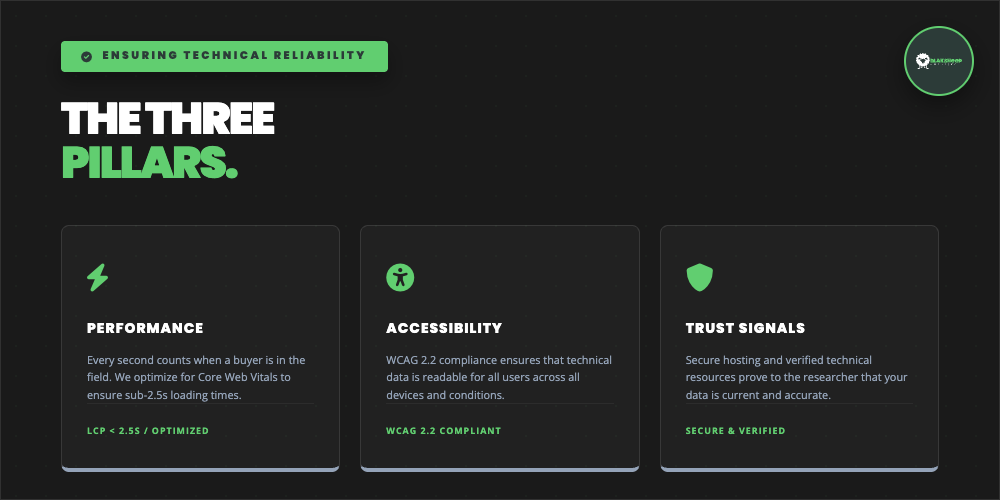
None of this is flashy, which is probably why so many businesses ignore it until the site starts quietly losing leads.
“Our website build with BlakSheep was the type of experience that you want to share and brag about. Very responsive, organized, to the point with our design. The creativeness of Clint provided us exactly what we wanted and needed. Would definitely use them again and recommend them!”

How to tell if your current website is costing you quotes
Your site may need work if any of these are true:
- Product categories are hard to browse.
- Manufacturer lines are missing or thin.
- Technical documents are hard to find.
- RFQ forms ask too much or too little.
- Users cannot tell who to contact.
- The mobile version feels stripped down or clumsy.
- The website looks polished, but it does not help buyers move forward.
If that list sounds familiar, you probably do not need more vague design talk. You need a website structure that matches how industrial buyers research, compare, and reach out.
Request an industrial website review.
If your current website is hard to use, hard to update, or hard to rank, that is usually fixable. The better move is to start with the structure, not the decoration.
Our team builds website designs for industrial supply companies focused on product discovery, technical content, stronger quote paths, and the usability B2B buyers actually expect. If you want a practical next step, request an industrial website review, and we will show you where your site is helping, where it is getting in the way, and what to fix first.
Thinking about a new website, redesign, or rebuild? Talk through the project before you spend a dollar, 15 minutes, no sales pitch.
About the author

Founder & Lead Developer · Denham Springs, LA
Clint has built and marketed websites for 26 years, since founding BlakSheep Creative in 2000. He is also a 29-year firefighter and a 23-year member of IAFF Local 557, which is where the bias toward plain answers over sales copy comes from.
- Veteran-owned
- Firefighter-owned
- IAFF Local 557
Common Questions About Industrial Supply Websites
Short answers to the questions that come up most on this topic.
Does an industrial supply company need e-commerce?
What pages should an industrial supply website have?
Why does mobile matter for a B2B industrial website?
How should technical documents be handled on the site?
How do I know if my industrial website is losing quotes?
Do speed and accessibility affect industrial supply websites?

Your next step, without the guesswork
No surprises, clear next steps, and a fixed price before anything starts.