
By Clint Sanchez · Published · Updated · 11 min read
Quick answer
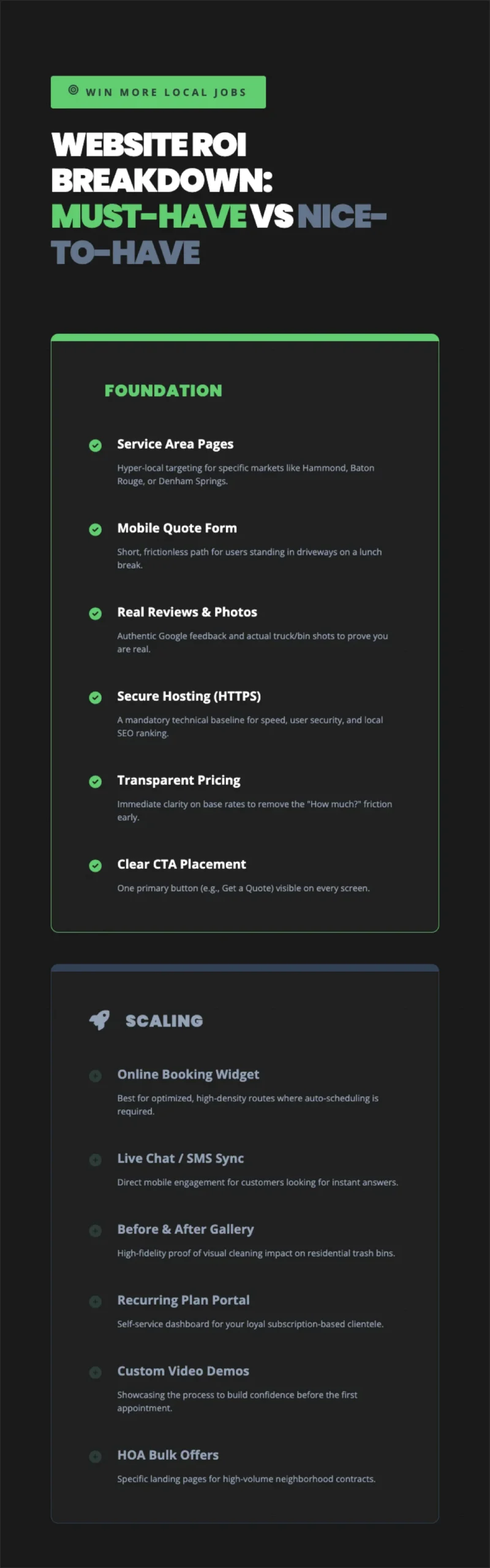
A trash can cleaning website should explain the service above the fold, show the exact areas and routes it serves, make quote requests short and easy on mobile, show real reviews and before-and-after photos, load fast on secure HTTPS hosting, use accessible headings and labels, and present recurring plans as a core offer. Google indexes the mobile version of the site, recommends good Core Web Vitals, and rewards complete business information for local visibility.
Key takeaways
- According to Pew Research, 15% of U.S. adults are smartphone dependent, so the mobile version of a service site is the main event for part of the market.
- Google indexes the mobile version of a site and recommends good Core Web Vitals, so speed and stability affect search as well as usability.
- Service positioning above the fold should answer what you clean, who it is for, how it works, where you go, and one-time versus recurring.
- Service areas must be obvious; useful city pages help when the market supports them, but duplicated pages with the city name swapped do not.
- Real Google reviews, before-and-after photos, and photos of the truck and team build trust faster than clever copy.
- Accessibility basics such as clear headings, labeled buttons, readable contrast, and alt text help both users and crawlers.
- Recurring plans and route logic belong in the site's content and quote form, not buried in one sentence near the bottom.
Bin cleaning around Baton Rouge is route-based by subdivision: Denham Springs and Walker neighborhoods on one day, Prairieville and Gonzales on another, with Livingston Parish addresses that a national template's service-area field cannot express. Homeowners here also ask about summer heat that makes a can foul in days and post-storm debris, so the site has to answer for the parish, not a generic city.

Want this handled instead of DIY?
A 15-minute call, no script, no pressure. You leave with a plan either way.
What Should a Trash Can Cleaning Website Include First?
A trash can cleaning website should explain the service fast, show the areas you serve, make quote requests easy on mobile, show proof like reviews and real photos, and give Google clear signals about relevance and quality. Google uses the mobile version of your site for indexing, recommends good Core Web Vitals, and says complete business information helps local visibility.
TLDR
A site that books jobs is one piece. The demand side is covered in our guide to trash can bin marketing, which walks through route density, paid ads, and missed-call recovery.
- Clear service positioning above the fold
- Visible service areas and city targeting
- Short mobile-friendly quote forms
- Real reviews, photos, and trust signals
- Fast load times and secure hosting
- Accessible structure with clear headings and labels
- Recurring plan content that matches how the business actually sells
If you serve local markets, this matters even more. People searching for a local home service on their phones are not looking for a design award. They are looking for a company that looks real, covers their area, and makes it easy to get started. Google uses the mobile version of your site for indexing, and Pew reports that 15% of U.S. adults are smartphone dependent, which means your mobile experience is not a side issue. It is the main event for part of your market.
Most operators miss at least one of these. When we reviewed 13 live sites, only 2 let a visitor check their address on the site itself.
Why Trash Can Cleaning Websites Lose Jobs Fast
Most weak service websites break down in the same places. They look generic, hide the service area, make the quote path harder than it needs to be, and do not build much trust.
That is a problem for a trash-can cleaning company because it is a route-based local service. People want to know what you clean, how it works, where you go, what they need to do next, and if your company looks reliable. If they cannot find that in a few seconds, they move on.
Google’s SEO Starter Guide says SEO is about helping search engines understand your content and helping users decide if they want to visit your site from search. That lines up perfectly here. A good trash-can cleaning website doesn’t try to impress people with fluff. It is trying to remove hesitation and make the next step obvious.
That is why the first thing to fix is not the logo animation or some dramatic video background. It is the clarity of the offer and the path to action.
Clear Service Positioning Comes First
Your homepage and primary service page should answer the main questions right away. What do you clean? Who is it for? How does it work? What areas do you serve? Can people sign up for a one-time or recurring service?
If you are comparing structure to shortcuts, read why generic website templates fail trash-can cleaning companies.
For a trash-can cleaning company, that usually means spelling out things like curbside bin cleaning, deodorizing, pressure-washing add-ons, HOA or multi-unit work if you offer it, and the difference between one-time cleanings and recurring plans. Do not leave people guessing if you clean residential bins only or also handle commercial dumpsters, pad washing, or other add-ons.
If you are weighing a shortcut build, read why AI-generated websites often hurt rankings and conversions before you commit to a generic setup.
This is also where generic cleaning company templates fall apart. They tend to use vague language that could describe almost any service business. That is bad for conversions and bad for topical relevance.
- Lead with the exact service
- State who the service is for
- Explain how the process works in simple steps
- Make recurring plans easy to understand
- Use plain English instead of filler copy
Once the service is clear, the next job is making your coverage area impossible to miss.
Your Service Area Has to Be Obvious
Trash can cleaning is local. Your website should act like it.
If someone lands on your site and cannot tell if you serve their city, neighborhood, parish, or zip code, you are making them do extra work. Google Business Profile Help also says that relevance improves when you provide complete, detailed business information, and that more reviews and stronger prominence signals can help with local ranking.
That means your website should support your local search visibility with:
- clear city and service area language
- location references where they make sense
- consistent business details
- service area pages when your market size supports them. When your market supports city content, use trash can cleaning service area pages to show coverage, route fit, local proof, and the next step for each location.
- internal links between your main service page and location-specific content
Your website should also support your map visibility, which is why our Google Business Profile optimization service pairs well with a stronger local service page strategy.
Also, you do not need to create junk city pages stuffed with the same paragraph, with the city name swapped. You do need useful local pages when you are targeting multiple territories and want stronger local relevance in those areas.
| Weak local setup | Stronger local setup |
| One vague service page with no city mentions | Main service page plus useful city or service area support pages |
| Buried phone number and no visible coverage area | Visible service area block with a clear call to action |
| No support for Google Business Profile relevance | Site content that reinforces business category and service area intent |
If local growth is part of the plan, a stronger Google Business Profile setup and optimization strategy should work with the site, not off by itself in a corner. Once those basics are in place, the next step is building stronger search visibility. Our guide to local SEO for trash can cleaning companies explains how to connect service areas, Google Business Profile, reviews, mobile quote paths, schema, and tracking.
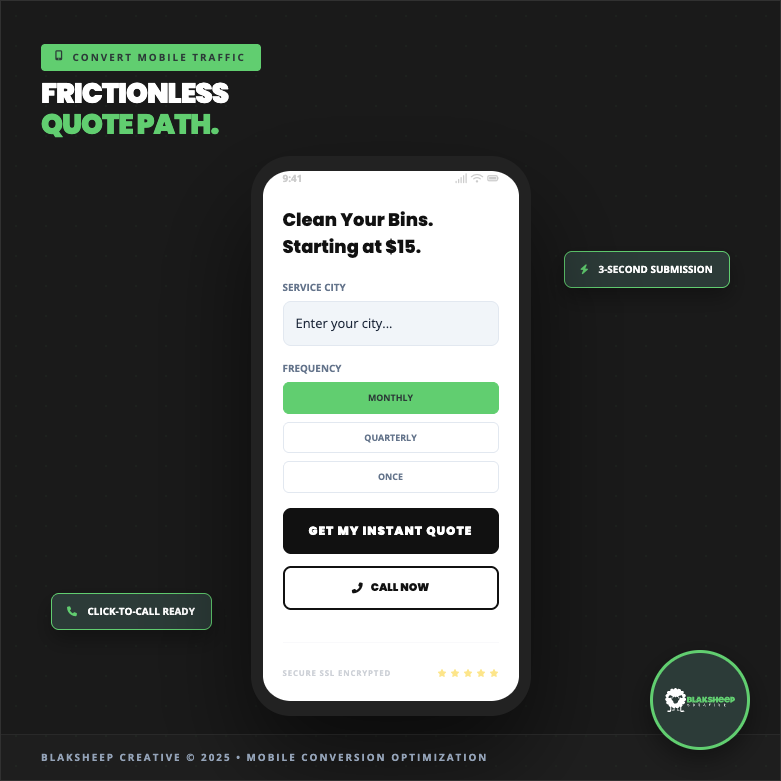
Once the form and mobile path are fixed, the next piece is trust.
According to Pew Research, 15% of U.S. adults are smartphone dependent, so the mobile version of a service site is the main event for part of the market.
Reviews, Photos, and Trust Signals Matter More Than Clever Copy
Home service buyers are trying to avoid bad experiences. They want signs that the company is legitimate, active, and worth contacting.
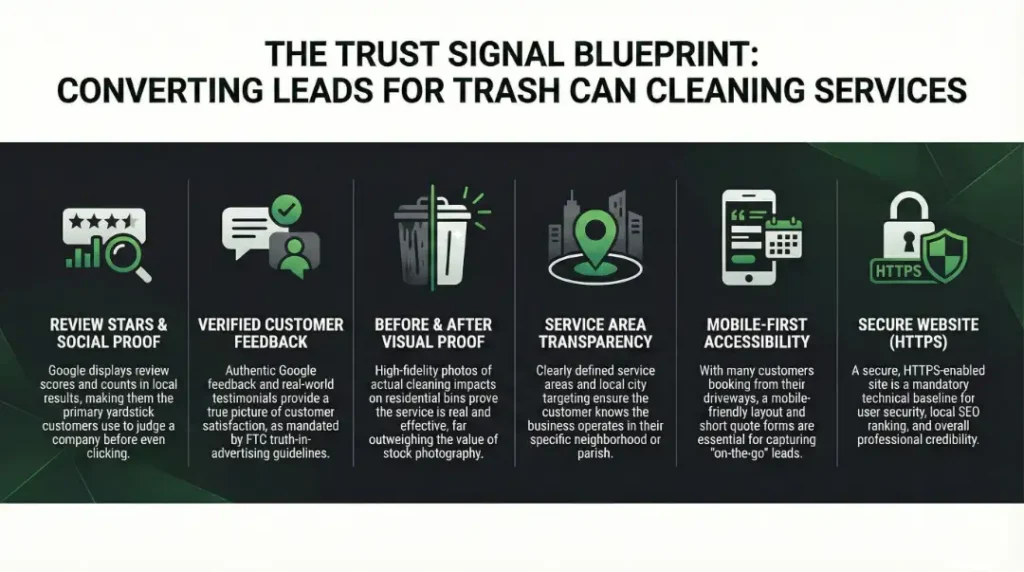
Google says Search and Maps can show review scores, top reviews, and total review count for local businesses. That makes the review strength part of how people judge the business before they ever click. FTC guidance also says consumers relying on online reviews should get a true and accurate picture of what real customers think.
For a trash can cleaning website, strong trust elements usually include:
- real Google reviews
- before and after photos
- photos of the truck, trailer, or equipment
- owner or team visibility
- local phone number and clear contact information
- simple FAQ answers
- service process photos that show the work is real
Do not fake reviews. Do not use stock photos for everything. Do not hide behind generic “quality service” language. People are not stupid, even if the internet sometimes tests that theory.
If you want buyers to trust you faster, let them see the work, the process, and the proof.
Trust is not just about content, though. It is also shaped by how the site performs.
Page Speed, Security, and Basic UX Still Matter
A trash can cleaning website does not need to be flashy. It does need to work well.
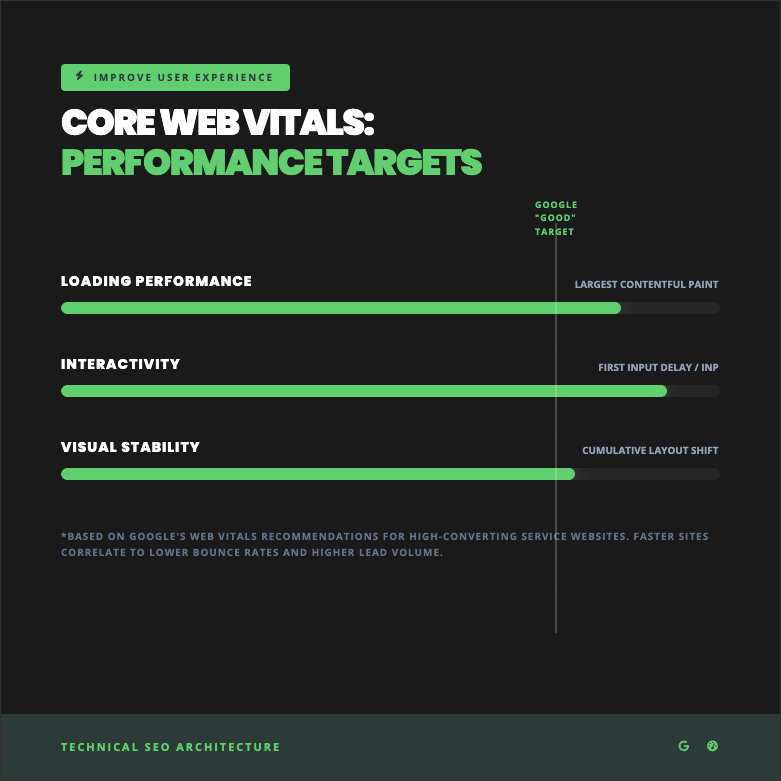
Google defines Core Web Vitals as real-world user experience metrics for loading performance, interactivity, and visual stability, and says site owners should aim for good Core Web Vitals to improve search performance and user experience. Google has also long treated HTTPS as a ranking signal. That means speed, stability, and security are not just tech chores. They are part of what makes the site usable and competitive.
At a practical level, that means:
- fast loading pages
- secure HTTPS
- clear buttons
- no giant wall of text at the top
- no intrusive popups blocking the screen
- mobile layouts that do not break the form or CTA
- images sized and compressed properly
If the site feels clumsy, cheap, or unstable, that hurts trust before a single word of sales copy gets a chance to do its job. A website can look sharp and still lose jobs if the phone process behind it is loose. If you want to tighten the follow-up side too, read how to fix missed-call lead leaks before more good inquiries go cold.
Good UX also overlaps with accessibility, which is where many sites get lazy.
Accessibility and Crawlability Are Part of a Better Service Website
Accessibility is not just there for a legal checkbox. It affects usability, clarity, and how different systems interpret the page.
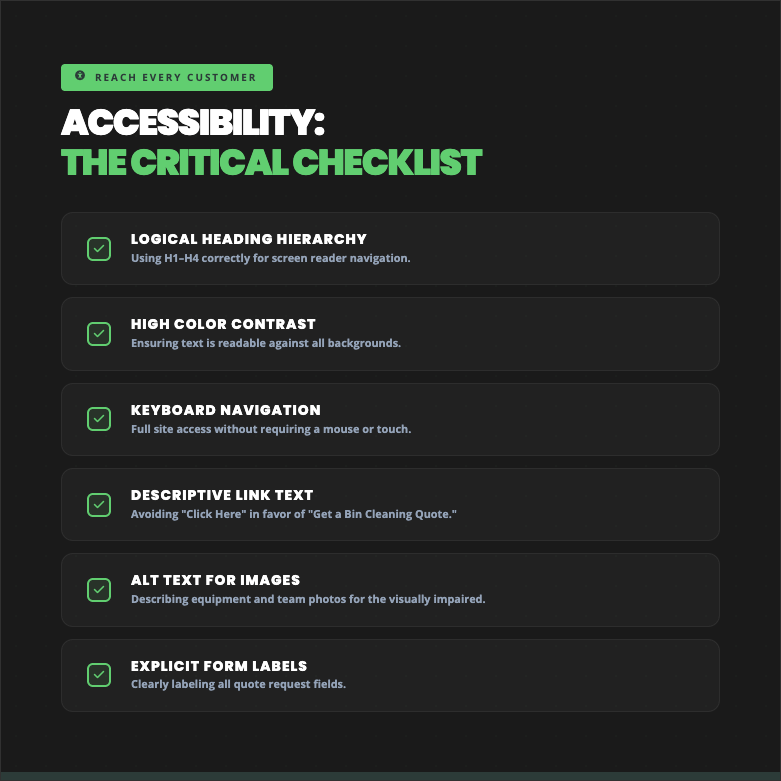
W3C says WCAG 2.2 is organized under four principles: perceivable, operable, understandable, and a fourth that requires content to be interpreted reliably by a wide variety of browsers and assistive technologies. Google also recommends descriptive image filenames and alt text, and says crawlable links help it discover pages and understand page relationships.
For this kind of site, that means:
- clear heading structure
- buttons with real labels
- form fields that make sense
- readable color contrast
- alt text for useful images
- internal links that support service pages and city pages
- FAQ content that is easy for users and search engines to parse
If your content is hard to navigate, vague, or broken by weird layout tricks, the page becomes harder to use and understand. That is a bad trade. For a deeper breakdown, read our guide on website accessibility for small businesses.
Once the structure is solid, the site should also support how the business actually makes money.
“Clint was incredible to work with! He was everything you need - quick to communicate from beginning to end, professional, flexible when I had questions and asked for extra options, and SO fast on his turnaround time. I would recommend Blaksheep Creative to everyone!”

Recurring Plans and Route Logic Should Be Built Into the Site
If recurring revenue matters to the business, the website should treat it like a core offer.
That means giving recurring plans their own space in the message, rather than burying them in a single sentence near the bottom of the page. You should explain what the recurring service includes, how often it occurs, the difference between one-time and ongoing service, and any add-ons that naturally fit with the offer.
This is also where route-based thinking helps. If your business works by grouping neighborhoods, cities, or service days, the site should reflect that in its service area content and call-to-action flow. A route-based service business needs the site to support the operating model, not just describe the service in broad terms.
- explain one-time and recurring options clearly
- make frequency choices easy in the quote form
- show add-on opportunities where they fit
- support route based service areas with relevant content
- tie the offer to convenience and repeatability
The more closely the site matches how the business sells and serves, the more useful it becomes.
That is exactly why generic templates often fall short.
Generic Templates Usually Miss the Important Stuff
A generic cleaning template can make a site look “done,” but that is not the same as making it useful.
Most template-driven setups miss the details that matter for this niche:
- weak service positioning
- no route-based thinking
- poor city targeting
- thin trust content
- weak mobile forms
- no recurring plan support
- no real internal linking strategy
- no plan for Google Business Profile alignment or local SEO support
That is why a better build usually starts by mapping the business model first, then building the content, calls to action, and page structure around that. Not the other way around.
At that point, the question is not “should the website look nicer?” It is “should the website work harder?”/
What a Better Trash Can Cleaning Website Should Include
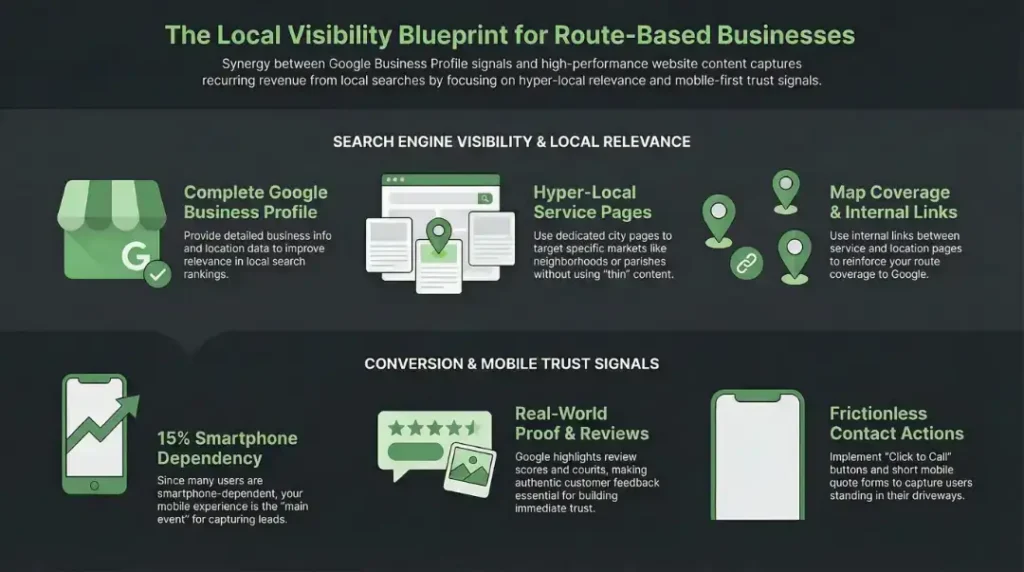
If you want the short version, here it is. A stronger trash can cleaning website should include:
- a clear explanation of the service
- visible service areas and local relevance
- mobile-friendly quote requests
- real photos and reviews
- fast load times and secure hosting
- accessible structure and crawlable internal links
- recurring plan support
- content built around how the business actually runs
That is what helps the site function as a lead tool rather than a brochure with a phone number stuck to it.
Trash Can Cleaning Website Requirements FAQ
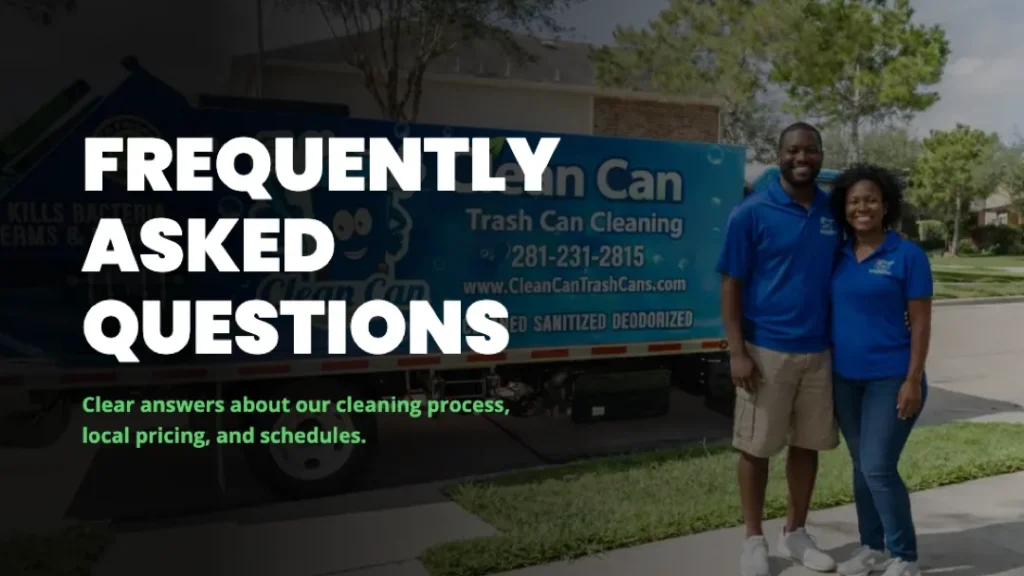
These are some of the most common questions owners ask when trying to figure out what a trash-can cleaning website should include.
What pages should a trash can cleaning website have?
At minimum, it should have a strong homepage, a dedicated main service page, a contact or quote page, an FAQ section, and trust-building content like reviews or project photos. If you target multiple cities or service areas, it can also make sense to add location support pages.
Do trash can cleaning companies need city pages?
Not always, but many do. If you serve multiple territories and want stronger local relevance in each one, useful city or service area pages can help. They need to be real pages with useful local context, not thin duplicate content with city names swapped in. That same local structure also supports newer search behavior, which we break down in this guide to local AEO for voice search and near me queries.
Should I use online booking or a quote form?
That depends on how your operation works. Some businesses do better with a short quote form and a follow-up process. Others benefit from online scheduling. The right setup depends on route density, service complexity, and the level of control you want over qualification before a job is booked.
How important are reviews for a trash can cleaning business?
Very important. Google shows review scores, top reviews, and total review counts in local business results, so reviews affect how people judge the company before they even visit the site. Reviews also help reduce hesitation for homeowners comparing several local options.
Does page speed really matter for a local service website?
Yes. Google recommends good Core Web Vitals for search success and user experience, and a slow mobile page can frustrate visitors before they even reach the quote form. A fast site helps both usability and lead flow.
What should go above the fold on the homepage?
The top of the page should quickly explain the service, show the service area, and give people a clear next step. For most trash-can cleaning companies, that means a direct headline, short supporting copy, and one strong call to action, such as requesting a quote or calling now.
Can a generic cleaning website template still work?
It can work in the sense that it puts something online. That does not mean it will support local rankings, recurring plan messaging, route-based service areas, trust building, and lead conversion very well. A template is often where operators start. It is rarely where they want to stay.

We build this for trash can cleaning companies.
Fixed quote before we start, and you talk to the people who do the work.
About the author

Founder & Lead Developer · Denham Springs, LA
Clint has built and marketed websites for 26 years, since founding BlakSheep Creative in 2000. He is also a 29-year firefighter and a 23-year member of IAFF Local 557, which is where the bias toward plain answers over sales copy comes from.
- Veteran-owned
- Firefighter-owned
- IAFF Local 557
More Questions About Trash Can Cleaning Websites
Short answers to the questions that come up most on this topic.
How should a trash can cleaning website present recurring plans?
What trust signals belong on a bin cleaning website?
Do I need HTTPS for a local service website?
What does accessibility have to do with a cleaning company website?
How should service areas be shown on the site?
Should the site mention commercial dumpster cleaning?

Your next step, without the guesswork
No surprises, clear next steps, and a fixed price before anything starts.