
By Clint Sanchez · Published · Updated · 9 min read
Quick answer
AI-generated websites hurt a business because they are built for appearance, not results. Pages launch in isolation with no internal linking or search intent mapping, so Google has nothing to rank. Layouts flatten messaging and misplace calls to action, so visitors do not convert. Nobody measures or iterates after launch, and branding, accessibility, and compliance drift. Most owners pay twice: once for the fast build, again for the fix.
Key takeaways
- AI website builders removed friction, not the work: BuiltWith counts over 8.7 million live Wix sites and W3Techs puts Wix at roughly 4 percent of all websites.
- SEO is architecture, not copy; Google Search Central explains that internal links help it discover pages and understand relevance, and AI sites launch without them.
- Shopify cites Google research showing bounce rate rises 32 percent when load time goes from 1 second to 3 seconds.
- Nielsen Norman Group reports usability improvements lift desired metrics by an average of 135%.
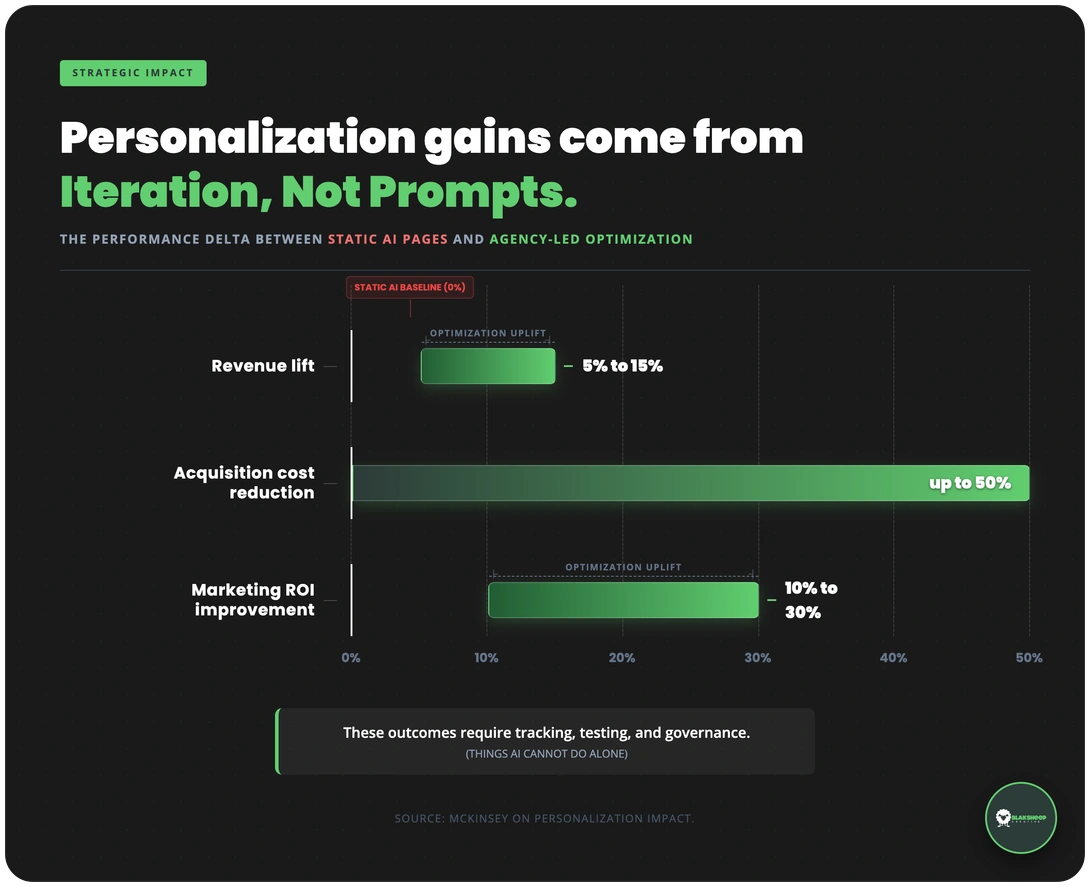
- McKinsey reports personalization can lift revenue 5 to 15 percent and cut acquisition costs up to 50 percent, but only when someone is measuring and adjusting.
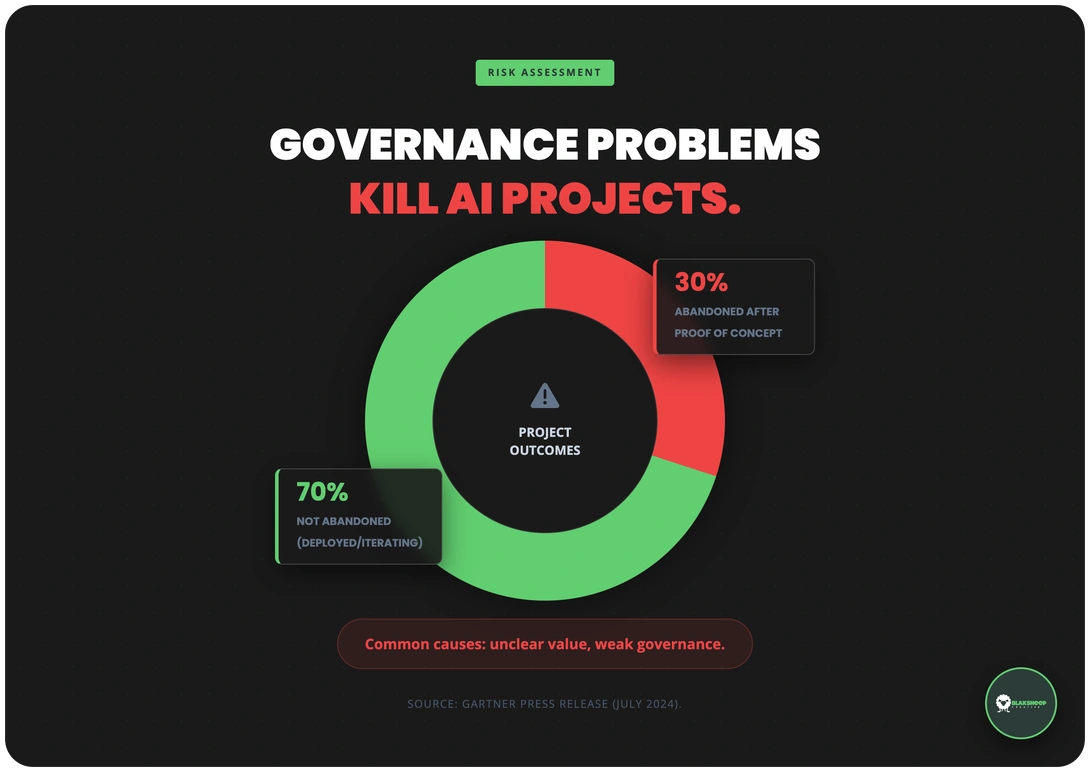
- Gartner predicts 30 percent of generative AI projects will be abandoned after proof of concept over unclear value and governance failures.
- A designer who cannot explain their internal linking strategy or show a site audit is prompting, not designing.
The example in this post is a Baton Rouge service business: clean-looking AI site, slow load, no internal links, no tracking, no organic traffic. That pattern shows up across the I-12 corridor. When a plumber or roofer in Denham Springs does not rank for their service and parish, the phone stays quiet, and the owner concludes SEO is dead when the site was the problem.

Want this handled instead of DIY?
A 15-minute call, no script, no pressure. You leave with a plan either way.
AI-generated websites are everywhere now. Most of them perform terribly.
Quick answer: AI-generated websites hurt your business not just by lacking SEO structure and conversions, but also by risking inconsistent branding, accessibility issues, and compliance failures that can damage reputation over time. Most businesses end up paying twice: once for the fast build, then again for the fix.
- SEO: thin structure and weak internal linking reduce visibility.
- Leads: generic messaging and weak UX reduce conversions.
- Cost: Rebuilding cycles from poorly executed AI sites often cost more than investing in a comprehensive, professionally developed website that is built right the first time, delivering better ROI over the long term.
Most business owners do not realize how badly until months go by and the leads never arrive.
TLDR:
- AI can generate pages, but it cannot build a revenue system, brand trust, or SEO architecture.
- Most DIY AI-generated sites launch with weak structure, generic messaging, and no measurement plan.
- Slow load times and poor UX increase bounce and suppress conversions.
- Without iteration, your website gets worse relative to competitors every month. Professional web services include ongoing optimization and measurement, giving you confidence that your site will adapt and improve over time.
- AI works when humans control strategy, structure, and accountability. This partnership makes sure your website aligns with your goals, providing a sense of control and trust in the process.
We are BlakSheep Creative. Veteran-owned. Firefighter led. Based in Denham Springs, Louisiana.
This is not a theory. We spend our days repairing SEO damage, rebuilding broken WordPress sites, fixing accessibility and compliance issues, and cleaning up “custom” websites that were anything but custom.
In practice, the pattern is always the same, fast launch. No results. Confusion. Then cleanup.
Here is a familiar story.
A Baton Rouge service business came to us after months on an AI website builder. The site looked clean. It loaded slowly. Pages were disconnected. There was no internal linking. No conversion tracking. No organic traffic. They thought SEO was dead. It was not. The site was.
Why are AI-generated websites everywhere right now?
Answer: AI website tools exploded because they removed friction. No developer. No strategy. No uncomfortable questions. Just prompts and templates that produce something that looks complete.
Want this handled for you? We build and market websites for Louisiana businesses, and we will tell you honestly if you do not need us.
Scale explains the problem.
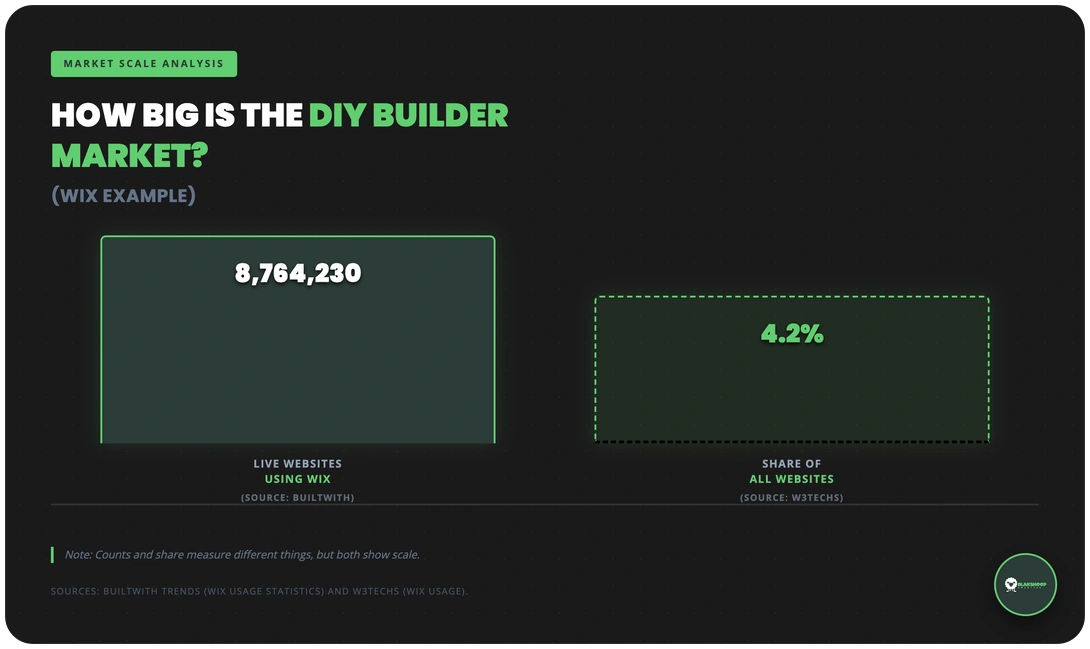
BuiltWith reports over 8.7 million live websites using Wix. W3Techs shows Wix is used by roughly 4 percent of all websites.
When publishing becomes effortless, quality becomes the bottleneck.
This is where most businesses confuse speed to launch with speed to revenue.
Fast does not mean effective. Finished does not mean functional.
When publishing becomes effortless, quality becomes the bottleneck.
This is where most businesses confuse speed to launch with speed to revenue.
Fast does not mean effective. Finished does not mean functional.
Why do AI-generated websites struggle with SEO?
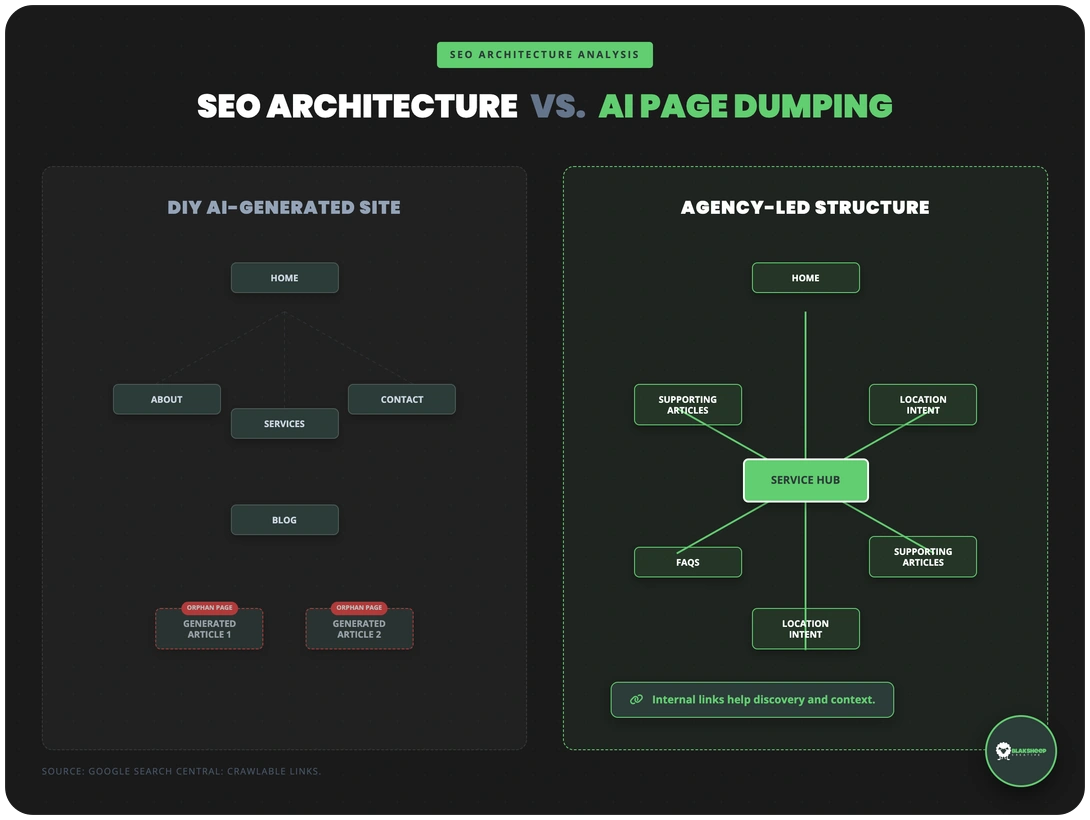
Answer: SEO is architecture, not copy. AI builders generate pages in isolation without hierarchy, internal linking, topical depth, or search intent mapping. Google ranks connected systems of content, not disconnected drafts.
Google has explained for years that internal links help search engines discover pages and understand relevance.
Google Search Central covers the basics of crawlable links and how links help Google find and contextualize pages.
Here is how this fails in practice.
AI sites launch with a handful of broad pages, no supporting content, and no internal links reinforcing authority. Google has nothing to trust. Users have nowhere to go. For a service-business example of this problem, read why generic website templates fail trash can cleaning companies.
This is why paid ads become the only option, and that bill never stops.
Why do AI-generated websites convert so poorly?
Answer: AI layouts optimize for appearance, not decision making. They flatten messaging, weaken trust signals, and place calls to action where users are not ready to act.
Performance makes it worse.
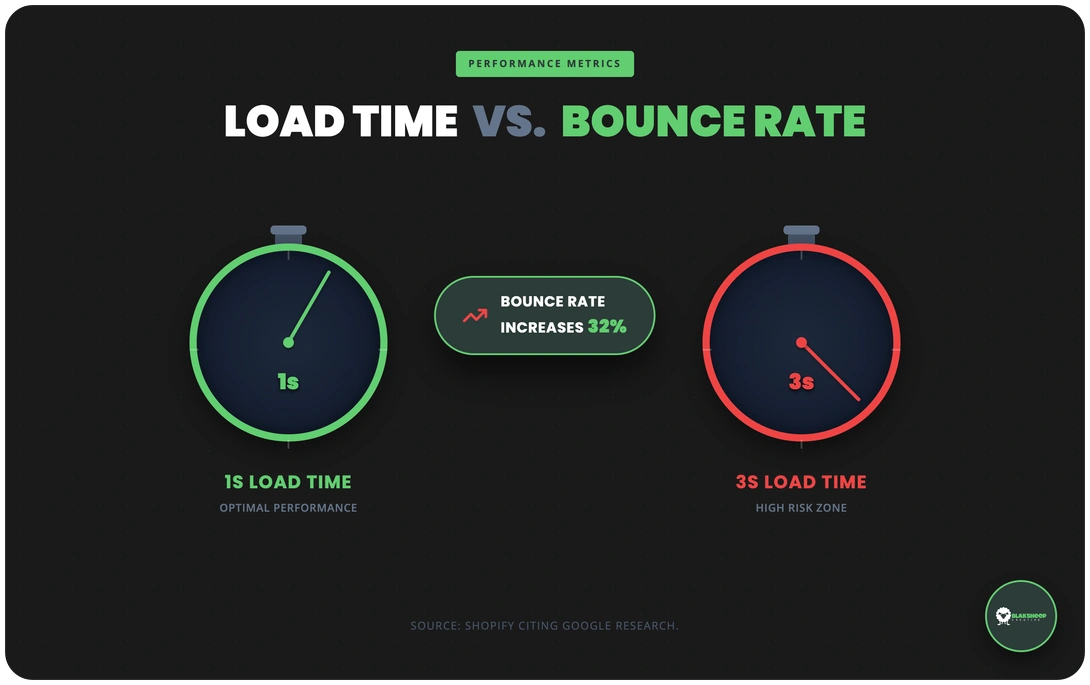
Shopify cites Google research showing that the bounce rate increases by 32 percent when load time rises from 1 second to 3 seconds.
UX is not subjective. It shows up in revenue.
Nielsen Norman Group reports that usability improvements increase desired metrics by an average of 135%.
Most AI websites are designed to look done, not to guide users to a decision.
They are optimized for screenshots, not outcomes.
AI website builders removed friction, not the work: BuiltWith counts over 8.7 million live Wix sites and W3Techs puts Wix at roughly 4 percent of all websites.
Why do AI-generated websites fail after launch?
Answer: AI websites are launched and forgotten, no analytics review. No testing. No iteration. No accountability. Without feedback loops, nothing improves.
Optimization is where growth actually happens.
McKinsey reports personalization can lift revenue by 5 to 15 percent, reduce acquisition costs by up to 50 percent, and improve marketing ROI by 10 to 30 percent.
That upside exists only when someone is measuring and adjusting. AI alone does not do that.
Use this table to diagnose what’s broken in about 60 seconds.
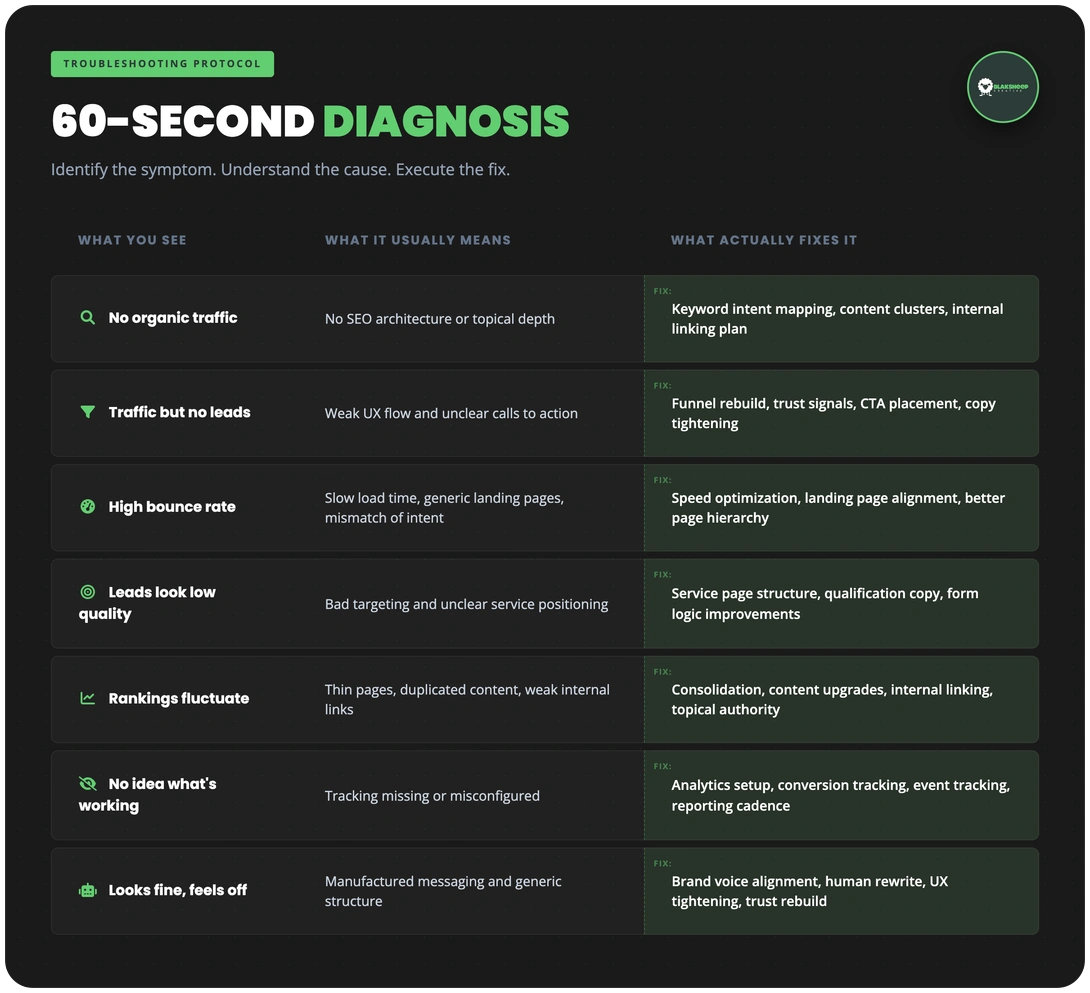
| What You See | What It Usually Means | What Actually Fixes It |
| No organic traffic | No SEO architecture or topical depth | Keyword intent mapping, content clusters, internal linking plan |
| Traffic but no leads | Weak UX flow and unclear calls to action | Funnel rebuild, trust signals, CTA placement, copy tightening |
| High bounce rate | Slow load time, generic landing pages, mismatch of intent | Speed optimization, landing page alignment, and better page hierarchy |
| Leads look low quality | Bad targeting and unclear service positioning | Service page structure, qualification copy, form logic improvements |
| Rankings fluctuate | Thin pages, duplicated content, weak internal links | Consolidation, content upgrades, internal linking, and topical authority |
| No idea what is working | Tracking missing or misconfigured | Analytics setup, conversion tracking, event tracking, reporting cadence |
| Website looks fine, but feels off | Manufactured messaging and generic structure | Brand voice alignment, human rewrite, UX tightening, trust rebuild |
If this table feels uncomfortably familiar, you’re not alone. The important part is that every issue listed here is fixable.
Recognize these symptoms? You don’t have to wait to see exactly what is broken, or keep reading to understand why. Fill out the form below to get started and see where your website falls short today.
Why does AI without strategy and governance create risk?
Answer: Without guardrails, AI creates inconsistency. Messaging drifts, brand voice fractures. Accessibility issues appear. Compliance risks grow quietly.
Even the AI industry acknowledges this problem.
Gartner predicts 30 percent of generative AI projects will be abandoned after proof of concept due to unclear value and governance failures.
This usually ends in a rebuild.
What are AI jockeys, and why are they hurting digital marketing?
Answer: AI jockeys rely almost entirely on AI tools to produce websites and content, with little human judgment, strategy, or accountability. They move fast, publish a lot, and leave behind generic work that lacks empathy, context, and trust.
AI jockeys treat AI as a replacement for thinking instead of a tool that supports it. Even worse, they give legitimate digital marketing agencies a black eye, causing clients to view the entire industry with skepticism and assume that all content is just low-effort, hallucinated noise.
The result is templated messaging, fragmented strategy, and content that looks polished but feels empty.
If your web designer cannot explain their internal linking strategy or show you a site audit report, they aren’t designing. They are prompting.
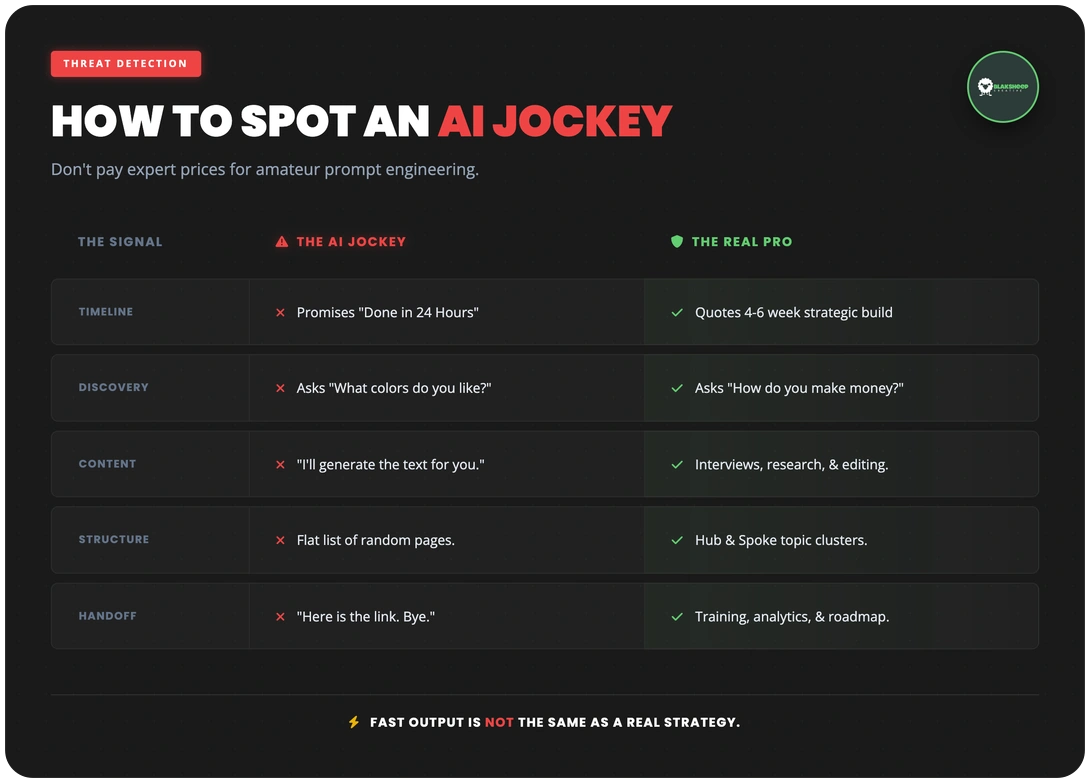
Here is how to spot an AI jockey before you pay for the cleanup.
| AI Jockey Behavior | What It Produces | What It Costs You |
| Publishes fast with no planning | Disconnected pages and shallow content | No rankings, no authority, rising ad spend |
| Uses templates for everything | Generic sites that look like everyone else | Low trust and weak conversion |
| No tracking or reporting | No learning, no iteration | Months wasted guessing |
| Over-polished content | Manufactured authenticity | Audience disengagement |
| Cannot explain the strategy | Random tactics | Rebuilds and rebrands |
If this sounds like the agency or tool you hired, it doesn’t mean you made a bad decision. It means you were sold speed instead of structure.
Most AI jockeys don’t intend harm. They simply skip the unglamorous work that actually makes websites perform.
“I wish we would have switched sooner. Advanced Office Care was forced to switch services when the big corporate giant we were using decided to discontinue those services. Not only did BlackSheep make the transition easy, Clint and his team also offers more for your money.”
Why AI-only marketing fails to build trust or brand authority
Answer: AI-only marketing fails because it cannot understand people, culture, timing, or emotional nuance. It generates from patterns, not lived experience.
Creativity and empathy are missing.
Context blindness shows quickly, cultural nuance, regional tone, and timing matter. In Louisiana markets, generic messaging sticks out fast.
Everything starts to look the same. Headlines repeat. Structures repeat. Brands blur together.
Ethical risks increase. Bias, misinformation, and manufactured authenticity erode trust.
Younger audiences detect this instantly. Content that looks too perfect feels fake.
The real solution is human and AI working together
Answer: The strongest results come from agencies that use AI for acceleration while humans control strategy, creativity, emotional connection, and ethical oversight.
AI handles drafts and automation. Humans decide what matters, what aligns with the brand, and what should never be published.
That is how AI becomes a lever rather than a liability.
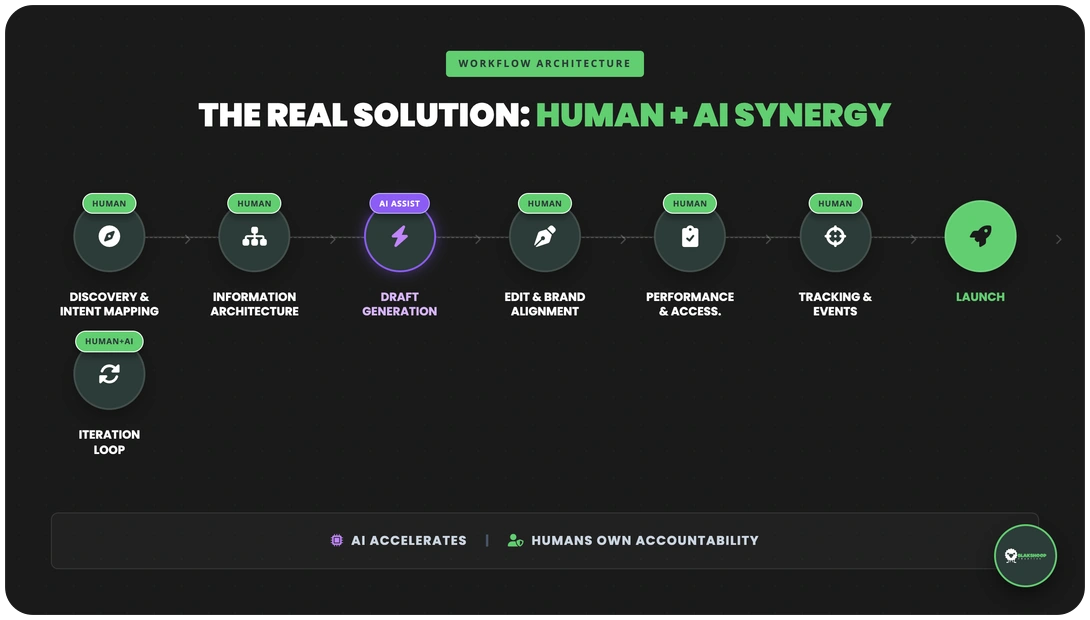
So, is an AI website always a bad idea?
Answer: No. AI is not the enemy. Unsupervised AI is. When professionals guide SEO architecture, UX, performance, accessibility, and optimization, AI becomes a multiplier.
That is how we use it at BlakSheep Creative.
To understand the difference, review SEO Services and Web Design and Development.
Accessibility matters too.
Accessibility Remediation is not optional if you care about usability and risk. We covered the legal side of that separately in is your AI generated website leaving you open to an ADA lawsuit.
SEO is architecture, not copy; Google Search Central explains that internal links help it discover pages and understand relevance, and AI sites launch without them.
Do professional websites cost more, and is it worth it?
Answer: Yes. Professional, non-AI websites cost more upfront. They also deliver significantly more value over time because they are built to rank, convert, and improve, rather than just exist.
AI-generated websites are optimized for fast launch. Professional websites optimize for outcomes.
The difference shows up in compounding returns. A site that ranks organically, converts consistently, and improves through iteration reduces ad spend, increases lead quality, and supports growth for years instead of months.
Cheap websites reset every time you rebuild, structured websites compound.
Most businesses that come to us have already paid once for something inexpensive that did not work. The real cost was not the invoice. It was the lost time, missed leads, and delayed growth.
This comparison helps explain why the return looks so different over time.
| Upfront Cost Focus | Outcome Focus |
| Lower initial price | Higher long-term ROI |
| Fast launch | Sustained organic traffic |
| Minimal planning | SEO and UX architecture |
| One-time build | Continuous optimization |
| Rebuild cycles | Compounding growth |
What is the real cost of a DIY AI-generated website?
Answer: The real cost is lost opportunity. Lost rankings. Lost leads. Lost time. Lost momentum. In markets like Baton Rouge and Denham Springs, mistakes compound fast.
Cheap upfront almost always becomes expensive later.
What should you do instead?
Answer: Use AI within a professional framework. Start with SEO architecture. Design UX around real intent. Tune performance early. Handle accessibility properly. Commit to measurement and iteration.
A website that does not rank is invisible. A website that does not convert is expensive. A website that never improves is already falling behind.
“Great to work with and has ideas for things you didn't even think about. Very impressed and pleased with their work. I'd definitely recommend them!”

FAQ: The questions we hear after the damage is done
These are the uncomfortable questions most agencies avoid answering until you’ve already signed the contract:
Are AI-generated websites bad for SEO?
Most are, because they launch without internal linking, hierarchy, and intent-driven structure. Google evaluates systems, not isolated pages. An audit can identify these gaps before you rebuild again.
Can an AI website rank on Google?
Yes, but only with proper architecture, performance tuning, and supporting content. Most DIY builds skip these steps. Getting structure right first saves months of wasted effort.
Why do AI websites load slowly?
Templates often include unnecessary scripts and unoptimized assets. Without performance tuning, load times rise and bounce increases. Fixing this requires technical cleanup, not more prompting.
Is an AI website cheaper long-term?
Usually no. Lost leads, lost rankings, and rebuilds cost more than doing it correctly once. Long-term value comes from optimization and iteration.
Should small businesses avoid AI website builders?
Small businesses should avoid relying solely on AI. AI works best with professional oversight that includes SEO, UX, accessibility, and measurement.
Bottom line: Paying more once for a website that performs is cheaper than paying repeatedly for one that does not.
Stop guessing. Get a free diagnostic.
You don’t need another generic marketing pitch. You need to know if your website is actually broken.
Fill out the form below. We will run a manual review of your structure, SEO, and performance. You will get a clear “Fix or Rebuild” assessment. No fluff. Just data.
Form not loading? Click here to contact us directly.

Ready to put this to work?
Talk to the people who would actually build it.
About the author

Founder & Lead Developer · Denham Springs, LA
Clint has built and marketed websites for 26 years, since founding BlakSheep Creative in 2000. He is also a 29-year firefighter and a 23-year member of IAFF Local 557, which is where the bias toward plain answers over sales copy comes from.
- Veteran-owned
- Firefighter-owned
- IAFF Local 557
More Questions About AI-Generated Websites
Short answers to the questions that come up most on this topic.
What does an AI website builder leave out that Google needs?
How can I tell if my website was built by an AI jockey?
What are the most common symptoms of a broken AI-built site?
Where does AI actually help when building a website?
What should I do if I already launched an AI-generated site?
Why is fixing an AI site often more expensive than building it right?

Your next step, without the guesswork
No surprises, clear next steps, and a fixed price before anything starts.