By Clint Sanchez · Published · Updated · 19 min read
Quick answer
An AI slop website is a site generated in minutes from a prompt by a seller who skipped the research that makes a website earn money: keyword research, competitor analysis, audience definition, positioning, messaging, voice, and visual identity. It looks fine in a screenshot, then costs customers quietly. It also carries unpaid bills in accessibility exposure, security holes, copyright gaps on the logo, and domain and hosting the owner may not control.
Key takeaways
- A near-zero price signals how little labor went in, and labor is where results come from. A site that produces no calls for eight months costs eight months of leads plus the rebuild.
- Google's spam policies name scaled content abuse, and the first example listed is using generative AI to produce many pages without adding value.
- According to the 2026 WebAIM Million, 95.9 percent of the top one million home pages had detectable WCAG failures, averaging 56.1 errors per page.
- In January 2025 the FTC ordered accessiBe to pay $1 million over claims its widget could make any website WCAG compliant.
- CVE-2025-48757, rated critical at 9.3, documented AI-generated Lovable sites exposing their databases to unauthenticated attackers; about one in ten scanned apps was affected.
- The D.C. Circuit affirmed in Thaler v. Perlmutter (2025) that a purely machine-generated work cannot be registered for copyright, and the Supreme Court declined review in 2026.
- Before paying anyone, confirm the domain, hosting, CMS, analytics, and Search Console will be in an account you control.
The pitch lands in Livingston Parish the same way it lands everywhere: a DM to a Denham Springs contractor, a comment in a Walker community group, a table at a chamber mixer in Baton Rouge. The sites that come out of it all have one Services page with nine bullets, and none of them has a termite page, a roofing page, or a page for the town the customer is actually searching from.

Want this handled instead of DIY?
A 15-minute call, no script, no pressure. You leave with a plan either way.
What Is an AI Slop Website, and Why Does It Matter?
An AI slop website is a site generated in minutes from a prompt by someone who skipped every piece of marketing research that makes a website earn money. It looks acceptable in a screenshot. Underneath there is no keyword research, no competitive analysis, no positioning, and no brand. The site costs you customers quietly, and the repair bill arrives months later.
TLDR:
- Slop sites are cheap or free because the research was never done, not because the seller found efficiencies.
- The missing work is specific: keyword research, competitor analysis, audience definition, positioning, messaging, voice, and visual identity.
- Google publishes a policy that names mass-generated pages with no added value as spam. The policy does not care who or what wrote them.
- The 2026 WebAIM Million found 95.9% of top home pages with detectable accessibility failures, and web accessibility lawsuits keep climbing.
- CVE-2025-48757 documented AI-generated sites leaking their databases to unauthenticated attackers, and the FTC fined an AI accessibility vendor $1 million over compliance claims.
- A purely AI-generated logo cannot be registered for copyright, per the D.C. Circuit in 2025.
- The seller is often selling you the website. The guru is selling the seller a program. You are the bottom of that funnel.
- Ask the 12 ownership and research questions in this post before you pay anyone a dollar.
If you own a small business anywhere in the country, you have gotten the message. A cold DM, a comment in a Facebook group, a booth at a chamber mixer, a neighbor’s kid who just finished a course. Free website. Built with AI. Live by Friday.
This is not a regional problem, and the pitch does not change when the area code does. The same script and often the same template land on contractors in Ohio, med spas in Arizona, and law firms in Georgia. The offer is real, the site will exist, and almost none of the work that makes a website produce customers will have happened.
Got an offer that sounds too good? Send us the pitch and the link. We will tell you honestly what is missing, with no obligation to hire us.
Meet the Slop Peddler: A Ring Light and a Proprietary 7-Step System
Before the website, there is the video. You have seen it a hundred times, and it is always the same video.
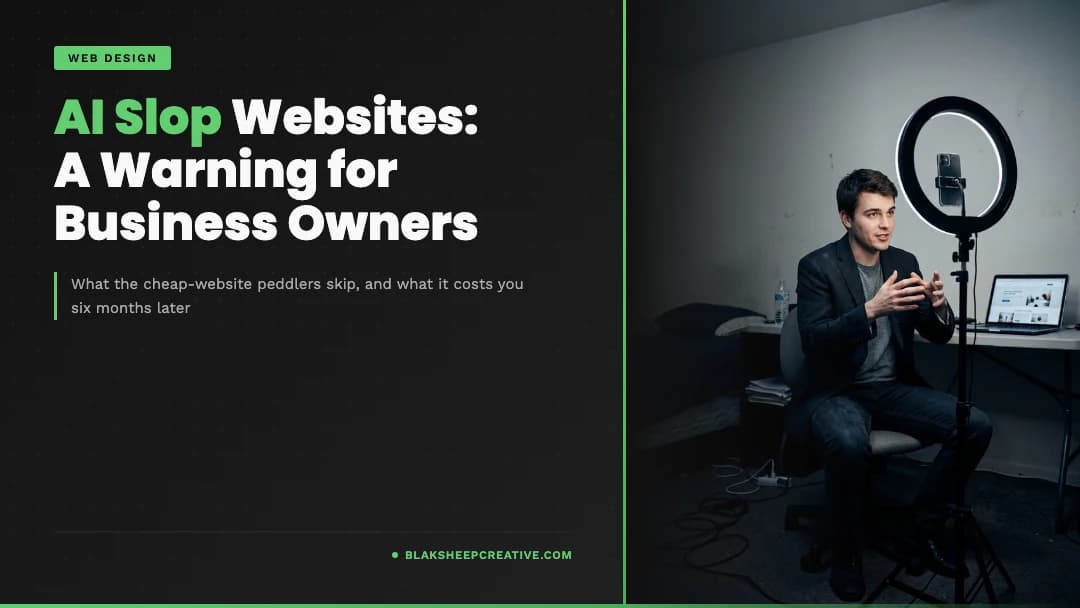
A young man sits in a rented apartment in front of a ring light. He is maybe nineteen. He scaled a five-figure-per-month agency in six months, and you can too, if you follow his proprietary 7-step system. The system is behind a button. The button leads to a lead magnet. The lead magnet leads to a webinar. The webinar leads to a $2,997 program, which contains, at long last, the seven steps: buy an AI website builder subscription, scrape a list of local businesses, send four hundred cold DMs a day, offer the first site free, upsell hosting, repeat, and film a video about how you did it.
Notice what is not in the seven steps. Nobody learns positioning. Nobody learns keyword research. Nobody learns what a service area business actually needs from a website. The program does not teach the work, because the program is not about the work. It is about the funnel, and you are standing at the end of it.
The Federal Trade Commission Has Been Watching This Pattern
This is not BlakSheep being cynical about young entrepreneurs. This is a documented enforcement priority.
In September 2024 the FTC announced Operation AI Comply, a sweep of five actions against companies selling AI-powered business opportunities. The agency charged Ascend Ecom with claiming its AI tools would let buyers earn thousands per month passively, when according to the complaint virtually none of its clients earned the advertised income. A related action against FBA Machine involved more than $15.9 million in consumer losses.
Then in January 2025 the FTC proposed expanding the Business Opportunity Rule to cover business coaching programs, plus a new Earnings Claim Rule, specifically so it can seek refunds and civil penalties over deceptive income claims.
To be clear about the boundary: those cases targeted ecommerce automation schemes, not web design agencies. What carries over is the sales architecture, which is identical. The lesson for you as a buyer is simple. When the income claim is the product, the deliverable is usually an afterthought.
The Free Website Is the Most Expensive One You Will Ever Buy
A price near zero is not generosity. It is a signal about how much labor went in, and labor is where the results come from.
Here is the arithmetic that never makes it into the pitch. A site that generates no calls for eight months does not cost $500. It costs eight months of the leads you would have had, plus the rebuild, plus the redirects and content migration when you finally move, plus whatever ranking history you burned in the meantime.
BlakSheep’s position, based on the rebuilds we get called into, is that a cheap site you have to replace is consistently more expensive than the right site the first time. We are not neutral on this, and we will not pretend to be, but you can verify it yourself by asking any owner who has done it twice.
The deeper problem is that the slop site is not a smaller version of a real website. It is a different object entirely. It skipped the parts you cannot see.
The Work That Got Skipped, Named Piece by Piece
This is the heart of it. A website is the output of a research process, and slop peddlers sell the output without running the process.
You do not have to take our word for what that process contains. The open-source brand-skills project on GitHub publishes the full brand-genesis pipeline as documentation anyone can read: brand context, naming, brand architecture, positioning, target audience, competitor branding, visual identity, voice, messaging, story, guidelines, and audit. Fifteen distinct disciplines. Every one of them produces decisions a designer needs before touching a layout.
Read the right column again and ask a simple question about the person who offered you a free site. Which of those twelve did they run? If the answer is that they asked for your logo and your phone number, you now know exactly what you are buying.
Keyword Research Is Not a Nice-to-Have
Keyword research decides what pages exist. Skip it and the site is built around what you call your services instead of what customers actually type.
We see this constantly. A contractor’s slop site has one page called “Services” listing nine offerings in a bulleted list. The searches are nine separate intents in six separate cities, and not one of them has a page to land on. No amount of design fixes that, because the problem is architecture. The pages that would rank were never created. Building that structure deliberately, one page per intent per market, is the core of how we approach search engine optimization.
Competitive Analysis Tells You What Not to Say
The brand-skills competitor-branding documentation makes a point worth repeating to any owner: half the value of studying competitors is finding what the entire category keeps saying, so you can stop saying it too.
Every roofer in your market claims quality workmanship and free estimates. Those are table stakes, not differentiators. A researched site leads with the thing nobody else claims and can prove it. A generated site leads with whatever the model has seen most often, which is by definition the thing everyone else already said.
Positioning and Brand Are the Parts AI Guesses At
Positioning answers what space you own and who you are the obvious choice for. It is a decision, made by people, with tradeoffs.
A language model cannot make that decision for you because it does not know your margins, your capacity, your best customers, or the two job types you want to stop taking. It will produce something plausible. Plausible is not the same as correct, and on a positioning statement the difference is your entire marketing budget for the next two years.
Marq, formerly Lucidpress, reported in its 2019 State of Brand Consistency research that companies presenting a brand consistently saw revenue increases of up to 33%. Treat that as vendor-published research rather than peer-reviewed science, but the direction matches what we see: consistency compounds, and you cannot be consistent about a position you never chose.
Google's spam policies name scaled content abuse, and the first example listed is using generative AI to produce many pages without adding value.
The Sea of Sameness: Why Every Slop Site Looks Like Every Other Slop Site
There is a reason these sites feel familiar the moment you land on one. They were all pulled from the same statistical center.
The scale is real. Graphite analyzed 65,000 English-language URLs from Common Crawl and found that AI-generated articles rose from 2.2% of the sample in January 2020 to 51.7% by May 2025, crossing human-written volume around November 2024. Axios covered the study with the right caveat, and so will we: that measures publishing volume, not traffic or visibility. Most of it is being ignored. Your site is about to join a very crowded pile of ignored things.
The brand-skills naming documentation calls the naming version of this a “sea of sameness” and catalogs the tells: suffix addiction on -ly and -ify, invented mashups like Nexagen and Syncora, thesaurus grabs like Apex and Pinnacle and Summit, and empty corporate padding such as anything followed by Solutions or Labs or Platform. Its test is the one to remember. If you can swap the name onto three different products in three different categories, and it still works, it is slop.
Web design has the identical failure mode in visual form. The same sans-serif. The same violet-to-blue gradient hero. The same three rounded feature cards with thin line icons. The same stock photo of a smiling team in a glass conference room your business does not have.
Here is the test, and you can run it in ten seconds. Cover the logo on your proposed homepage. Could it belong to a dentist, a law firm, or a bin cleaning company just as easily? If yes, you did not buy a brand. You bought a layout with your phone number typed into it.
Google Publishes a Policy With a Name for This
The search engine is not confused about what is happening, and it wrote the rule down.
Google’s spam policies for Google Search define scaled content abuse as generating many pages for the primary purpose of manipulating search rankings rather than helping users. The very first example Google lists is using generative AI tools to generate many pages without adding value for users. The policy is deliberately method-agnostic. Human, machine, or scraped, the test is added value.
This matters because the standard slop upsell is a stack of city pages. Forty near-identical pages where the only variable is the town name is not a clever growth hack. It is the named example in the policy, published by the company that decides if you rank. Content that earns visibility answers something specific, which is also what gets you cited in AI answers. That is a different discipline, covered in our work on answer engine optimization.
The policy is one thing. What Google has actually done about it is another, and the record there is more interesting than either side of this argument usually admits.
What Google Actually Did to AI-Built Sites, and What It Did Not
This is where most agency scare pieces overreach, so here is the honest version, including the part that does not help our argument.
Google has said repeatedly that it rewards helpful content regardless of how it was produced. There is no penalty for using AI. We have found no credible study showing that sites built with AI assistance rank worse simply because AI touched them, and anyone telling you otherwise is selling something. Platform choice matters far less than page quality, structure, and intent match.
Now the part that should worry you. When Google acted on unhelpful content at scale in March 2024, it started with manual actions that deindexed sites outright. Originality.ai checked 79,000 websites, identified 1,446 that had been hit, and sampled 100 recent articles from each publicly shared casualty. It reported that 100% of those deindexed sites showed signs of AI-generated content, and half were 90% to 100% AI-written.
Read that carefully, because the caveat matters. This is correlation, not causation, run by a company that sells AI detection, using its own detector. It does not prove AI writing caused the deindexing. What it does show is a real pattern: when Google swung at low-value mass-produced content, the sites in the strike zone were overwhelmingly the ones publishing AI output at volume with nothing added.
The distinction is the whole point of this article. AI as a production tool is fine. AI as a substitute for having something worth publishing is what gets deindexed, and a slop site is built entirely out of the second one.
“BlakSheep Creative is amazing with the ability to take an idea from a conversation and bring it to life! From custom logo to website design, call BlakSheep!”

The Bill Nobody Mentions: Accessibility, Security, and Liability
The pitch ends at launch. The obligations do not.
Accessibility Is a Legal Exposure, Not a Design Preference
The six most common failures are simple to prevent and simple to ship when nobody is checking.
The 2026 WebAIM Million report found detectable WCAG 2 A and AA failures on 95.9% of the top one million home pages, averaging 56.1 errors per page, which is 10.1% worse than the year before. Text too faint against its background, and missing alternative text on images, lead the list. Automated generation does not fix these, and in our experience it reliably produces the first two.
That is a legal exposure, not just a quality issue. We covered that exposure on its own in is your AI generated website leaving you open to an ADA lawsuit. Web accessibility lawsuit filings have climbed every year, and trackers disagree on totals because they count federal and state cases differently, so treat any single figure with caution. The number that should get your attention comes from UsableNet’s 2025 research: roughly 36% of sued companies had annual revenue above $25 million, meaning most of the businesses being sued were smaller than that. There is no small business exemption under ADA Title III.
The standard slop answer to this is an accessibility widget, one line of code, AI handles the rest. Regulators have already ruled on that pitch. In January 2025 the FTC ordered accessiBe to pay $1 million over claims that its AI-powered accessWidget could make any website WCAG compliant. The complaint alleged the widget did not make all user sites compliant, and the final order now bars the company from claiming its automated products can make any website WCAG compliant without evidence to back it.
The same complaint carried a second count worth reading twice: the FTC alleged accessiBe formatted third-party articles and reviews to look like independent opinions from impartial authors while hiding its own connection to them. Fake independent praise is not a slop-peddler innovation. It is a named deceptive practice.
Generated Sites Have Already Leaked Customer Data
Security is the second unpaid invoice, and here the evidence is not theoretical. CVE-2025-48757, published in May 2025 and rated critical at 9.3, describes an insufficient database row-level security policy in the AI app builder Lovable that allowed remote unauthenticated attackers to read or write arbitrary database tables of generated sites. Security researcher Matt Palmer scanned 1,645 apps built on the platform and found 170 of them, about one in ten, with exposed databases.
In fairness, the vendor disputes the framing and argues each customer is responsible for securing their own application data, which is a defensible position and also exactly the point: the person who generated your site accepted that responsibility on your behalf without telling you.
The broader pattern backs it up. Veracode’s 2025 GenAI Code Security Report tested more than 100 large language models across 80 curated coding tasks and found that 45% of the code samples introduced a known OWASP Top 10 weakness. Unreviewed generated code on a site that collects customer information is a risk somebody eventually owns, and that somebody is the business named on the domain.
You Own What Your Website Says, Including What It Made Up
The third exposure is liability for the words on the page.
Start with what the site says. In Moffatt v. Air Canada, decided in 2024, a British Columbia tribunal held the airline responsible for inaccurate information its own website chatbot gave a customer, rejecting the argument that the bot was a separate entity. Generated content that states a price, a policy, or a guarantee you cannot honor is your statement, not the tool’s.
That failure mode repeats at every size of company. In April 2025 the AI support bot for the developer tool Cursor invented a login policy that did not exist, and users canceled subscriptions over a rule no human had ever written. New York City’s own MyCity chatbot spent 2024 telling business owners things that conflicted with city law. If a municipal government and a well-funded software company both shipped an AI answer engine that confidently made things up, the bolt-on chatbot your free website came with deserves more scrutiny than it got.
Your AI-Generated Logo May Not Legally Be Yours
This one surprises nearly every owner we explain it to, and it hits the exact asset you most need to protect.
United States copyright requires a human author. In March 2025 the D.C. Circuit decided Thaler v. Perlmutter and affirmed that a work generated autonomously by a machine cannot be registered, because the Copyright Act requires that eligible work be authored in the first instance by a human being. The Supreme Court declined to review the case in March 2026, so the rule stands. The Copyright Office reached the same conclusion in its January 2025 report on copyright and artificial intelligence: AI can assist, but the protectable work has to reflect human creative input.
Apply that to the logo a slop peddler generated from a one-line prompt in ninety seconds. The purely machine-generated elements are not yours to register, which weakens your ability to stop a competitor from using something confusingly similar. Trademark law is a separate track with its own rules and can still protect a mark you actually use in commerce, so this is not the end of the story. But you bought a brand asset with a hole in it, and nobody mentioned the hole.
A real identity process produces human-made decisions about the mark, documented, and that documentation is worth something later. This is one of the reasons visual identity sits as its own discipline in the brand-genesis pipeline instead of being a byproduct of the homepage.
Who Actually Owns the Site When the Guru Ghosts You?
This is the question that ends most slop deals, and almost nobody asks it before signing.
The recurring pattern we get called into looks like this. The domain is registered under the seller’s account. Hosting is a reseller plan you cannot log into. The site is locked to a proprietary builder that has no meaningful export. Analytics and Search Console are owned by an email address you have never seen, and sometimes the Google Business Profile is too. When the seller stops answering, and they do stop answering, you are not moving a website. You are starting over and you have lost your history.
That is BlakSheep’s field observation, not a published statistic. It is also entirely preventable with a fifteen-minute conversation before you pay.
Ghosting is not only an AI-builder problem. We laid out 15 risks of hiring a freelancer to build your website, including what happened when I asked one free-website poster for proof.
Already own one of these sites? We will audit what you have, tell you what is salvageable, and hand you the list either way.
According to the 2026 WebAIM Million, 95.9 percent of the top one million home pages had detectable WCAG failures, averaging 56.1 errors per page.
The 12 Questions to Ask Before You Pay Anyone
Print this. Ask it of us, ask it of them, and compare the answers. Any professional will answer all twelve without hesitating.
Before you ask a single question, look at how the seller markets itself. We explain why a web design company’s website is part of its résumé.
- Will the domain be registered in my name, in an account I control?
- Do I get admin access to the hosting, the CMS, analytics, and Search Console?
- If we part ways, what exactly do I keep, and in what format?
- What keyword research did you run, and can I see the list with search volumes and intent?
- Which competitors did you analyze, and what did you find that changed the plan?
- What is my positioning statement, and why that one?
- Who is the target customer, in specifics, and who is this site not for?
- How many pages, and what is each page targeting?
- What is the conversion path on every page, and how will we measure it?
- What accessibility standard are you building to, and how will you verify it?
- What structured data goes on the site, and why those types?
- What happens after launch, and what does month two look like?
If the answer to questions four through seven is a variation of “the AI handles that,” you have your answer. Those four decide if the site earns anything.
How BlakSheep Creative Does It Instead
We build websites for businesses across the country out of our shop in Louisiana, and we are obviously not neutral here. So here is the process, stated plainly enough that you can hold us to it.
We start with discovery, not a template. Before design begins we define the audience, study the competitors actually ranking in your market, choose a position you can defend, and build the keyword and page map from real search demand. Then we design to that plan, build it on a platform you own, wire schema and conversion tracking, and measure what happens. We use AI heavily, because refusing good tools is its own kind of malpractice, and we use it where it belongs: production speed, drafting, and iteration, on top of research and decisions made by people who will answer the phone next year.
You keep the domain. You keep the hosting. You keep the credentials. If you leave, you leave with everything, and we will tell you so in writing at the start. That is the difference between buying a website and renting a screenshot. Our full web design and development process and our local SEO work both start from the same place: research first.
The same instant-agency crowd now sells AI search retainers too. We checked their favorite statistics in why most AI search fear is hype.
What Business Owners Ask Us About Cheap AI Websites
These come up in nearly every discovery call since the DM wave started. Short, direct answers follow.
Is using AI to build a website automatically bad?
No. AI is a legitimate production tool, and we use it daily. The failure is not the tool, it is skipping the research and decisions the tool cannot make. A site built with AI on top of real keyword, competitor, and positioning work is fine. A site built with AI instead of that work is the problem.
How can I tell if a site is AI slop before I buy?
Ask for the keyword list and the competitor analysis. Cover the logo on the mockup and ask if it could belong to any other business in any other industry. Ask what the positioning statement is. Sellers who did the work answer immediately, because the documents exist.
Will Google penalize my AI-generated website?
Not for using AI. Google’s policies target mass-generated pages that add no value, regardless of who or what wrote them. The warning sign is volume without substance. When Google deindexed sites at scale in March 2024, an Originality.ai sample found every one of them carrying AI-generated content, which is correlation rather than proof, but a pattern worth respecting.
Do I own the copyright to an AI-generated logo?
Probably not to the machine-generated parts. The D.C. Circuit affirmed in 2025 that copyright registration requires a human author, and the Supreme Court declined to review it in 2026. Trademark protection works differently and may still cover a mark you use in commerce, so ask a lawyer about your specific situation.
The free website offer has no contract. Is that a red flag?
Yes. No contract usually means no defined deliverable, no ownership terms, and no support obligation. Get in writing who owns the domain, the hosting, the content, and the accounts, plus what happens if either side walks away.
I already bought one. What should I do now?
Do not panic and do not immediately rebuild. Get the domain and account access into your name first, because that is the piece that expires. Then have the site audited for accessibility, speed, structure, and conversion. Some slop sites are worth repairing. Many are worth keeping online only until a real one replaces them.
What should a real small business website cost?
It depends on page count, research depth, and if you need ongoing SEO. What matters more than the number is what the number buys. A price that excludes research is not a bargain, it is a smaller purchase. We publish our own numbers rather than making you ask, including the pay-by-the-month website plans and what the setup fee actually covers.
Get a straight answer about your website. We will review what you have or what you were pitched, tell you what is real and what is filler, and give you the list even if you never hire us.

Ready to put this to work?
Talk to the people who would actually build it.
About the author

Founder & Lead Developer · Denham Springs, LA
Clint has built and marketed websites for 26 years, since founding BlakSheep Creative in 2000. He is also a 29-year firefighter and a 23-year member of IAFF Local 557, which is where the bias toward plain answers over sales copy comes from.
- Veteran-owned
- Firefighter-owned
- IAFF Local 557
More Questions About Cheap AI Websites
Short answers to the questions that come up most on this topic.
Why is a free AI website more expensive than a professional one?
What research should a web designer do before building my site?
How do I tell if a website design is generic?
Are AI-generated websites less secure?
Am I liable for what an AI chatbot on my website says?
What should I do if the seller controls my domain and hosting?

Your next step, without the guesswork
No surprises, clear next steps, and a fixed price before anything starts.