By Clint Sanchez · Published · 14 min read
Quick answer
For a website tied to revenue, leads, or customer data, an agency is usually the safer choice. The biggest risk of hiring a freelancer is not skill. It is dependence on one person. If that person gets sick, gets busy, or quits, your logins, your files, and your support can go with them. A freelancer fits a small, defined project. An agency should bring a system.
Key takeaways
- The top risk with a freelancer is a single point of failure, not a lack of talent.
- A free or portfolio website still gets access to your domain, hosting, email, and customer data.
- Under U.S. copyright rules, paying for a website does not automatically make you its owner. The contract decides.
- The FTC says to put vendor security in writing, and Verizon's 2025 report found third parties involved in 30% of breaches.
- When I asked one free-website poster for a portfolio and references, I got a one-star Google review instead.
- A freelancer can be a smart hire for one defined task with one specific skill.
- Ask the same ten questions of anyone, agency or freelancer, before they touch your accounts.

Want this handled instead of DIY?
A 15-minute call, no script, no pressure. You leave with a plan either way.
Scroll any Facebook business group for five minutes and you will see the post. "Looking for three businesses that need a website. I'll build it free for my portfolio." No upfront cost, done by Friday, better than the agencies charging thousands.
Some of those people are talented. That is not the issue. The issue is what happens to your business when everything depends on one person, one laptop, and one schedule.
Is a Freelancer or an Agency Safer for a Business Website?
We build websites for service businesses from Denham Springs, Louisiana, and the same offers fill local business groups from Baton Rouge to Hammond. The worst case is simple to picture: the builder stops answering, and nobody can find the domain login. This list is the conversation to have first.
If you would like a second opinion before you say yes to any offer, book a free discovery call or request a website design quote. No pitch required to get a straight answer.
Why Is Everyone Suddenly Offering a Free Website?
The tools got cheap, so the offers multiplied. Building pages is no longer the hard part, and that changed who can call themselves a web designer.
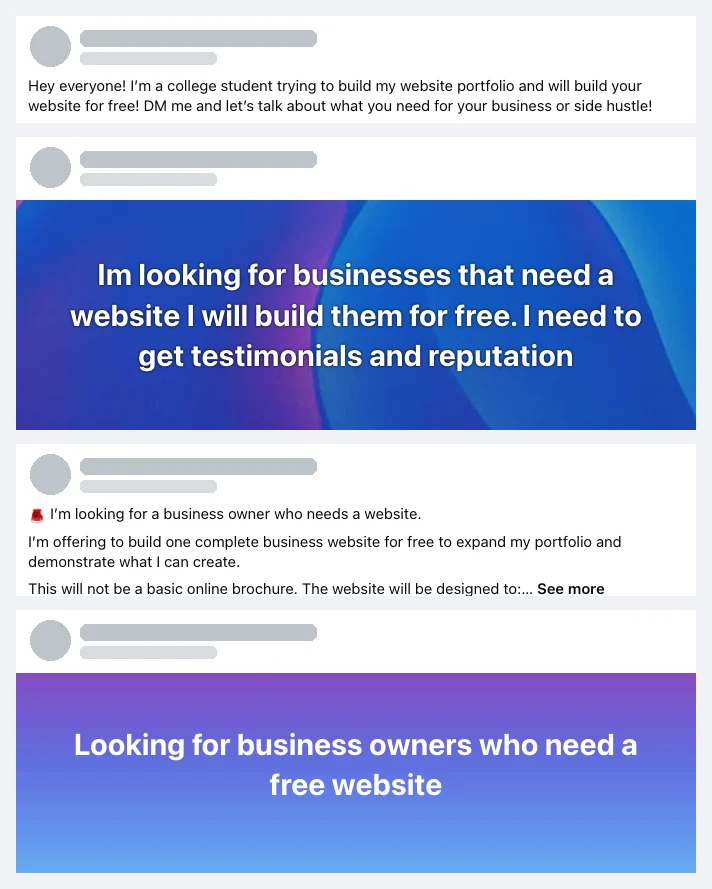
Those are four real posts, captured from Facebook on October 5, 2026. Names, photos, and group names are covered. The wording barely changes from one to the next.
AI can write the copy and generate the layout. White label marketing platforms bundle the rest. HighLevel's published pricing lists a $97 per month Starter plan and a $297 per month Unlimited plan with unlimited client sub-accounts. One subscription, as many "clients" as a person can sign.
The audience for those tools is huge. OpenAI's May 2026 small business analysis found at least four million people in the United States used ChatGPT in March 2026 to plan, start, run, or grow a business. Its January 2026 report on ChatGPT at work says over a quarter of U.S. workers report using it for work.
That is good technology, and we use modern tools ourselves. The gap is between owning the tools and knowing what to build with them. We covered the quality side of that in our warning about AI slop websites.
"Free" also works as a pitch because it removes the reason to ask questions. A $0 price tag is not a qualification. The risks below apply at any price, and most of them get worse when no money and no contract are involved.
What Happened When I Asked One of Them for Proof
This part is first-hand, and it happened the same week I wrote this. It shows how the risks below look in real life.
A freelancer posted a free website offer in local Facebook groups. I found the same post in at least six groups covering Livingston Parish, Baton Rouge, and the Northshore. The identifying details are covered in every image here. The offer was a free build that you could keep for $299.
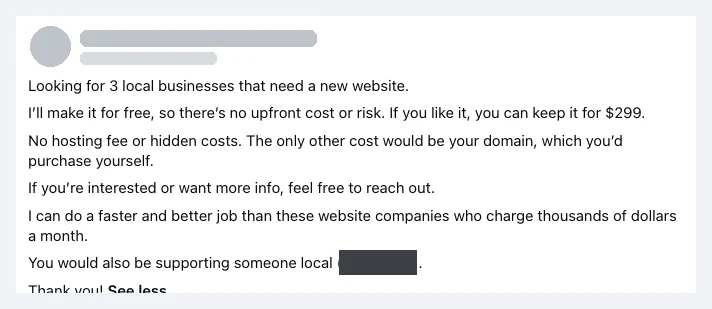
One line caught my eye: "I can do a faster and better job than these website companies who charge thousands of dollars a month." That is a claim about results, so I asked for the things I tell every business owner to ask for.
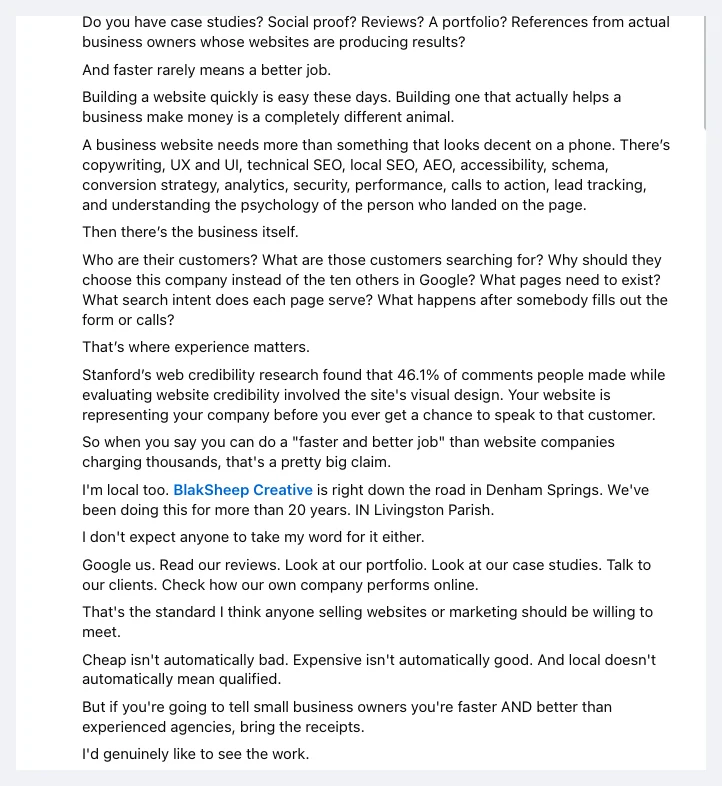
I asked for case studies, reviews, a portfolio, and references. I pointed people to our own reviews and portfolio and told them not to take my word for it either.
What Came Back Instead of Proof
No portfolio came back. No reviews, no references, and no case studies either. These are three of the replies, word for word.
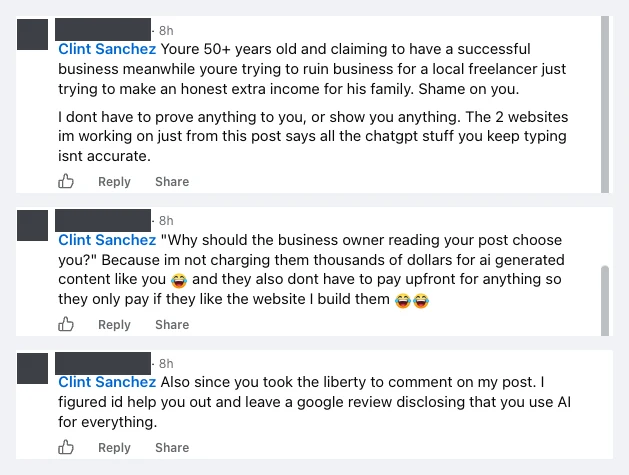
The first says, "I dont have to prove anything to you, or show you anything." The second gives price as the only reason to hire him. The third says he left us a Google review because I commented on his post.
Then a One-Star Review Showed Up
A one-star review landed on our Google Business Profile while the thread was still going. It opens with "WARNING SCAM" and comes from someone who has never hired us, paid us, or had a site built by us. Here it is in full, with my reply.
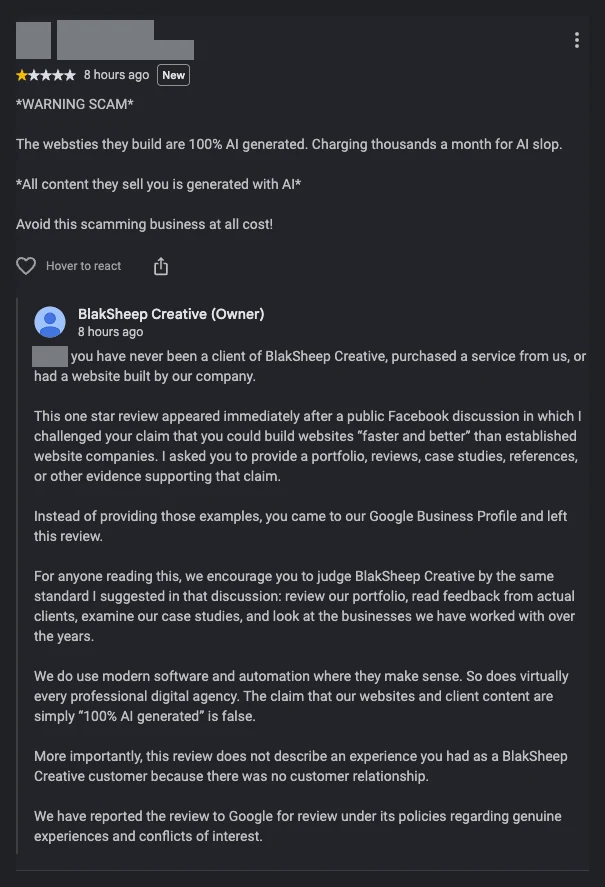
I reported it. Google's policy on fake and misleading reviews says a review "should reflect an actual experience with a business." It also bars posting on a competitor's listing "to undermine that business' or product's reputation." As of October 5, 2026, the review was still up.
Why This Matters to You
I am not sharing this to embarrass anyone, which is why there is no name on it. I am sharing it because you could be the next person asking that freelancer a hard question.
Picture the same reaction when you ask for your domain login. Or when you dispute an invoice, or ask why the contact form stopped working. With one person and no contract, you have no manager to call and no process to fall back on.
One freelancer does not speak for all of them. Plenty would have answered with a link to their work and won the argument on the spot. That is the test. Ask for proof before you hand over anything, and watch how the person handles being asked.
The 15 Risks of Depending on One Person
These are grouped the way the problems tend to show up: first the schedule, then the work, then the accounts, then the paperwork. Each one is a question to raise before you hire, not proof that a given freelancer will fail you.
1. One Person Is a Single Point of Failure
Everything rides on one human staying healthy, interested, and reachable. People get sick. They take full-time jobs. They change careers.
When that happens to a freelancer, your project stops with them. There is no second person who knows where things stand.
Businesses close, too. Bureau of Labor Statistics survival data shows that of private business establishments opened in the year ended March 2019, 79.2% were still open a year later and 46.8% after six years.
That figure covers businesses of every kind, agencies included. It is not a freelancer statistic. The point is what happens to your site when the one business holding it closes.
2. One Person Is Doing Six Jobs
A solo freelancer is the salesperson, designer, developer, support desk, bookkeeper, and project manager. Every one of those jobs competes for the same hours.
Communication is usually the first thing to slip. The person who needs to answer your question is the same person trying to finish someone else's build.
3. Their Workload Changes and Your Deadline Does Not
A freelancer who can comfortably handle five clients can sign three more next week. Nobody tells you that happened.
Your launch date does not stretch because their calendar filled up. On a free project with no contract, you are also the easiest client to push to the back of the line.
4. There Is No Backup, and Replacing Them Is Your Job
When an agency employee leaves, the agency reassigns the work. That turnover is the agency's problem to solve.
When your freelancer leaves, you become the recruiting department. You have to find, vet, hire, and catch up a replacement while the website sits untouched.
5. The Knowledge Lives in One Head
Passwords, settings, custom code, and the reasons behind past decisions often exist only in one person's memory. Teams write things down because more than one person needs them.
A solo builder has less reason to document anything. If they go quiet, the next person starts from zero, and you pay for the detective work.
6. Emergencies Wait Until They Are Available
Websites do not break during business hours on purpose. If yours goes down at 8:00 on a Saturday morning, your freelancer may be camping, asleep, or at their day job.
Ask anyone you hire how after-hours problems get handled and who answers. If you want that covered regardless of who built the site, that is what ongoing website maintenance and support is for.
7. One Person Rarely Covers Every Skill
A working business website touches development, design, copywriting, SEO, analytics, accessibility, security, hosting, and conversion strategy. Deep skill in all of those is rare in one person.
The gap also shows up as order-taking. A freelancer may build exactly what you asked for. A team with different specialties is more likely to ask if what you requested makes business sense in the first place.
8. Nobody Checks the Work
In a team, a second person reviews the code, the copy, the design, and the launch checklist. With a freelancer, the person doing the work is usually the person approving it.
Everyone misses their own mistakes. A broken form or missing tracking code can sit unnoticed for months when there is no second set of eyes.
9. The Process May Be a Text Thread
Some freelancers run excellent systems. Others manage a project through text messages, email chains, and whatever they remember from Tuesday.
Ask how they handle staging, backups, testing, and launch. "I have the latest copy somewhere" is an answer you want to hear before the project starts, not after something is lost.
10. They Get Access to Far More Than the Website
Building a site can mean logins to your hosting, CRM, lead forms, analytics, email, and payment tools. Freelancers often ask for full administrator access to everything because it is convenient.
The FTC's vendor security guidance for small businesses says to limit access to a need-to-know basis, and only for as long as the job takes. It also says to confirm vendors follow your rules: "Don't just take their word for it."
The stakes are real. Verizon's 2025 Data Breach Investigations Report found that third-party involvement in breaches doubled to 30%.
11. Your Accounts End Up in Their Personal Email
Domains, hosting, Google Analytics, ad accounts, plugin licenses, and social assets often get created under the freelancer's own email. It is faster for them. It is a mess for you later.
Your domain is the clearest example. ICANN's registrant rights belong to the person the registrar has on record for the domain. If that person is your freelancer, they hold those rights, not you.
When one person controls the site, hosting, domain, analytics, and ads, losing that relationship hits every part of the business on the same day.
12. You May Not Own What You Paid For
Without a solid contract, expect questions about who owns the website, the source files, the custom code, the graphics, and the content. Paying for the work does not settle it.
The U.S. Copyright Office's Circular 30 on works made for hire explains why. Commissioned work from a non-employee only counts as a work made for hire if it fits one of nine listed categories and both sides sign a written agreement saying so. If it fails any requirement, it "is not a work made for hire."
In plain terms, the transfer of ownership needs to be in writing. A free build with no contract leaves that question open. This is general information, not legal advice, so have an attorney review anything you sign.
13. Thin Contracts and No Insurance
Many small jobs start on a handshake or a direct message. The FTC's vendor guidance is blunt about this: "Put it in writing," and make the security provisions that matter to your company non-negotiable.
An established company may carry professional liability or cyber liability coverage. An individual may carry none. Ask. If a mistake takes your site down or exposes customer data, you want to know who stands behind the work.
Accountability also covers how a provider behaves in a disagreement. A company with a name, a location, reviews, and clients to keep has reasons to settle a dispute like a professional. The exchange above shows what the alternative can look like.
14. Compliance Gets Missed
Making a site "work" is not the same as making it compliant. Accessibility, privacy, customer data handling, and advertising rules all reach past the design.
Accessibility shows how common the misses are. The 2026 WebAIM Million report found detectable WCAG 2 failures on 95.9% of the top one million home pages. That number covers everyone, agencies included, which is the point. It takes a deliberate check to catch, and website accessibility for small businesses is easy for a one-person shop to skip.
15. Support Fades After Launch
The freelancer who had plenty of time during the build may have far less six months later. That is when you need an update, a fix, or a new landing page.
Needs also grow. A person who handled a five-page site well may struggle when you need SEO, ads, email, automation, and reporting running at the same time.
Those fifteen come down to one idea. With a freelancer, turnover is your problem. With an agency, it should be theirs.
Already dealing with one of these? Get a free website review before you decide what to fix first.
The top risk with a freelancer is a single point of failure, not a lack of talent.
When Is a Freelancer the Right Call?
Freelancers are not bad, and saying so would be dishonest. Every established agency was once one person with a laptop.
A good freelancer is a smart choice for a defined project that needs one specific skill. A logo refresh, a single landing page, a photo shoot, or a one-time fix all fit. The scope is clear, the access is limited, and the business keeps running if they vanish.
Honesty matters too. "I'm new, I'm building a portfolio, and I'll do this cheap to prove myself" is a fair offer. "I can do it faster and better than companies with decades of experience" is a claim, and claims need proof. Ask to see live sites, real reviews, and references you can call.
Reviews carry legal weight now. The FTC's Consumer Reviews and Testimonials Rule went into effect on October 21, 2024, and targets fake reviews and testimonials. A real track record is hard to fake, and faking one is now a liability.
The label matters less than the setup. An agency that is three freelancers sharing a logo carries the same risks. Judge the system, not the name on the invoice.
What Should You Ask Before Anyone Touches Your Accounts?
These ten questions work on a freelancer, an agency, and us. None of them are hostile. A professional answers them without flinching.
| Question | Why it matters |
|---|---|
| Who will be listed as the owner of my domain? | Your domain is a core business asset. |
| Whose email are the accounts created under? | Accounts in someone else's name are hard to recover. |
| Do I own the site, files, and content in writing? | Ownership follows the contract, not the payment. |
| Can I move the site to another host? | Some platforms and setups lock you in. |
| What access do you need, and for how long? | Less access means less exposure. |
| Who covers for you if you are unavailable? | This is the single point of failure test. |
| How do you handle backups and testing? | Process is what prevents lost work. |
| Do you carry business insurance? | It shows who stands behind mistakes. |
| What does support cost after launch? | Sites need updates, security, and fixes. |
| Can I call two past clients? | References are harder to fake than a pitch. |
If the answers are vague, slow down. For more on vetting a provider, read how to choose a web design agency.
Proof starts with their own site. Here is how to vet a web design company by its own website in about fifteen minutes.
Hire a System, Not Just a Person
With a freelancer, you are often hiring a person. With an agency, you should be hiring a system: more than one set of eyes, documented process, and accounts that stay in your name.
BlakSheep Creative is a veteran and firefighter owned agency in Denham Springs, Louisiana. Vet us the way this article tells you to vet anyone. Look through our website design portfolio, read about who we are, and ask us all ten questions.
When you are ready, schedule a free discovery call. You will leave knowing what you own today and what a properly built site would take, with no surprises. You can also see how we approach custom web design and development, or call 225-505-3834.

Ready to put this to work?
Talk to the people who would actually build it.
About the author
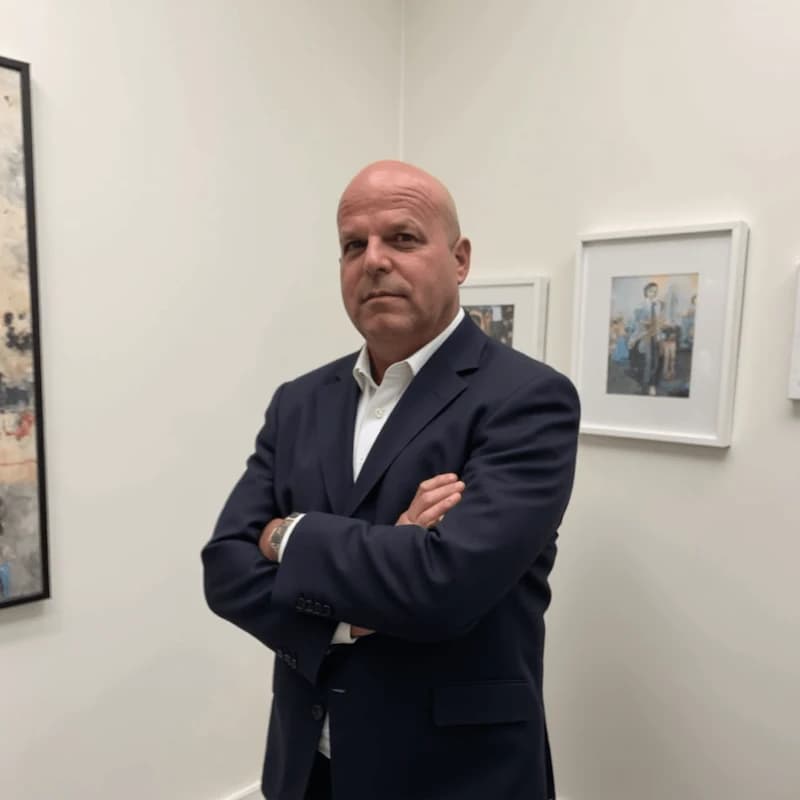
Founder & Lead Developer · Denham Springs, LA
Clint has built and marketed websites for 26 years, since founding BlakSheep Creative in 2000. He is also a 29-year firefighter and a 23-year member of IAFF Local 557, which is where the bias toward plain answers over sales copy comes from.
- Veteran-owned
- Firefighter-owned
- IAFF Local 557
What Business Owners Ask About Freelancers and Free Websites
A free or low-cost website offer raises the same handful of questions every time. The short answers below cover ownership, safety, and what to do if you already said yes.
Is it safe to accept a free website from someone building a portfolio?
What is the biggest risk of hiring a freelancer for a website?
Who owns my website if a freelancer built it?
Is a web design agency always better than a freelancer?
What should I do if my freelancer disappeared with my logins?
How do I protect my business when I hire any web designer?

Your next step, without the guesswork
No surprises, clear next steps, and a fixed price before anything starts.