
By Clint Sanchez · Published · 13 min read
Quick answer
Start with the company's own website and search footprint. Search the business on Google, look at the pages Google surfaces, and check for service pages, a portfolio with live links, case studies, reviews, and proof of expertise. Then ask for references and results. Price does not tell you who is good. Evidence does.
Key takeaways
- Search the web design company before you hire it, and look at the pages Google surfaces from its own site.
- A site: search is a starting point, not an index count. Google says the list it returns "is not always exhaustive."
- Look for individual service pages, a portfolio with live URLs, case studies, and content that teaches you something.
- Google publishes its own list of questions to ask before hiring an SEO, and "check your SEO's business references" is on it.
- BrightLocal's 2026 survey found 97% of consumers read reviews for local businesses. Read the agency's reviews the same way.
- A small website is not automatically a bad one. The test is evidence, not page count.
- Cheap or expensive does not determine quality. Proof does.

Want this handled instead of DIY?
A 15-minute call, no script, no pressure. You leave with a plan either way.
If you are hiring a web design company, one of the easiest places to begin your due diligence is staring you right in the face: their own website.
Not their Facebook pitch. Not the mockup they built yesterday. Not the claim that they can build your website "faster and better" than everyone else. Their actual website.
How Do You Vet a Web Design Company Before You Hire One?
We build websites for service businesses from Denham Springs, Louisiana, and the same pitches land in business groups from Baton Rouge to Hammond every week. Most owners here hire a web company off a Facebook post, a referral, or a price. Very few spend five minutes checking how that company markets itself first.
If you would like a second set of eyes before you sign anything, book a free discovery call or request a website design quote. You will get a straight answer with no pitch attached.
What Can a Simple Google Search Tell You About a Web Design Company?
Quite a bit, as long as you understand its limits. Recently, I looked at the Google footprint of a company actively selling website design and management services.
I removed the company's identifying information on purpose. This is not about embarrassing one business. It is about showing business owners how to ask better questions before handing someone the keys to their online presence. And the results raised some questions.
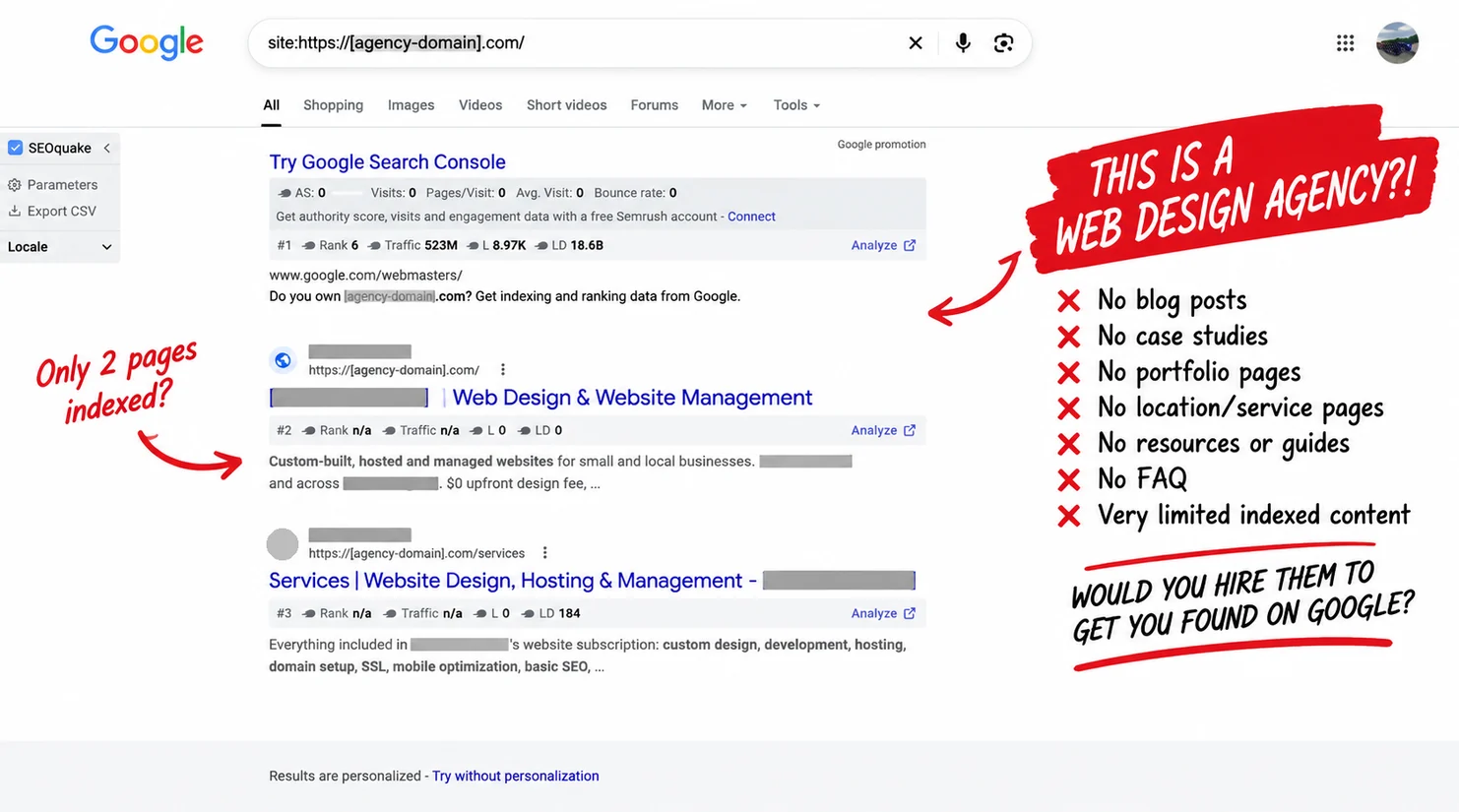
That is a real search result with the company's name, domain, and logo covered. The notes on the right are the things I went looking for and could not find in the results.
How the site: Search Works
One quick test is Google's site: search operator. Type site:example.com into Google, with the company's domain in place of example.com.
Google's documentation for the site: operator says the search "returns a list of indexed and serving URLs." The same page adds a warning: "The list of URLs returned is not always exhaustive."
Google is even more direct under the heading Limitations. The operator "doesn't necessarily return all the URLs that are indexed," and a site: search with no other words "doesn't rank the results." Only the site owner sees the real numbers, inside Google Search Console.
What You Can and Cannot Say From It
That distinction matters. If Google shows only a couple of pages, you cannot responsibly announce, "This website only has two pages indexed."
What you can say is this: "Google is surfacing a very limited number of pages in this search. Let's look closer." That is where the interesting part begins.
10 Things to Check on a Web Design Company's Own Website
These ten checks take about fifteen minutes and cost nothing. None of them is a verdict by itself. Each one is a question to raise before you hire, and a professional will have an answer ready.
1. How Much Searchable Content Do They Have?
In the example that prompted this article, the site: search prominently surfaced only a homepage and a services page. For a web design business, that makes me curious right away.
Where are the individual service pages, the case studies, and the portfolio? Where are the educational resources, and the content supporting the areas the company says it serves?
None of those things decides rankings, and not every web design company needs hundreds of pages. But Google's SEO Starter Guide says organizing a site in a logical way "can help search engines and users understand how your pages relate to the rest of your site."
If a company wants to improve your visibility, its approach to its own visibility is a reasonable place to start.
2. Do They Practice the SEO They Sell?
This is one of my favorite questions for any marketing provider. Do they practice what they sell?
- If someone sells SEO, search for them.
- If someone sells reputation management, read their reviews.
- If someone sells social media management, inspect their social presence.
- If someone builds websites, inspect their website.
- If someone claims to specialize in local visibility, search for their services in the markets they claim to serve.
This does not mean your SEO company must rank first for every imaginable keyword. That's nonsense. Rankings depend on competition, intent, location, authority, content, links, relevance, and plenty of other factors.
Google agrees. Its guide to hiring an SEO says, "No one can guarantee a #1 ranking on Google." But there should be evidence that the people selling the service understand it.
The Starter Guide describes SEO plainly. It is "about helping search engines understand your content, and helping users find your site." So ask the company selling you SEO to show you how it has done that for itself. If you want that work done for you, here is how we handle search engine optimization for small businesses.
3. Where Are the Case Studies?
This one bothers me more than a small website. A web design company should be able to show you work, and a screenshot of a pretty homepage is not much of a case study.
I want to know five things:
- What problem did the client have?
- What did you recommend?
- What did you build?
- Why did you build it that way?
- What happened afterward?
Depending on the project, useful results might include more qualified leads, more phone calls, higher conversion rates, better local search visibility, more booked appointments, faster pages, or increased sales.
This is not just my opinion. The first question on Google's own list of things to ask a prospective SEO is, "Can you show me examples of your previous work and share some success stories?"
If the company cannot share confidential numbers, fine. Show the process. Show the thinking. Show something that proves the website was not merely assembled and launched.
4. Where Is the Evidence of Expertise?
Google's own guidance gives business owners a useful framework for sizing up a marketing company. It was written for publishers, but it works on vendors too.
Google's guide to creating helpful, people-first content asks, "Does your content clearly demonstrate first-hand expertise and a depth of knowledge?" It also asks if someone who researched the site would "come away with an impression that it is well-trusted or widely-recognized as an authority on its topic."
Forget SEO for a second. Those are pretty damn good questions to ask before hiring somebody.
- Does the company's website teach you anything?
- Can they explain technical subjects clearly?
- Do they have original analysis and real experience?
- Can you identify the people responsible for the work?
- Can you independently verify their history?
Google puts that fourth point in its own words: "Is it self-evident to your visitors who authored your content?" Or does the website basically say, "We build awesome websites. Contact us."
There is a difference between claiming expertise and demonstrating it.
5. Where Are the Individual Service Pages?
Suppose a company offers website design, development, hosting, website management, SEO, local SEO, e-commerce, reputation management, and automation. Explaining all of that on one page creates problems for users and for search engines.
Someone searching for website hosting has different questions than someone searching for SEO. Someone evaluating an e-commerce developer has different concerns than a local plumber looking for lead generation.
Good service pages give each subject room to breathe. Google's URL structure guidance recommends descriptive URLs with "readable words rather than long ID numbers," organized in a way "that is most intelligible to humans."
This is not about creating pages because somebody heard that "more pages equal more SEO." They don't. The pages need a purpose.
6. What About Location Pages?
This matters most when a web design company markets itself across several cities or regions. If you claim to serve Baton Rouge, Denham Springs, Hammond, New Orleans, or an entire state, how are you showing relevance to those markets?
Stuffing city names into the homepage footer is not much of a strategy. Useful local content helps customers in those markets understand what you offer, who you serve, and why you are relevant to them.
Google Search Essentials says to "use words that people would use to look for your content" and place them in prominent spots, "such as the title and main heading of a page."
That does not mean manufacturing 47 nearly identical city pages and swapping the city name. Humanity has suffered enough of those. Google's spam policies name the tactic as doorway abuse, with this example: "multiple domain names or pages targeted at specific regions or cities that funnel users to one page."
It means building useful content around real markets you serve. We cover the vetting side of that in how to choose a web design agency.
7. Where Is the Portfolio?
This seems painfully obvious for a web design company. Show me what you have built, and do not stop at screenshots. Give me the URLs.
- I want to use the websites and see them on mobile.
- I want to read the copy and see how services are organized.
- I want to see what happens when I submit a form.
- I want to search for the businesses on Google.
- I want to know if every site looks like the same template wearing a different shirt.
Your portfolio should make your sales pitch easier to believe. Ours is public: see our website design portfolio.
8. What Do Their Clients Say?
Reviews are not perfect. They are still useful. BrightLocal's 2026 Local Consumer Review Survey found that 97% of consumers read reviews for local businesses, and the average consumer uses six different review sites when choosing one.
Search the company on Google. Read the positive reviews, the negative reviews, and the company's responses. Then look for patterns. Do customers keep mentioning communication, responsiveness, results, or problems that got resolved?
The responses count too. The same BrightLocal survey reports that slow or generic review responses are increasingly seen as a red flag. Google's local ranking guidance adds that "more reviews and positive ratings can help your business's local ranking."
A real track record is hard to fake, and faking one is now a legal risk. The FTC's Consumer Reviews and Testimonials Rule went into effect on October 21, 2024, and it targets fake reviews and testimonials.
Then ask for references. Google's hiring guide says to "check your SEO's business references" and ask past clients if the provider "was easy to work with, and produced positive results." A legitimate company should not be offended when you ask. Here is what our clients say about working with us.
9. Can They Show You Their Own Results?
This is where things get uncomfortable. Ask the web design company one question: how does your website generate business for you?
Ask about organic search traffic, ranking keywords, leads, conversion rates, local search visibility, referring domains, calls, form fills, and booked appointments.
They do not need to hand you administrator access to Google Analytics. But someone selling digital marketing should be able to discuss how digital marketing works for their own business. Google's list covers this too: "What kind of results do you expect to see, and in what timeframe? How do you measure your success?"
The same Google page offers one more warning worth remembering: "Be careful if a company is secretive or won't clearly explain what they intend to do."
There is a simple principle here. If you are selling the medicine, I am allowed to ask how it is working for you.
10. Is the Website Technically Sound?
Content is only part of the equation. Google's page experience guidance asks site owners three plain questions. "Do your pages have good Core Web Vitals? Are your pages served in a secure fashion? Does your content display well on mobile devices?"
Core Web Vitals come with published targets. Per Google's Core Web Vitals documentation, a page should load its main content within 2.5 seconds, respond to input in under 200 milliseconds, and keep its layout shift score under 0.1.
So test the company's website. Paste its address into Google's free PageSpeed Insights tool, then look at mobile usability, broken links, HTTPS, forms, structured data, metadata, and internal linking.
Check accessibility as well. The 2026 WebAIM Million report found detectable WCAG 2 failures on 95.9% of the top one million home pages, so most sites miss something. We explain what to look for in website accessibility for small businesses.
No website will score perfectly on every automated test, and that is not the point. Google itself says chasing "a perfect score just for SEO reasons may not be the best use of your time." You are looking for evidence of professional workmanship.
The 10 Checks at a Glance
Here is the whole list in one place. Print it, or keep it open while you look at the next company that pitches you.
| What to check | Where to look | What good looks like |
|---|---|---|
| Searchable content | A site: search on their domain |
More than a homepage shows up |
| SEO they practice | Search their services in their market | They can be found for what they sell |
| Case studies | Their website | Problem, recommendation, build, result |
| Expertise | Blog, guides, About page | Named people and content that teaches |
| Service pages | Site menu and URLs | One clear page per service |
| Location pages | Pages for cities they serve | Useful local content, not clones |
| Portfolio | Portfolio page | Live URLs you can click and test |
| Reviews | Google and other review sites | Recent reviews with real replies |
| Their own results | The sales conversation | Plain talk about leads and traffic |
| Technical health | PageSpeed Insights, your phone | Fast, secure, works on mobile |
A company does not need a perfect row in every line. Three or four blanks in a row is your cue to slow down and ask more questions.
Want this same checklist run on your own site? Get a free website review and we will show you what we find.
A Small Website Isn't Automatically a Bad Website
This deserves emphasis, because otherwise this becomes another stupid internet absolutism. A website does not need hundreds of pages to succeed.
A small website serving a narrow audience can perform very well. Google's people-first guidance warns against content "made primarily to gain search engine rankings," and one of its warning signs is "producing lots of content on many different topics in hopes that some of it might perform well."
Two excellent pages can be more useful than 200 garbage pages. So the question is not, "How many pages does this company have?"
The better question is this: does its online presence provide enough evidence to support the expertise it is selling? That is a much more useful test.
Search the web design company before you hire it, and look at the pages Google surfaces from its own site.
The Web Design Company's Website Is Part of the Interview
Think about hiring a marketing company the same way you would think about hiring an employee. You are interviewing them, and everything they have published is part of the application.
Their website is part of the résumé. Their portfolio is the work history. Their reviews are the references, and their case studies are evidence of performance.
Their search presence shows how they handle at least part of their own marketing. Their communication during the sales process shows you what working with them may feel like.
Their willingness to answer difficult questions tells you something too. Don't be afraid to ask. If the answer to a fair question is anger, you have learned what you needed to know. We saw that firsthand, and wrote about it in the risks of hiring a freelancer to build your website.
Your own customers run the same kind of check on you. See what we found when we checked 77 contractor websites for licensed, bonded and insured.
Don't Hire BlakSheep Creative Because We Tell You We're Good
This applies to us too. BlakSheep Creative has been building websites and working in digital marketing for more than 20 years. But you should not hire us because I wrote that sentence. Vet us.
- Google BlakSheep Creative and read our reviews.
- Look through our portfolio and search for the businesses in it.
- Ask for references and talk to our clients.
- Ask us about SEO and accessibility.
- Ask us who owns your website and accounts.
- Ask what happens if the person you normally deal with is not available.
- Ask us to explain what we are recommending and why.
Then ask every other company you are considering the exact same questions. We welcome it.
The company you choose is not simply making something pretty for the internet. You may be trusting them with your website, domain, analytics, customer data, reputation, lead generation, and advertising. That is a piece of the infrastructure that makes your business money.
That is worth more due diligence than scrolling through three Facebook posts and picking whoever said "free website" first.
Don't buy the pitch. Verify the proof.
BlakSheep Creative is a veteran and firefighter owned agency in Denham Springs, Louisiana. Read about who we are, see how we approach custom web design and development, and bring your hardest questions.
When you are ready, schedule a free discovery call. You will leave knowing what a properly built site would take, with no surprises. You can also call 225-505-3834.

Ready to put this to work?
Talk to the people who would actually build it.
About the author

Founder & Lead Developer · Denham Springs, LA
Clint has built and marketed websites for 26 years, since founding BlakSheep Creative in 2000. He is also a 29-year firefighter and a 23-year member of IAFF Local 557, which is where the bias toward plain answers over sales copy comes from.
- Veteran-owned
- Firefighter-owned
- IAFF Local 557
What Business Owners Ask About Vetting a Web Design Company
These are the questions that come up when an owner is comparing two or three web companies and the prices are far apart. The short answers below cover the search test, the red flags, and what to ask for.
How do I check out a web design company before hiring?
What does a site: search tell me about a company's website?
Should a web design company rank number one on Google?
What should a web design case study include?
Does a small website mean a web design company is bad?
What red flags should I watch for when hiring a web designer?

Your next step, without the guesswork
No surprises, clear next steps, and a fixed price before anything starts.