
By Clint Sanchez · Published · Updated · 4 min read
Quick answer
Web design is about how a website looks and feels; web development is about building it. Designers, including UX, UI, and visual designers, plan the layout, style, and user experience using tools like Photoshop and page builders plus some HTML and CSS. Developers turn that concept into a working site: front-end developers build what users see, back-end developers build servers and databases, and full-stack developers do both.
Key takeaways
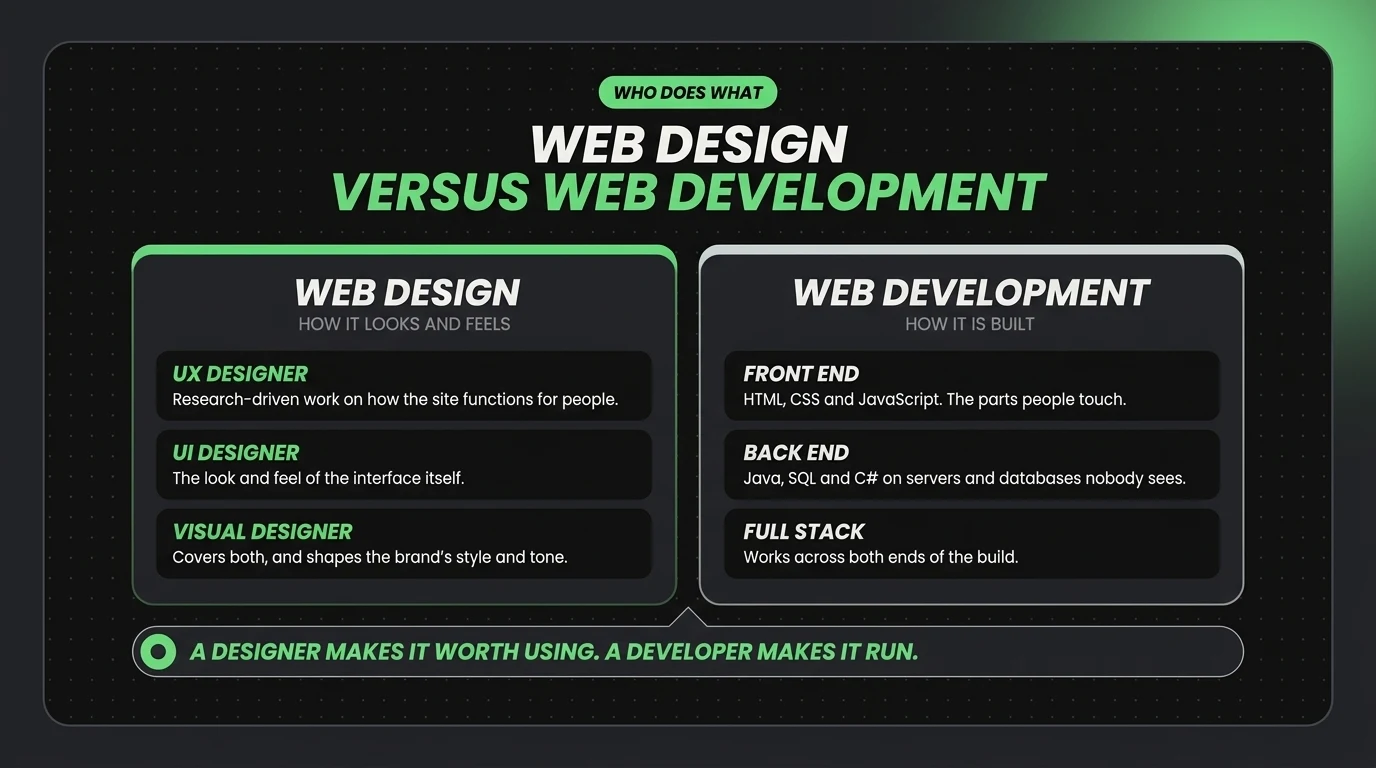
- A web designer makes the site look good and feel easy to use; a web developer builds the framework that makes it run.
- UX design is research-driven work on how a site functions for users; UI design focuses on the look and feel of the interface.
- A visual designer covers both UX and UI and helps shape a brand's style and tone.
- Back-end developers work in languages such as Java, SQL, and C# on servers and databases that users never see.
- Front-end developers use HTML, CSS, and JavaScript to build the parts users interact with, such as lead forms.
- A full-stack developer works across both the front and back end.
- New homepage, branding, and photo edits call for a designer; contact forms, web applications, and server errors call for a developer.
Developer or Designer?
Web Design, Web Developer, Website Creator, it’s all the same, right?
Believe it or not, each has unique characteristics. Some focus on user experience, while others have unique skill sets that enable them to dig deeper into your website’s actual nuts and bolts and use their coding skills to tweak everything about your site.
This article will find the differences between a web designer and a developer and explain when each is best used.
What is a Web Designer?
To put it plainly, a web designer makes your website look good.
They focus on the page’s style and overall feel, using design software like Adobe Photoshop, Adobe Muse, or one of the many WordPress page builders to customize the website’s visual elements.
Want this handled for you? We build and market websites for Louisiana businesses, and we will tell you honestly if you do not need us.
They also use HTML, CSS, and JavaScript code to craft their pages.
Web designers tend to have a specialty, which we will now explain.
User Experience (UX) designer.
User Experience (UX) keeps the visitor on your site. These guys (and girls) focus on building a website that is user-friendly and easy to use
A good UX designer does their research and conducts thorough research into the demographics and needs of the site’s users, not to mention tons of prototype testing and site restructuring.
Because website design is so much more than just putting images and text on a page, a UX designer must have a working knowledge of graphic design. Good design lends itself to happy customers, and most of the complaints people make about a website are about how it looks and feels rather than what it says. Anything from typographical elements to color schemes can impact users’ opinions of your site (and company).
Think about it. If your site is easy to use and aesthetically appealing, the user will likely revisit it and recommend it to friends.
This means more sales, right?
User Interface (UI) designer
A UI web designer focuses on how users interact with your website’s elements, or the interface. They translate complex brand ideas and values into an enjoyable and easy-to-navigate website.
A web designer makes the site look good and feel easy to use; a web developer builds the framework that makes it run.
So, what’s the difference between UX and UI?
Pay attention, it’s subtle:
UX involves research into building a solid foundation for a positive user experience, while UI focuses on the website’s aesthetics (look and feel).
Did you catch that?
Visual designer.
A visual designer is both UX and UI. Their job is to not only improve the user path using their creative and coding skills but to solve design issues.
They also help to conceptualize a brand’s unique style or tone of voice.
In essence, they’re masters of all web design trades, and their specific roles can vary greatly depending on your needs.
What is a web developer, then?
A web developer’s role is to create the website from the web designer’s concept.
Remember, web developers build, and web designers envision.
A developer usually specializes in designing website apps, while a web designer focuses more on what the user will enjoy doing.
Ok, so how do developers and designers work together?
A web developer builds a website’s framework using software like Javascript and JQuery, aiming to craft a smooth-running website. They pour the foundation for web designers to build upon.
Just like designers, there are specific roles for web developers.
What are the specific roles of web developers?
We’re glad you asked. Here we go!
Back-end developer
The backend is the portion where the website’s core structure is designed. It is where all programming languages are spoken to create the “how” portion of your site.
These developers are experts in programming and using complex software languages like Java, SQL, and C#. Users do not see their work because it involves coding on the web servers and databases, not on the browser (unlike front-end developers, which you’ll soon find out).
In short, a back-end developer creates logical, functional websites using various programs and languages. They also spend a lot of time testing and fixing bugs.
Front-end developer
Some refer to this as client-side development.
A front-end developer is more connected to web design than back-end development because it uses HTML, CSS, and JavaScript to create things the user can see, like client lead forms.
Much like a back-end developer, front-end developers have coding skills, but they build frameworks the user can actually interact with.
Full-stack developer
A full-stack developer is a one-stop shop. They work across different stacks (or layers), including both front and back ends. Our team is full-stack developers, probably some of the most experienced in Louisiana. As experts in all areas, they are ready, willing, and able to meet your website’s needs.
Information overload! Now you’re probably asking:
“BlakSheep Creative rocks! Clint was super helpful in putting together our website and offered suggestions that really put us on the right track. If you are looking for help with any of your "creative" needs look no further.”

Do I need a web designer or a web developer?
Now that you know the differences between web development and web design, it’s time to learn which one you need for your project(s).
| Your project is: | You need a: |
| Design a new homepage | Web Designer |
| Create a new contact form. | Web Developer |
| Create a web application | Web Developer |
| Envision new website branding | Web Designer |
| Fix server issues or errors on your site | Web Developer |
| Edit photos or videos | Web Designer |
| All of the above | BlakSheep Creative |
We can help you with that!
Still unsure? We’ve got you covered. We can handle all of your designing and coding for your project at a price you can afford. We’re Baton Rouge’s best full-stack development agency for a reason. And we do it at a price you can afford. Get an estimate today.
Thinking about a new website, redesign, or rebuild? Talk through the project before you spend a dollar, 15 minutes, no sales pitch.
About the author

Founder & Lead Developer · Denham Springs, LA
Clint has built and marketed websites for 26 years, since founding BlakSheep Creative in 2000. He is also a 29-year firefighter and a 23-year member of IAFF Local 557, which is where the bias toward plain answers over sales copy comes from.
- Veteran-owned
- Firefighter-owned
- IAFF Local 557
Common Questions About Web Design vs. Web Development
Short answers to the questions that come up most on this topic.
Do I need a web designer or a web developer?
What is the difference between UX and UI design?
What does a front-end developer do?
What does a back-end developer do?
What is a full-stack developer?

Your next step, without the guesswork
No surprises, clear next steps, and a fixed price before anything starts.