
By Clint Sanchez · Published · 7 min read
Quick answer
Most leave out the basics a homeowner checks first. Of 77 United States contractor websites featured in best-of roundups, 22 say licensed, 19 say insured, 8 say bonded, and only 7 say all three. Just 18 show a license number, and 5 show before and after work. Good design is common. Stated credentials are not.
Key takeaways
- We checked 77 United States contractor websites that published roundups call the best.
- Only 7 of the 77 say licensed, bonded and insured. That is 9 percent.
- 42 of the 77 say none of the three words and show no license number.
- 18 show a license number. 5 show before and after work. 10 mention financing.
- The Federal Trade Commission tells homeowners to consider only contractors who are licensed and insured.
- Of the 102 websites the roundups feature, 5 no longer load and 2 now belong to gambling sites.
- The fix is a line of text in the header, the footer, or beside the estimate form.

Want this handled instead of DIY?
A 15-minute call, no script, no pressure — you leave with a plan either way.
Search for the best contractor websites and you get galleries. Big photos, clean menus, a nice font. They are judged the way a designer judges a website.
A homeowner judges it differently. Before they call, they want to know one thing: is this company legitimate? So we took the contractor websites those galleries feature and checked them for the three words every contractor paints on the side of the truck.
What Do the Best Contractor Websites Leave Out?
We build websites for contractors from Denham Springs, Louisiana. After a storm, a Baton Rouge homeowner with a damaged roof wants to know who is climbing onto it and if that company is covered. That question does not change by state. The answer should be on the website before anyone has to ask.
If you want a second set of eyes on your own site, book a free discovery call or request a website design quote.
How Did We Check 77 Contractor Websites?
We started with four published roundups of the best contractor websites. Together they feature 102 websites. On October 10, 2026, we loaded every one of them.
- 5 did not load at all.
- 2 are no longer contractor websites. The domains lapsed and now promote online gambling.
- 7 are not contractors. They are suppliers, a designer, a security company and similar businesses.
- 88 are working contractor websites, and 77 of those are in the United States.
We report on the 77, because licensed, bonded and insured is United States wording.
For each site we read the text of three pages: the home page, the contact page, and the about page. Then we looked for specific things in that text.
What This Check Can and Cannot See
It reads words on the page. Words inside an image are invisible to it, and so is content a page loads later with a script. The check also stops at three pages, so a license listed only on a deeper page is missed.
That means these counts are a floor. A site we marked as silent may say it somewhere we did not look. But the three pages we read are the three a homeowner reads, and that is the point of the test.
We read every license number and every bonded match by eye to confirm it was real.
What Do 77 Contractor Websites Show, by the Numbers?
| What the site shows | Sites | Share of 77 |
|---|---|---|
| A projects or gallery link | 56 | 73% |
| Reviews or testimonials | 51 | 66% |
| A tap-to-call phone link | 50 | 65% |
| The word licensed | 22 | 29% |
| The word insured | 19 | 25% |
| A license number | 18 | 23% |
| Financing | 10 | 13% |
| The word bonded | 8 | 10% |
| Licensed, bonded and insured together | 7 | 9% |
| Before and after work | 5 | 6% |
The pattern is plain. These sites are good at showing the work. Three out of four link to a project gallery, and two out of three show reviews.
What they skip is the paperwork. 42 of the 77 never say licensed, never say insured, never say bonded, and show no license number on the pages a visitor reads first. That is 55 percent of websites that were picked as the best.
Why Does Licensed, Bonded and Insured Belong on a Contractor Website?
Because it is what homeowners are told to check. The Federal Trade Commission's guide How To Avoid a Home Improvement Scam, published in July 2022, says it in one line: "Consider only contractors who are licensed and insured."
The same guide tells homeowners what to do next: "Check with your state or county government to confirm a contractor's license, and ask the contractor for proof of insurance."
A license number on the page makes that check a thirty-second job. Leaving it off does not make the homeowner trust you less. It makes them do more work, and some of them will do that work on a competitor's site that made it easy.
It matters on bigger jobs too. A general contractor putting a subcontractor on a project asks for the same three things before anything else. If you want that work, read what we build into websites for general contractors.
We checked 77 United States contractor websites that published roundups call the best.
Which Contractor Websites Get It Right?
Seven of the 77 say all three words. Eighteen show a license number. Here are five that do it well, and where they put it.
1. Tri State General Contractors: License Numbers Above the Menu

This is the first thing on the page, above the logo. Eight license numbers, each labeled by state. A client in any of those states can confirm the license without clicking anything.
2. White Castle Roofing: A Badge Row Under the Headline

Four short facts in a row, right under the company name. Rating, years in business, licensed, bonded and insured, and a community number. A visitor reads all four in about three seconds.
3. Yuras Roofing: Beside the Estimate Form
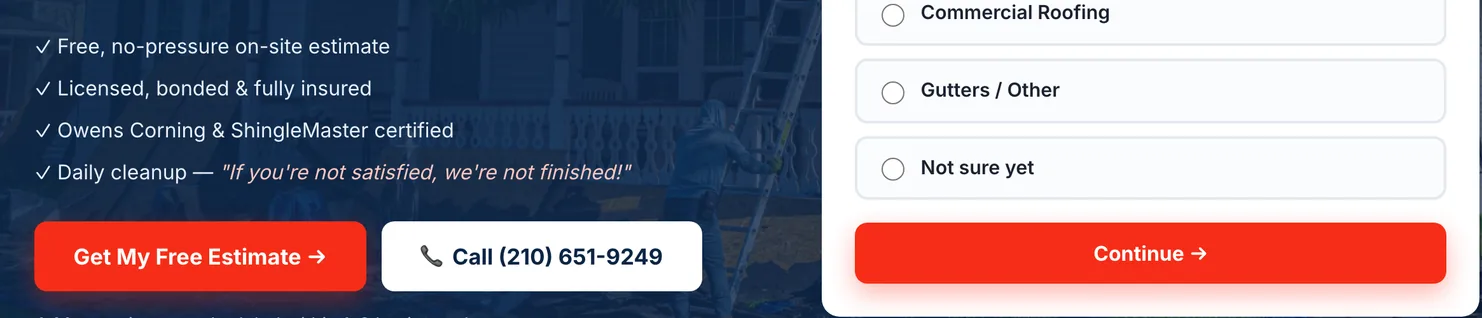
This is the best placement of the five. The line sits next to the estimate form and the call button, so the reassurance arrives at the exact moment someone is deciding to reach out.
4. Oasis Builders: All Three Words and the Number in the Footer

One of only three sites in the 77 that state all three words and show the license number. It is a single line in the footer, which means it appears on every page of the site.
5. Dyna Builders: One Line Does the Whole Job
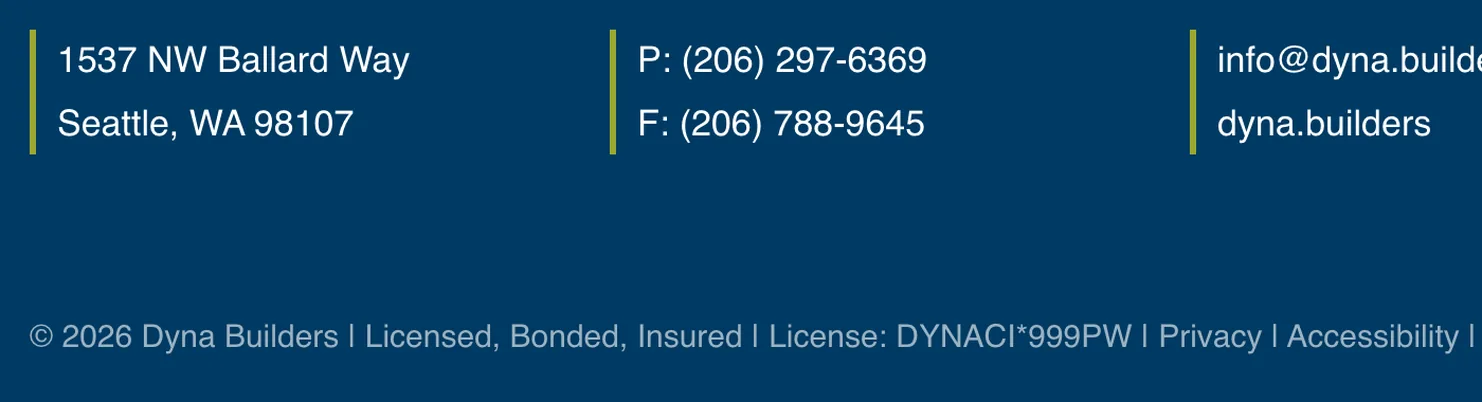
Licensed, bonded, insured, then the license number, in the footer next to the copyright. This is the third site with all three words and the number. It took one line of text. That is the whole fix.
What Else Is Missing From Contractor Websites?
Three more gaps stood out.
- Before and after work. Only 5 of 77 show it by name. The before photo is what the homeowner is living with right now. Showing it next to the finished job is the strongest proof a contractor has.
- Financing. Only 10 of 77 mention it. If you offer payment options, a visitor comparing two bids should not have to call to find out.
- A tap-to-call link. 50 of 77 have one on the home page. On the other 27 we did not find one, which leaves a visitor on a phone typing the number in.
We also saw what happens when a site is left alone. Two of the websites the roundups still call the best are now gambling pages, because the domain was not renewed. Five more do not load. A website is not finished the day it launches.
If roofing is your trade, we covered the full list in what a roofing contractor website needs.
How Do You Add These to Your Own Contractor Website?
Start with what is true, in your own wording. Do not write bonded if you are not bonded.
- Put your license number in the footer. Number, the name it is under, and the state or agency that issued it. The footer puts it on every page.
- Say insured, and say what kind if you can. General liability and workers' compensation are the two a homeowner cares about.
- Say bonded only if you are.
- Repeat the line beside your estimate form. That is where the decision gets made.
- Add before and after pairs to your project pages. Label each one with the job type and the town.
- Make the phone number a tap-to-call link.
None of this needs a redesign. It is text. For how the pieces fit together on a full build, see contractor website design, or the version written for construction companies.
And when you hire someone to build it, vet them the same way your customers vet you. We wrote a checklist for that: how to vet a web design company.
Check Your Own Site Before a Customer Does
Open your home page on a phone. Find the word licensed. Find the word insured. Find your license number. If any of them takes more than a few seconds, or is not there, that is the fix for this week.
Then look at the next three contractors in your town. Odds are they have not done it either, and that is the opening.
BlakSheep Creative is a veteran and firefighter owned agency in Denham Springs, Louisiana. See how we approach websites for contractors, read about who we are, and bring your hardest questions.
About the author

Founder & Lead Developer · Denham Springs, LA
Clint has built and marketed websites for 26 years, since founding BlakSheep Creative in 2000. He is also a 29-year firefighter and a 23-year member of IAFF Local 557, which is where the bias toward plain answers over sales copy comes from.
- Veteran-owned
- Firefighter-owned
- IAFF Local 557
Common questions about contractors
Should a contractor put a license number on the website?
Where should licensed, bonded and insured go on a contractor website?
What does licensed, bonded and insured mean?
Do good-looking contractor websites get more calls?
How often should a contractor update the website?
What if my trade does not require a license?

Your next step, without the guesswork
No surprises, clear next steps, and a fixed price before anything starts.