By Clint Sanchez · Published · Updated · 12 min read
Quick answer
Recurring bin cleaning plans should be explained on a website with plan cards that state the plan name, service frequency, included bins, extra-bin pricing, who the plan fits, billing timing, minimum commitment, cancellation terms, and a specific call to action. Name plans by customer need, put trust signals and billing terms next to pricing, match the form to the operation, and track CTA clicks and booked plans.
Key takeaways
- Every plan card should state frequency, included bins, extra-bin price, best fit, billing terms, minimum commitment, and a specific CTA.
- Name plans by need, such as Monthly Odor Control or Seasonal Refresh, rather than by frequency alone.
- FTC guidance on negative option programs calls for clear terms, informed consent, and a simple way to cancel; put those terms where customers can see them.
- Specific CTA text like Start Monthly Service or Check Route Availability outperforms vague buttons like Learn More.
- Trust signals belong next to pricing: before-and-after photos, short reviews, a one-sentence process, and truck and crew photos.
- Use a direct booking form when prices and routes are fixed; use a quote form when pricing depends on location, bin count, or commercial access.
- Track CTA clicks, form starts, form submissions, click-to-call, plan selected, and booked recurring plans in GA4 and the CRM.
Bin cleaning operators in Baton Rouge, Denham Springs, and Hammond sell to a homeowner who just dragged a reeking can back from the curb in August. That person is on a phone, deciding fast. A plan card that says every 4 weeks, two bins included, billed after each cleaning, cancel before your next service date, closes the sale before they scroll back to Google.

Want this handled instead of DIY?
A 15-minute call, no script, no pressure. You leave with a plan either way.
Recurring Bin Cleaning Plans Website Copy That Helps Customers Choose Faster
Quick Answer: Recurring bin cleaning plans should be explained with clear plan names, service frequency, included bins, pricing for extra bins, billing terms, what each visit includes, and a simple way to request service. A strong website does not make customers decode monthly, bi-monthly, quarterly, and one-time options. It shows who each plan fits and makes the next step obvious.
Ready to turn your website into a recurring revenue engine? Build a site that makes it easy for your customers to choose a plan
TLDR:
- Use plan cards for monthly, bi-monthly, quarterly, seasonal, and one-time service.
- Explain who each plan is for, not only how often service happens.
- Show included bins, extra bin fees, billing timing, minimum commitments, and cancellation terms near the CTA.
- Put reviews, before-and-after photos, and service process details close to pricing.
- Use plain language for recurring billing so customers know what they are agreeing to.
- Make the quote or booking path easy on mobile.
- Track calls, form starts, form submissions, CTA clicks, and booked recurring plans.
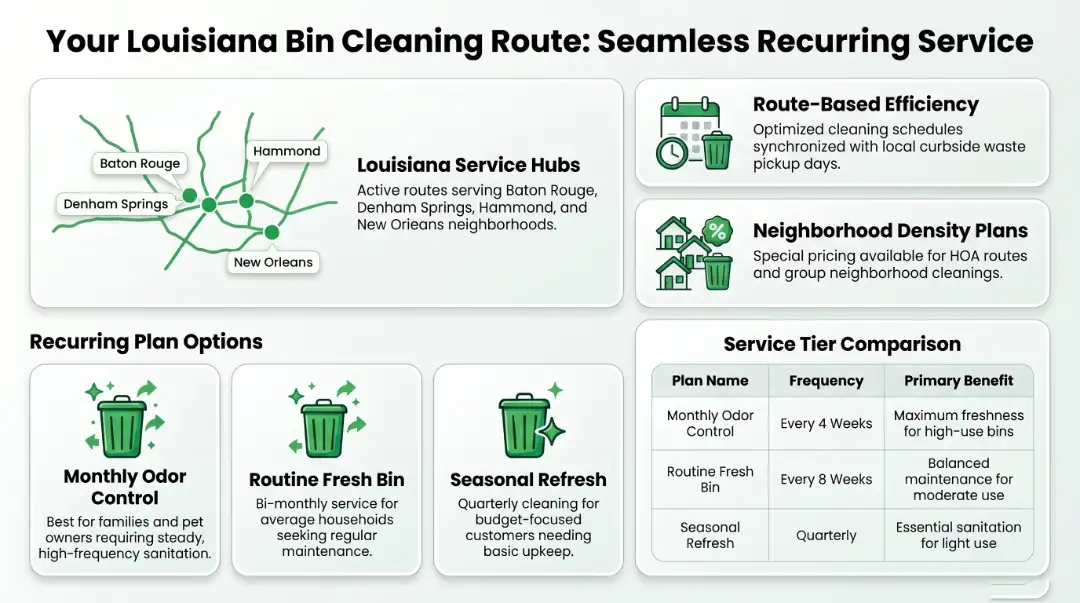
Trash can cleaning operators in Baton Rouge, Denham Springs, Hammond, and New Orleans compete in a local service market where customers move fast. A homeowner with a stinking can after pickup day does not want to read a mystery novel about pricing. They want to know the plan, the price, the service area, and how to get on the route.
Need a website that explains recurring plans without confusing customers?
Start with BlakSheep Creative’s custom website design for trash can cleaning businesses.
Why Recurring Plan Copy Matters for Trash Can Cleaning Companies
Recurring service is where a bin cleaning business becomes steadier. One-time cleanings help, but monthly and seasonal plans create cleaner routes, more predictable revenue, and better customer habits.
The problem is simple. Many websites display a price table and expect customers to figure out the rest. That makes people pause. Pausing kills forms. Customers need enough detail to make a decision without feeling trapped in a subscription they did not understand.
A better plan section answers the real buying questions: how often service happens, what is included, how billing works, how customers cancel, and what happens after they sign up.
Google’s helpful content guidance supports complete information that helps people complete a task. For a trash-can cleaning customer, the task is to compare plans and request service without confusion.
Once the role of the recurring plan copy is clear, the next step is to build each plan card so it can answer customer questions quickly.
What Every Recurring Plan Card Should Include
A plan card should do more than show a price. It should reduce doubt. The customer should know the frequency, included cans, added costs, service rules, and action step before they click.
| Plan Card Element | What to Include | Why It Matters |
|---|---|---|
| Plan name | Monthly Odor Control, Seasonal Refresh, HOA Route Plan, Commercial Bin Care | Benefit based names help customers self select faster. |
| Frequency | Every 4 weeks, every 8 weeks, quarterly, seasonal, one time | Frequency sets expectation and prevents service confusion. |
| Included bins | Two cans included, one cart included, dumpster quote required | Customers need to know what the base price covers. |
| Extra bin pricing | Each additional bin is listed clearly | This prevents form abandonment and billing disputes. |
| Best fit | Families, rentals, HOAs, restaurants, offices, seasonal users | This helps customers match the plan to their need. |
| Billing terms | Billed monthly, billed per visit, prepaid season, invoice after service | Billing clarity builds trust before sign up. |
| Minimum commitment | Three cleanings, one season, no contract, custom agreement | Service businesses need route protection, but customers need plain terms. |
| CTA | Request Service, Get Route Availability, Start Monthly Cleaning | Specific CTA text beats vague buttons like Learn More. |
The best plan card gives the customer enough information to act without turning the page into a legal scroll of doom.
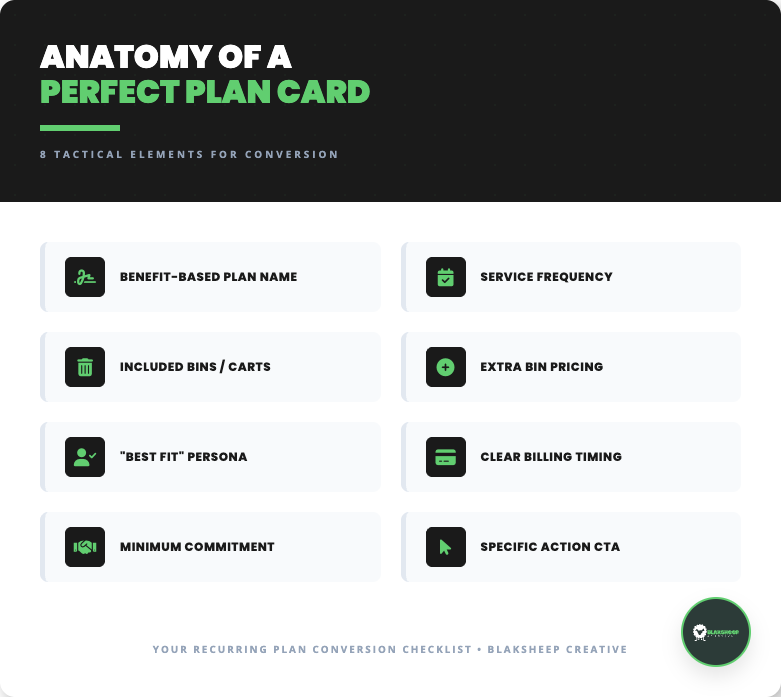
After the card structure is set, the plan names need to do more selling work than “Monthly” and “Quarterly.”
Name Plans by Customer Need, Not Frequency Alone
Frequency labels are useful, but they do not explain value. A customer may not know if monthly, bi-monthly, or quarterly cleaning is right for their household.
Use the frequency in the card, but let the plan name explain the use case. This gives customers a shortcut and helps the website speak like a service advisor rather than a vending machine with invoices.
| Weak Plan Name | Better Plan Name | Best Fit |
|---|---|---|
| Monthly | Monthly Odor Control Plan | Families, pet owners, active households, warm weather odor issues |
| Bi Monthly | Routine Fresh Bin Plan | First Clean or Move-In Clean |
| Quarterly | Seasonal Refresh Plan | Customers who want upkeep without monthly service |
| One Time | New customers, renters, move-outs, special cleanup needs | New customers, renters, move outs, special cleanup needs |
| Commercial | Business Bin Care Plan | Offices, small restaurants, shops, apartments, facilities |
| HOA | Neighborhood Route Plan | Subdivisions, HOAs, group buys, route density opportunities |
The frequency still matters, but the label should help the customer picture why the plan exists.
Once the names are clear, the pricing layout needs to compare plans without overwhelming people. Some operators keep it to one line per plan, and others show the yearly cost beside each price.
Every plan card should state frequency, included bins, extra-bin price, best fit, billing terms, minimum commitment, and a specific CTA.
Sample Website Layout for Recurring Bin Cleaning Plans
A clean pricing layout should show the main choice first, then the details underneath. Do not bury the most useful plan in a six-column grid that looks like a tax form had a bad afternoon.
| Busy households, pets, warm months, high-use bins | Best For | What the Card Should Say | Recommended CTA |
|---|---|---|---|
| Monthly Odor Control | Light use or budget-focused customers | Cleaned every 4 weeks. Includes 2 bins. Extra bins added at checkout. Billed monthly. Best for steady odor control. | Start Monthly Service |
| Routine Fresh Bin | Average household use | Cleaned every 8 weeks. Includes 2 bins. Good for households that want regular cleaning without a monthly visit. | Check Route Availability |
| Seasonal Refresh | New customers and one-time needs | Cleaned quarterly or three times per season. Good for maintenance and seasonal odor control. | Request Seasonal Service |
| First Clean | One-time cleaning for move-ins, move-outs, or first-time service. Upgrade to a recurring plan anytime. | Book One-Time Cleaning | Book One Time Cleaning |
| HOA Route Plan | Subdivisions and neighborhood groups | Group pricing based on route density, number of homes, and service frequency. | Ask About HOA Pricing |
| Commercial Bin Care | Small businesses, apartments, restaurants, offices | Custom plan based on bin count, access, frequency, and service window. | Request Commercial Quote |
This structure helps residential, HOA, and commercial visitors choose their path without having to read every word on the page.
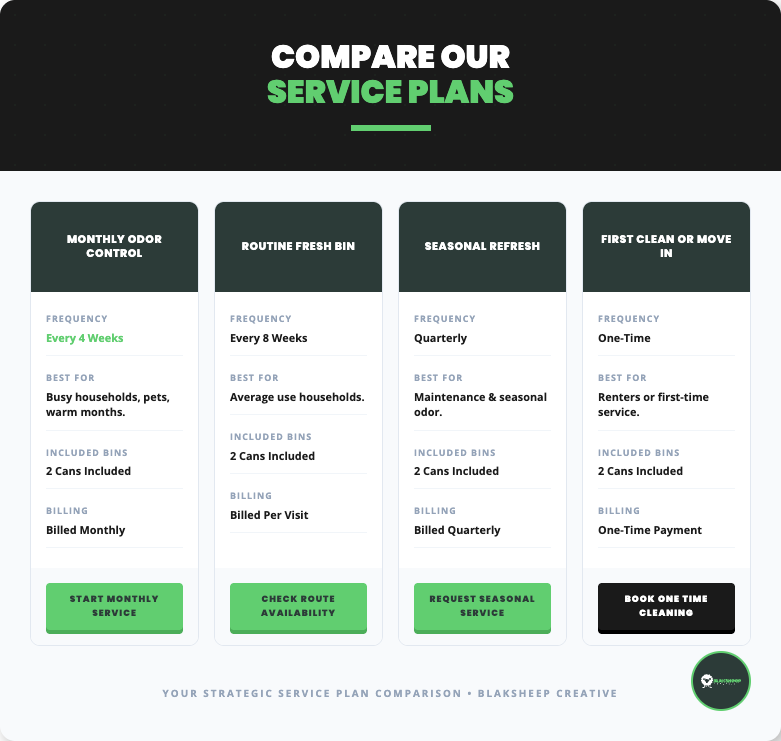
Good pricing layout helps customers choose, but recurring billing terms need their own plain language rules.
Explain Recurring Billing Without Sounding Shady
Recurring revenue is good business. Hidden recurring terms are not. Customers need to know what they are agreeing to before they submit a form or save a card.
FTC guidance on negative option programs focuses on clear terms, informed consent, and a simple cancellation method. Even when a small local service is not trying to act like a giant subscription trap, the same practical lesson applies: say the terms where customers can see them.
Operators are split on how they handle it. Five of the 13 bin cleaning sites we reviewed state a minimum number of cleanings, and one advertises no contracts beside a three-visit minimum.
| Term to Explain | Plain Website Copy Example |
|---|---|
| Billing timing | Monthly plans are billed after each scheduled cleaning. |
| Minimum service | Recurring plans require a three cleaning minimum because routes are planned in advance. |
| Auto renewal | Recurring service continues until you cancel. |
| Cancellation | Cancel before your next scheduled service date by calling or sending the cancellation form. |
| Saved payment | Recurring customers may be asked to keep a card on file for scheduled billing. |
| Route availability | Service dates depend on your neighborhood route and pickup schedule. |
| Extra bins | Extra bins can be added for the listed per bin rate before service. |
Plain language makes the business look professional and reduces billing complaints later.
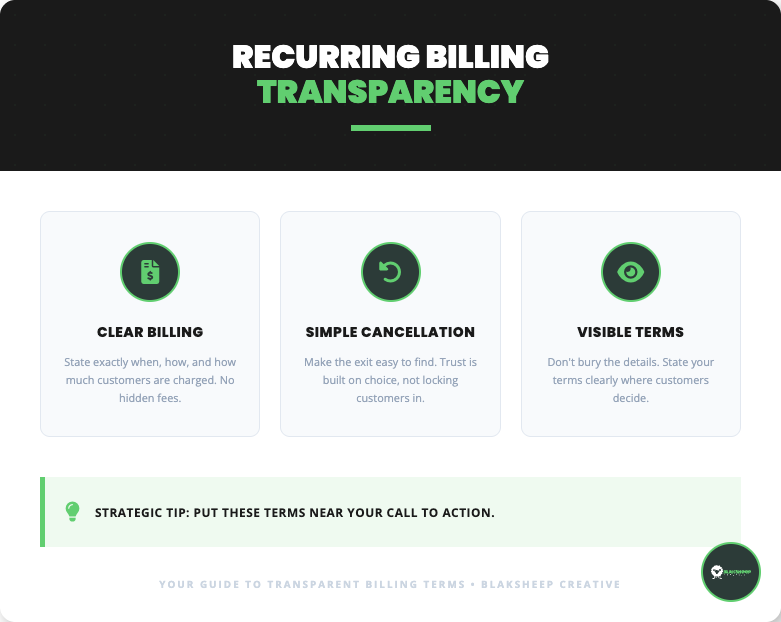
Clear terms belong near the action step, so the CTA section needs to do more than shout “Sign Up” and hope for the best.
If your pricing page leaves customers guessing about what happens next, your website is working against you. Cute. Terrible, but cute.
BlakSheep Creative builds custom WordPress websites for trash-can cleaning companies that need clear plans, local SEO, ADA-compliant design, conversion tracking, and booking paths that don’t make people rage-click their way back to Google.
Place CTAs Where Customers Decide
CTA placement matters because people do not all decide at the same point. Some are ready after seeing pricing. Some need to read the process. Some scroll to the FAQ because they enjoy making everyone’s analytics weird.
| CTA Placement | Recommended CTA | Purpose |
|---|---|---|
| Above the fold | Build My Trash Can Cleaning Website | Moves business owners to the main service page early. |
| After the billing terms section | Get a Better Plan Layout | Connects the article lesson to BlakSheep website design work. |
| After billing terms section | Fix My Pricing Page | Targets readers who know their current plan page is unclear. |
| FAQ section | Talk Through My Website | Captures cautious readers after objections are answered. |
| Final section | Request a Website Consultation | Pushes decision stage readers to act. |
Use specific CTA text that matches the section. Generic buttons make people think less and act less.
CTA placement gets attention, but trust signals give customers a reason to believe the plan is worth buying.
“Absolutely outstanding. No matter the time of the day if I have a question I get quick responses. Highly recommend”
Put Trust Signals Near Pricing and Plan Terms
Customers are more likely to choose a recurring plan when they believe the service will actually be delivered as promised. Trust signals should sit close to the plan cards, not floating in a random footer like abandoned furniture.
Use trust assets that answer customer doubts before they become objections.
- Before-and-after photos of real bins.
- Short reviews that mention odor, reliability, friendliness, or local service.
- A one-sentence service process: curbside pickup day, cleaning method, deodorizing, return, reminder.
- Simple guarantee or re-clean policy, if the business truly offers one.
- Badges for local ownership, insured service, contact options, and support availability.
- Photos of the truck, technician, equipment, and the real neighborhoods served.
Do not invent proof. Use what the company can back up. Fake trust signals are still fake, even with prettier icons.
Once trust is in place, the website has to decide how customers should start: with a booking form or a quote form.
Booking Form or Quote Form: Pick the Right Path
Some trash-can cleaning companies allow customers to book directly. Others need route confirmation, city availability, HOA coordination, or commercial review before taking payment.
The form should match the operation. A direct booking form is great when routes, prices, and service areas are fixed. A quote form works better when pricing depends on location, bin count, access, or commercial needs.
| Use This Path | Best When | Fields to Collect |
|---|---|---|
| Direct booking form | Residential pricing is fixed and route availability is clear | Name, phone, email, address, bin count, plan choice, pickup day, payment option |
| Quote request form | Routes vary or prices require review | Name, phone, email, address, city, bin count, service type, notes |
| Commercial quote form | Customer has dumpsters, multiple bins, gates, business hours, or access rules | Business name, contact, address, bin type, bin count, frequency, photos, service window |
| HOA inquiry form | Customer wants neighborhood or group pricing | HOA name, contact, subdivision, number of homes, desired frequency, meeting timeline |
Keep the form short enough to finish. Ask for what the business needs to respond, not every detail ever conceived by a committee.
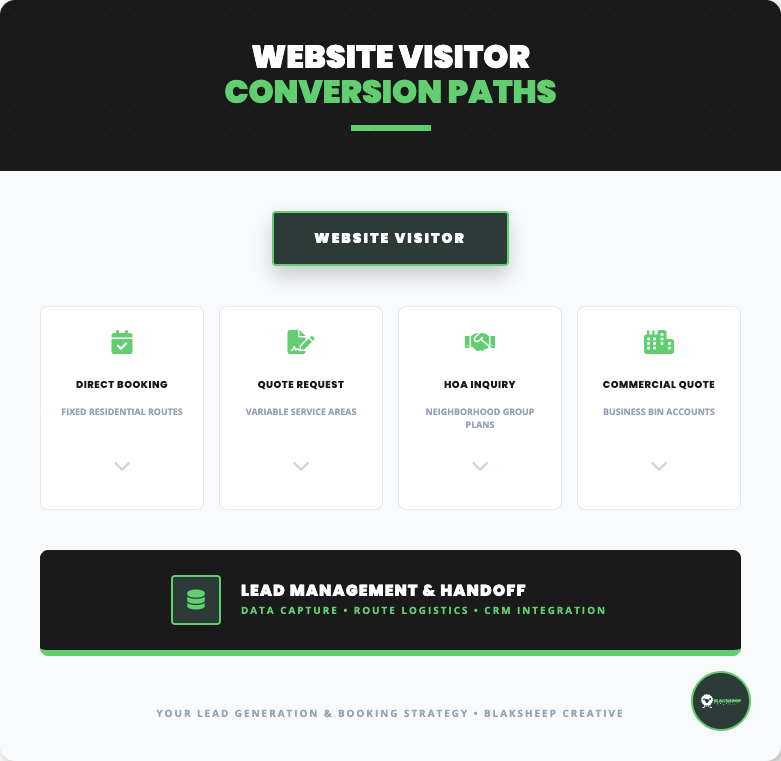
The form path should also connect to local service area content so customers know their neighborhood is actually covered.
Connect Recurring Plans to Service Area Pages
Trash can cleaning is route-based, so local content should do more than list cities. It should explain how recurring service works in each area and what customers can expect when they request a spot on the route.
For service area pages, add a short section that explains plan availability, route timing, pickup day coordination, and recurring options. This supports local SEO and reduces poor-fit leads. If your recurring plans vary by city or route, include them on your trash can cleaning service area pages so customers can confirm coverage before requesting a quote.
- Mention the city or neighborhood naturally in the page copy.
- Explain how route availability works in that location.
- Link back to the main pricing or plans section.
- Use local reviews from that area when available.
- Show nearby service areas to help customers self-qualify.
- Avoid copy that only swaps city names without adding anything useful.
Service area pages should help customers make a decision, not pretend that replacing “Baton Rouge” with “Hammond” counts as strategy.
After the plan content is live, tracking tells you if the page is producing real business or just collecting pageviews like novelty stamps.
Name plans by need, such as Monthly Odor Control or Seasonal Refresh, rather than by frequency alone.
Track the Metrics That Show Plan Page Performance
A recurring plan page should produce measurable actions. Rankings matter, but the business needs calls, forms, bookings, and better recurring plan adoption.
| Metric | How to Track It | Why It Matters |
|---|---|---|
| CTA clicks | GA4 event tracking on plan buttons | Shows which plan cards attract action. |
| Form starts | Track when a visitor begins the form | Shows interest before abandonment. |
| Form submissions | GA4 conversion event and CRM source field | Shows actual lead capture. |
| Click to call | Mobile call click tracking and call tracking number | Shows phone demand from plan readers. |
| Plan selected | Hidden field or form dropdown value | Shows which plan drives lead quality. |
| Booked recurring plans | CRM pipeline or booking tool status | Connects website action to real revenue. |
| Local landing page conversions | Page path plus form event reports | Shows which cities and neighborhoods convert. |
Review performance weekly after launch, then monthly once patterns are clear. Adjust plan labels, CTA text, form fields, and internal links based on what people actually do.
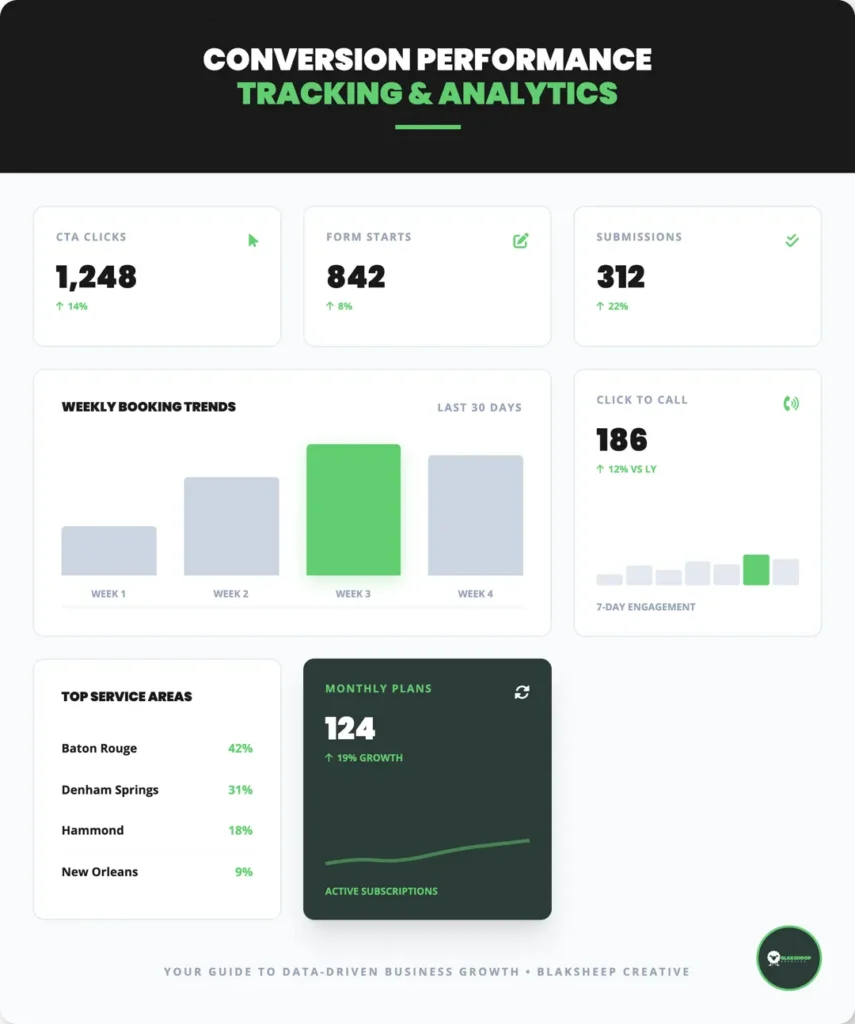
Tracking closes the loop and helps the website keep improving after the content is published.
Final Takeaway
Recurring bin cleaning plans should be easy to compare, understand, and request. A strong website explains the value of each plan, presents the terms in plain language, and provides customers with a clear next step.
For trash-can cleaning companies, that means better plan cards, stronger trust signals, cleaner forms, local service-area support, and conversion tracking. The goal is not a prettier pricing page. The goal is a website that helps turn searchers into recurring customers.
Want a trash can cleaning website that explains your plans clearly and turns more visitors into quote requests? Contact BlakSheep Creative and let’s map out the right structure for your service area, pricing model, and route-based workflow.
Common Questions About Recurring Bin Cleaning Plans on Your Website
These questions help customers and business owners understand how recurring plans should be presented before someone submits a form, books service, or saves a card for future cleanings.
How should I display monthly trash-can cleaning plans on my website?
Show monthly plans in a simple card with the service frequency, included bins, extra-bin price, billing timing, minimum commitment, and an action button. Add a short note explaining who the plan fits, such as families, pet owners, or customers who want stronger odor control.
Should I publish trash-can cleaning prices or have people request a quote?
Publish prices when your residential service is simple, and route availability is predictable. Use quote forms when pricing depends on city, bin count, commercial access, HOA size, or route limits. Many operators use both: clear starting prices for homes and custom quotes for larger accounts.
What recurring billing terms should a bin cleaning website explain?
Explain when customers are billed, how often service happens, what is included, how extra bins are charged, any minimum cleaning requirement, and how cancellation works. Place the terms near the CTA so customers understand the plan before they submit payment information.
What is the best CTA for a recurring bin cleaning plan?
Use a CTA that matches the customer action. “Start Monthly Service” works for direct booking. “Check Route Availability” works when the service depends on the location. “Request HOA Pricing” works for neighborhood accounts. Specific CTA text gives customers more confidence than a vague “Submit” button.
How can service area pages support recurring bin cleaning plans?
Service area pages can explain route availability, pickup day coordination, nearby neighborhoods, recurring plan options, and local customer proof. This helps customers confirm you serve their area and helps search engines connect your plans with the cities you want to target.
Understanding these details helps trash can cleaning operators build plan pages that are clear for customers and easier to improve over time.
Tired of Explaining Your Bin Cleaning Plans Over and Over?
Your website should answer the common questions before your phone does. If customers still have to call just to understand your monthly, quarterly, one-time, HOA, or commercial bin-cleaning plans, your site is adding friction rather than removing it.
BlakSheep Creative builds trash can cleaning websites that make your service plans clear, support local SEO, and guide visitors toward quote requests, bookings, and recurring customers.
Talk to BlakSheep Creative about a trash can cleaning website

We build this for trash can cleaning companies.
Fixed quote before we start, and you talk to the people who do the work.
About the author

Founder & Lead Developer · Denham Springs, LA
Clint has built and marketed websites for 26 years, since founding BlakSheep Creative in 2000. He is also a 29-year firefighter and a 23-year member of IAFF Local 557, which is where the bias toward plain answers over sales copy comes from.
- Veteran-owned
- Firefighter-owned
- IAFF Local 557
More Questions About Recurring Bin Cleaning Plans on Your Website
Short answers to the questions that come up most on this topic.
Why do recurring plans matter more than one-time cleanings for a bin cleaning company?
What plan names work better than Monthly and Quarterly?
How should a bin cleaning website explain auto-renewal?
Where should trust signals go on a pricing page?
How do service area pages connect to recurring plans?
What metrics show a plan page is working?

Your next step, without the guesswork
No surprises, clear next steps, and a fixed price before anything starts.