
By Clint Sanchez · Published · Updated · 4 min read
Quick answer
AI systems reuse short, self-contained answers, not full pages. To structure content so AI uses it, put the main answer within the first 120 words, frame headers as questions, bold the one-sentence direct answer at the start of each section, keep paragraphs short, use ordered lists for processes and tables for comparisons, and use one consistent term for each concept. Pages that reduce ambiguity get cited; pages that bury answers in narrative get skipped.
Key takeaways
- Answer Engine Optimization (AEO) extends SEO so AI tools can read, understand, and cite content when answering questions.
- AI tools skip content that needs interpretation, persuasion, or several paragraphs to extract a single answer.
- Definition blocks, one-sentence direct answers, step lists, comparison tables, and exceptions sections are the formats AI reuses.
- The main answer should appear within the first 120 words of the page.
- Traditional SEO content is written to rank and hold the reader; AEO content is written to be cited.
- Reverse engineer AEO by asking a buyer question in an AI tool, then auditing the structure of the pages it cites.
- Consistent terminology, clear topical focus, question-aligned headers, and internal links are the authority signals AI responds to.
Ask an AI assistant for a roofer in Denham Springs or an electrician in Walker and it names one or two businesses, not ten blue links. That single answer comes from whichever local site stated its service area, hours, and specialties plainly enough to be lifted. For Livingston Parish businesses the structure question is no longer academic; it decides who gets the recommendation.
Many teams are publishing accurate, well-written content and still watching AI tools ignore it. The issue is rarely expertise or effort. It is structure. AI systems do not read pages the way people do. They extract answers they can reuse safely. This article explains how content should be structured to be understood, cited, and surfaced by modern answer engines.
Structure is one of the main reasons AI skips otherwise strong content.
Answer Engine Optimization Content Framework
This article explains how to structure content so AI tools can read, understand, and cite it directly in answers. The focus is not on ranking theory. It is on formatting and structure that match how AI systems actually choose sources.
What Is Answer Engine Optimization?
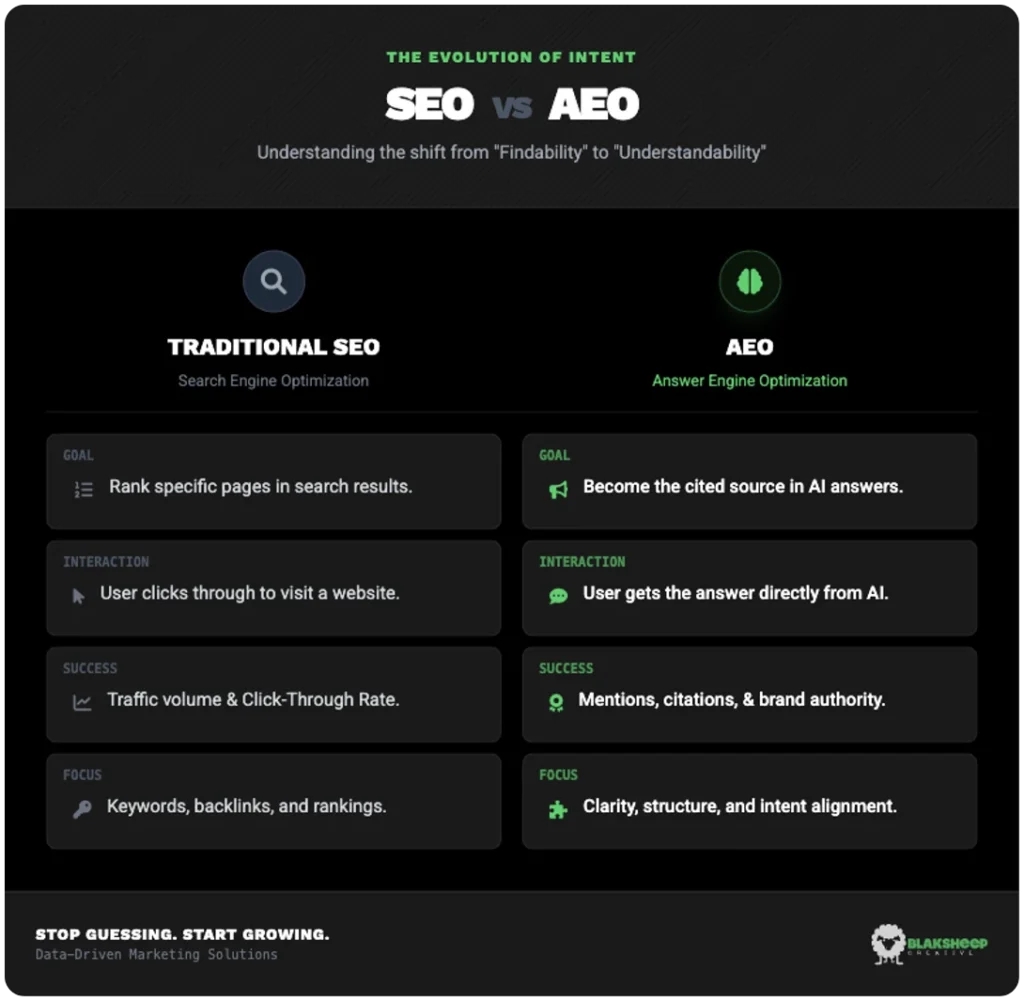
Answer Engine Optimization (AEO) is an extension of traditional SEO that focuses on optimizing content so AI tools can read, understand, and cite it when answering user questions.
The goal is not just visibility in search results, but inclusion as the source of the answer.
- AI tools reuse answers, not full pages
- Clear formatting increases citation likelihood
- Short, direct answers outperform long explanations
- Consistent keywords reduce ambiguity
- Tables and lists improve machine readability
- Being cited matters more than being clicked
Many sites still write content assuming users will scroll and read. AI does not behave that way. It scans for clean answers that it can reuse safely. If your content is difficult to extract, it will be skipped.
Want this handled for you? We build and market websites for Louisiana businesses, and we will tell you honestly if you do not need us.
For a concrete example of how AEO structure plays out at the local level, especially for voice search and near me queries, see Local AEO for Voice Search and Near Me AI Queries, which shows how AI selects one clear local answer instead of a ranked list of results.
This also applies to campaign websites. Candidate bios, priorities, FAQs, endorsements, and event pages should be structured so search engines and AI tools can understand the official source. See our guide to political campaign website structure.
Why Do AI Systems Ignore Most Website Content?
AI systems ignore content that cannot be reused safely without the surrounding context.
Most pages fail not because the information is wrong, but because it is buried. AI tools avoid content that requires interpretation, persuasion, or reading multiple paragraphs to extract a single answer.
- Answers hidden inside lengthy introductions
- Multiple terms used for the same concept
- Marketing language instead of explanation
- Key details dependent on nearby text
What Types of Content Can AI Systems Reuse?
AI systems reuse short, self-contained blocks of information that stand on their own.
Winning pages make answers obvious without requiring full context. This is why skimmability matters as much as accuracy.
- Definition blocks: Clear “What is X” sections
- One-sentence direct answers: Bolded summaries at the start of sections
- Step-by-step explanations: Ordered lists for processes
- Comparison tables: Structured data for decision-making
- Limits or exceptions sections: Explicit clarification of nuance
Answer Engine Optimization (AEO) extends SEO so AI tools can read, understand, and cite content when answering questions.
How Should Content Be Structured for AEO?
AEO content should answer the question immediately, then support the answer with structured detail.
Pages that perform well for AEO follow predictable formatting patterns that facilitate extraction.
- Main answer appears within the first 120 words
- Headers are framed as questions
- Direct answers are visually emphasized (bolded)
- Paragraphs stay short and focused
How Is Traditional SEO Content Different From AEO Content?
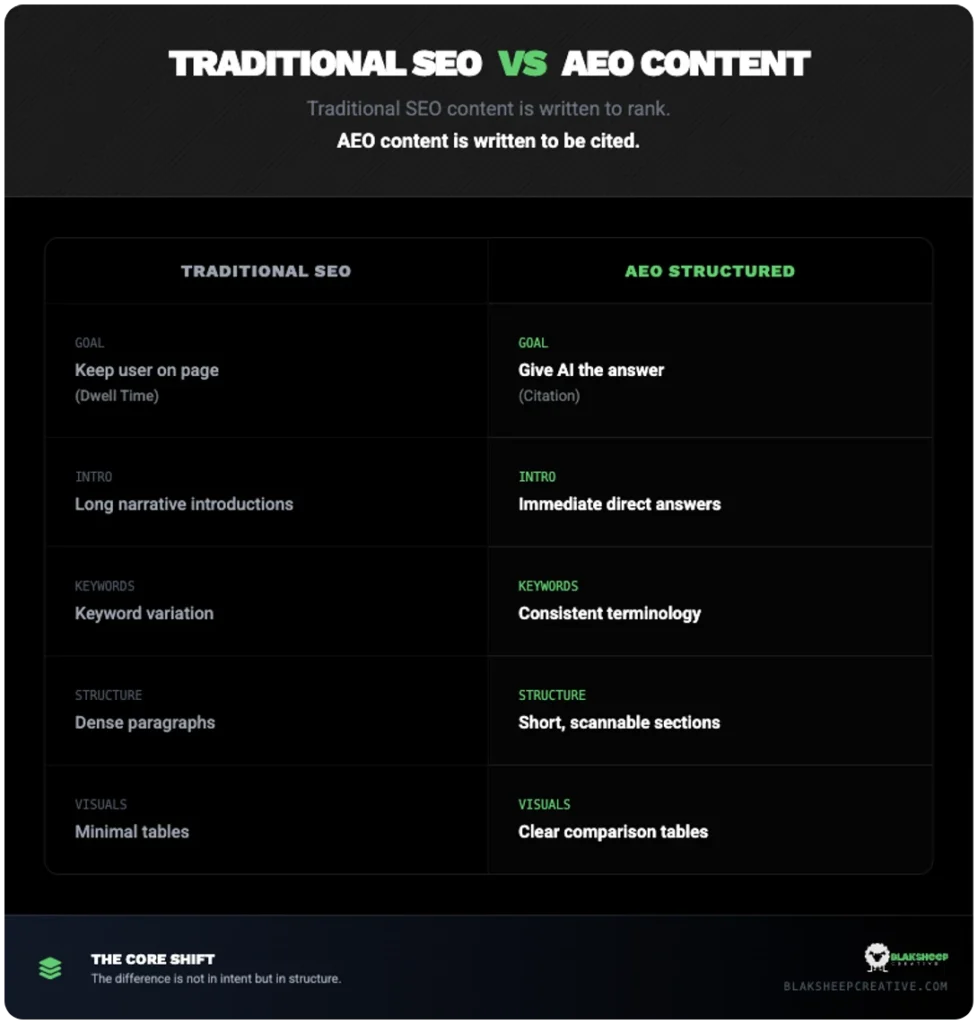
Traditional SEO content is written to rank, while AEO content is written to be cited.
The difference is not in intent but in structure. If you want a real example outside pure AEO theory, see what industrial supply buyers expect from a website. It shows how structure, a clear page hierarchy, and direct next-step paths matter when buyers compare product lines and gather technical details.
| Feature | Traditional SEO Content | AEO Structured Content |
| Goal | Keep the user on page (dwell time) | Give AI the answer (citation) |
| Intro | Long narrative introductions | Immediate direct answers |
| Keywords | Keyword variation | Consistent terminology |
| Structure | Dense paragraphs | Short, scannable sections |
| Visuals | Minimal tables | Clear comparison tables |
How Do You Reverse Engineer AEO?
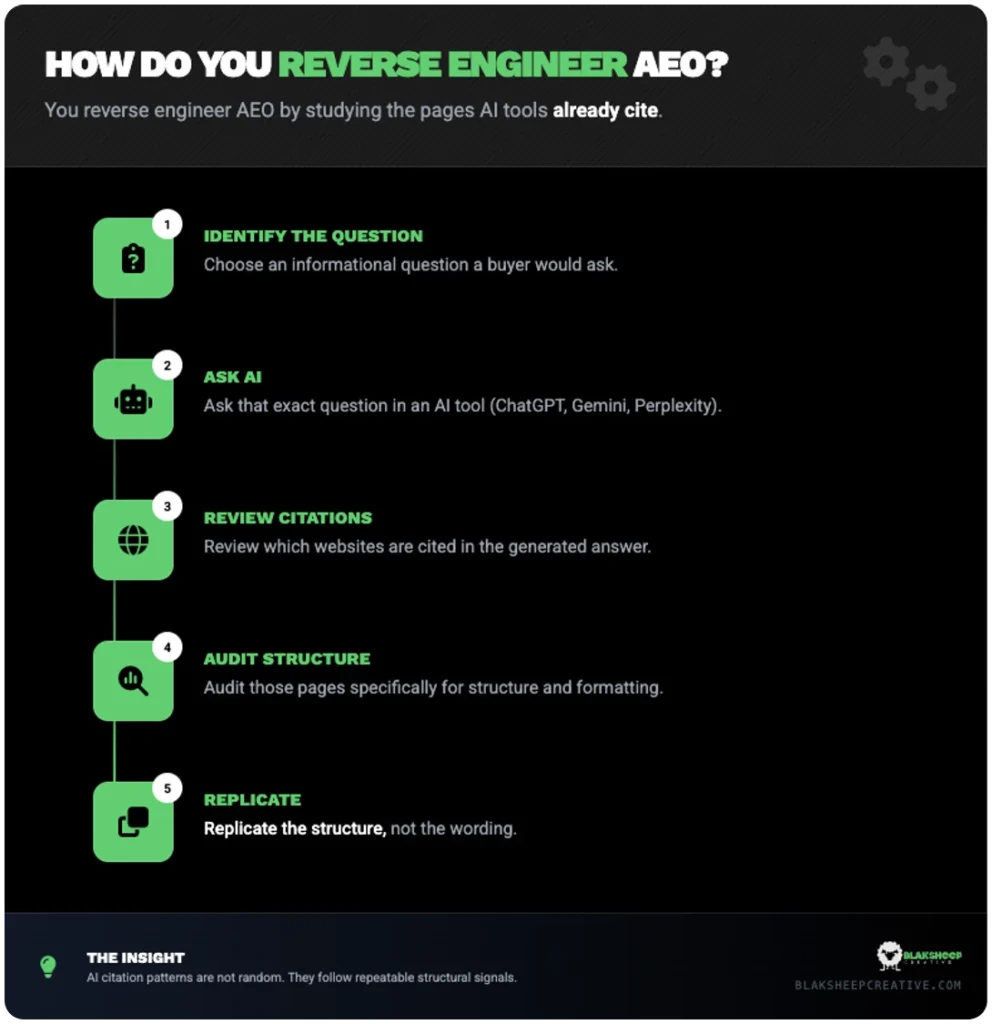
You reverse engineer AEO by studying the pages AI tools already cite.
- Choose an informational question a buyer would ask
- Ask that exact question in an AI tool
- Review which websites are cited
- Audit those pages for structure and formatting
- Replicate the structure, not the wording
AI citation patterns are not random. They follow repeatable structural signals.
“Clint was incredible to work with! He was everything you need - quick to communicate from beginning to end, professional, flexible when I had questions and asked for extra options, and SO fast on his turnaround time. I would recommend Blaksheep Creative to everyone!”

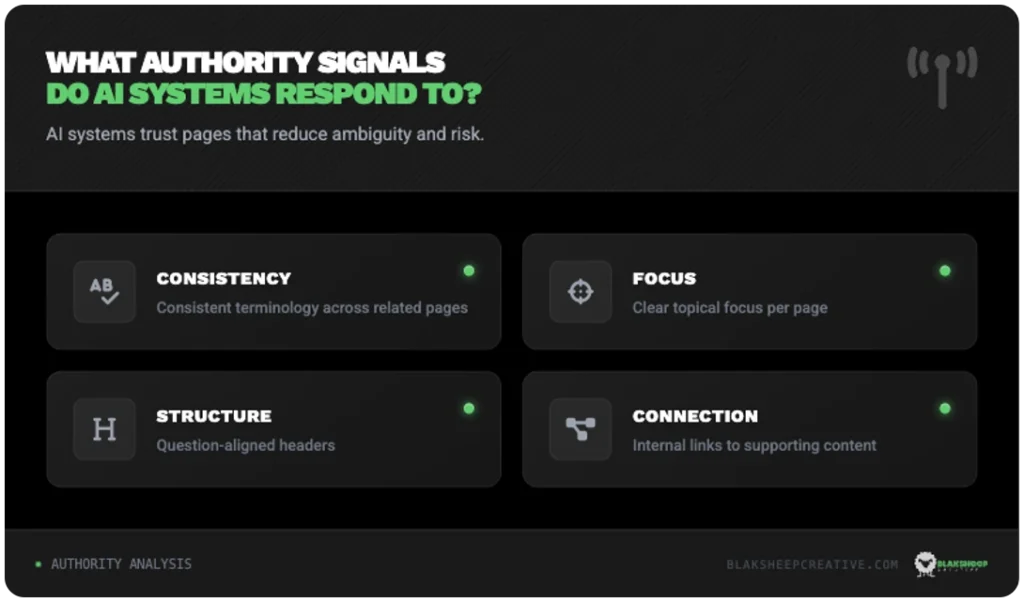
What Authority Signals Do AI Systems Respond To?
AI systems trust pages that reduce ambiguity and risk.
- Consistent terminology across related pages
- Clear topical focus per page
- Question-aligned headers
- Internal links to supporting content
How Does AEO Work for Real Businesses?
AEO increases visibility even when clicks decline.
After restructuring pages to include direct answers, bolded responses, and comparison tables, businesses can appear in AI-generated answers even with lower on-site traffic. Why?
AEO works best when the structure answers a real buyer problem, not just a broad topic. For a practical example, review missed calls for restaurants and notice how the article uses direct answers, workflow tables, FAQs, and a clear path into AI automation for restaurants.
Implementing Answer Engine Optimization at Scale
Answer Engine Optimization is not about predicting algorithms or chasing new tools. It is about reducing ambiguity. When content is clearly structured, AI systems can understand, extract, and reuse it without risk.
The pages that surface in AI-generated answers are rarely the most creative or persuasive. They are the easiest to interpret. Clear definitions, consistent terminology, short sections, and visible answers are what make content usable in modern search environments.
If your content is accurate but invisible to AI, structure is usually the missing layer. Addressing that gap is less about rewriting and more about organizing what you already know.
Applying this structure consistently across a site is where most teams benefit from a dedicated AEO approach.
Looking for a real conversation about your business, no sales pitch, no commitment? Book a free 15-minute Discovery Call.
About the author

Founder & Lead Developer · Denham Springs, LA
Clint has built and marketed websites for 26 years, since founding BlakSheep Creative in 2000. He is also a 29-year firefighter and a 23-year member of IAFF Local 557, which is where the bias toward plain answers over sales copy comes from.
- Veteran-owned
- Firefighter-owned
- IAFF Local 557
Common questions about digital marketing
Why does bolding the direct answer help AI citation?
Do comparison tables really matter for AEO?
Should every header be written as a question?
Does AEO replace traditional SEO?
How do I check if AI tools are citing my competitors?
Can a business appear in AI answers while site traffic drops?

Your next step, without the guesswork
No surprises, clear next steps, and a fixed price before anything starts.