By Clint Sanchez · Published · 17 min read
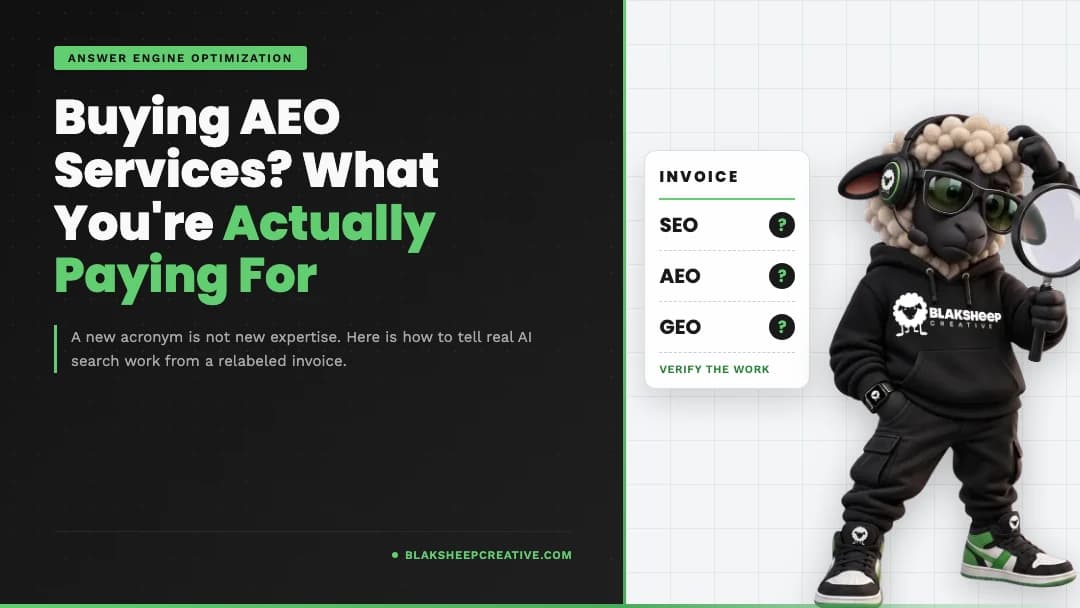
What Does an AEO Agency Actually Sell You?
Quick answer
Mostly SEO, under a newer name. Google says its AI features run on the same fundamentals as regular search and need no special tricks. Other AI tools work differently, so good AEO work names the platforms it targets, the tasks it will do, and how results get measured. Nobody can promise a spot in an AI answer.
Key takeaways
- Google says SEO best practices remain relevant for AI Overviews and AI Mode, with no extra requirements or special optimizations.
- Google lists AEO and GEO tools under services to approach with caution, and says no third-party tool sees its internal ranking data.
- ChatGPT search uses its own crawler, OAI-SearchBot, which is separate from the GPTBot crawler OpenAI uses for training.
- In BrightLocal's study of about 200,000 local AI searches, tracked businesses showed up in 66% of Google Maps searches but only 32% to 38% on AI surfaces.
- AI answers shift a lot. Repeat runs of the same prompt shared only 20% to 33% of their results on average.
- The best-known GEO paper found visibility gains of up to 40% in a lab benchmark, not in client revenue.
- Being mentioned by AI is not the same as getting a call, a booking or a sale.
If you run a service business, someone has probably already offered to make you "show up in AI." Some of those offers are solid work. Some are your old SEO package with a new label and a bigger invoice. Here is how to tell them apart before you sign.

Want this handled instead of DIY?
A 15-minute call, no script, no pressure. You leave with a plan either way.
The pitch usually sounds something like this: "We'll get your business recommended by ChatGPT. Guaranteed." It comes with a monthly fee, a dashboard and a score out of 100. The business owner on the other end of the call is left wondering what, exactly, they just bought.
AI search visibility matters, and it is worth paying for when the work is real. The trouble starts when the acronym does more work than the agency.
First, What Are SEO, AEO and GEO?
These three terms get used as if they were separate products. In practice, they overlap so much that the line between them is mostly a sales decision.
| Term | Plain English | What it is trying to earn |
|---|---|---|
| SEO (search engine optimization) | Making your site easy to find, crawl, understand and trust | Rankings and clicks in search results |
| AEO (answer engine optimization) | Shaping pages so they answer real questions clearly | Being used or quoted in an answer |
| GEO (generative engine optimization) | Building the reputation and references AI tools draw on | Being named or recommended in an AI response |
Take a mobile notary. SEO gets their "loan signing agent" page found. AEO makes sure that page clearly answers "Can a notary come to my house?" GEO is the reviews, directory listings and local mentions that make an AI tool comfortable naming them. All three depend on the same site, the same profile and the same reputation.
For a deeper side-by-side, we compared the three terms in GEO vs. AEO vs. SEO, and we broke down how AEO and traditional SEO actually differ in a separate post. Short version: same foundation, different emphasis.
Why did the agency rename its SEO package AEO? Same work, more vowels.
What Google Says About AEO and GEO
Google has addressed this directly, and its answer is less exciting than most sales decks. That is a good thing for your budget.
Google's page on AI features and your website says "the best practices for SEO remain relevant" for AI Overviews and AI Mode. It adds that there are "no additional requirements" and no "special optimizations necessary." Its checklist is plain SEO:
- Allow crawling in robots.txt, and in any CDN or hosting firewall.
- Make content easy to find through internal links.
- Provide a good page experience.
- Put important content in text, not only images.
- Keep structured data matched to what is visible on the page.
- Keep your Google Business Profile current.
In May 2026, John Mueller announced a new Google guide on optimizing for generative AI features, including a section "mythbusting common AEO/GEO misconceptions." The guide itself says that from Google Search's perspective, optimizing for generative AI search "is optimizing for the search experience, and thus still SEO."
The Tactics Google Says You Can Skip
The same guide says that for Google Search, "you can ignore tactics like 'chunking' content, creating unnecessary AI text files (like llms.txt), or pursuing inauthentic mentions." It also says structured data is not required for its generative AI features and there is no special schema to add. We walked through each of these in our breakdown of AI citation myths.
Google's guidance on evaluating third-party SEO help goes further. It lists services "promising improvements for AI experiences and search formats (also known as 'AEO' or 'GEO' tools)" among the ones to approach carefully. It also says plainly that "third-party tools don't have access to our internal ranking data."
There is a limit to all of this, and it matters. Google is describing Google's own AI products. Its guidance does not set the rules for ChatGPT, Claude or Perplexity.
If you would rather hear it from Google directly, Mueller and Danny Sullivan talked through how SEO relates to newer AI search experiences in a December 2025 Search Off the Record episode.
ChatGPT Doesn't Work Exactly Like Google
ChatGPT is a separate system with its own crawlers, its own sources and its own controls. An agency that treats "AI" as one thing is already skipping a step.
OpenAI's crawler documentation splits its bots by job:
- OAI-SearchBot surfaces websites in ChatGPT's search features. Block it and your pages won't appear in ChatGPT search answers.
- GPTBot collects content that may be used to train OpenAI's foundation models.
- ChatGPT-User visits pages when a user's request calls for it. OpenAI says it does not crawl the web automatically.
OpenAI says "each setting is independent of the others." You can allow OAI-SearchBot and block GPTBot, which keeps you eligible for ChatGPT search while opting out of training. OpenAI notes that search-related robots.txt changes can take about 24 hours to apply. We covered the bigger training-versus-visibility question in AI training opt out vs. AI search visibility.
| Google AI Overviews and AI Mode | ChatGPT search | |
|---|---|---|
| Crawler that matters | Googlebot, the same one regular search uses | OAI-SearchBot |
| Training crawler | Separate (Google-Extended) | Separate (GPTBot) |
| Official rules | Standard SEO, per Google Search Central | OpenAI's crawler and publisher documentation |
| Business info it leans on | Heavily uses Google Business Profile, per BrightLocal | Hardly uses Google Business Profile; ties to Yelp and Bing, per BrightLocal |
So the first fair question for any AEO agency is simple: which platforms are you working on, and what will you do differently for each one?
What the Biggest Local AI Study Found
Most AI visibility claims come with no data at all. This study comes with plenty, along with its own limits.
In September 2026, BrightLocal published an analysis of about 200,000 localized AI searches across ChatGPT, Google AI Mode and Google AI Overviews. It tracked about 1,300 business locations over 60 days, with Google Maps as a comparison, and logged roughly 1.97 million citations.
The gap is the headline: "Google Maps mentions a tracked business in 66% of searches vs 32-38% for AI surfaces." These are rates for the businesses BrightLocal tracked, under its prompts. They are not the odds that your business shows up for any given search.
AI Answers Move Around a Lot
BrightLocal found "only 20-33% average overlap between result sets on repeat searches." A business that shows up once "is seen again in about half of subsequent attempts." That is why one screenshot of your business in a ChatGPT answer proves very little, in either direction.
Your Website Still Carries Weight
The study's most quoted number is also the easiest to misquote. Two figures come from the same sentence, and they measure different things.
Business websites made up 93% of the unique domains AI tools cited, and 42% of all citations. That is a strong case for having a real, useful website. It is not proof that 93% of AI citations point to business sites. Listings matter too: Google Business Profile accounted for 28.5% of all citations across the three platforms, and BrightLocal says all three lean on Yelp.
What the Study Can't Tell You
BrightLocal is upfront about some limits. It left out branded prompts, and AI Overviews showed up for fewer searches than the other platforms. The study used chosen prompts and tracked businesses, so it cannot show how every customer searches. It also does not measure clicks, calls or revenue, and it cannot prove that any one tactic caused a business to be recommended.
Google says SEO best practices remain relevant for AI Overviews and AI Mode, with no extra requirements or special optimizations.
Does GEO Actually Work?
GEO is not made up. It started as academic research, and that research deserves a fair hearing, along with an honest read of what it tested.
The paper that named it, "GEO: Generative Engine Optimization" by Pranjal Aggarwal and colleagues, was presented at the ACM SIGKDD conference in 2024. The authors built a benchmark called GEO-bench and reported that some content changes could "boost visibility by up to 40% in generative engine responses." They also found the results "vary across domains."
That is a lab result. It measured how prominently a source appeared in generated answers inside a test setup. It did not measure leads, phone calls or revenue for a business, and it did not test every live AI product.
A July 2026 critical survey by Olivier Martinez, a preprint that has not been peer-reviewed, looked at 45 GEO studies. It notes that the original gains assume a source is already in the AI's context. Its conclusion: no technique reviewed showed a stable, long-term, cross-platform effect on being found in the first place.
So GEO is real research with real but narrow findings. A 40% lab number on an agency's sales page is not a 40% promise for your phone.
Mentioned, Cited and Recommended Are Not the Same Thing
AI visibility reports love the word "visibility" because it covers a lot of ground. Before you judge one, it helps to know which rung of the ladder it is actually measuring.
| Term | What it means | What it proves |
|---|---|---|
| Mention | Your business is named in an AI answer | The AI knows you exist |
| Citation | Your site or a page about you is linked as a source | Your content was used |
| Recommendation | You are suggested as an option to hire | You made the shortlist, that time |
| Referral visit | Someone clicks through from an AI tool | Interest |
| Qualified inquiry | A real prospect asks about a service you offer | Demand |
| Conversion | A booked job, signed quote or sale | Business |
| Revenue | Money that shows up in your records | The only number your bank cares about |
Each step loses people, and none of them happens automatically. An agency that reports only the top rung is reporting the cheapest number to produce.
Five AEO Sales Pitches That Deserve Better Questions
None of these pitches is automatically a scam. Each one, though, should come with evidence, and you should know what that evidence looks like.
1. "We Guarantee ChatGPT Recommendations"
Google's guidance says using a service "doesn't guarantee ranking success," and BrightLocal's 2026 local AI study found AI answers reshuffle from one run to the next. Ask what exactly is guaranteed, on which platform, for which prompts, and what happens if it doesn't hold.
2. "We Submit Your Site to the AI Index"
Google's AI features use the same crawling and indexing as regular search. ChatGPT search relies on OAI-SearchBot reaching your pages. Ask what the "submission" is, where it goes, and which official documentation describes it.
3. "You Need an llms.txt File"
Google says its Search ignores llms.txt. For other AI tools, the verdict is still out, so one can be a cheap experiment. Your llms.txt file is not a VIP pass to the AI nightclub, though, and it should not be billed like one.
4. "We'll Build Your Citations and Reviews Fast"
Accurate listings on real directories are good housekeeping. Manufactured mentions are another story: Google warns against seeking inauthentic mentions, and the FTC's final rule announced in August 2024 bans buying or selling fake reviews and testimonials. Ask where every listing, mention and review will come from.
5. "Your AI Visibility Score Is 41. We'll Get It to 92."
A score of 92 sounds impressive. Ninety-two out of 100 what, exactly? Ask which prompts, how many locations, how many runs, which platforms and which dates. If the method is secret, the score is a guess with a logo on it.
In a January 2026 episode, Mueller and Sullivan discuss hiring an SEO in the age of AI, how to evaluate one, and what to make of third-party tools. It is worth 26 minutes before you sign a contract.
“Clint and BlakSheep created a top quality website, quickly at an incredible value literally putting my little startup project on the map. I can’t thank the team enough!”

What Legitimate AI Visibility Work Looks Like
Real AI visibility work is not mysterious. Most of it is the same work good SEO has always required, plus better measurement for the AI side.
- Technical SEO. Pages that crawl, index and load cleanly, with no firewall rule quietly blocking Googlebot or OAI-SearchBot.
- Useful service content. Pages that answer what customers actually ask, written from real experience.
- Accurate business information. The same name, address, phone, hours and services everywhere they appear.
- Honest structured data. Schema that matches what is on the page, nothing invented.
- Real reviews. Asked for consistently, never bought, gated or written by staff.
- Relevant third-party references. Listings, local press and associations that genuinely know your business.
- Citation analysis. Finding which sources AI tools actually cite in your market, then earning a place there honestly.
- Repeated prompt testing. The same prompts, run several times, on several platforms, over several weeks.
- Referral and conversion tracking. Following AI visitors from the first click to the booked job.
A good agency adds judgment on top: knowing which of those matters most for your business, fixing it, and telling you straight when something is not working. Slapping a new acronym on an invoice doesn't turn it into a research paper.
Questions to Ask an AEO Agency Before You Sign
These ten questions sort real work from repackaged work fast. A good agency will answer every one of them without getting defensive.
- Which platforms are you targeting? Google AI Overviews, AI Mode, ChatGPT, Perplexity or all of them, and what changes for each.
- What work is included? A list of tasks, not a list of outcomes.
- How is this different from the SEO I'm already paying for? If the answer is "it isn't," the price should reflect that.
- What technical changes will you make to my site? Specific pages, settings and files.
- How will you measure AI visibility? Tools, prompts and how often.
- How many prompts and locations do you sample, and how many runs? One run in one city is an anecdote.
- Can you show actual case studies? Real businesses, real dates, and the before-and-after data behind them.
- Which of your metrics are your own estimates? Anything proprietary should be labeled that way.
- How will you track qualified leads? Calls, forms and bookings, not just mentions.
- What happens if the results don't improve? A plan, a review date and a way out.
What You Can Check This Week
You don't need an agency to get a read on where you stand. Give yourself an hour and work through this list.
- Check indexing. In Google Search Console, confirm your service pages are indexed. Google's guide also points owners to its Generative AI performance report there.
- Check your robots.txt. Make sure it isn't blocking Googlebot or OAI-SearchBot by accident.
- Read your top five pages like a customer. Does each one clearly say what you do, where, and how to reach you?
- Update your Google Business Profile. Hours, services, categories, photos and service area.
- Answer real customer questions. Turn the questions your team hears every week into clear answers on your site.
- Look at your reviews. Make sure every one is from a real customer, and keep asking for more.
- Test a few AI prompts more than once. Ask ChatGPT and Google's AI Mode the same three questions on three different days, and write down who gets named.
- Track actual inquiries. Ask new leads how they found you, and log "ChatGPT" or "Google AI" when they say it.
If you want a deeper read, we laid out a repeatable method in how to tell if AI recommends your business.
Google lists AEO and GEO tools under services to approach with caution, and says no third-party tool sees its internal ranking data.
How We Handle AI Search Visibility at BlakSheep
We'd rather show our work than sell a new acronym. Here is what that means in practice.
We start with research: what your customers search, which platforms matter for your trade, and what AI tools say about you today, tested more than once. Then we fix what we find. An audit report lists problems; somebody still has to repair the site, rewrite the pages and clean up the listings. That second part is where most of the value lives.
What We See in Our Own Numbers
We track this for ourselves the same way we'd track it for you. ChatGPT tags the links it sends, so we can see exactly which inquiries came from it.
From May to early November 2026, seven inquiries reached our forms through a ChatGPT link. One was spam. Of the six real ones, one became a client, one website is being built now, three didn't move forward, and one just came in.
The client is Riverside Fairways, a mobile golf simulator business. They found us through ChatGPT in July 2026 while looking for someone to build a website for their new business. That site launched in August, and they have stayed on with us for ongoing marketing since.
That is the ladder above in real life: seven leads, one signed client so far, and a second on the way. It is real and worth having. It is also only the part we can measure. Someone who hears our name in ChatGPT and then Googles us looks like ordinary search traffic, so we've started asking every new lead where they found us.
We report in the order of the ladder above, from mentions to booked jobs, and we label anything that is an estimate. We don't guarantee placements, because nobody honestly can. If you want to see how we approach it, our answer engine optimization services page lays out the process.
The Bottom Line on Buying AEO Services
AI search is worth taking seriously. It is also mostly built on the work SEO has always required, and the parts that are new deserve clear methods and honest measurement.
So before you sign, ask what will be done, on which platforms, backed by what evidence, measured how, and tied to which business result. Don't buy another acronym. Buy work you can verify.
If you want a straight answer on where your site stands, start with a free website and SEO audit.

Ready to put this to work?
Talk to the people who would actually build it.
About the author
Co-Founder & Lead Developer · Denham Springs, LA
Clint has been designing for clients since 2008 and co-founded BlakSheep Creative in 2018. He is also a 29-year firefighter and a 23-year member of IAFF Local 557, which is where the bias toward plain answers over sales copy comes from.
- Veteran-owned
- Firefighter-owned
- IAFF Local 557
What Business Owners Ask About Buying AEO Services
These are the questions owners ask us most once the sales calls start. Each answer sticks to what Google, OpenAI and the published research actually say.
Is AEO replacing SEO?
Is GEO a legitimate marketing discipline?
Can anyone guarantee my business will be recommended by ChatGPT?
Does Google require an llms.txt file?
Do reviews influence AI visibility?
Should I pay separately for AEO?
How should AI visibility be measured?
Your next step, without the guesswork
No surprises, clear next steps, and a fixed price before anything starts.