By Clint Sanchez · Published · 14 min read
Does Blocking AI Training Remove You From AI Answers?
Quick answer
Usually not, though it depends on the company. Microsoft treats training and AI answers as separate choices. Google has one real exception: it plans to read the new shared opt-out as blocking Google-Extended, which also covers Gemini Apps answers. Neither company honors the new signal yet, and the study being cited tested a different control.
Key takeaways
- The shared robots.txt signal is not live. Microsoft starts honoring it February 1, 2027, and Google is aiming for early 2027.
- The specification is a version 00 individual Internet-Draft, not a finished standard.
- At Microsoft, training and grounding are independent, and neither changes your eligibility for regular Bing results.
- At Google, Google-Extended covers Gemini training and Gemini Apps grounding together, so a training opt-out can reach those answers.
- AI Overviews and AI Mode have their own Search Console control. Google says that control does not affect AI training.
- The one-site study in circulation removed a site from AI Overviews and AI Mode. It was published before the new signal was announced, so it did not test that signal.
- If your site uses NoArchive or NoCache, Microsoft has given you a March 1, 2027 deadline to act.
If you run a service business, you probably did not plan to have an opinion about robots.txt this year. But your web person may soon offer to "block AI," and that phrase can mean at least five different settings. Here is what each one does, so the decision is yours.

Want this handled instead of DIY?
A 15-minute call, no script, no pressure. You leave with a plan either way.
On October 30, Google and Microsoft both backed a shared way to tell AI companies not to train on your website. Within a day, business owners were being warned that using it could make them vanish from AI answers. That warning is partly right, for reasons that have little to do with the evidence being passed around with it.
The warning owners are hearing started with one widely shared argument, so that is where we will start too.
The Post That Prompted This Article
A Facebook post aimed at local business owners made the case against flipping the new switch. We removed the author's identity and promotional details because the argument is what matters here, not the person making it.
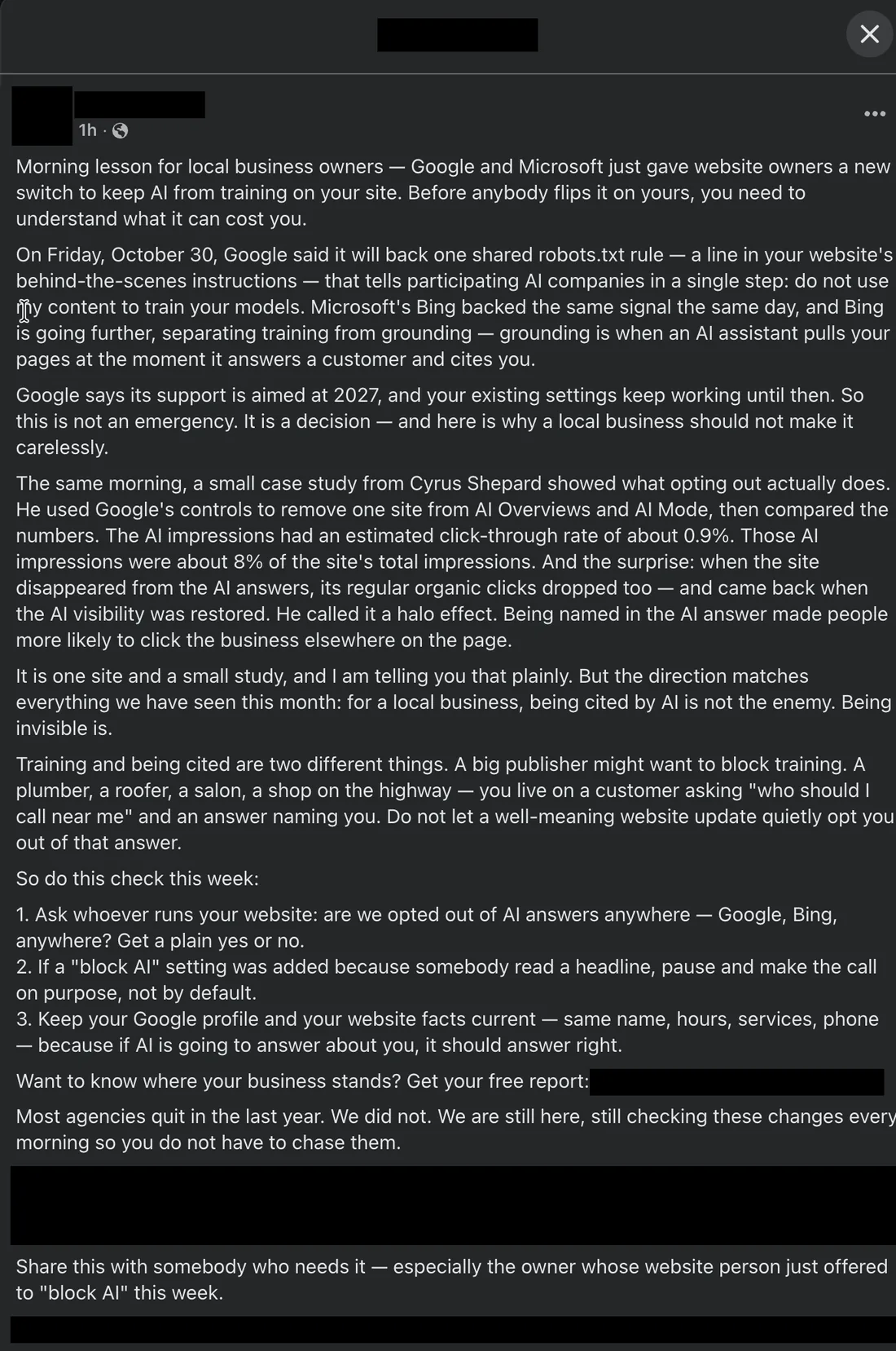
Much of it holds up. The dates are right, it calls the study small, and it says plainly that this is not an emergency. "Training and being cited are two different things" is exactly correct.
The trouble is the bridge in the middle. It introduces the new training switch, then says a case study "showed what opting out actually does." That study never touched the training switch. The rest of this article separates the pieces.
What Google and Microsoft Actually Announced on October 30, 2026
Both companies announced support for the same signal, but on different terms. Here is what each one committed to.
Google's Search Central announcement says it plans to support a shared "policy token" in robots.txt, so site owners can state a training preference across participating AI providers in one step. Google says it aims to support this in 2027. Its crawler documentation narrows that to early 2027.
Microsoft's Bing announcement goes further. It adopts the same training signal and adds a separate page-level grounding preference, both honored as it crawls starting February 1, 2027.
OpenAI said the same day that it will honor the signal for foundational generative AI training, and that it aims to implement it "in the coming months." Its existing crawler controls stay in place. PPC Land reports that Anthropic is participating too. Anyone not participating has made you no promise.
The Standard Is Not Finished
The signal comes from an Internet-Draft filed October 30, 2026. The tracker lists it as an individual draft at version 00, and the document itself says it has no formal standing in the IETF standards process. Google calls it a "draft proposal" too.
That does not make it unimportant. It does mean the wording can change, so nobody should describe it as a universal block on AI. It is a stated preference that participating companies have said they will honor.
AI Training, AI Grounding and AI Search Are Different
Most of the confusion comes from three jobs getting called "AI." Each one answers a different question about your content.
| Job | Plain meaning | Example | What you might gain or give up |
|---|---|---|---|
| Training | Your content helps build a future AI model | A model's learned parameters change | Control over that use. Microsoft says allowing it can help improve future models, with no promise of traffic |
| Grounding | Your page is pulled in to inform an answer as it is generated | Copilot or Gemini Apps answering a question | Citations and links, plus the visibility that comes with them |
| AI search features | Your site appears inside a search engine's AI results | AI Overviews and AI Mode | Links and impressions inside those features |
Those lines blur in practice, and they do not fall in the same place at each company. The chart below maps each control to what it changes, based on what Google and Microsoft have published.
Note the Regular Search column. Google says Google-Extended is not a ranking signal, and Microsoft says its preferences don't change eligibility for traditional Bing results. Blocking regular crawlers is a separate decision with far bigger consequences, so don't let the two get mixed up.
Why Google-Extended Makes the Answer More Complicated
This is the part of the warning that has real teeth, and it comes straight from Google's own documentation. The post never mentions it.
Google-Extended is one token doing two jobs. Google's documentation says it manages Gemini model training and also grounding in Gemini Apps and in Grounding with Google Search on Vertex AI. Google's announcement adds that if you opt out with the shared token and don't name Google-Extended, it plans to read that as if you had disallowed Google-Extended.
The announcement also says sites that "specifically allow Google-Extended are eligible to appear in responses and receive clicks via grounding in Gemini Apps." Put those together and a plain training opt-out looks likely to take you out of Gemini Apps answers. That is our reading of the documents, since nobody can test a signal Google does not honor yet.
Here is how the two choices would look in robots.txt, based on the syntax Google and Microsoft have published. Don't paste either one until you have made the decision on purpose.
# Option A: opt out of training with participating providers.
# Google plans to read this as disallowing Google-Extended.
User-Agent: __usage_ai-training
Disallow: /

# Option B: same as above, plus an explicit Google exception.
# Keeps Gemini Apps grounding eligibility, and also keeps Gemini training.
User-Agent: __usage_ai-training
Disallow: /

User-Agent: Google-Extended
Allow: /
As documented today, Google offers no way to split those two inside Google-Extended. You can't refuse Gemini training while keeping Gemini Apps grounding the way Microsoft lets you split the two.
What Google-Extended does not control is AI Overviews or AI Mode. Google's documentation says it "does not impact a site's inclusion in Google Search," and those features have their own Search Console control.
The shared robots.txt signal is not live. Microsoft starts honoring it February 1, 2027, and Google is aiming for early 2027.
What the Cyrus Shepard Experiment Actually Tested
The study is real and worth reading. It just tested something else.
Cyrus Shepard described it in a LinkedIn post as an "admittedly small case study." Barry Schwartz covered it for Search Engine Roundtable on October 30, 2026. Schwartz reports that Shepard used Google's Search generative AI opt-out controls to keep one site out of AI Overviews and AI Mode for a period, then compared the numbers.
Here is what he reported, for that one site:
- AI impressions fell to zero right away. They had been about 8% of the site's total impressions.
- AI impressions had an estimated click-through rate of about 0.9%. He got that by working backward from overall click data, so it is an estimate and not a direct measurement.
- Regular organic clicks also fell while the site was out of the AI features, which he called the most surprising result.
- Average position rose sitewide, which he put down to new posts and brand search. On the URLs with the most AI visibility, position dropped and then rose when AI visibility came back.
Both write-ups include the chart below. Neither labels the report, but we read it as his AI impressions, since the line hits zero while the site stayed in regular search.
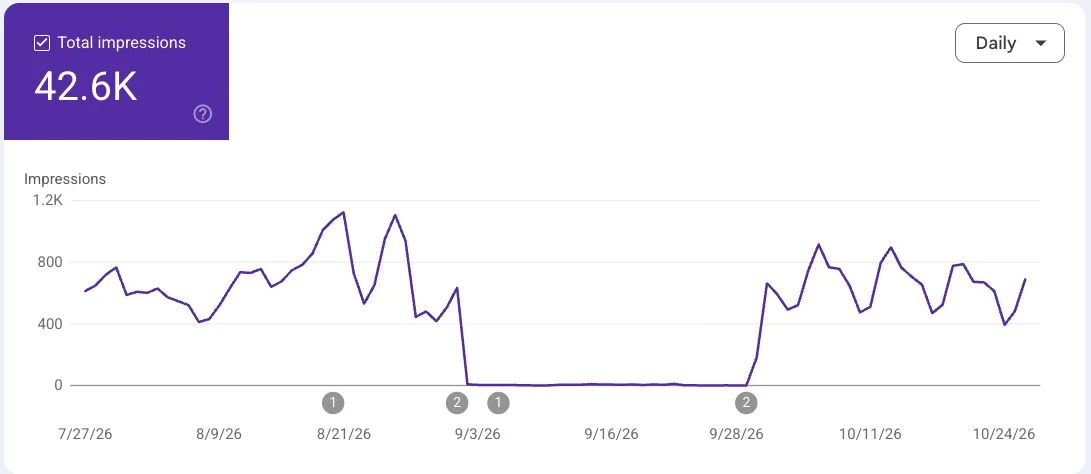
Shepard's explanation is a "Search SERP Halo Effect": appearing in more places on a results page makes a click somewhere more likely. It's a reasonable idea. He offered it as a possibility, and the post states it as what happened: being named "made people more likely to click."
One detail is still unsettled. Shepard's post doesn't name his method, and Search Engine Land's October 29 write-up says he didn't disclose it, so Schwartz's account is the only one we found that does. That timing matters too: the study was already public the day before Google and Microsoft made their announcements, and the chart suggests the opt-out itself ended about a month earlier, around September 28.
What the Experiment Cannot Prove
A result from one site can be a good reason to run more tests. It can't tell a plumber what will happen to their phone.
It did not test the new signal. The test appears to have finished weeks before the signal was announced, and no provider honors it yet. If Schwartz has the method right, the control used is a different mechanism too. Google's help page says of it: "This control doesn't affect AI training."
It can't show cause. One site, one before-and-after comparison, with new posts and brand searches moving during the same period. Search Engine Land notes he did not share the site's traffic volume, the test dates or the size of the click decline. The dates we mention are read off his chart, so treat them as approximate. Schwartz calls it "super limited" and says he hasn't seen anyone else produce data like it.
Google also says the control "isn't used as a ranking or inclusion signal affecting other parts of Search," so a penalty is an unlikely explanation for the drop, though not one this test can rule out.
It says nothing about leads. The study reports impressions, clicks and position. It has no calls, form fills or revenue, and nothing shows the site resembles a local service business. So the idea that invisibility is the real enemy may turn out to be true for local businesses, but this study doesn't establish it.
What it does support is narrower and still useful: if someone removes your site from AI Overviews and AI Mode, watch your regular clicks closely. For the wider pattern of stretched AI search claims, see our look at the viral stats behind AI search panic and our roundup of the worst SEO advice this year.
A Practical AI Visibility Audit for Your Business
The post suggests asking your web person for a plain yes or no on being opted out of AI answers. It's a good instinct, but one answer can't cover five controls. Ask for this instead.
- Read your robots.txt. Open yoursite.com/robots.txt and list every rule naming an AI crawler or token, including Google-Extended, GPTBot, OAI-SearchBot and __usage_ai-training.
- Check Search Console. Under Settings, look at Search generative AI. Include is the default, and a parent property can pass its setting down.
- Check page-level tags. Look for nosnippet, max-snippet and noindex, plus NoArchive and NoCache. Google lists the first three among the controls that limit what appears from your pages in Search.
- Look past your own site. Plugins, security tools and CDN settings can block crawlers without touching the settings above. Test what a crawler actually receives, for example with the URL Inspection tool in Search Console.
- Record each provider separately. OpenAI, for example, documents separate settings for search (OAI-SearchBot) and training (GPTBot). "We block AI" is not a useful entry.
- Take a baseline before any change. Note the date, who changed what and why. Pull the Generative AI performance report in Search Console and your actual calls and form fills.
Keep your Google Business Profile and website details accurate as well. That won't change any training preference, but conflicting business info can hurt AI recommendations, and it is cheap to fix. Our free AI Search Self-Check gives you prompts to run and a scorecard to fill in, and our guide to tracking AI visibility over time covers the follow-up.
One Deadline Worth Checking Now
If your site uses NoArchive or NoCache, Microsoft wants you to act. After March 1, 2027, it will stop reading those tags as training or grounding preferences, and both new preferences default to Allow. Microsoft says sites not using those tags need no transition action. Check anyway, because a tag someone added years ago could stop meaning what they intended.
“I wish we would have switched sooner. Advanced Office Care was forced to switch services when the big corporate giant we were using decided to discontinue those services. Not only did BlackSheep make the transition easy, Clint and his team also offers more for your money.”
Should Small Businesses Block AI Training?
There isn't a universal answer, and anyone giving you one is guessing. The evidence on what this does to a local business's leads doesn't exist yet.
So decide based on what you are protecting and what you want found. This table is our judgment, not a finding from any study.
| If this describes you | A reasonable starting point |
|---|---|
| Your site mostly lists services, areas and contact details, and you want to be named in answers | Leave grounding and AI search features alone. Training is your call, but if you opt out, decide on purpose what to do about Google-Extended |
| You sell original content, research, courses or paid knowledge | Blocking training is a sensible choice. Weigh the Gemini Apps tradeoff against what that content is worth |
| You object to AI training on principle | That is a legitimate reason. Microsoft lets you refuse training and allow grounding. At Google, expect to give up Gemini Apps eligibility |
| A few pages are sensitive or premium, and the rest are marketing | Use path or page-level settings where they exist, so one rule doesn't cover the whole site |
| You have no idea what is set today | Run the audit above first and change nothing until you know |
Keep your expectations modest either way. Microsoft says "Neither choice guarantees inclusion, traffic, or payment." Allowing everything won't get you cited by itself. As we covered in what actually earns AI citations, that comes from useful pages and a real reputation. If AI tools skip you today, the usual reasons have little to do with this signal.
Get a Clear Answer Before You Change Your Website
The announcements are real, and so is the study. They just aren't about the same switch. Nothing here needs a rushed change this week, apart from finding out what your site says today.
If you want help reading those settings and measuring the result, our answer engine optimization team and SEO service start with what is actually on your site. We can't promise citations or rankings, and nobody honest can. We can tell you what each setting does and what you would be trading.

Ready to put this to work?
Talk to the people who would actually build it.
About the author

Co-Founder & Lead Developer · Denham Springs, LA
Clint has been designing for clients since 2008 and co-founded BlakSheep Creative in 2018. He is also a 29-year firefighter and a 23-year member of IAFF Local 557, which is where the bias toward plain answers over sales copy comes from.
- Veteran-owned
- Firefighter-owned
- IAFF Local 557
Common Questions About AI Training Opt-Outs and AI Search
These are the questions we expect owners to ask their web person this month. Each answer sticks to what Google and Microsoft have published as of October 31, 2026.
Does blocking AI training remove me from Google?
Does Google-Extended control AI Overviews?
Can I allow AI grounding but block training in Bing?
What does the new robots.txt signal do?
Will blocking AI training lower my rankings?
How can I check my website's current AI crawler settings?

Your next step, without the guesswork
No surprises, clear next steps, and a fixed price before anything starts.