By Clint Sanchez · Published · 10 min read
Quick answer
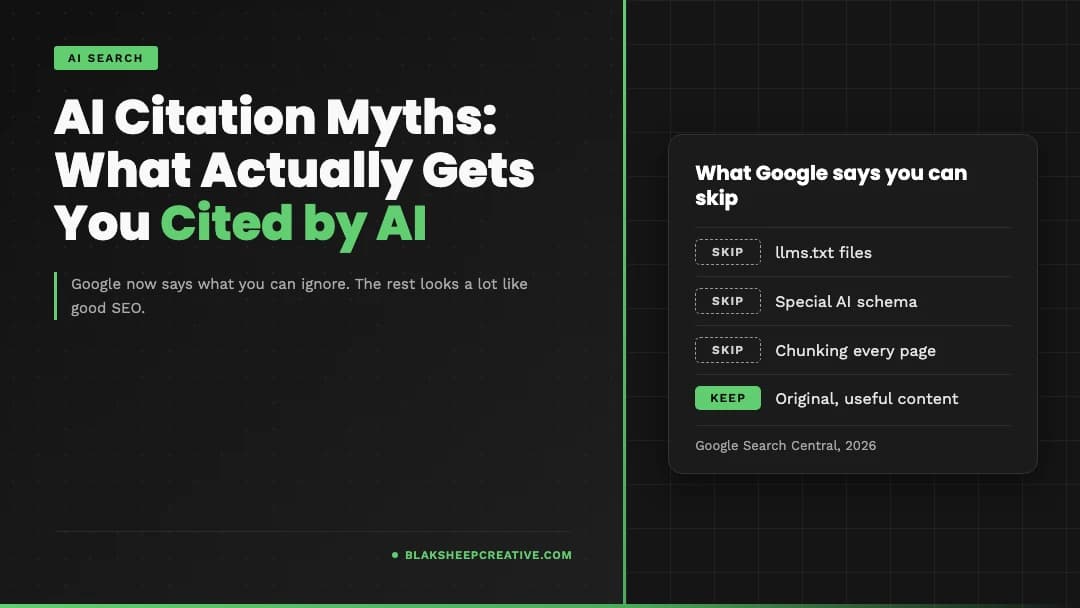
There's no secret. Google's 2026 guide on generative AI search says optimizing for AI search is still SEO, and that you can ignore llms.txt files, special AI markup and "chunking" content for Google Search. What earns AI citations is the same work that earns rankings: original, useful content on crawlable pages, kept current, backed by real reviews and mentions.
Key takeaways
- Google's May 2026 guide calls optimizing for generative AI search "still SEO" and includes a myth-busting section on AEO and GEO advice.
- Google Search ignores llms.txt files. Creating one will neither help nor hurt your Google visibility.
- No special schema.org markup is required for AI Overviews or AI Mode, though structured data still helps with rich results.
- You do not need to chop pages into tiny chunks or rewrite your whole site for AI.
- Inauthentic mentions are not worth chasing. Real reviews, real press and real forum answers are.
- Nobody can guarantee an AI citation, and no third-party tool has access to Google's internal AI systems.
- Search Console now reports how often your pages appear in Google's AI features, at no cost.
We build answer engine optimization for local service businesses from Denham Springs, Louisiana. The honest version of our pitch is that most “AI SEO” is regular SEO done well, so here are the myths owners hear most and where to spend instead.

Want this handled instead of DIY?
A 15-minute call, no script, no pressure. You leave with a plan either way.
Getting your business named in ChatGPT, Perplexity or a Google AI Overview has become the newest thing to sell. The pitches promise a secret file, a special kind of markup, or a full content rewrite that will make AI tools cite you.
Most of it does not hold up. Google said so in writing this year, and the most careful industry guides agree with Google more than they agree with the pitches.
Is There a Secret to Getting Cited by AI?
We build answer engine optimization for local service businesses from Denham Springs, Louisiana. That puts us in a strange spot: the honest version of our pitch is that most "AI SEO" is regular SEO done well. Below are the most common myths, what the sources actually say, and where to spend your money instead.
Where the AI Citation Misinformation Comes From
Most AI citation advice comes from two places: real research stretched past what it shows, and sales pitches that need AI search to sound brand new. A new label makes it easier to sell a new retainer.
The demand behind those pitches is real. BrightLocal’s 2026 consumer survey found 45% of consumers have used an AI tool for a local business recommendation, up from 6% a year earlier. Being cited pays, too: in Seer Interactive’s 2025 click-through data, brands cited in an AI Overview earned 35% higher organic click-through than on AI Overview queries where they weren’t cited.
Even Google noticed. Its guide to optimizing for generative AI features, published in May 2026, says many suggested AEO and GEO "hacks" are not effective or supported by how Google Search works. It then lists the ones you can ignore.
To check that list against industry advice, we compared it with Semrush's guide to earning citations and mentions in AI search, written by Zach Paruch and last updated in February 2026. The two agree on more than the pitches would have you believe. Here is how each myth holds up.
Myth 1: AI Search Needs a Brand-New Strategy
This is the myth the rest are built on. If AI search were a separate discipline, you would need a separate budget for it. The people who build these systems say otherwise.
Google's guide answers the question "Is SEO still relevant for generative AI search?" with "In short, yes!" It explains that its AI features are rooted in its core Search ranking and quality systems. They pull pages from the regular Search index and run extra related searches, which Google calls query fan-out. It also says that from Google's perspective, optimizing for generative AI search "is optimizing for the search experience, and thus still SEO."
Microsoft takes the same position in its guide to AEO and GEO for retailers. It says SEO and catalog investments "built a foundation to expand upon in LLM-based search" and that "traditional SEO remains essential" because AI systems run live web searches. Semrush's guide cites that Microsoft advice and concludes that most AI SEO practices are "extensions of what already works in traditional SEO."
If your pages don't rank, AI tools that pull from search have a harder time finding you. Fix that first, starting with SEO for the pages that bring in customers.
Myth 2: You Need an llms.txt File or Special AI Markup
An llms.txt file is a plain-text file that some people suggest putting on your site to point AI tools at your best pages. It gets sold as a quick fix because it is cheap to make and easy to put on an invoice.
For Google, it does nothing. The generative AI guide says you don't need new machine-readable files, AI text files, markup or Markdown to appear in Google Search, "as Google Search itself doesn't use them." It adds that creating one "will neither harm nor help" your visibility in Google Search, because Google ignores it.
Google's separate page on AI features and your website says the same about AI Overviews and AI Mode: "There are no additional requirements to appear in AI Overviews or AI Mode, nor other special optimizations necessary." If someone charges you for an llms.txt file as a way to get cited by Google, you are paying for nothing. For other AI tools, the verdict is still out. Google itself notes some other services may use these files, so treat one as a cheap experiment, not a citation strategy.
Google's May 2026 guide calls optimizing for generative AI search "still SEO" and includes a myth-busting section on AEO and GEO advice.
Myth 3: Schema Markup Is the Magic Switch for AI Citations
Schema markup is code that describes your business to search engines in a structured way. It is useful. It just isn't a magic switch, and some pitches treat it like one.
Google's myth-busting list includes "overfocusing on structured data." It says structured data is not required for generative AI search and "there's no special schema.org markup you need to add." It also says to keep using it, because it helps pages qualify for rich results in regular search.
So keep accurate schema on your site, and make sure it matches what the page actually says. Don't expect it to earn citations on its own. Google's guide covers Google Search only, so be careful with anyone who claims schema is "the" factor for ChatGPT without showing you the evidence.
Myth 4: You Have to Chop Every Page Into Tiny Chunks
"Chunking" means breaking content into short, self-contained blocks so AI can lift single passages out of a page. This myth has a grain of truth in it, which is why it spreads.
Semrush recommends descriptive headings, short paragraphs and sections that make sense on their own. Its reasoning is that AI tools read content in segments. Google says that is not a requirement: "There's no requirement to break your content into tiny pieces for AI to better understand it." Google says its systems can understand several topics on one page and show people the relevant part.
Both are right in practice. Clear headings and direct answers make a page easier for people to read, and Google's guide also recommends organizing pages with paragraphs, sections and headings. That is a reason to write well. It is not a reason to rebuild every page into fragments. We cover what good structure looks like in our guide to structuring content so AI can use it.
Myth 5: You Have to Rewrite Your Whole Site for AI
This one costs the most when people believe it. A full rewrite is a large invoice, and Google and Semrush both say you don't need one.
Google says you don't need to write in a special way for generative AI search. AI systems understand synonyms and general meaning, so you don't need to cover every long-tail variation of a keyword. Google also warns that making separate pages for every variation of a search can break its scaled content abuse spam policy.
Semrush's FAQ answers "Do You Need to Rewrite All Your Content for AI Search?" with "No." Its advice is to start with your most important pages and apply the same patterns elsewhere once you see results. For a service business, that usually means the homepage, your core service pages and your city pages.
“Absolutely the best to work with. Very kind and responsive. They were very patient with me especially when I have no technical vocabulary. The team explained to me in terms that I could understand. I highly recommend them.”
Myth 6: AI-Written Content Is Either Banned or a Shortcut
One camp says Google punishes anything written with AI. The other says AI can mass-produce pages that get cited. Both are wrong, for the same reason.
Google's 2023 guidance on AI-generated content says appropriate use of AI "is not against our guidelines," and that using AI "doesn't give content any special gains. It's just content." The 2026 guide goes further. It tells site owners not to "just recycle what others on the internet have already said" or publish what "could easily be produced by a generative AI model."
That is the real problem with AI-written pages. If an AI tool could have written your page, it has little reason to cite your page instead of writing the answer itself. We made a similar point in our earlier look at if Google favors AI content.
Myth 7: Buying Mentions Will Get You Cited
Brand mentions do matter to AI tools. The myth is that you can manufacture them. Paid listicles, fake forum posts and bought "best of" placements all get pitched as shortcuts.
Semrush recommends building brand signals through press coverage, expert commentary, guest posts, reviews and joining in forums where AI tools pull information. Every one of those is earned. Google's myth-busting list warns that "seeking inauthentic 'mentions' across the web isn't as helpful as it might seem," because its AI features depend on both its quality systems and its spam systems.
For a local business, the strongest mentions are boring ones: real reviews, accurate directory listings and local press. Keeping that information consistent everywhere matters too, which we cover in why conflicting business info hurts AI recommendations.
Myth 8: A Tool or Agency Can Guarantee AI Citations
No one controls what an AI tool says. Anyone who promises a citation is promising something they cannot deliver.
Google's own guide says that even a page that meets every requirement is not guaranteed to be crawled, indexed or shown: "Indexing and serving aren't guaranteed." On tools, it is blunt: "No third-party tool has access to our internal ranking or AI systems." It says to use them if they help your workflow, but to check their advice against Google's official guidance.
Tracking tools are useful for seeing trends. Semrush, which sells one, presents it as a way to check how your citations change after you make updates. That is a fair use. A guarantee is not.
Google Search ignores llms.txt files. Creating one will neither help nor hurt your Google visibility.
What Actually Earns AI Citations
Strip out the myths and what's left is short. It is also the part where Google and Semrush agree almost completely.
Here is the same list with the reasoning behind each item:
| What to do | Why it matters | Who says so |
|---|---|---|
| Publish original, first-hand content | AI tools have little reason to cite a page that repeats what everyone else says | Google and Semrush |
| Keep pages crawlable and indexable | Google's AI features can only use pages that are indexed and eligible to show a snippet | Google and Semrush |
| Keep information current | Google's AI features retrieve relevant, up-to-date pages; Semrush recommends refreshing old stats and examples | Google and Semrush |
| Keep your Google Business Profile complete | Google says Business Profiles help your services show up in AI responses | |
| Earn real reviews, press and mentions | Brand signals help, but only authentic ones | Google and Semrush |
None of these are new. That is the point. A business that has been doing honest, local SEO is already most of the way there.
How to Check If AI Is Citing Your Business
You don't need a paid tool to start. Google now gives you the data for its own AI features.
Google launched Generative AI performance reports in Search Console in June 2026 and finished rolling them out to all websites on August 31, 2026. They show how often your pages appeared in AI Overviews, AI Mode and Discover, which pages appeared, and in which countries and on which devices.
For ChatGPT, Perplexity and Gemini, the simplest check is to ask them the questions your customers ask and note who gets named. We walk through a repeatable way to do that in our guide on how to tell if AI is recommending your business.
The Bottom Line on AI Citations
Most of what gets sold as an AI citation strategy is either regular SEO with a new label or a shortcut Google now says it ignores. The businesses that get cited are the ones with useful, original pages, a sound site and a real reputation.
If you want help with the parts that matter, our generative engine optimization service starts with an honest look at where you stand and skips the hacks.

Ready to put this to work?
Talk to the people who would actually build it.
About the author

Founder & Lead Developer · Denham Springs, LA
Clint has built and marketed websites for 26 years, since founding BlakSheep Creative in 2000. He is also a 29-year firefighter and a 23-year member of IAFF Local 557, which is where the bias toward plain answers over sales copy comes from.
- Veteran-owned
- Firefighter-owned
- IAFF Local 557
What Business Owners Ask About Getting Cited by AI
These are the questions that come up most once the myths are cleared away. Each answer sticks to what Google, Microsoft and Semrush have actually published.
How do I get my business cited by AI?
Does Google use llms.txt files?
Do I need schema markup to show up in AI Overviews?
Is AEO different from SEO?
Will AI-written content hurt my chances of being cited?
How can I tell if AI is citing my business?

Your next step, without the guesswork
No surprises, clear next steps, and a fixed price before anything starts.