
By Clint Sanchez · Published · Updated · 7 min read
Quick answer
Answer engine optimization and traditional SEO differ in what they win. Traditional SEO wins a ranked position so somebody clicks through to your site. AEO wins the answer itself, so your business gets named inside a featured snippet, a voice reply, or an AI summary. The underlying work overlaps heavily. The measurement, and the payoff, do not.
Key takeaways
- Traditional SEO optimizes the page for a click; AEO optimizes a passage inside the page to be quoted, often with no click at all.
- Pew tracked 68,879 Google searches in March 2025 and found users clicked a result on 8% of visits when an AI summary appeared, against 15% when none did.
- Clicks on sources cited inside AI summaries happened on just 1% of visits, so AEO is brand visibility work rather than a traffic replacement.
- Google states there are no additional requirements or special optimizations, and no special schema, needed to appear in AI Overviews or AI Mode.
- A page must be indexed and eligible for ordinary Google snippets before it can appear in any AI feature, which makes technical basics the prerequisite.
- Google's query fan-out means one question triggers several searches, so pages answering a cluster of related questions have more chances to be pulled in.
- Measure SEO on position and clicks; measure AEO on branded search, direct traffic, and a monthly manual check of what assistants name.
When someone in Baton Rouge asks an AI assistant who to call for a roof leak or a cracked slab, the assistant names one or two businesses, not ten blue links. A Denham Springs contractor whose site answers plain questions, carries LocalBusiness schema, and matches its Google Business Profile has a chance of being that name; a site built only for rankings usually does not.

Want this handled instead of DIY?
A 15-minute call, no script, no pressure — you leave with a plan either way.
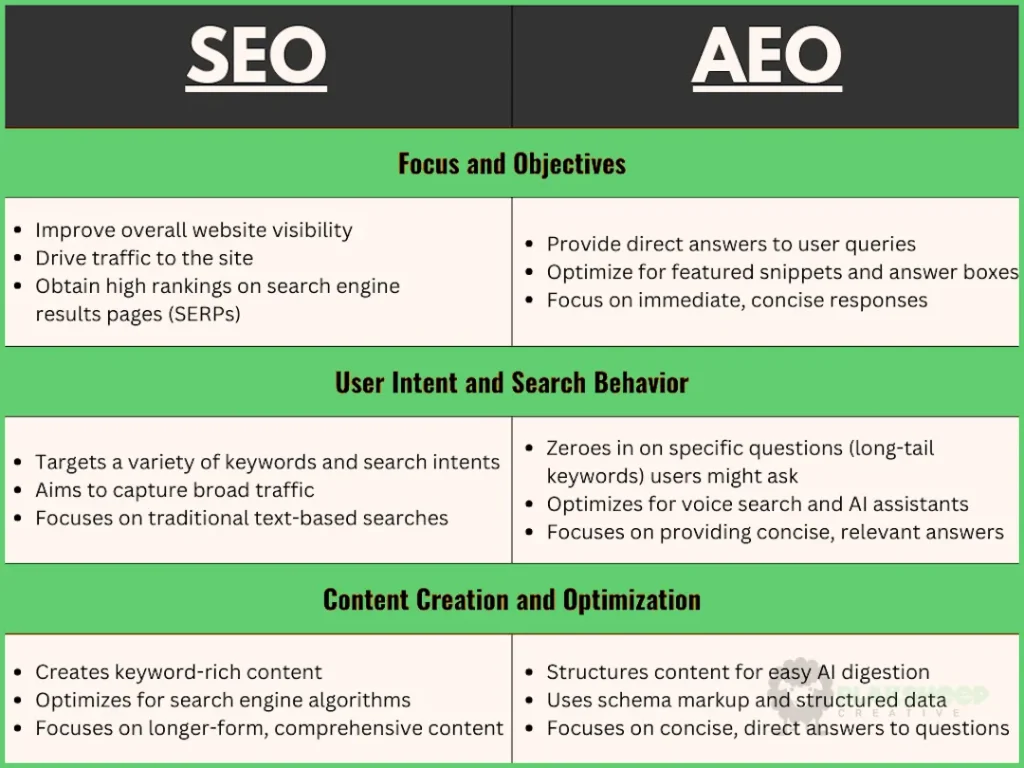
Answer engine optimization and traditional SEO differ in what they are trying to win. Traditional SEO wins a ranked position so somebody clicks through to your site. AEO wins the answer itself, so your business gets named inside a featured snippet, a voice reply, or an AI summary. The underlying work overlaps heavily. The measurement, and the payoff, do not.
How answer engine optimization differs from traditional SEO
Set the two side by side and the differences are narrower than the marketing around them suggests. Both need crawlable pages, accurate information, and content that matches what a person asked. They diverge on the unit of success: a ranked URL against an extracted passage.
| Traditional SEO | Answer engine optimization | |
|---|---|---|
| Goal | Rank a page so a person clicks it | Have a passage quoted, with your name attached |
| Unit of work | The page | The passage, section, or list inside the page |
| Query shape | Short keyword phrases | Full questions and conversational phrasing |
| Structure | Title, headings, internal links, links earned | Question headings with a self-contained answer directly beneath |
| Primary payoff | A session on your site | A mention when there may be no session at all |
| Measured by | Position, clicks, click-through rate, sessions | Snippet and AI citation appearances, branded search, assistant mentions |
The practical consequence is where the answer sits on the page. Traditional SEO tolerates a preamble because a reader who clicked will scroll. An answer engine will not scroll for you. If the answer to the heading is in paragraph four, the passage that gets extracted is paragraph one, and paragraph one was throat-clearing.
How effective is AEO compared to traditional SEO
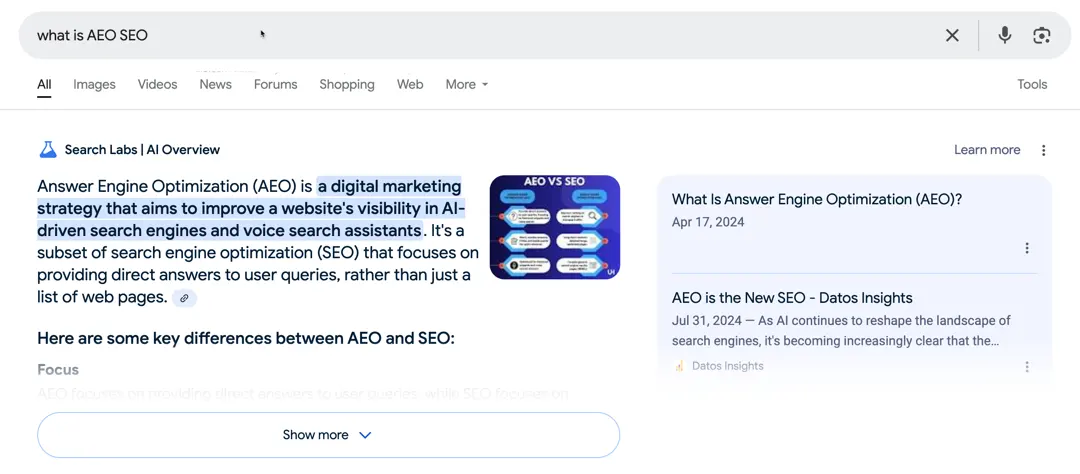
This is the question worth being honest about, because the two are not competing for the same outcome. Traditional SEO produces sessions you can attribute. AEO produces visibility you often cannot, and it grows in a channel where the click is disappearing.
The Pew Research Center tracked 68,879 Google searches from 900 US adults during March 2025 and measured what happens when an AI summary appears.
Users clicked a traditional search result on 8% of visits when a summary was present, against 15% when it was not. Clicks on the sources cited inside the summary happened on 1% of visits. Sessions ended after an AI summary 26% of the time, against 16% for ordinary results.
Two conclusions follow, and they pull in different directions:
- AEO is not a traffic strategy. Being cited inside an AI summary earned a click on 1% of visits. Anyone selling AEO as a way to replace lost organic sessions is selling the wrong thing.
- Traditional SEO is losing volume where summaries appear. 18% of searches in that sample produced an AI summary, and the click rate on those roughly halved. Doing nothing is not a neutral choice.
The honest framing is that AEO is brand work carried out inside search results. Its return shows up as recognition, branded searches, and direct calls rather than as a traffic line in analytics. For a local service business, that is often worth more than a session, because the person hearing your name from an assistant has already been pre-sold. We looked at how that plays out regionally in how Louisiana businesses show up in AI search.
What Google actually says you need to do
Most AEO advice implies a hidden checklist. Google's own documentation says the opposite, and it is worth reading before you buy an AEO package.
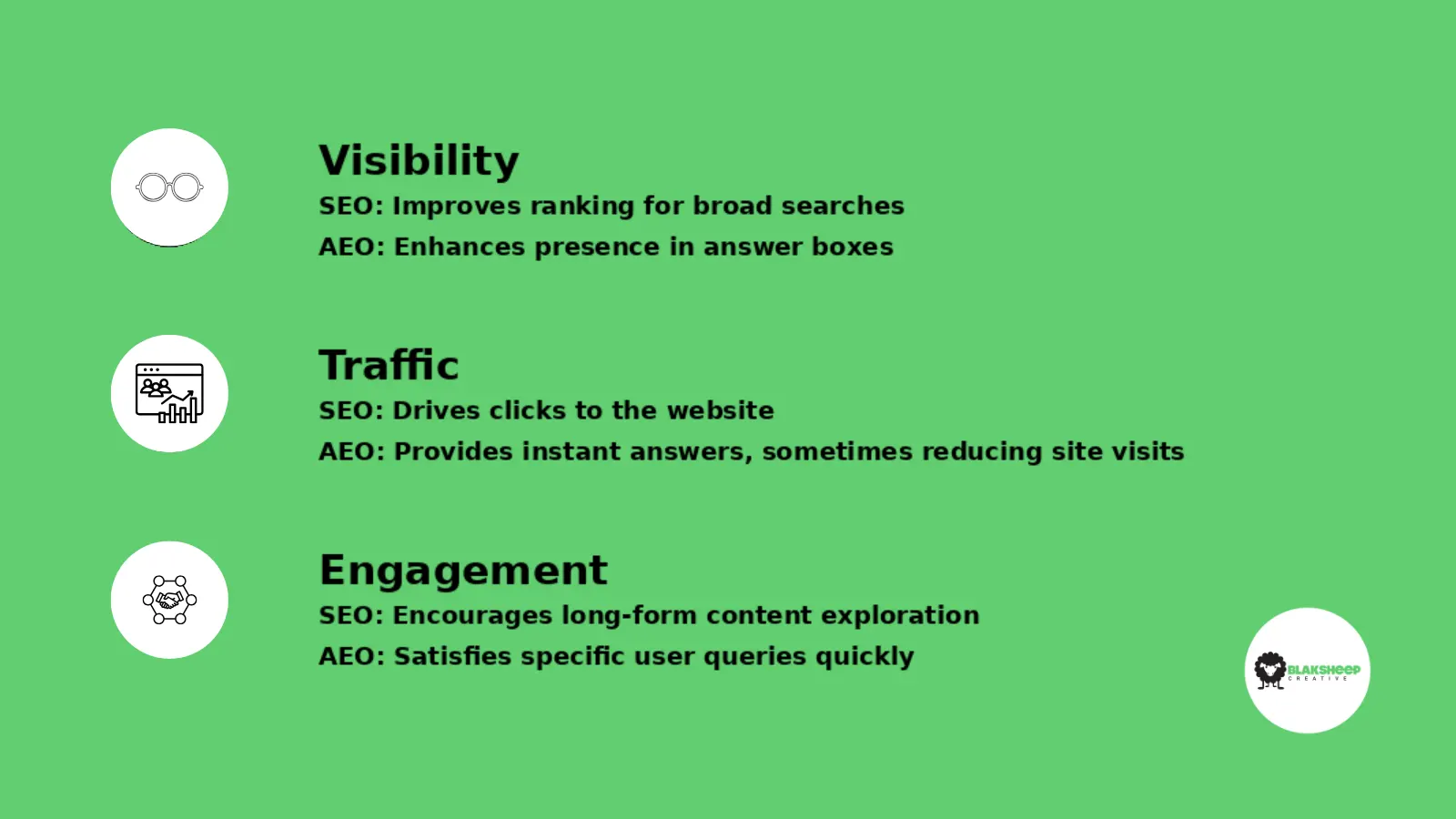
In its guidance on AI features in Google Search, Google states: "There are no additional requirements to appear in AI Overviews or AI Mode, nor other special optimizations necessary."
It goes further on the files and markup being sold as AEO deliverables: "You don't need to create new machine readable files, AI text files, or markup to appear in these features. There's also no special schema.org structured data that you need to add."
The eligibility rule is plain. A page has to be indexed and eligible for ordinary Google snippets before it can appear in an AI feature. Google also describes a query fan-out technique, where the system issues several related searches behind one question and surfaces a wider set of links than a normal results page would.
That last detail is the actionable part. If one question triggers several searches underneath, a page that answers a cluster of related questions clearly has more chances to be pulled in than a page targeting one keyword. Schema still earns its place for rich results and for describing your business unambiguously, which we covered in what schema markup does. It is not a magic key to AI answers, and no honest answer engine optimization proposal should say it is.
What actually changes when you write for answer engines
If Google says no special optimization exists, what is left is craft. The changes are small and they apply to every page, not to a separate AEO content type.

- Answer in the first two sentences under the heading. Not after context, not after a definition of the industry. A passage that needs the paragraph above it to make sense cannot be extracted.
- Write headings the way people ask. "How much does a slab leak repair cost" pulls better than "Pricing."
- Keep one term for one thing. Switching between "answer engine optimization," "AEO," and "AI SEO" in the same article makes the passage harder to reuse. Pick one and define it once.
- Give numbers a source and a date in the sentence. Models weight attributable claims, and readers do too.
- Make lists and tables genuinely parallel. A comparison table with consistent columns is the easiest thing on a page to lift.
- Say who you are and where. Named authors, a real address, and consistent business details matter more when a machine is deciding if you are a credible source.
None of that hurts a human reader. That is the test for any AEO tactic: if it makes the page worse to read, it is not AEO, it is formatting for its own sake. The mechanics are in how to structure content so AI actually uses it.
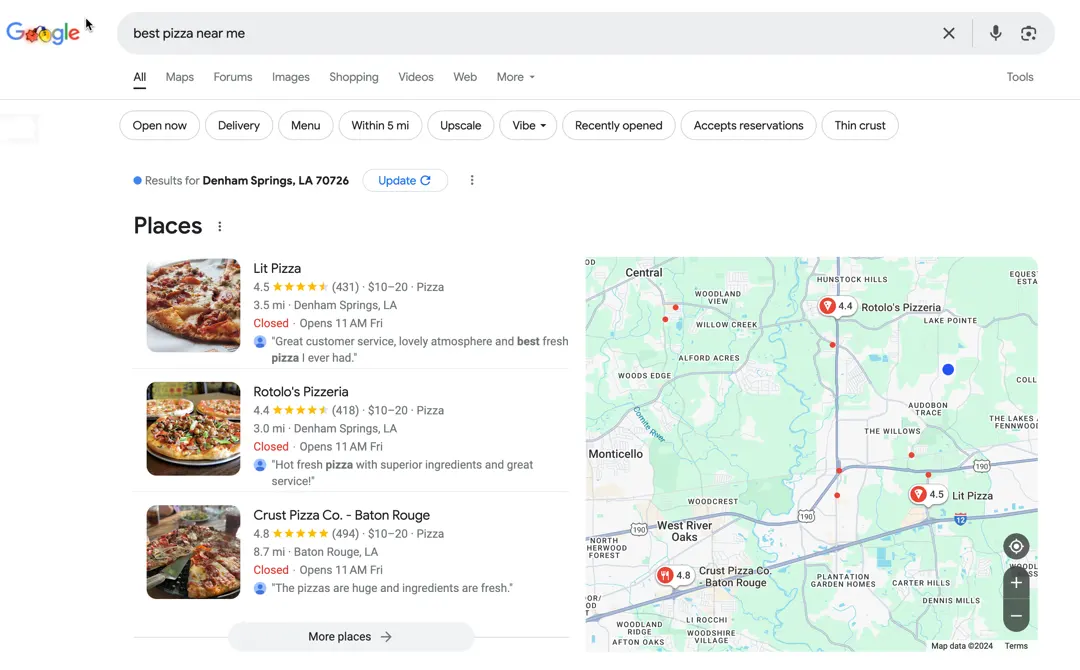
Traditional SEO optimizes the page for a click; AEO optimizes a passage inside the page to be quoted, often with no click at all.
The part that is identical in both
Strip out the vocabulary and most of the work is shared. That is the reason splitting your budget between an SEO vendor and an AEO vendor usually buys the same tasks twice.
Both need pages that are crawlable and indexed. Both need a site that loads on a phone. Both need content that reflects real experience rather than a rewrite of the top three results. Both need consistent business information across your site, your Google Business Profile, and every directory that mentions you. Both are damaged by thin pages generated at scale.
Where AEO adds something genuinely new is in the questions nobody was targeting because they had no keyword volume. Long conversational queries were never worth a page under a traditional model. Under a fan-out model they are exactly what triggers a search. That is where the search work we do and AEO stop being separable.
What to measure for each
Mismatched metrics are the most common way an AEO program gets judged unfairly. Measure each discipline against what it is actually trying to move.
| Measure | Where it comes from | Tells you about |
|---|---|---|
| Position and clicks | Google Search Console | Traditional SEO |
| Impressions rising while clicks flatten | Search Console | Answers being read without a click |
| Branded search volume | Search Console, brand queries | If being cited is registering with people |
| Assistant mentions | Asking the assistants your customers' questions, monthly | AEO presence, crudely but honestly |
| Direct and phone traffic | Analytics and call tracking | People who heard the name and came straight to you |
Checking assistants by hand every month is unglamorous and it is currently the most reliable method available. Ask the ten questions your customers ask, write down which businesses get named, and watch the list change. If your name never appears, the diagnosis is usually structural rather than mysterious, and we listed the common causes in why AI answer engines ignore a site.
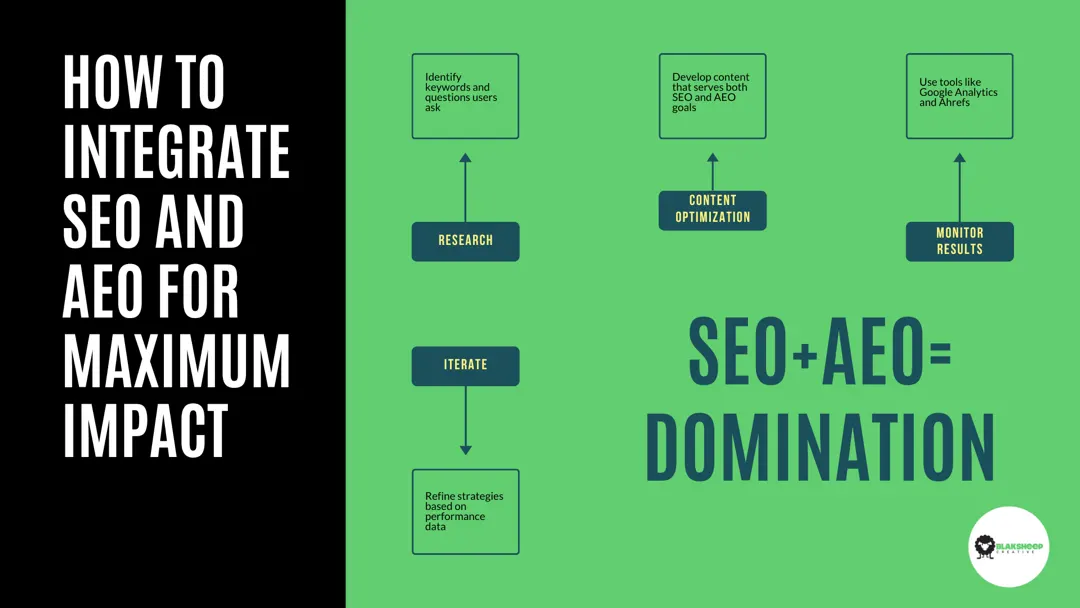
A sensible order of work
Do these in sequence rather than buying them as separate programs. Every step below serves both disciplines, which is the point.
Start with indexing and speed, because nothing appears anywhere if the page cannot be crawled or does not load. Fix your business information next, so your name, address, phone, and hours match on the site, in schema, and on your Google Business Profile.
Then rewrite the top twenty pages so each section answers its heading in the first two sentences. After that, add the question pages nobody was targeting because the keyword volume looked too small. Finally, set the monthly assistant check and let it run for two quarters before drawing conclusions.
If your service business is not being recommended by assistants at all, the structured data on your site is usually the first thing to look at; the specific failure pattern is in the schema fix for service businesses assistants skip.
Where to go from here
Traditional SEO is not dead, and AEO is not a replacement for it. One brings people to the site; the other keeps your name in the answer when there is no click to be had. Pick your ten most valuable customer questions, ask them of Google and of an assistant, and note who gets named. That comparison is the fastest read on where you stand, and it is the starting point for the free audit we run.
About the author

Founder & Lead Developer · Denham Springs, LA
Clint has built and marketed websites for 26 years, since founding BlakSheep Creative in 2000. He is also a 29-year firefighter and a 23-year member of IAFF Local 557, which is where the bias toward plain answers over sales copy comes from.
- Veteran-owned
- Firefighter-owned
- IAFF Local 557
Common questions about seo
What is the difference between answer engine optimization and traditional SEO?
How effective is AEO compared to traditional SEO?
Do I need special schema markup to appear in AI Overviews?
Is traditional SEO dead now that AI answers questions?
How do I track if AEO is working?
Should I hire separate SEO and AEO vendors?

Your next step, without the guesswork
No surprises, clear next steps, and a fixed price before anything starts.