
By Clint Sanchez · Published · Updated · 8 min read
Quick answer
To rank a YouTube video, match one clear search topic and put it in the first few words of the title, the opening lines of the description, and the spoken audio. Upload a custom thumbnail, add corrected captions and chapters, then earn watch time in the first 48 hours. YouTube ranks on relevance and engagement, not on raw view count.
Key takeaways
- YouTube ranks search results on relevance and engagement, and states directly that results are not a list of the most-viewed videos.
- Put the target phrase in the first few words of the title, the first 150 characters of the description, and the spoken audio.
- YouTube says 90 percent of its best-performing videos use a custom thumbnail, so never settle for an auto-generated frame.
- Tags play a minimal role in discovery according to YouTube's own documentation, and are mainly useful for catching misspellings.
- Chapters need at least three timestamps in ascending order, starting at 00:00, with each chapter at least ten seconds long.
- Ranking in Google is a separate job: embed the video on an indexed page of your own site and describe it with VideoObject structured data.
- Watch impressions click-through rate and average view duration. The first diagnoses packaging, the second diagnoses the video.

Want this handled instead of DIY?
A 15-minute call, no script, no pressure. You leave with a plan either way.
To rank a YouTube video, match one clear search topic and put it in the first few words of the title, the opening lines of the description, and the spoken audio. Upload a custom thumbnail, add accurate captions and chapters, then earn watch time in the first 48 hours. YouTube ranks on relevance and engagement, not on view count.
How YouTube search ranking actually works
Before you optimize anything, it helps to know what the two systems in front of you are measuring, because they are not the same system.
YouTube states its search ranking plainly. Results are ordered by relevance, which is "how well the title, description, and video content match the viewer's search", and by engagement, meaning "what videos drive the most engagement for a search". The company is explicit that search results are not a list of the most-viewed videos for a query.
That single line reframes the work. A video with 400 views can outrank one with 40,000 if the smaller one holds attention on that specific query. Relevance is what you control at upload. Engagement is what you earn afterwards, and it is measured against other videos competing for the same search, not against YouTube as a whole.
Google is a separate system with separate rules. A YouTube video can appear in Google Search results, in the video carousel, or embedded on a page of your own, and each of those routes has its own requirements. We cover the crossover in video SEO according to Google.
So there are two jobs here, and this guide handles them in order: make the video legible to YouTube, then make it legible to Google.
Pick a keyword YouTube can rank you for
Most videos fail at this step, before a single frame is shot, by aiming at a phrase already owned by channels with a decade of authority behind them.
YouTube's own advice for creators is to "identify 1-2 main words that describe your video and feature them prominently in both your description and title", and it points you at the Research tab in YouTube Analytics and at Google Ads Keyword Planner to find those words. Both are free.
Three checks before you commit to a phrase:
- Does YouTube autocomplete it? Type your topic into the YouTube search bar and read the suggestions. Those are real queries, ordered by real demand, straight from the platform you are trying to rank on.
- Do videos already rank for it in Google? Search the phrase in Google. If the results page carries a video block, Google has decided the query wants video, and your upload has somewhere to land.
- Can you honestly beat what is on page one? Watch the top three results. If they are thin, dated, or answer a different question than the one being asked, you have an opening.
The temptation is always to chase the biggest number in the keyword tool. We argue the opposite in why chasing high-volume, low-competition keywords is the wrong instinct, and the logic holds on YouTube too. A narrow query you can genuinely win beats a broad one you will never crack. If you want the research handled properly, that is what our keyword research service does.
Title, description, and thumbnail: the fields that do the work
These three fields carry most of the ranking and nearly all of the clicking. Here is what each one allows and what belongs in it.
| Field | Limit | What to put in it |
|---|---|---|
| Title | 100 characters, but search results and suggested tiles truncate around 70 | Target phrase in the first few words, branding and episode numbers at the end |
| Description | 5,000 characters, with roughly the first 150 shown before "Show more" | A two-line summary using the target phrase, then chapters, then links |
| Thumbnail | 16:9, 1280x720 or larger, JPG or PNG, up to 2MB on mobile | One readable idea, high contrast, text large enough to survive a phone screen |
| Tags | 500 characters total | Misspellings of your topic, and little else |
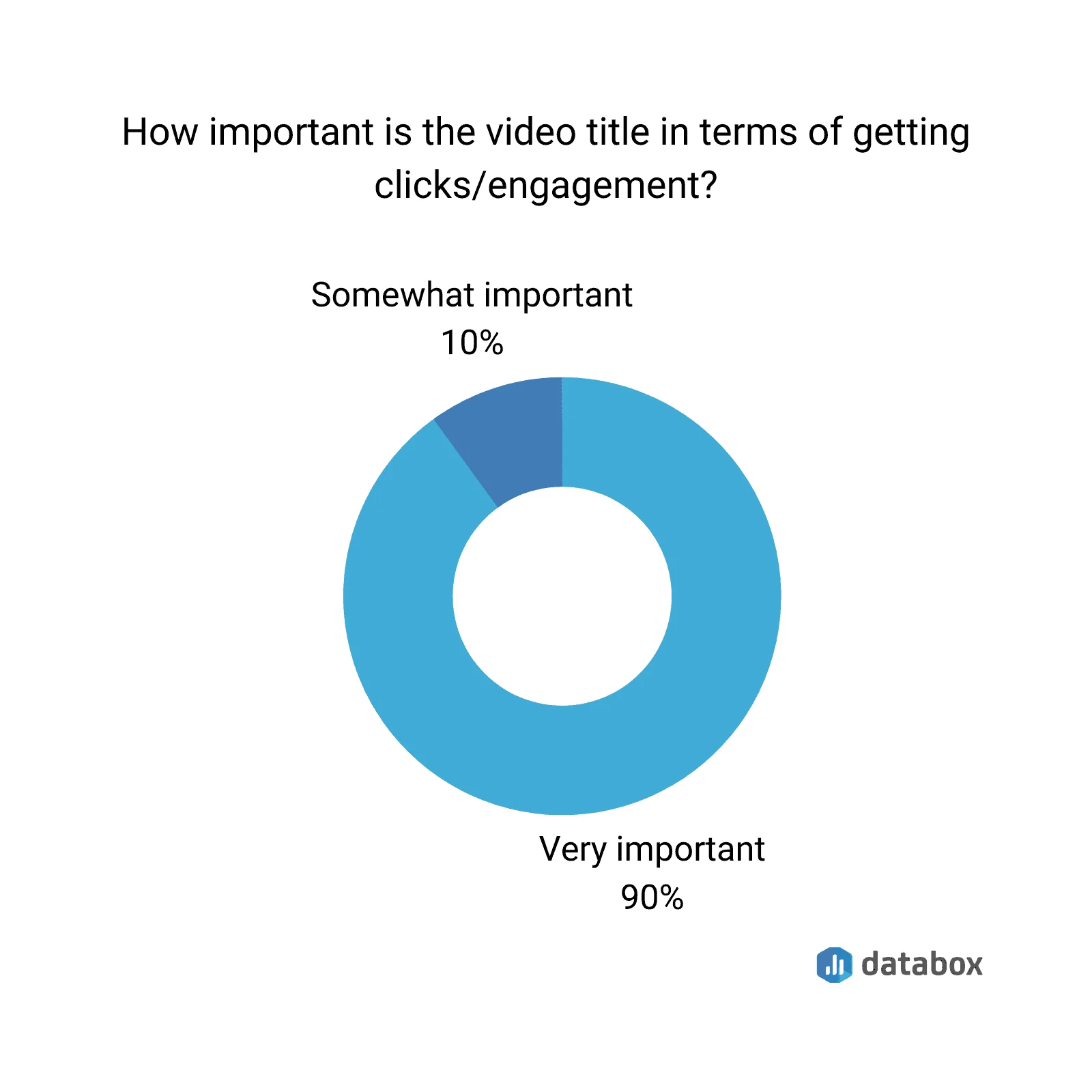
On titles, YouTube tells creators to "be succinct" because "viewers may only see part of your title", and to put the most important words near the beginning. It also asks you to limit all caps and emoji. A title that overpromises is worse than a dull one, since viewers who leave early damage the engagement half of the ranking.
On thumbnails, the number worth remembering is YouTube's own: 90 percent of the best-performing videos on YouTube have custom thumbnails. Auto-generated frames are a wasted asset. You need a verified account to upload one, which takes about two minutes at youtube.com/verify.

Canva's free tier has a 1280x720 YouTube thumbnail preset, which is enough for most channels. Build a template once with your colors and a consistent text position, then reuse it, so your videos become recognisable in a crowded results page.
Do YouTube tags matter?
Barely, and the source on that is YouTube itself, which saves you the hour a lot of creators still spend stuffing the tag field.
YouTube's help documentation says tags play a minimal role in your video's discovery, and that title, thumbnail, and description matter far more. The one case the documentation calls out as genuinely useful is misspellings: if your topic is commonly typed wrong, a tag catches it.
So add four or five tags, include the obvious misspelling of your brand or topic, and move on. Time spent on a hundred tags is time not spent on the first fifteen seconds of the video, which is where the engagement half of the ranking is actually decided.
The same goes for the file name. Naming the upload after your keyword takes two seconds and costs nothing, and there is no harm in doing it, but it is not the lever people describe it as.
YouTube ranks search results on relevance and engagement, and states directly that results are not a list of the most-viewed videos.
Captions and chapters: the parts most people skip
Two upload settings take under ten minutes between them and do more for discovery than anything else in the sidebar.
Captions. YouTube auto-generates a transcript, and it gets names, jargon, and Louisiana place names wrong often enough to matter. Open the auto-caption file in YouTube Studio, correct it, and republish. A corrected transcript gives the platform an accurate text version of everything said in the video, and it makes the video usable for deaf and hard-of-hearing viewers, which is the same reasoning behind our guide to web accessibility.
Chapters. Timestamps in the description turn into a clickable segment list. YouTube's requirements are specific: at least three timestamps in ascending order, the first one starting at 00:00, and each chapter at least ten seconds long. Get any of those wrong and the chapters silently do not appear.
Chapters also feed Google's key moments feature, which can put individual segments of your video into search results as separate entry points. One video, several ways in.
Cards and end screens belong in the same category of small settings with compounding effects. They push a finished viewer into a second video instead of into the recommendation feed, and the session that follows is credited to your channel.
How to rank a YouTube video on Google
Ranking inside YouTube and ranking inside Google Search are different projects, and the second one is usually won on your own website rather than on the YouTube channel.
Google's video documentation sets out what it needs. The watch page has to be indexed and performing in Search before the video is considered for indexing, and the video has to be embedded with a standard HTML element such as an iframe or a video tag, not hidden behind a click or a swipe.
Thumbnails need a single stable URL. Google also asks for consistent metadata through VideoObject structured data, a video sitemap, or Open Graph tags.
In practice, for a small business, that means one thing: embed the video on a page of your own that answers the same question, and describe it in structured data. The page gives Google a watch page it can index and rank, and the embed gives the video a second surface. If structured data is new to you, our post on schema markup after Google's core updates covers why it matters.
Do not skip the obvious part. If your page has no chance of ranking for the query, embedding a video on it will not create one. The video and the written page have to answer the same search, and the page still needs the fundamentals covered in small business search engine optimization.
The first 48 hours decide a lot
Engagement is half the ranking equation, and the earliest signals are the cheapest ones to influence, because you already have the audience.
A promotion checklist that fits in one afternoon:
- Email your list on publish day with the specific problem the video solves, not the fact that a video exists.
- Post it natively where your audience is, with a real first line rather than a bare link. Our notes on using social media for a small business apply here.
- Answer the first comments yourself within a few hours. Comment threads are engagement, and they signal an active video.
- Embed it on a relevant page of your website the same week.
- Find the forum or subreddit where the question is genuinely being asked, answer the question in text, and link the video as support rather than as the answer.
What not to do: buy views. Bought traffic does not watch, which drops your average view duration, which is precisely the metric the engagement half of the ranking is watching.
“BlakSheep made me an Incredible website and they have even better customer service to make sure all my questions were answered.”
What a realistic timeline looks like
Search rankings on YouTube move slowly for a new channel and quickly for an established one, and pretending otherwise is how people quit at video six.
A new channel with no watch history is asking YouTube to take a chance on it. The way through is volume against a narrow topic: eight to twelve videos answering closely related questions, published on a schedule you can actually keep, each one embedded on a matching page of your website. Channels that pick one subject and stay on it accumulate the topical signal that lets the next upload rank faster.
Track two numbers in YouTube Analytics and ignore the rest at first. Impressions click-through rate tells you if the title and thumbnail are working. Average view duration tells you if the video is. A low click-through rate is a packaging problem. A high click-through rate with a low duration is a content problem, and no amount of tag editing fixes it.
Where to start
Pick one question your customers ask you every week, check that YouTube autocompletes it, and record a five-minute answer with the phrase in the first line of the title and the first fifteen seconds of the audio. Correct the captions, add three chapters, upload a custom thumbnail, and embed it on the page of your site that answers the same question.
If you would rather have the research, the optimization, and the page it lives on handled together, our Baton Rouge SEO team does that work as part of every plan.
About the author

Founder & Lead Developer · Denham Springs, LA
Clint has built and marketed websites for 26 years, since founding BlakSheep Creative in 2000. He is also a 29-year firefighter and a 23-year member of IAFF Local 557, which is where the bias toward plain answers over sales copy comes from.
- Veteran-owned
- Firefighter-owned
- IAFF Local 557
Common Questions About Ranking YouTube Videos
Short answers to the questions that come up most on this topic.
How long does it take for a YouTube video to rank?
Do YouTube tags help a video rank?
What is the best length for a YouTube title?
How do I get my YouTube video to show up in Google search?
Do captions improve YouTube rankings?
Should I buy views to help a new video rank?

Your next step, without the guesswork
No surprises, clear next steps, and a fixed price before anything starts.