
By Clint Sanchez · Published · Updated · 11 min read
Quick answer
Restaurants get more Google reviews in 2026 by making the ask easy and honest: one SMS 24 to 48 hours after the visit (SMS converts at 12 to 15 percent, email at 3 to 4), a table-tent QR code with a hand-signed owner note, one sincere sentence from a server when a guest says something nice, a QR on the receipt, and a thank-you email with one quiet link. Gating and incentives get reviews deleted.
Key takeaways
- According to a Harvard Business School study by Michael Luca (2011, revised 2016), a one-star rating increase drives 5 to 9 percent more revenue for an independent restaurant.
- BrightLocal's 2025 survey found top-3 local-pack restaurants average 47 more reviews than ranks 4 through 10.
- Per Emulent's 2026 ranking factors, a review older than 90 days loses about 20 percent of its ranking weight, so recency beats volume.
- SMS review requests convert at 12 to 15 percent versus 3 to 4 percent for email, according to Birdeye.
- Google blocked 292 million reviews and removed 13 million fake Business Profiles in 2025, and 38 percent of deleted reviews were five-star.
- Review-gating, screening guests privately before sending happy ones to Google, is banned under Google's April 2026 policy update.
- Restaurants that respond to reviews earn 35 percent more revenue, and 53 percent of consumers expect a reply within a week.
A Baton Rouge restaurant lives on LSU weekends, crawfish season, and the Friday lunch crowd off I-12, and Google reviews are how those visitors choose between you and the place two doors down. We have watched Denham Springs restaurants lose a third of their review count in 90 days because a prior vendor gated reviews or had staff post from the restaurant's Wi-Fi. The recovery is slow, one or two real reviews a week.

Want this handled instead of DIY?
A 15-minute call, no script, no pressure. You leave with a plan either way.
A Harvard Business School study by Michael Luca, first published in 2011 and revised in 2016, found that a one-star rating increase drives 5-9% more revenue for an independent restaurant (Harvard Business School, Reviews, Reputation, and Revenue: The Case of Yelp.com). The study measured Yelp ratings, but the mechanism, diners trusting a star rating before they trust your food, is the same on Google, and Google is where diners look now. Yet most restaurants try to earn those stars by training servers to beg, slapping QR codes everywhere, or texting guests until they block the number. Spoiler: that doesn’t work anymore. Google’s 2025 AI crackdown deleted 292 million reviews for being shady, and a lot of them came from restaurants doing exactly what their last marketing agency told them to do.
TL;DR
- One extra star is worth 5-9% more revenue for an independent restaurant (Harvard Business School, Luca, 2011, revised 2016).
- Top-3 local-pack restaurants average 47 more reviews than ranks 4-10 (BrightLocal LCRS 2025).
- Recency now beats volume: a review older than 90 days loses ~20% of its ranking weight (Emulent 2026 Local Ranking Factors).
- SMS review requests convert at 12-15%; email crawls along at 3-4% (Birdeye 2025).
Do Google Reviews Really Make or Break a Restaurant?
In 2026, 93% of diners check Google before they pick a restaurant, and 87% won’t even consider a place rated under 4 stars (BrightLocal Local Consumer Review Survey, 2025). That’s not a soft preference. That’s two-thirds of your potential dinner crowd making a yes/no decision before they ever taste your food.
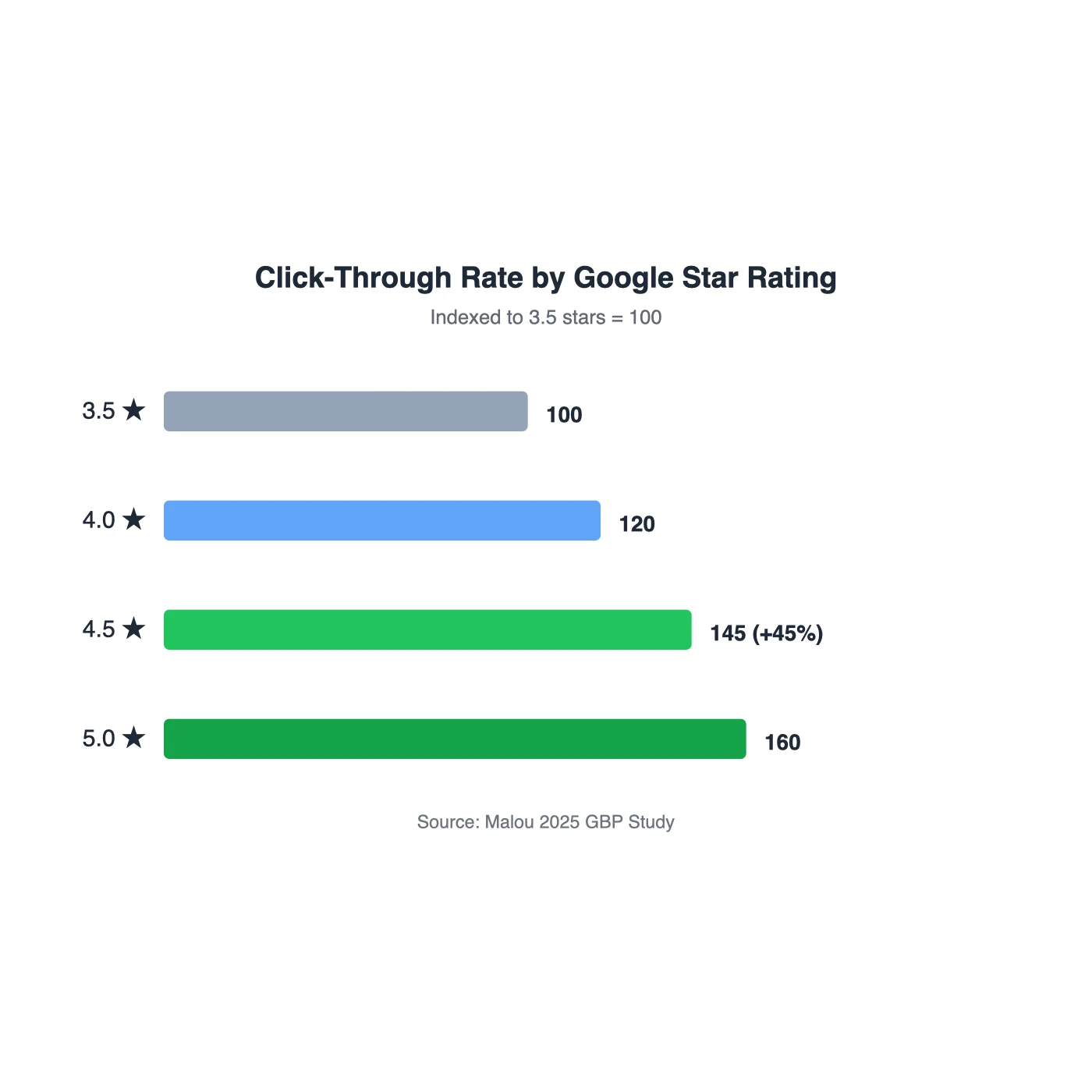
The math gets ugly when you look at click-through rates. Restaurants with a 4.5-star average get 45% more clicks than 3.5-star competitors (Malou 2025 GBP Study, Google Reviews for Restaurants). And businesses ranked 1-3 in Google’s local pack, that little map thing above organic results, earn 126% more consumer traffic than ranks 4-10 (Shapo Google Review Statistics 2025). Half a star is the difference between a packed Friday and a quiet one.
Here’s the part most agencies skip. Google reviews now drive about 16% of the total local-pack ranking weight, up from 14% the year before (Emulent 2026 Local SEO Ranking Factors). That’s bigger than your hours, bigger than your menu photos, bigger than the description that took your marketing manager three drafts to write. Reviews aren’t a vanity metric. They’re the lever.
Job marked complete
Invoice paid · today
The business: Thanks again for your business! If we did right by you, would you mind leaving a quick review? It really helps.
Sent automatically when the job closes.
How Did Google’s 2025 Fake-Review Purge Change the Rules?
Google blocked 292 million reviews and removed 13 million fake Business Profiles in 2025, up from roughly 240 million the year before (Google Maps Spam Report, December 2025). Between January and July, deletion rates jumped over 600%. Even at the slower late-2025 pace, current enforcement still runs about 400% hotter than it did at the start of last year.
Here’s the part that should make you sit down. 38% of the deleted reviews were five-star (Marketing Growth Hub, Google Fake Reviews Crackdown 2025). Google’s Gemini AI doesn’t just hunt the angry one-star revenge jobs from competitors. It hunts pumping schemes, the “everybody in the family writes a glowing review” playbook your last consultant probably sold you for $497.
What Google’s AI flags now: reviews from accounts that only post for your business, reviews left from the same IP cluster, reviews timed in unnatural bursts, reviews that use language patterns recycled from other listings. It also flags accounts that work with a “reputation management” vendor.
We onboard restaurants holding 150-200 Google reviews and routinely watch 30-40% of that count vanish in the first 90 days, usually after a single audit triggered by one of two patterns. First: a legacy “review funnel” app that scored guests privately first, then only sent the happy ones to the public Google form. That tactic, review-gating, is now explicitly banned under Google’s April 2026 Business Profile policy update. Second: a previous vendor that seeded reviews from staff accounts on the restaurant’s own Wi-Fi network or matching device fingerprints. Gemini AI’s pattern detection clears those out roughly 48 hours after an audit fires. The deleted reviews don’t come back, and Google doesn’t accept appeals on policy violations. We’ve never won one. The only path that holds is rebuilding from real guests with a clean SMS or QR follow-up sequence. At a steady 1-2 reviews per week from real diners, most restaurants we work with reach their original review count within 6-9 months, but with reviews that actually rank.
The takeaway: the old game, pump the count, hope nobody notices, is over. The new game is steady, real, and patient. Which is also, conveniently, the only game that works long-term.
Does Review Velocity Really Beat Volume in 2026?
A review less than 30 days old carries its maximum ranking weight. By 90 days, the algorithm has discounted it by ~20%. By 180 days, you’re keeping a fraction of its original juice (Emulent 2026 Local SEO Ranking Factors). Translation: that 200-review pile you collected three years ago is becoming a museum exhibit.
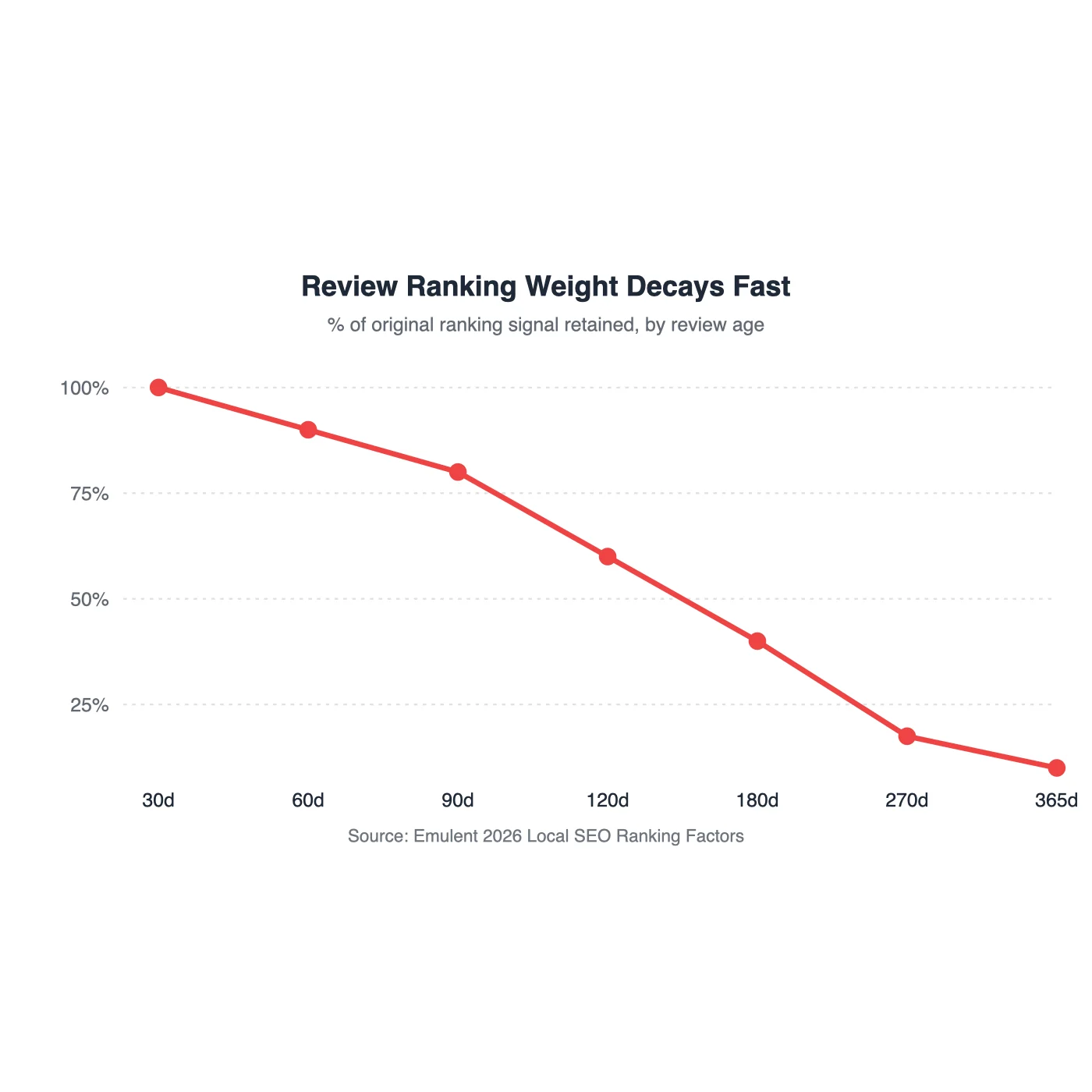
The flip side is good news for smaller restaurants. A competitor with 120 reviews from two years ago is beatable with 60 fresh reviews from the last six months. In hyper-competitive niches, the floor to stay visible is roughly 2.4 new reviews per month (Emulent 2026). For most local restaurants, one or two a week keeps you in the game and lets you nap with the lights off.
The new local pack math: Volume + Rating + Recency + Velocity. Skip any one of those four signals and you’re handing the spot to whoever didn’t.
How Can You Get More Reviews Without Annoying Guests? 5 Tactics That Work
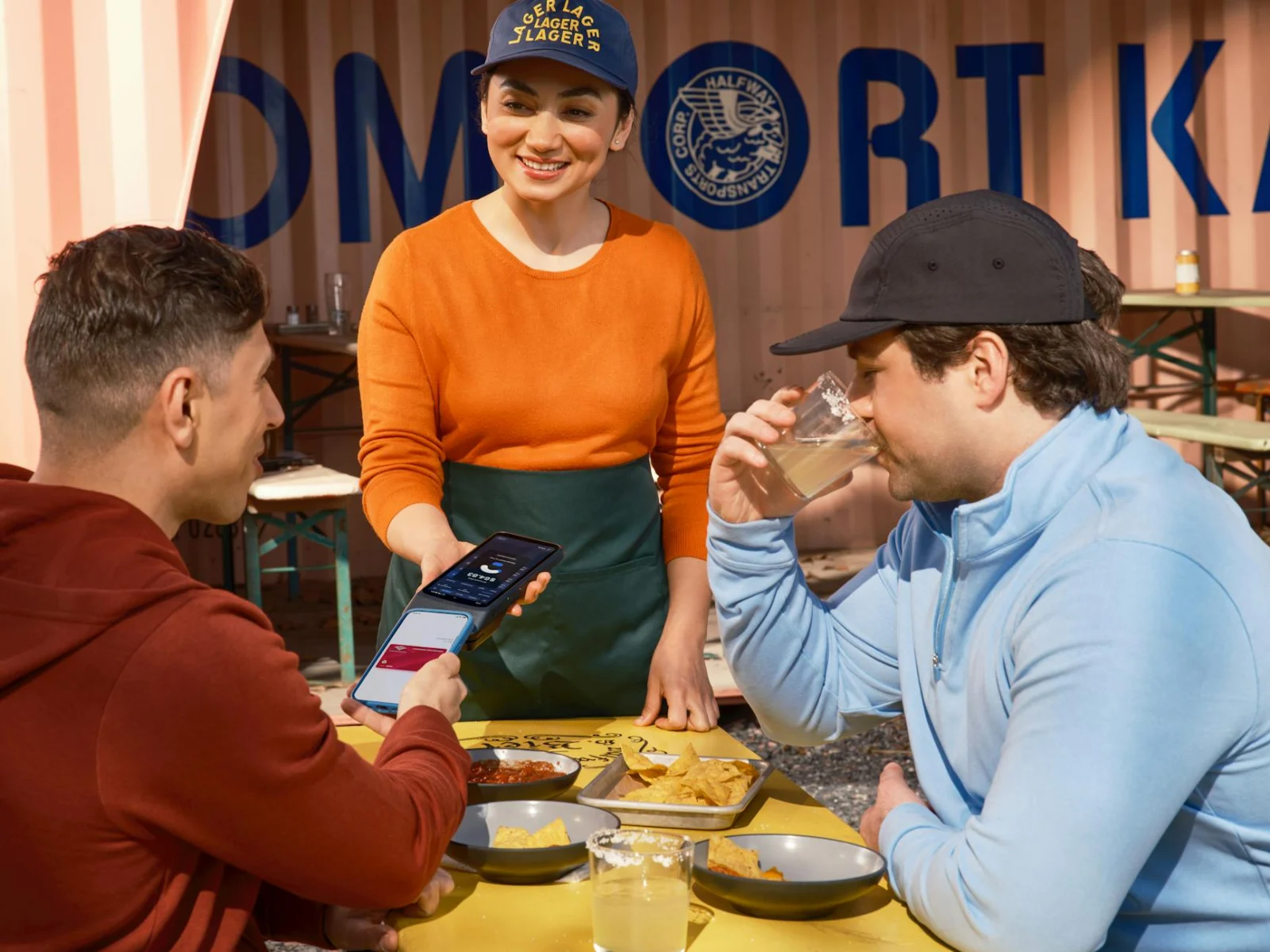
Most “ask for reviews” advice fails because it treats guests like vending machines. The actual problem isn’t unwillingness, 78% of consumers say they’ll share feedback when the process is quick and effortless (Supercode QR Customer Feedback Strategies, 2026). Friction kills review velocity. Begging kills tips. Here’s what works in 2026.
1. SMS follow-up 24-48 hours after the visit
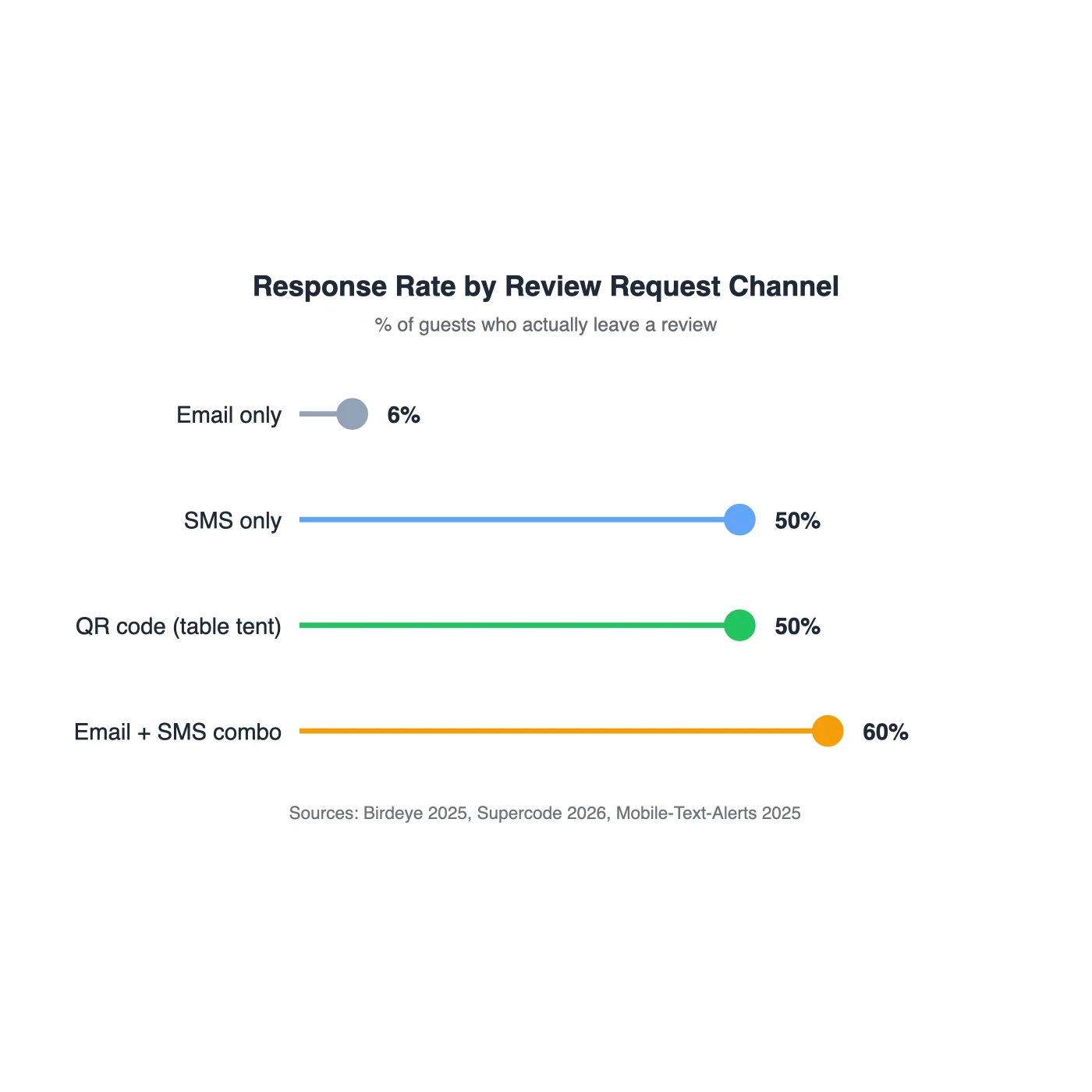
This is the single biggest lever. SMS review requests convert at 12-15%; email crawls along at 3-4% (Birdeye 2025, SMS vs. Email Review Requests). Send one text, the day after the meal, while the experience is fresh and the leftovers are still in the fridge. One link. No follow-up. No nag. Restaurants that send a short SMS reminder 48 hours after an email lift response rates by another 10% (Mobile-Text-Alerts SMS Benchmarks, 2025).
2. Table-tent QR with a hand-signed note from the owner
QR-code feedback programs hit 40-60% response rates (Supercode, 2026). The trick is the note. Print “Was tonight good? Tell Mike, owner. ↓” with a Sharpie-style font under the QR. Not a corporate template. Not a 12-point compliance disclaimer. A note. Guests scan because Mike asked, not because a kiosk asked.
3. Train servers to say one sentence at the right moment
Right moment = when the guest just said something nice. Not at the check drop. The script is short: “That made our night. If you’ve got 30 seconds, we’d really appreciate a Google review. Mike reads every one.” That’s it. No “five-star,” no incentive, no scan-this-QR pressure. Sincere, brief, walks away.
4. Receipt-printer prompt with a QR
If your POS prints receipts, it can print a QR. Most modern restaurant POS systems, Toast, Square, SpotOn, Lightspeed, let you add a footer. Use it. “Scan to review us. We read every one.” Done.
5. The “Thank you” email that doesn’t ask for anything
This one’s counterintuitive. Send a follow-up email that just says thank you, and nothing else. No review ask, no upsell, no offer. Buried at the bottom: a single line, “If you’d like to share your experience, here’s our Google link.” That subtle ask outperforms the aggressive variant because it doesn’t feel transactional. Customers respond to gratitude, not requests.
The pattern under all five: you’re earning the review, not extracting it. Big difference in how it lands, and in how Google’s AI scores the resulting review pattern.
BrightLocal's 2025 survey found top-3 local-pack restaurants average 47 more reviews than ranks 4 through 10.
How Should You Respond to Reviews (Especially the Brutal Ones)?

Restaurants that actively respond to reviews earn 35% more revenue than restaurants that don’t (MagicReply analysis, cited in Shapo Google Review Statistics 2025). Faster is better: 53% of consumers expect a response within one week, and 38% expect it within two to three days (ReviewTrackers data, cited in Malou 2025). Your weekend window matters more than your menu redesign.
The 5-star response (90 seconds): Thank them by name, mention something specific from their review, invite them back. Skip the corporate boilerplate. “Thanks Sarah! So glad you tried the étouffée. Chef Marcus only makes it on Thursdays. Come back and try the bread pudding next time.” Done.
The 3-star response (the awkward middle child): Acknowledge what they liked, address what they didn’t, offer a fix without being defensive. “Glad the gumbo hit, sorry about the wait. We were short two servers Saturday, totally on us. Next visit, ask for Mike and dinner’s on the house.”
The 1-star response (the hard one): Don’t fight. Don’t get clever. Don’t write a 600-word manifesto about how the guest was actually wrong. Acknowledge, apologize for the experience (not the facts in dispute), invite a private conversation. Future guests are reading your response, not the bad review. Make sure the response is the part that sells.
What never to write back: Anything that starts with “We’re sorry you feel that way,” any sentence with “We pride ourselves on…,” and any defense that names the guest’s specific allegations and disputes them. You’re not in court. You’re in customer service.
Which Review Tactics Will Get You Penalized by Google in 2026?
Google updated its Business Profile review policy in April 2026, and the enforcement has teeth (Launchcodex, Google Business Profile review policy update April 2026). Gemini AI flags pattern violations automatically, meaning a tactic that worked in 2022 could nuke your entire review history this quarter.
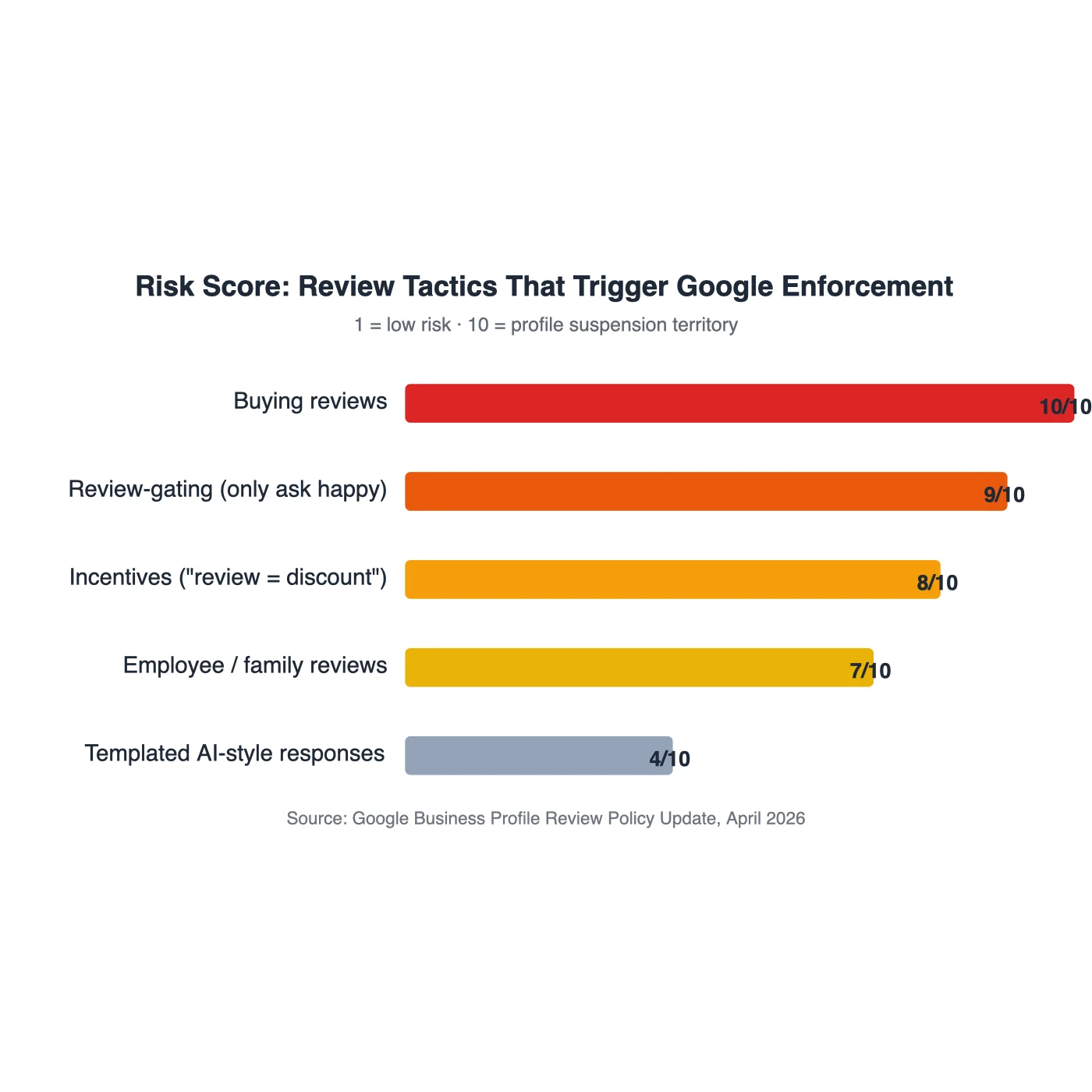
Buying reviews is an obvious one. Review-gating, where you screen guests for happiness before sending them to Google, is the one that catches most restaurants off-guard. Google’s policy explicitly bans it now, and most “reputation management” software still does it.
Here’s the original insight: review-gating is the #1 reason we see clients get review batches deleted en masse. They didn’t break a rule on purpose. Their previous vendor sold them an “automated review funnel” that quietly filters one-star intent and only sends happy customers to Google. Gemini’s pattern detection has been onto this since mid-2025. If your current review platform asks customers to rate you privately first before deciding if to redirect them to Google, get a new platform.
Incentives (“leave a review, get 10% off”) are also banned outright. Same with employee and family reviews, Gemini flags shared IPs, shared device IDs, and account-creation timing patterns.
Templated AI-style responses won’t get you suspended, but they read like you don’t care. Future guests notice. So does Google, eventually.
Ready to Stop Guessing? Here’s the Honest Pitch
If your last three “marketing consultants” sold you software, slogans, and silence, we get it. BlakSheep Creative is firefighter and first-responder owned. We don’t run a funnel. We don’t pretend a CRM (customer relationship management software) fixes a hospitality problem. We build review systems for restaurants the same way we ran a fire engine: train the people, check the equipment, show up when the alarm goes off.
If you want help setting this up, without an agency that talks like a LinkedIn post, see our AI Automation for Restaurants service page, or get in touch directly. Old-school option: call us at (225) 505-3834. We answer the phone. Wild concept.
Frequently Asked Questions
The questions restaurant owners ask most about review counts, incentives, deletions, and response timing.
How many Google reviews does a restaurant need to rank in the local pack?
There’s no hard floor. BrightLocal’s 2025 survey shows top-3 map results average 47 more reviews than ranks 4-10. And 33% of consumers want to see 20-49 reviews before they trust a business (BrightLocal LCRS 2025). Aim for 50 quality, recent reviews with steady velocity, that beats 200 stale ones every time.
Can I offer a discount in exchange for a Google review?
No. Google’s April 2026 policy explicitly bans review incentives, and Gemini AI flags the pattern automatically (Launchcodex, 2026). Restaurants that ran “leave a review, get 10% off” campaigns have lost entire review batches retroactively. Free food is great. Tie it to a review and Google wipes the whole shelf.
What happens if Google deletes my reviews?
Probably nothing you can appeal. Google deleted 292 million reviews in 2025, and the appeals queue is brutal (Google Maps Spam Report, 2025). Focus on the reviews you can still earn: real guests, real experiences, recent dates. Authenticity is the only durable strategy now.
How quickly should I respond to negative reviews?
Within 48 hours, ideally same-day. 53% of consumers expect a response within a week, 38% within 2-3 days (ReviewTrackers, via Malou 2025). A fast, calm, specific reply earns back more goodwill than a defensive essay written three weeks later, by which point the bad review has been read 400 times by potential guests.
Is it worth asking guests directly for reviews?
Yes, but only at the right moment and with zero pressure. The “ask without asking” tactics work because they reduce friction (78% of guests share when it’s easy, per Supercode 2026) without making the request feel transactional. Train servers to ask only when guests volunteer positive feedback first. Don’t ask the table that complained about the wait time.
“A pleasure to work with this company. Easy going and understands what the costumer wants. I look forward to work with this company again.”

The Bottom Line
Three things, and then we’ll let you get back to running a restaurant.
- Recency beats volume. Stop chasing the 200-review trophy and start chasing the next four reviews this week.
- Friction is the enemy, not unwillingness. Most guests will leave a review if you ask once, at the right moment, with a one-tap link.
- The shady playbook is dead. Google’s AI got smart in 2025. Earn the reviews or lose the ones you have.
When you’re ready to install a real review system instead of patching together a Frankenstein of QR codes and hope, BlakSheep Creative can help. Or don’t, your competitors with steady review velocity will appreciate the room.
About the Author
Clint Sanchez is Chief of Information and Technology at the Baton Rouge Fire Department and a digital marketer at BlakSheep Creative. With 26 years in public service, he manages technological infrastructure under conditions where “the form was confusing” isn’t an acceptable failure mode, and he brings the same operational discipline to local SEO, AI automation, and review systems for restaurants and small businesses across Louisiana and the Gulf South. BlakSheep is firefighter and first-responder owned. No funnels, no jargon, no “synergy.” Get in touch or call (225) 505-3834.
Sources
- Harvard Business School, Reviews, Reputation, and Revenue: The Case of Yelp.com (Michael Luca), 2011, revised 2016, retrieved 2026-05-17
- BrightLocal, Local Consumer Review Survey 2025, retrieved 2026-05-17
- Search Engine Roundtable, Google Maps Spam Fighting Report 2025, retrieved 2026-05-17
- Emulent, Weighted Local SEO & Map Pack Ranking Factors (2026), retrieved 2026-05-17
- Birdeye, SMS vs. Email Review Requests in 2025, retrieved 2026-05-17
- Supercode, QR Code Customer Feedback Strategies (2026), retrieved 2026-05-17
- Mobile-Text-Alerts, 2025 SMS Marketing Benchmarks, retrieved 2026-05-17
- Marketing Growth Hub, Google Fake Reviews Crackdown 2025, retrieved 2026-05-17
- Launchcodex, Google Business Profile Review Policy Update April 2026, retrieved 2026-05-17
- Malou, Google Reviews for Restaurants: A Comprehensive Guide (2025), retrieved 2026-05-17
- Shapo, Google Review Statistics 2025, retrieved 2026-05-17
Images: Pexels (photographers Quang Nguyen Vinh, SpotOn POS, Yan Krukau, Pexels license, no attribution required but credited here).

Ready to put this to work?
Talk to the people who would actually build it.
About the author

Founder & Lead Developer · Denham Springs, LA
Clint has built and marketed websites for 26 years, since founding BlakSheep Creative in 2000. He is also a 29-year firefighter and a 23-year member of IAFF Local 557, which is where the bias toward plain answers over sales copy comes from.
- Veteran-owned
- Firefighter-owned
- IAFF Local 557
More Questions About Google Reviews for Restaurants
Short answers to the questions that come up most on this topic.
What is review-gating and why does it get reviews deleted?
When should a restaurant send a review request text?
What should a server say to ask for a review?
What does Google's AI flag as a fake review pattern?
Does a review's age affect local rankings?
What should a restaurant never write in a review response?

Your next step, without the guesswork
No surprises, clear next steps, and a fixed price before anything starts.