
By Clint Sanchez · Published · Updated · 13 min read
Quick answer
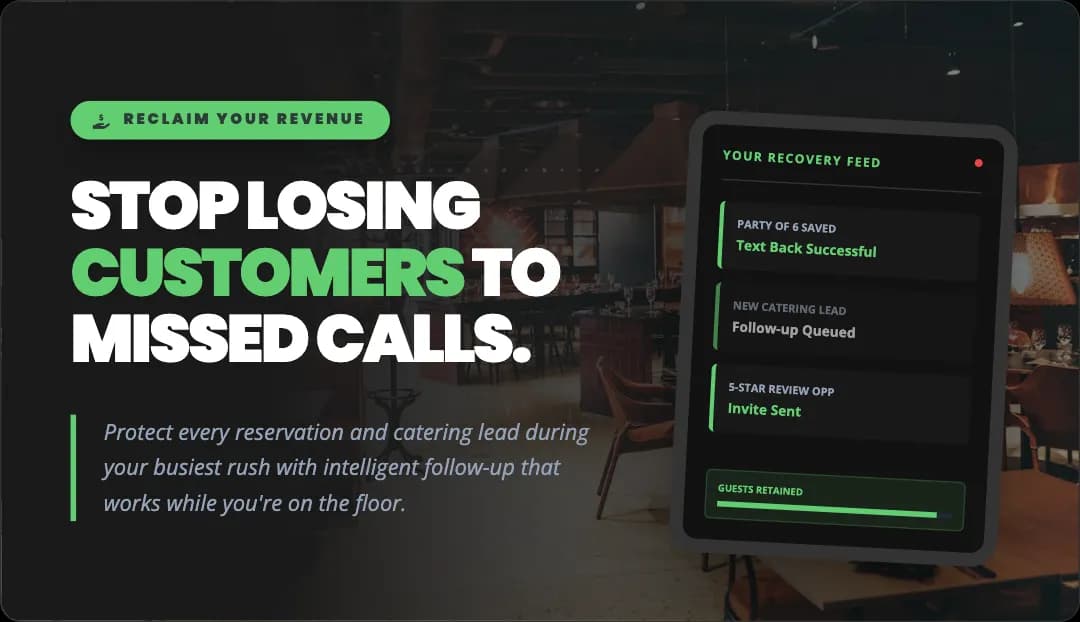
Restaurants stop losing customers from missed calls with a missed-call text-back system: when the phone goes unanswered, an automatic SMS names the restaurant, explains the call was missed, and asks what the guest needs. Replies are tagged by intent (reservation, catering, private event, complaint), routed to a named staff owner, and tracked against reservations saved and catering leads captured. Automation supports staff; it does not replace hospitality.
Key takeaways
- Missed calls cluster in the busiest, highest-value windows: lunch rush, dinner service, football weekends, festivals, and storm disruptions.
- A missed call can be a table for six, a catering order, a private event inquiry, or a complaint that becomes a public review if nobody responds.
- A missed-call text should name the restaurant, explain the call was missed, ask what the guest needs, and include opt-out language where required.
- Route replies by intent: reservations to the host or manager the same shift, catering and private events to their owner the same day, complaints to a manager immediately.
- Google says local results are ranked on relevance, distance, and prominence, so a complete Business Profile feeds the same system that generates the calls.
- The FTC warns against fake or deceptive reviews, so keep guest recovery and honest review requests as two separate workflows.
- Measure outcomes, not message volume: total calls, missed calls, guest replies, reservations saved, and catering leads captured.
Restaurants around Baton Rouge and Denham Springs get slammed on LSU home-game Saturdays, during crawfish season, and the day after a hurricane when everyone wants to know who is open. Those are exactly the hours the host stand cannot pick up, and the guest calling from I-12 traffic does not leave a voicemail; they call the next place on Google Maps.

Want this handled instead of DIY?
A 15-minute call, no script, no pressure. You leave with a plan either way.
Missed Calls for Restaurants Are Lost Opportunities You Can Fix
Missed calls for restaurants turn into lost reservations, cold catering leads, frustrated guests, and fewer repeat visits. The fix is not another staff meeting. Restaurants need a simple missed-call text-back system that responds quickly, captures the guest’s need, alerts the right person, and keeps the conversation moving after the rush subsides.
TLDR;
- Missed calls usually happen during the busiest and most valuable service windows.
- A fast SMS reply can keep the guest from calling the next restaurant on Google.
- Missed call text back should support staff, not replace hospitality.
- Restaurants should connect missed calls to reservations, catering, reviews, and repeat guest follow-up.
- SMS workflows need clear consent, opt-out language, and practical staff handoff rules.
- Call tracking and conversion tracking help owners see which workflows lead to real bookings.
Restaurants compete in a market where guests make quick decisions from Google Search, Google Maps, social posts, and word of mouth. During lunch rush, dinner service, football weekends, festival traffic, and hurricane season disruptions, the phone still matters. When nobody answers, the guest does not wait around like a loyal golden retriever. They usually call the next place.
That behavior is part of a larger shift in search, which we explain in our guide to Answer Engine Optimization and why clear answers now matter more than generic SEO copy.
Missing calls during rush hours? BlakSheep Creative can help you build a practical missed-call text-back and guest follow-up system for your restaurant.
Missed call
Your business · just now
The business: Sorry we missed your call. What can we help you with? Reply here and we'll get right back to you.
Sent automatically, seconds after the call.
Why Missed Calls Hurt Restaurants More Than Owners Realize
Most restaurant owners already know the phone gets ignored when the team is buried. The problem is what those calls represent.
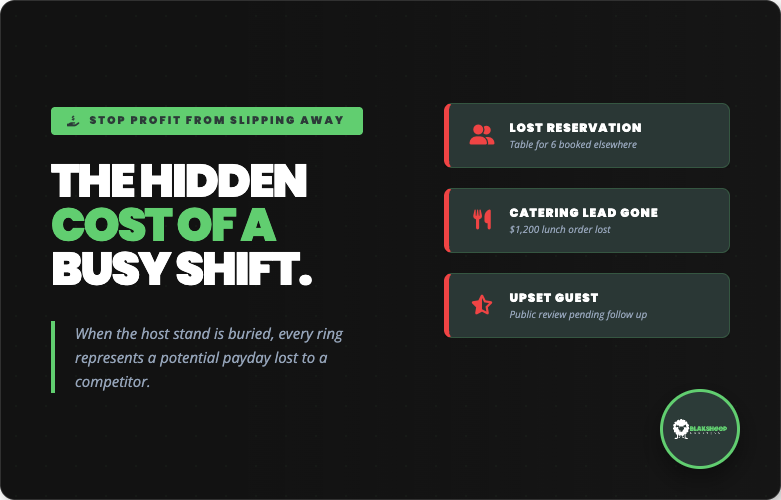
A missed call can be a table for six, a large catering order, a private event inquiry, a menu question, a guest complaint, or someone asking if you are open after a storm. Each missed call creates a small gap in the guest experience. Enough gaps turn into lost revenue.
Restaurants do not lose every missed caller forever. Some people call back. Some use online ordering. Some check the menu and move on. But guests who search on Google Maps or tap the call button on a Business Profile usually want a quick answer. Google’s restaurant Business Profile guidance points owners to calls, reservations, ordering links, menus, photos, posts, reviews, and performance tracking, as these actions shape how guests choose where to eat.
That means missed calls are not just a phone problem. They are part of your local visibility, guest communication, and conversion system.
| Missed Call Type | What the Guest Wanted | What It Costs You |
|---|---|---|
| Reservation question | Availability, wait time, party size, special seating | The guest books somewhere else. |
| Catering inquiry | Pricing, guest count, date availability | A higher-value lead cools off. |
| Private event request | Room rental, group menu, date availability | The inquiry gets lost in voicemail or email. |
| Takeout question | Order help, menu clarification, allergy question, delivery details | The guest chooses a simpler option. |
| Guest issue | Refund, mistake, concern, manager request | The guest may leave a public review before staff responds. |
The table shows why missed calls should be treated as lead follow-up rather than background noise.
Once you know what the call might be worth, the next step is building a faster response path.
Why Restaurants Miss Calls During the Moments That Matter Most
Missed calls usually happen because the restaurant is busy, not because the team does not care.
During a rush, hosts are seating guests, servers are asking questions, managers are solving problems, kitchen staff are pushing tickets, and someone is trying to find the extra ranch that apparently determines the fate of civilization. The phone rings in the middle of all that.
Restaurants usually miss calls for predictable reasons:
- The host stand is overloaded.
- The phone rings during lunch or dinner rush.
- Staff assumes the call is not urgent.
- Voicemail is full or ignored.
- After-hours calls do not trigger a follow-up task.
- Catering inquiries go to one person who is off that day.
- No one tracks how many calls are missed each week.
This is why the fix needs to be operational. A shiny phone tool without staff handoff rules will become another dashboard nobody checks.
A good missed call workflow starts with a simple goal: respond quickly enough that the guest does not leave.
How Missed Call Text Back Works for Restaurants
Missed call text back gives the guest a fast response when your team cannot answer the phone.
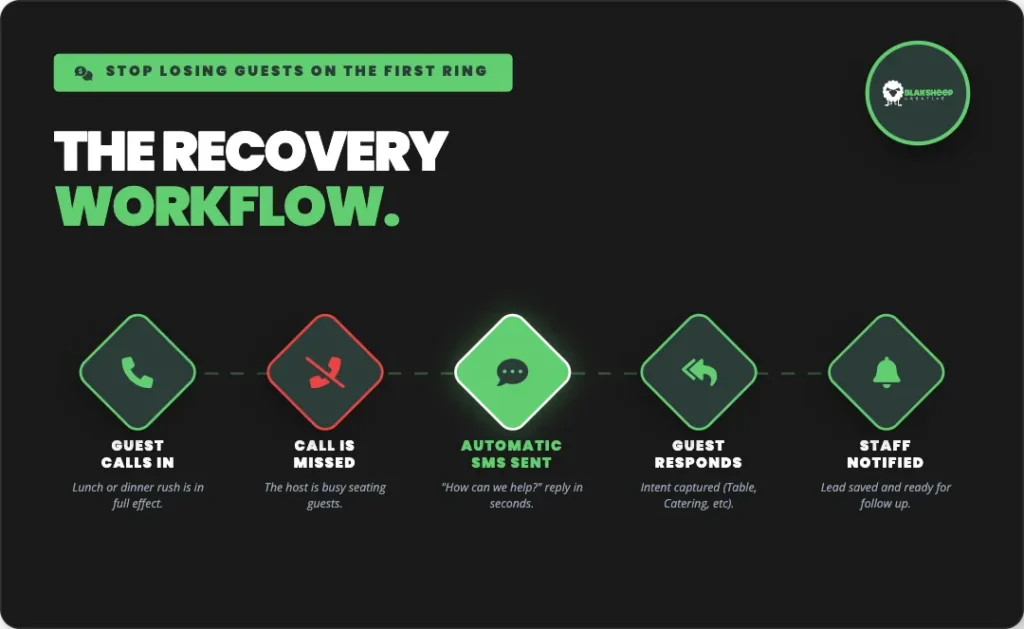
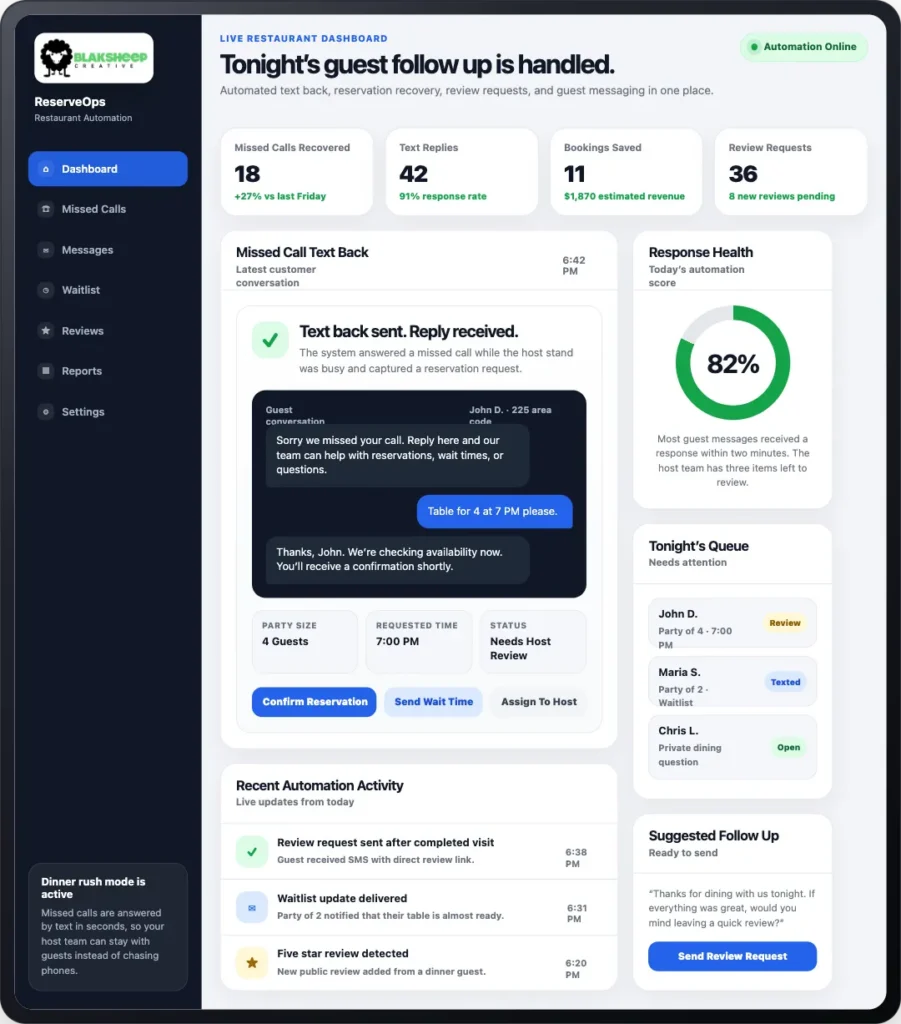
Here is the basic flow. A guest calls your restaurant. The team misses the call. The system automatically sends a short SMS message. The message gives the guest a useful next step, such as asking what they need, pointing them to reservations, or letting them request catering information. Staff can then reply once the rush subsides.
That first message should sound human and useful. It should not sound like a robot got trapped in a fryer.
| Workflow Step | What Happens | Why It Matters |
|---|---|---|
| Missed call trigger | The system detects the missed call. | No lead disappears into voicemail. |
| Automatic SMS reply | The guest receives a short message asking how the team can help. | The restaurant keeps the conversation alive. |
| Guest response | The guest replies with a reservation, catering, order, or a question. | The system captures intent. |
| Staff alert | The right person gets notified. | The lead does not sit unnoticed. |
| Follow-up task | The system creates a reminder or pipeline step. | The team has a clear next action. |
The workflow only works when the message, timing, and handoff match how the restaurant actually operates.
The same principle applies to search content: clear structure helps systems understand the next step, which is why we explain how to structure content so AI actually uses it.
This is where restaurant automation should stay simple and useful.
Need a simple missed-call text-back system? BlakSheep Creative builds restaurant automation around real guest communication, not generic templates.
Missed calls cluster in the busiest, highest-value windows: lunch rush, dinner service, football weekends, festivals, and storm disruptions.
What a Restaurant Missed Call Text Should Say
The first text should help the guest take the next step without creating confusion.
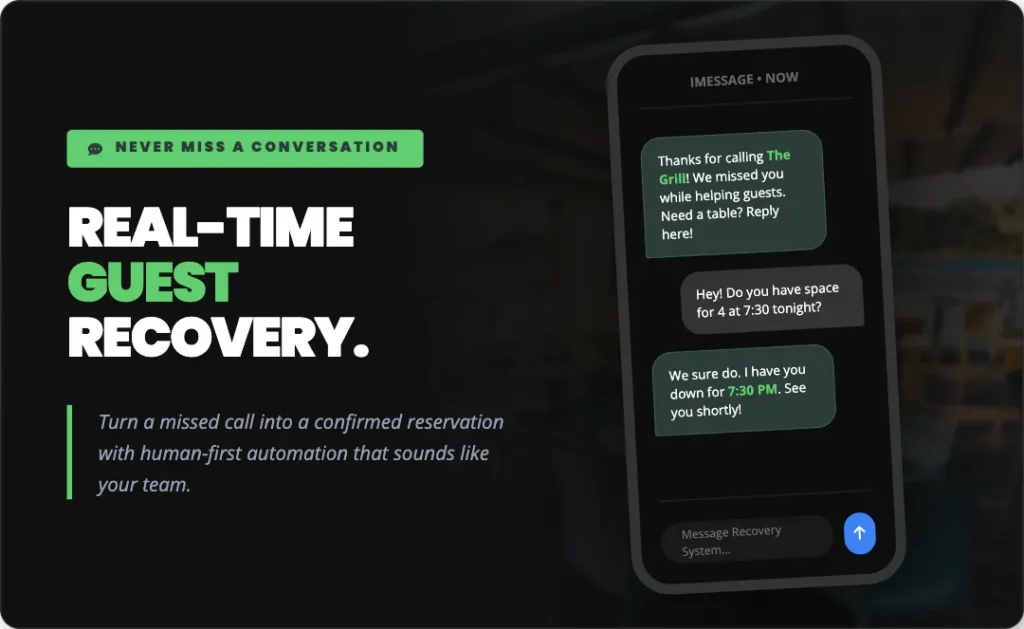
Keep it short. Use the restaurant name. Tell the guest why they received the message. Ask what they need. Include opt-out language where appropriate for your SMS setup and campaign type. The CTIA Messaging Principles and Best Practices call for consumer opt-in before messaging and for honoring every opt-out request; do not treat SMS as a free-for-all.
Here are examples your team can adapt:
| Scenario | Example Message |
|---|---|
| General missed call | Thanks for calling [Restaurant Name]. We missed you while helping guests. Reply here and let us know how we can help. |
| Reservation support | Thanks for calling [Restaurant Name]. Need help with a reservation or wait time? Reply with your party size and preferred time. |
| Catering inquiry | Thanks for calling [Restaurant Name]. If this is about catering or a private event, reply with your date, guest count, and best contact name. |
| After hours | Thanks for calling [Restaurant Name]. We are closed right now. Reply here with your question and someone will answer when we open. |
| Guest concern | Thanks for calling [Restaurant Name]. If you need help with a recent visit or order, reply here and a manager will follow up. |
These messages work because they give the guest a path instead of a dead end.
Once the text starts the conversation, the system needs to route the reply correctly.
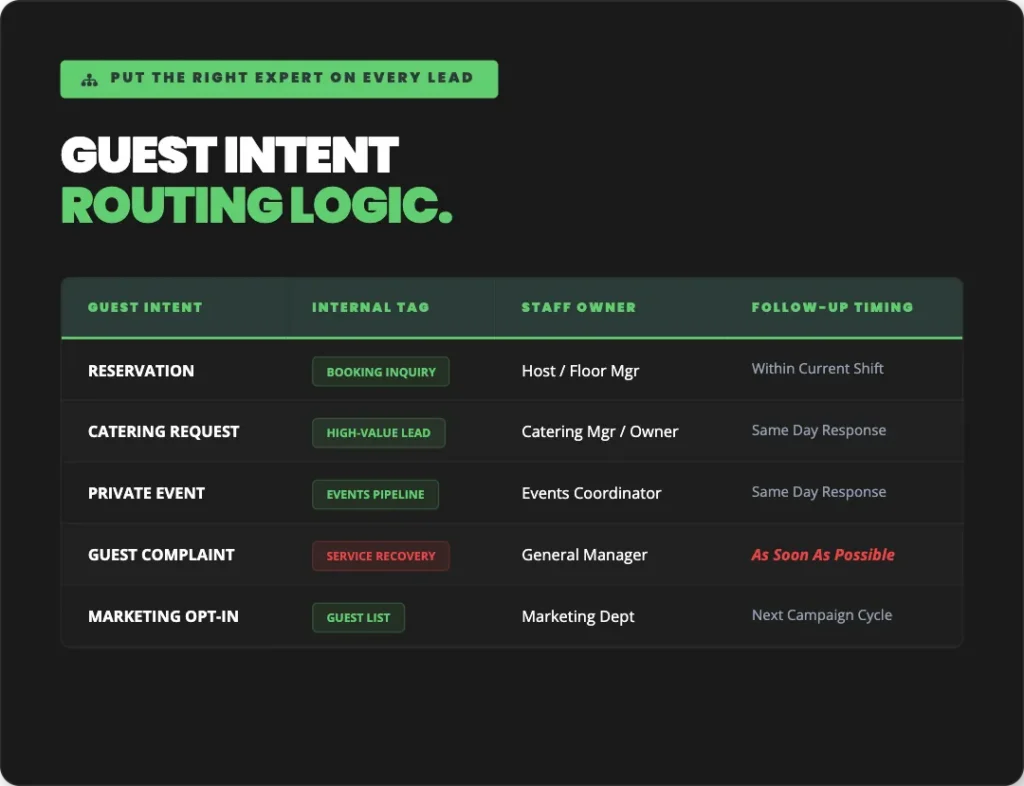
How To Route Missed Calls Based on Guest Intent
Not every missed call needs the same response from the same person.
A catering lead should not be handled like a menu question. A guest complaint should not sit in the same pile as a table availability question. Good restaurant automation uses tags, statuses, alerts, and follow-up steps to separate the intent behind the call.
This is where a simple CRM setup helps. BlakSheep Creative’s CRM setup service can support missed call workflows by organizing guest details, inquiry sources, contact history, and next steps in one place.
| Guest Intent | Suggested Tag | Staff Owner | Response Window |
|---|---|---|---|
| Reservation question | Reservation Inquiry | Host or manager | Same shift |
| Catering request | Catering Lead | Catering manager or owner | Same day |
| Private event | Private Dining Lead | Events contact | Same day |
| Guest complaint | Guest Recovery | Manager | As soon as possible |
| Marketing opt in | Guest List | Marketing or manager | Next campaign cycle |
That routing is where lead follow-up automation becomes useful because it gives each missed call a clear owner, next step, and response path.
The right routing turns a missed call into a managed conversation.
After the conversation is routed, the restaurant needs to connect calls with reviews, repeat visits, and local visibility.
How Missed Calls Connect to Reviews and Reputation
A missed call does not always mean a lost sale. Sometimes it becomes a reputation problem.
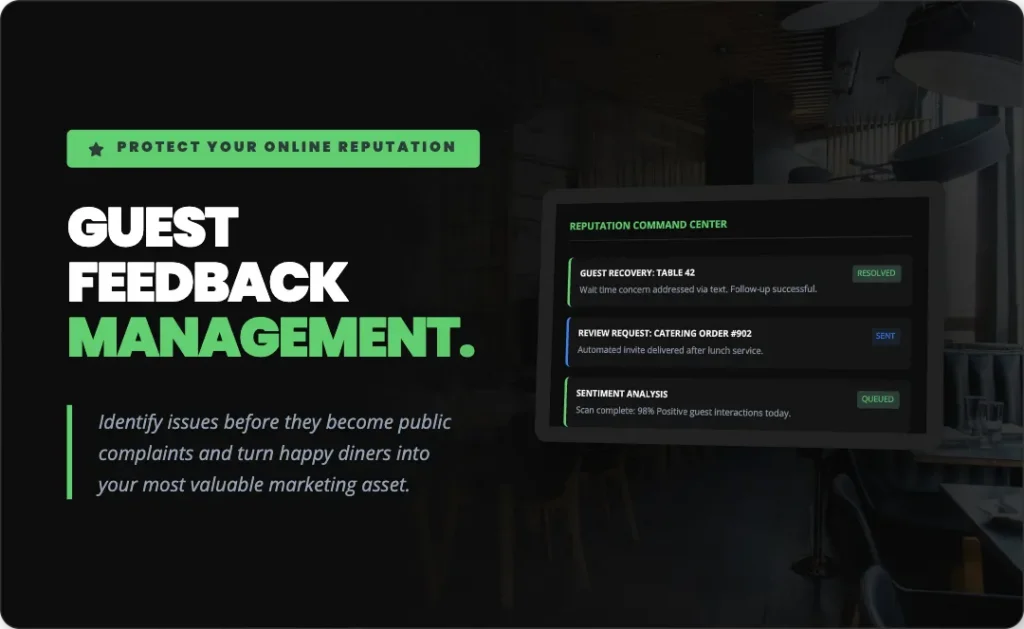
If a guest calls about an incorrect order, a bad experience, a refund, or a reservation issue and no one responds, that guest may move from private frustration to a public review. That is bad for business, bad for staff morale, and bad for your Google presence. Google’s profile guidance gives more detail on how restaurants can manage calls, menus, ordering links, reservations, photos, reviews, posts, and performance data.
Restaurant review workflows should be built with care. The FTC rule banning fake reviews and testimonials, in force since October 2024, prohibits fake, false, or deceptive reviews and any incentive tied to writing a positive one. That means restaurants should ask real guests for honest feedback, avoid fake review schemes, and avoid pressure tactics.
BlakSheep Creative’s reputation management work can support a cleaner review process by helping restaurants request feedback, monitor reviews, and respond with professionalism.
A strong workflow separates two actions:
- Guest recovery: Help unhappy guests before their issues become public.
- Review requests: Ask real guests for honest feedback after a good interaction.
That separation matters because review generation should never become review manipulation.
Once calls and reviews are connected, the next layer is local search.
“We have used Black Sheep Creative for all of website and SEO needs and have been absolutely blown away with their response and dedication to creating high quality products and helping translate that into a strong ROI for us. Thank you to Blacksheep Creative”
Why Google Business Profile Calls Need Better Follow-Up
Many missed calls start with Google Search or Google Maps.
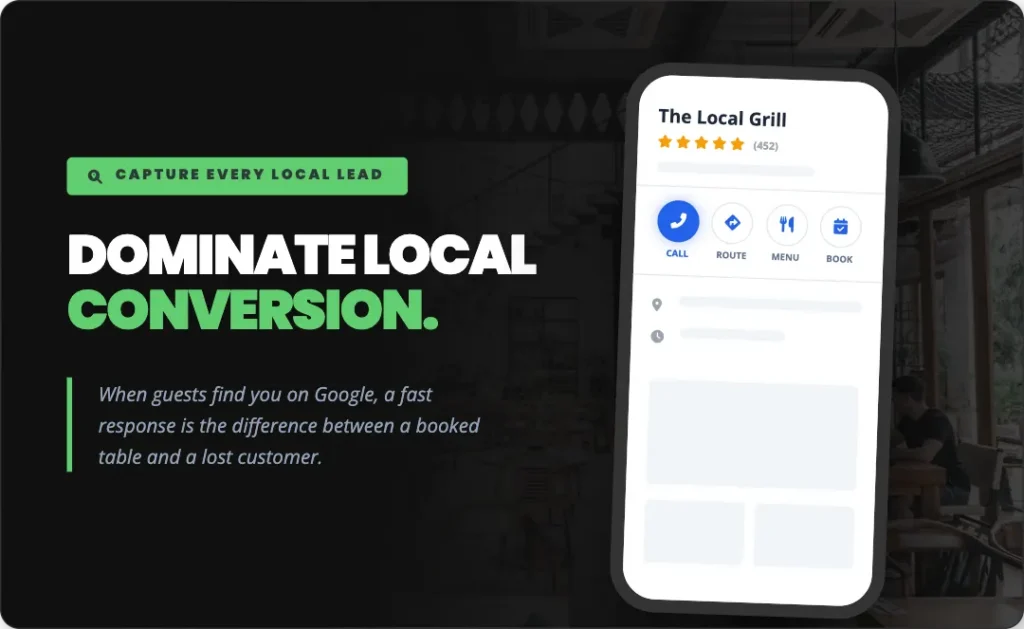
When someone finds your restaurant profile, they may tap to call, check your menu, look at photos, read reviews, request directions, or make a reservation. Google’s restaurant Business Profile guidance encourages owners to manage these details because they shape guest decisions before the guest ever reaches your website.
That makes Google Business Profile traffic a direct source of conversions, not just an SEO vanity metric.
Google says local results use relevance, distance, and prominence, so complete profile information and active reputation signals matter for local visibility.
Restaurants should check:
- Is the phone number correct?
- Are hours accurate during holidays and storm events?
- Are menu links current?
- Are the reservation and ordering links working?
- Are reviews being answered?
- Are missed calls tracked?
- Are posts used for specials, events, and updates?
If your restaurant gets calls from Google but has no missed call recovery, you are paying for visibility with no safety net. That is digital marketing with a hole in the bucket.
Once profile traffic is connected for follow-up, restaurant owners need to know what to fix first.
What Restaurants Should Fix First
Trying to automate everything at once is how good ideas become expensive clutter.
For most restaurants, that means missed call text-backs, catering lead follow-ups, review requests, and basic guest list organization. The National Restaurant Association reports that restaurants are using technology, analytics, and automation to improve efficiency and hiring performance.
Start with the workflows that protect revenue and reduce staff pressure.
| Priority | Workflow | Why Fix It First |
|---|---|---|
| 1 | Missed call text back | It responds when staff cannot answer. |
| 2 | Catering lead routing | It protects higher-value opportunities. |
| 3 | Review request automation | It builds steadier feedback from real guests. |
| 4 | Guest CRM tagging | It organizes contacts for future follow-up. |
| 5 | Repeat visit campaigns | It helps bring past guests back during slower windows. |
This order keeps the system focused on practical value instead of turning your restaurant into a software museum.
The next step is building a setup that your staff will actually use.
How BlakSheep Creative Builds Missed Call Automation for Restaurants
A restaurant automation setup should reflect the restaurant’s real behavior.
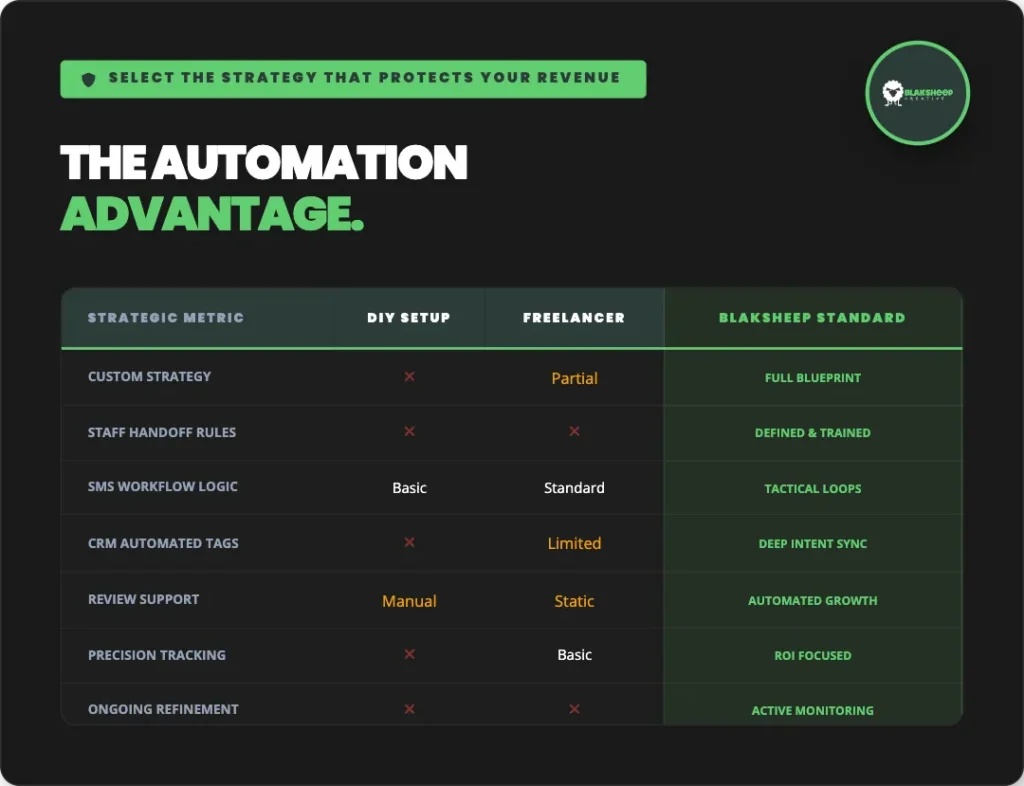
At BlakSheep Creative, we start by looking at how your restaurant handles calls, forms, reservations, catering, reviews, and guest follow-up today. Then we map the simple workflow that should happen when the phone rings and no one can answer.
Our restaurant’s missed call setup can include:
- Missed call text back messages
- Guest reply capture
- Staff alerts
- Contact tagging
- Catering and private event routing
- Review request workflows
- SMS and email follow-up
- Basic reporting and call tracking
- Training and handoff guidance
The goal is not to make the restaurant sound automated. The goal is to keep guests from falling through the cracks while your team handles the dining room.
If you need a broader system, our AI automation for restaurants service can integrate missed call recovery, review requests, guest follow-up, catering workflows, and repeat-visit campaigns.
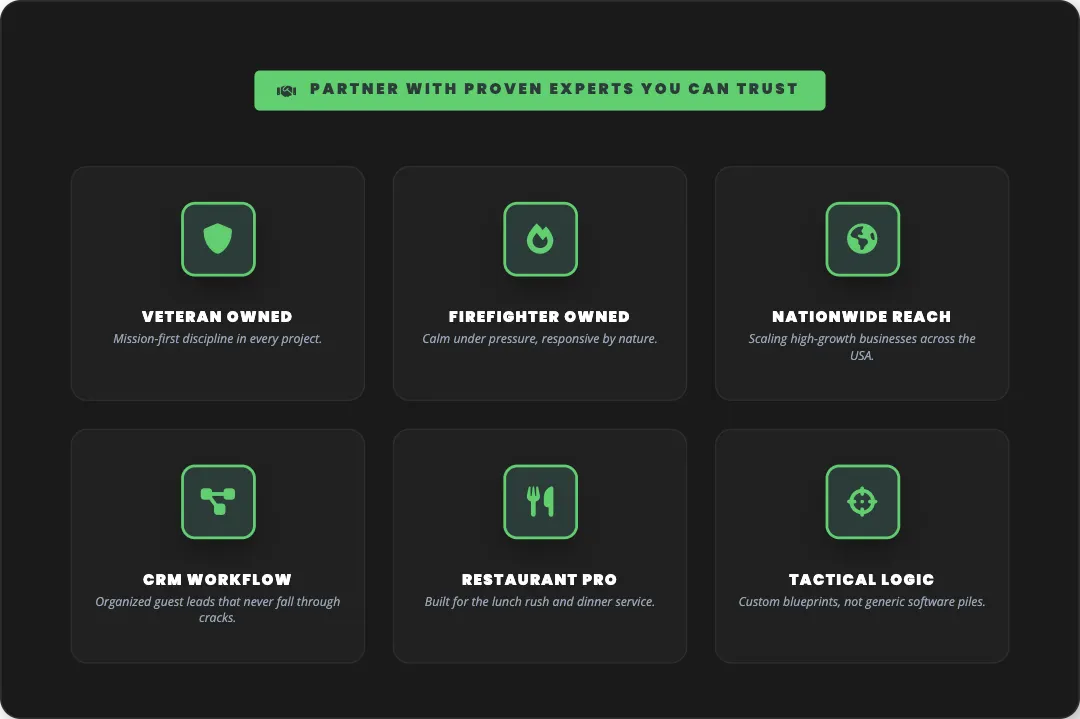
Stop losing guests to missed calls. Request a Restaurant Automation Review, and we will look at where your follow-up is breaking down.
A missed call can be a table for six, a catering order, a private event inquiry, or a complaint that becomes a public review if nobody responds.
Common Mistakes Restaurants Make With Missed Call Automation
Automation helps only when it respects the guest experience.
Bad automation creates confusion, sends too many texts, routes replies nowhere, or gives guests a fake sense that someone is helping. That is worse than a missed call because now the guest has proof that your system is annoying.
| Mistake | Why It Hurts | Better Approach |
|---|---|---|
| Sending a vague text | The guest does not know what to do next. | Ask a clear question based on likely intent. |
| No staff alert | The reply sits unseen. | Notify the right person or role. |
| Ignoring consent rules | The message may violate expectations and platform rules. | Use proper consent and opt-out handling. |
| Over-automating complaints | Upset guests want a real person. | Route guest recovery issues to a manager. |
| No tracking | You cannot prove what is working. | Track calls, replies, booked tables, and catering leads. |
The best missed call workflow is simple, trackable, and easy for staff to follow.
Once the mistakes are avoided, owners can focus on a clean first-month plan.
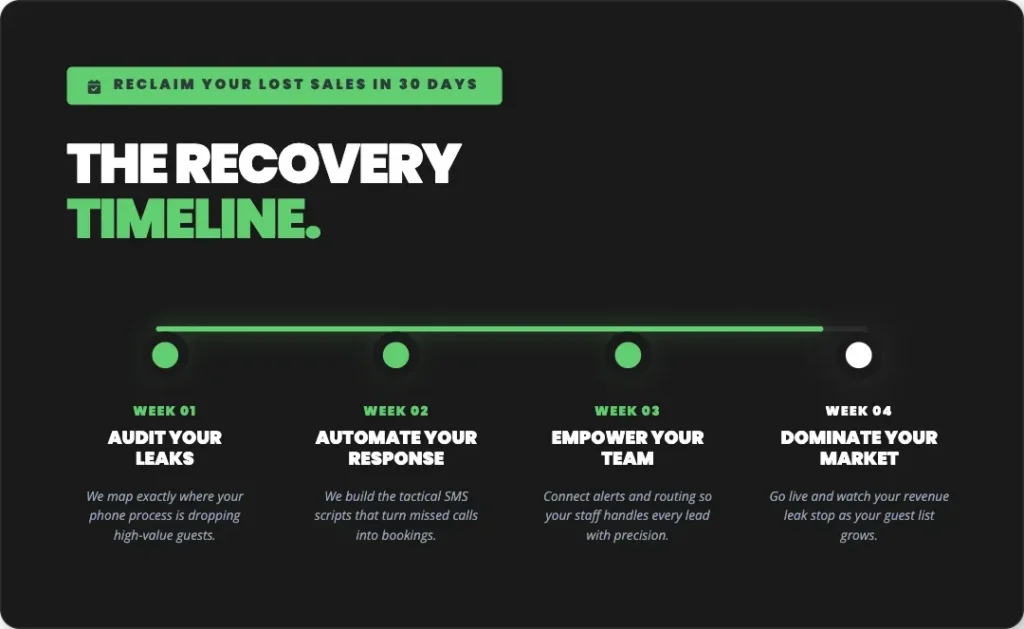
A Simple 30 Day Missed Call Recovery Plan
Restaurants do not need to rebuild every system in one month.
Use the first 30 days to fix the biggest leak, collect baseline data, and make sure staff understand the workflow. This gives the restaurant a cleaner path before adding larger guest retention or review campaigns.
| Timeline | Action | Goal |
|---|---|---|
| Week 1 | Review call volume, missed calls, voicemail, forms, and staff process. | Find the current leak. |
| Week 2 | Write missed call text messages and route by intent. | Create a useful response path. |
| Week 3 | Configure tags, alerts, reminders, and staff ownership. | Keep replies from getting lost. |
| Week 4 | Launch, test, monitor, and refine. | Improve response without confusing staff. |
This plan gives the team a controlled rollout instead of a giant automation project that collapses under its own cleverness.
The final step is measuring the right numbers.
How To Measure Missed Call Recovery
Restaurants should measure outcomes, not just message volume.
A system that sends texts but does not create bookings, cater to conversations, or create review opportunities is just noise with a login screen. Track the metrics that connect follow-up to revenue and guest experience.
- Total incoming calls
- Missed calls
- Text back messages sent
- Guest replies
- Reservations saved
- Catering leads captured
- Private event inquiries captured
- Review requests sent after resolved interactions
- Booked consults or form submissions from the website
Use GA4 events, call tracking, form tracking, and Google Business Profile performance data to understand which channels produce real guest actions.
For profile-level reporting, use our guide on how to interpret Google Business Profile Insights so that call clicks, direction requests, and website visits are reviewed as business signals instead of vanity metrics.
With the right measurement, restaurant owners can decide what to automate next.
“Absolutely the best to work with. Very kind and responsive. They were very patient with me especially when I have no technical vocabulary. The team explained to me in terms that I could understand. I highly recommend them.”
Final Takeaway
Missed calls are not just missed conversations. They are missed chances to book tables, save guests, capture catering leads, and build repeat visits.
The fix does not need to be complicated. Start with a clear missed-call text-back workflow. Route replies to the right person. Track results. Then connect the system to reviews, catering, guest CRM, and repeat-visit campaigns once the foundation is working.
BlakSheep Creative builds restaurant automation around real operations, not software theater. If your restaurant keeps missing calls during the moments that matter, we can help you build a cleaner system.
Ready to stop losing guests to missed calls? Request a Restaurant Automation Review from BlakSheep Creative.
Common Questions About Missed Calls for Restaurants
Restaurant owners usually have the same concerns before they add a missed-call text-back. These answers explain what the system does, what it should not do, and how to keep it useful for guests and staff.
What is a missed-call text-back for restaurants?
Missed call text back sends an automatic SMS message when a restaurant cannot answer the phone. The message helps the guest continue the conversation by asking what they need, such as reservation help, catering information, private event details, or general support. Staff can reply when they are available.
Does a missed-call text-back replace restaurant staff?
No. Missed call text back supports staff by catching calls during busy moments and after hours. A real person should still handle reservations, guest complaints, catering details, and service recovery. The automation keeps the conversation from dying before staff can respond.
Can missed call automation help with catering leads?
Yes. A missed-call workflow can identify catering or private-event inquiries, tag the contact, alert the appropriate staff member, and trigger a follow-up reminder. This helps restaurants protect higher-value opportunities that can get lost during busy shifts or after hours.
Is SMS follow-up allowed for restaurants?
Restaurants should use SMS with proper consent, clear identification, and opt-out handling. The safest approach is to use text back for direct guest responses and use marketing texts only when guests have agreed to receive them. Staff should avoid blasting guests without permission.
What should a restaurant’s missed call text say?
A good missed call text should name the restaurant, explain that the call was missed, and ask how the guest needs help. For example: “Thanks for calling [Restaurant Name]. We missed you while helping guests. Reply here and let us know how we can help.”
How fast should restaurants follow up after a missed call?
Restaurants should respond as quickly as their operation allows. For active service hours, staff should check missed call replies during slower moments. Catering, private event, and guest recovery messages should get clear ownership so they do not sit unanswered for hours or days.
What should restaurants track after adding a missed-call text-back?
Track total calls, missed calls, text back messages sent, guest replies, reservations saved, catering inquiries, private event leads, and review request opportunities. These numbers show if the workflow is creating real business value or just sending messages without outcomes.
Understanding these details helps restaurant owners build a missed-call recovery system that supports guests rather than irritates them.
About the Author: This guide was produced by the senior strategy team at BlakSheep Creative. Based in Denham Springs, Louisiana, we build websites, SEO systems, CRM workflows, and AI automation for local businesses that need clearer lead flow and better follow-up.

Ready to put this to work?
Talk to the people who would actually build it.
About the author
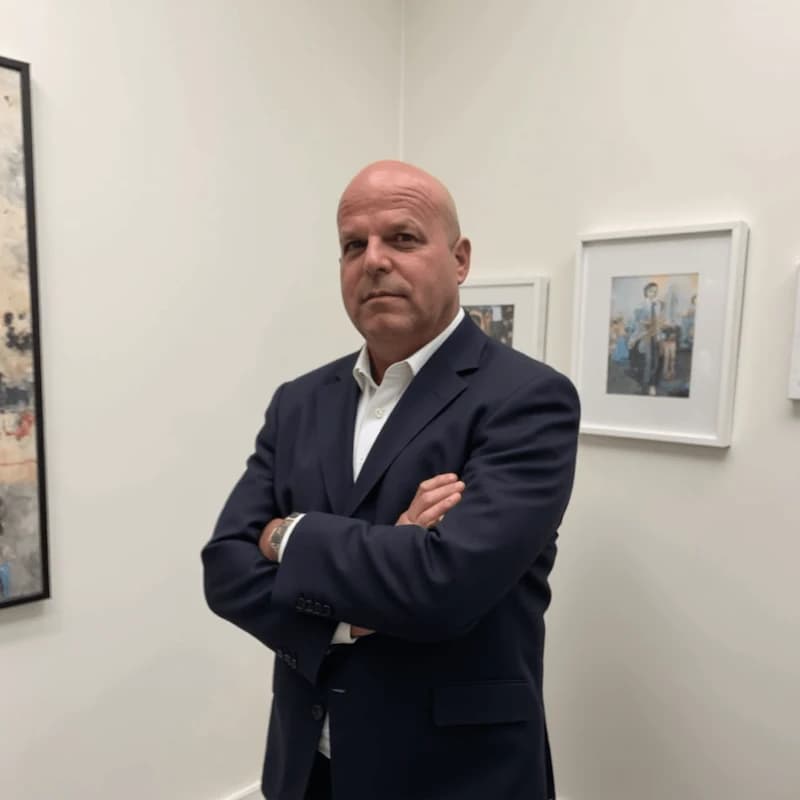
Founder & Lead Developer · Denham Springs, LA
Clint has built and marketed websites for 26 years, since founding BlakSheep Creative in 2000. He is also a 29-year firefighter and a 23-year member of IAFF Local 557, which is where the bias toward plain answers over sales copy comes from.
- Veteran-owned
- Firefighter-owned
- IAFF Local 557
More Questions About Missed Calls for Restaurants
Short answers to the questions that come up most on this topic.
Why do restaurants miss so many calls?
How does missed call text back connect to Google Business Profile?
What should a restaurant automate first?
What are the most common missed call automation mistakes?
How long does it take to set up missed call recovery?
Can a missed call turn into a bad review?

Your next step, without the guesswork
No surprises, clear next steps, and a fixed price before anything starts.