
By Clint Sanchez · Published · Updated · 8 min read
Quick answer
Off-page SEO is everything done away from your own site to make it more credible: earned links, brand mentions, reviews, a complete Google Business Profile, and coverage where your customers already read. Of the nineteen activities usually taught, roughly six still move rankings and nine are leftovers from an era Google's spam policies now name directly.
Key takeaways
- Off-page activities fall into three types: earned links, brand and entity signals, and local prominence signals. Each can achieve different things.
- Nine of the nineteen classic techniques, including social bookmarking, article submission, and web 2.0 networks, no longer pass ranking value.
- Google's spam policies define link spam as creating links primarily to manipulate rankings, which covers most submission-based tactics.
- General web directories are worthless. Citation directories that a human might actually check still feed local prominence.
- Google's own local ranking documentation names how many sites link to your business and how many reviews you have as prominence inputs.
- BrightLocal's 2025 survey of 1,026 consumers found 87 percent use Google for reviews and 74 percent check two or more sites before deciding.
- Only 42 percent now trust reviews as much as a personal recommendation, down from 79 percent in 2020, so review volume alone convinces fewer people.
For a Denham Springs or Baton Rouge business, the off-page signals that actually move local rankings are close to home: a complete Google Business Profile, a listing with the Livingston Parish or Baton Rouge chamber, coverage from local news, and links from the organizations you sponsor. A citation from a parish directory does more for "near me" searches than a bookmark on a national site.

Want this handled instead of DIY?
A 15-minute call, no script, no pressure. You leave with a plan either way.
Off-page SEO is everything done away from your own site to make it more credible: links other people give you, mentions of your brand, reviews, a complete Google Business Profile, and coverage in places your customers already read. Of the nineteen activities usually taught as off-page SEO, roughly six still move rankings and the rest are busywork left over from 2012.
This post sorts them. Every activity is rated against what Google now documents about links and local ranking, so you can stop spending Friday afternoons on submissions nobody reads.
The three types of off-page SEO
Every off-page activity falls into one of three buckets, and knowing which bucket a task sits in tells you what it can possibly achieve.
- Earned links. Editorial links from sites that chose to link because the page was useful. This is the only bucket that passes ranking credit reliably, and it is the hardest to fake.
- Brand and entity signals. Unlinked mentions, reviews, social profiles, and consistent business details. These do not pass link credit but they tell search engines and AI systems that a real business exists and what it does.
- Local prominence signals. The specific inputs Google names for map results, which sit apart from the ordinary ranking systems and reward different work.
Most off-page SEO advice mixes all three together and rates everything as equally valuable. It is not. A directory listing in a parish chamber does nothing for a national organic ranking and a great deal for a local pack position.
The 19 off-page SEO activities, rated
Here is the complete list as it is usually taught, with an honest verdict on each. The ratings reflect Google's published policies, not tradition.
| Off-page activity | Type | Verdict |
|---|---|---|
| Creating genuinely linkable content | Earned links | Works. Everything else depends on it. |
| Digital PR and press outreach | Earned links | Works, for real news. |
| Guest authoring on relevant sites | Earned links | Works if the site is real and the piece is good. |
| Influencer and blogger outreach | Earned links | Works, slowly, and mostly for reach. |
| Google Business Profile | Local | Works. Highest return per hour for a local business. |
| Reviews on Google and elsewhere | Local and brand | Works. Named by Google as a prominence input. |
| Local citations and chamber listings | Local | Modest but real for local pack results. |
| Video on YouTube | Brand | Worth doing for reach and mentions, not for links. |
| Social media engagement | Brand | Indirect. Distribution, not a ranking factor. |
| Question and answer sites | Brand | Marginal. Traffic sometimes, links no. |
| Infographic outreach | Earned links | Diminished. Still occasionally works with original data. |
| Press release submission alone | Neither | Nofollowed by policy. The coverage is the value. |
| General directory submission | Local | Only reputable, curated directories. See below. |
| Blog directory submission | None | Dead. These directories barely exist. |
| Article submission sites | None | Dead, and named in Google's link spam policy. |
| Social bookmarking | None | Dead. No ranking value since roughly 2012. |
| Blog commenting for links | None | Dead. Nofollowed and widely filtered as spam. |
| Forum posting for links | None | Dead as a link tactic. Fine as genuine participation. |
| Web 2.0 property submission | None | Dead. A classic link scheme pattern. |
Nine of the nineteen are dead. That is not a stylistic judgment. Google's spam policies for Google web search describe link spam as "creating links to or from a site primarily for the purpose of manipulating search rankings", and name low-quality directory links, forum comments with optimized links, and keyword-rich links in distributed articles among the examples.
Off-page SEO directory submission: what survives
Directory submission is the activity people ask about most and the one with the widest gap between the old advice and the current reality. The short version is that the category split in two.
General web directories, the kind that accept any site for a small fee and organize it under a category tree, are worthless and have been for over a decade. Google's spam policies name low-quality directory or bookmark site links directly. Submitting to five hundred of them is a recognisable pattern, and it is the pattern the system is looking for.
Citation directories are a different animal. Google Business Profile, Apple Business Connect, Bing Places, Yelp, the Better Business Bureau, your parish chamber of commerce, your trade association, and the licensing bodies for your industry all publish your name, address, and phone number. Those listings feed local prominence and they are what a customer checks when verifying you exist. Consistency across them matters more than quantity.
A workable rule: submit only where a human being might plausibly look you up. If nobody browses the directory, neither does Google. There is more on the citation side in our post on building a citations page for local SEO.
Earning links people actually choose to give
Everything in the earned-links bucket runs on the same engine: publish something a stranger would cite, then tell the right strangers it exists.
The assets that reliably earn links are original data from your own operations, a genuinely better explanation of a confusing process, a free tool or calculator, and local research nobody else has done. A pressure washing company that publishes actual before-and-after square-foot pricing across a parish has something a journalist can cite. A company that publishes another list of cleaning tips does not.
Outreach then does the distribution. Guest authoring still works when the target site is one real people read and the article is written for them rather than for the link at the bottom. Influencer and blogger outreach works for reach more than for ranking credit, and it needs the same relevance filter: four people who cover your industry beat four hundred who do not. The mechanics of the whole process sit in our guide to getting high-quality backlinks, and the press side in how press releases help SEO.
The failure mode to avoid is paying for placement with optimized anchor text. Google's policy names that pattern explicitly, and when the effect of those links is removed, the ranking they were propping up goes with them.
Off-page activities fall into three types: earned links, brand and entity signals, and local prominence signals. Each can achieve different things.
Google Business Profile and reviews
For any business with customers in a specific area, this is the highest-return off-page work available, and Google publishes the criteria rather than leaving them to be guessed.
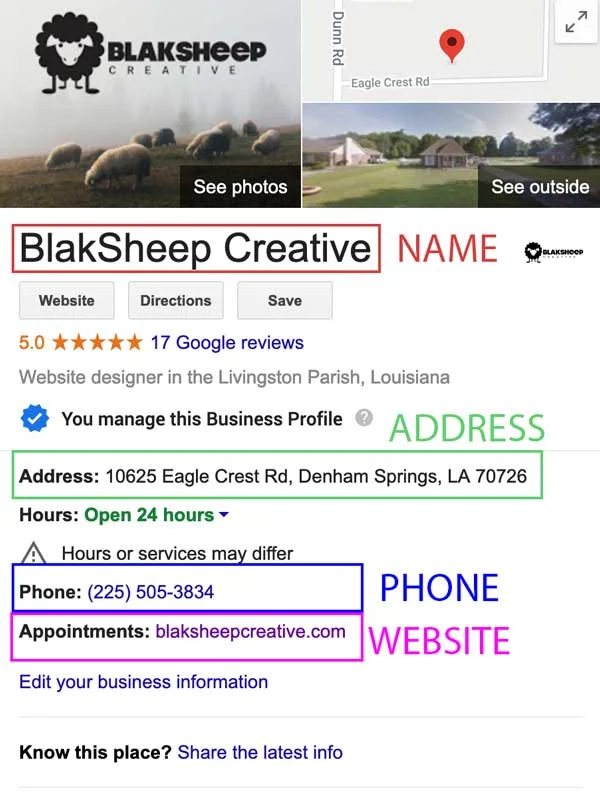
Google's help documentation on improving local ranking names three factors: relevance, distance, and prominence. On prominence it says the calculation considers "how many websites link to your business and how many reviews you have", and states that "More reviews and positive ratings can help your business's local ranking". That is Google naming reviews as an input, in its own documentation.
The customer side backs it up. BrightLocal's Local Consumer Review Survey 2025, based on 1,026 US consumers, found 87 percent use Google to find reviews and 74 percent check two or more websites before deciding on a business. It also found 42 percent now trust online reviews as much as a personal recommendation, down from 79 percent in 2020, which is a useful corrective: reviews still matter, and volume alone convinces fewer people than it used to.
Practically that means asking every satisfied customer, replying to every review including the bad ones, and keeping the profile complete with real photographs. Our Google Business Profile service covers the setup, and there is a free-links angle in our post on getting free backlinks from your GBP.
Social, video, and the mentions that are not links
Social media posts do not pass ranking credit. That has been true for years and it is still the most common misunderstanding in off-page SEO. What social does is put content in front of the people who might link to it.
The same applies to YouTube, question and answer sites, and forum participation. None of them hand you a followed link. All of them can put your business in front of a buyer or a writer. All of them create the unlinked brand mentions that increasingly determine what an AI assistant says when somebody asks it for a recommendation.
The audience data supports treating them seriously. BrightLocal's 2025 survey also found 48 percent of consumers use local news outlets and 31 percent use YouTube when looking into a business, which is a reminder that search results are not the only surface being checked.
Treat these as distribution and reputation channels with a clear job each, not as link sources. Our post on monitoring brand mentions online covers how to see the mentions you are already getting, and social media marketing explains how we run the distribution side.
The off-page activities to stop doing
Nine of the nineteen belong in this section, and dropping them frees up more time than adding anything new.
Social bookmarking, article submission sites, blog directory submission, web 2.0 property networks, blog commenting for links, and forum posting for links share one property: they are all things you can do to a site without anyone choosing to endorse it. That is precisely the definition of link spam in Google's documentation. Sites are not usually penalised for these so much as the links are simply discounted, which means the hours produce nothing rather than producing damage.
There is one caveat worth stating. Participating genuinely in a forum where your customers are, answering questions without dropping links, is a fine use of time. It is not off-page SEO, it is business development, and it works for entirely different reasons.
“I have been working with Clint, BlakSheep for over 2 years now and they have absolutely crushed it for my business. I highly recommend and I send everyone looking for their services to them. My wife just signed up also!”
How to sequence off-page SEO work
Order matters, because the earlier items make the later ones easier. This is the sequence we use for a local service business starting from nothing.
- Claim and complete the Google Business Profile. Correct category, service area, hours, and real photographs.
- Fix name, address, and phone consistency across every listing that already exists, before adding new ones.
- Build a review habit. Ask every finished customer, reply to every review, and keep it going permanently.
- Add the listings a human might check. Chamber, trade association, licensing body, the major map platforms.
- Publish one asset worth citing. Original data or a genuinely better explanation, not a listicle.
- Pitch it to a short, relevant list. Reporters and site owners who cover your subject, individually.
- Repeat steps five and six quarterly. Off-page results compound over years, not weeks.
A local business that finishes step four is usually already ahead of its competitors, and steps five and six are what separate the top of the local pack from the middle of it. The full local sequence is in our Denham Springs local SEO process.
Where to start
Audit what you are already doing against the table above and delete everything in the dead column. Then spend the recovered hours on the profile, the reviews, and one asset worth citing. If you would rather have it run for you, our SEO services page explains the scope, and the search work is included with every plan.
About the author

Founder & Lead Developer · Denham Springs, LA
Clint has built and marketed websites for 26 years, since founding BlakSheep Creative in 2000. He is also a 29-year firefighter and a 23-year member of IAFF Local 557, which is where the bias toward plain answers over sales copy comes from.
- Veteran-owned
- Firefighter-owned
- IAFF Local 557
Common Questions About Off-Page SEO
Short answers to the questions that come up most on this topic.
What are the main types of off-page SEO?
Does directory submission still work for SEO?
Is social media a Google ranking factor?
How many off-page SEO activities does a small business actually need?
Can bad off-page SEO hurt my rankings?
How long does off-page SEO take to work?

Your next step, without the guesswork
No surprises, clear next steps, and a fixed price before anything starts.