
By Clint Sanchez · Published · Updated · 8 min read
Quick answer
AIDA is a copywriting framework with four stages: Attention, Interest, Desire, and Action. Stop the reader, hold them with something they already care about, make the outcome feel worth having, then tell them exactly what to do next. Attributed to E. St. Elmo Lewis in the early 1900s, it still structures landing pages, emails, ads, and search content.
Key takeaways
- AIDA is attributed to E. St. Elmo Lewis, who set out the full sequence in a Rochester talk in January 1910. The acronym was popularised by C. P. Russell in 1921.
- Nielsen Norman Group found readers get through at most 28 percent of the words on a page, and see about two words of a headline before deciding.
- On a page built for search, the attention stage happens in the title tag and meta description, before the click. The page itself starts at interest.
- Desire is written by converting every feature into a consequence for the reader, then adding proof and naming the objection.
- Give a page one action, and say what happens after the click rather than writing Contact Us.
- AIDA ends at the sale. Arthur Sheldon added satisfaction as a fifth stage in 1911, which is the part service businesses need most.
- For warm audiences and cold email, Before-After-Bridge often outperforms AIDA because it starts inside the problem.

Want this handled instead of DIY?
A 15-minute call, no script, no pressure. You leave with a plan either way.
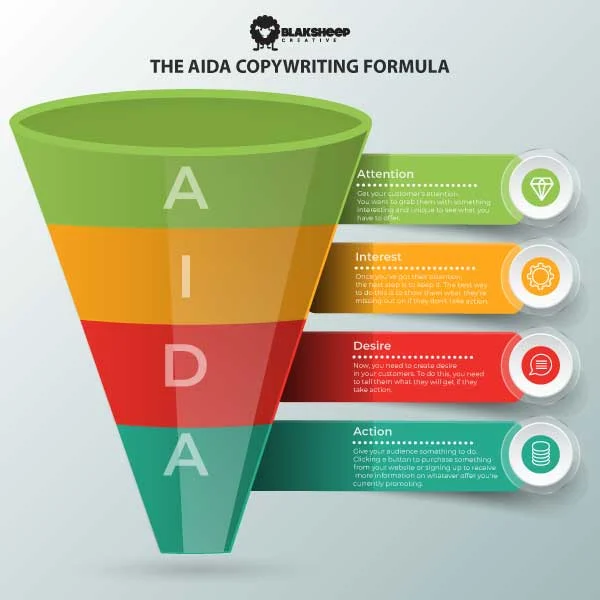
AIDA is a copywriting framework with four stages: Attention, Interest, Desire, Action. Stop the reader, hold them with something they care about, make the outcome feel worth having, then tell them exactly what to do next. It has been in use for more than a century and still structures landing pages, emails, ads, and search content.
Where the AIDA formula came from
AIDA is older than radio advertising, and the history is worth two minutes because it explains why the model is shaped the way it is.
The model is attributed to E. St. Elmo Lewis, an American advertising and sales pioneer. Writing in The Book-Keeper in 1903, Lewis described the mission of an advertisement as attracting a reader, interesting him, and then convincing him. In a talk given in Rochester in January 1910, he stated the full sequence: all advertising must attract attention, maintain interest, arouse desire, and get action.
The acronym itself came later. According to the documented history of the model, C. P. Russell noted in 1921 that the first letters conveniently spelled the name of an opera, and the mnemonic stuck. Arthur Sheldon had already proposed a fifth stage, satisfaction, in his 1911 book Successful Selling, arguing that repeat business is where the money actually is.
Two things follow from that origin. First, AIDA was built for a one-shot medium, a print advertisement a stranger encounters cold. That is exactly the situation your landing page is in. Second, it was never meant to describe a modern buying process with reviews, comparison shopping, and six visits before a purchase. Treat it as a structure for a single piece of copy, not as a map of your customer's whole decision.
The four stages and what each one has to do
Each stage has one job, and the most common failure is a page that does three of them well and skips the fourth entirely.
Attention
You are competing with the back button, and the evidence on how little gets read is unkind.
Nielsen Norman Group's analysis of browsing behavior concluded that users have time to read at most 28 percent of the words during an average page visit, and that 20 percent is the more likely figure. Their eye-tracking work on scanning found readers typically see about two words of a headline or link before deciding to move on.
So the attention stage is not a paragraph, it is a first line. Front-load the specific thing: the problem, the place, the number. "Your website gets found in Denham Springs or it does not" earns a second line. "Welcome to our website" does not. We go deeper on this in writing headlines people actually click.
Interest
Interest is where you prove you understand the reader's situation better than they expected a stranger to.
The move is specificity about their world, not yours. A roofing company writing for Livingston Parish homeowners can name the storm, the insurance adjuster, the six-week wait. Every detail that only somebody inside the problem would know buys another few seconds. Generic benefit language buys nothing, because the reader has already read it on four competitors' sites.
This is also where emotion does its work, which we cover in why emotional marketing works. Interest is felt before it is reasoned.
Desire
Interest is "this is about me". Desire is "I want the version of my life where this is handled".
The mechanical way to write it is to convert every feature into a consequence. Not "responsive design", but "the half of your visitors on a phone can actually call you". Not "monthly reporting", but "you know by the fifth of the month if it worked". Proof belongs here too: a named client, a real before and after, a review with a full name attached.
Desire is also where you handle the objection the reader is already holding. Price, time, risk, or the last agency that burned them. Naming it costs less than leaving it unanswered.
Action
The last stage is the one most small business pages fumble, usually by being polite about it.
One action per page. Say what happens next and what it costs in time. "Book a 15-minute call, no pitch" outperforms "Contact us" because it answers the two questions the reader has: how long, and what am I signing up for. Our post on calls to action makes the case at length, and the short version is that you have to ask.
AIDA for SEO: applying the formula to search content
AIDA and SEO get treated as separate disciplines, which is how you end up with pages that rank and convert nobody. The two fit together once you accept that on a search page, the reader arrives already in motion.
Somebody who searched "how to fix a running toilet" has granted you attention already. The click was the attention stage. Spending your first two paragraphs re-earning it with a scene-setting introduction is how bounce rates get built.
Here is the mapping that works on a page built to rank:
| AIDA stage | On a landing page | On a page built for search |
|---|---|---|
| Attention | The headline and hero | The title tag and meta description in the results page, before the click |
| Interest | The opening section | An answer in the first 60 words that resolves the query immediately |
| Desire | Benefits, proof, objections | The depth that a competitor's page lacks: specifics, examples, real numbers |
| Action | The primary call to action | The next step offered after the question is genuinely answered |
The important shift is that attention moves off the page. In search, the title and the description are the advertisement, and the page itself starts at interest. That is also why matching intent matters more than any copy trick, which is the argument in search intent for small business owners.
The other half of the shift is the order of the payoff. Answer first, then sell. A page that withholds the answer to keep the reader scrolling gets closed, and in a world of AI summaries the answer gets extracted anyway. Give it up front and earn the rest.
AIDA on a website: a worked example
Abstract frameworks are easy to nod at, so here is the same structure on a live contractor site we built.
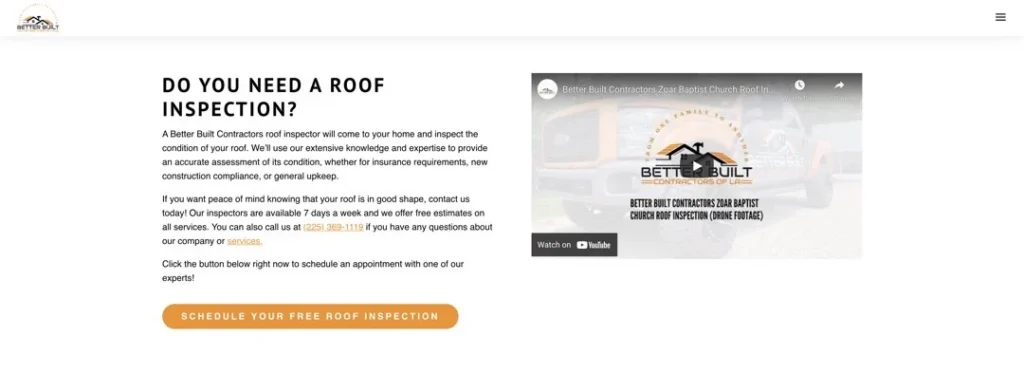
Attention is the headline naming the trade and the outcome. Interest is the sub-headline speaking to the specific worry a homeowner has about a contractor. Desire is the proof block, the photography of finished work, and the credentials. Action is a single button repeated at the points where a reader is most likely to be convinced.
The same shape works inside a blog post, which is where most small business traffic actually lands.
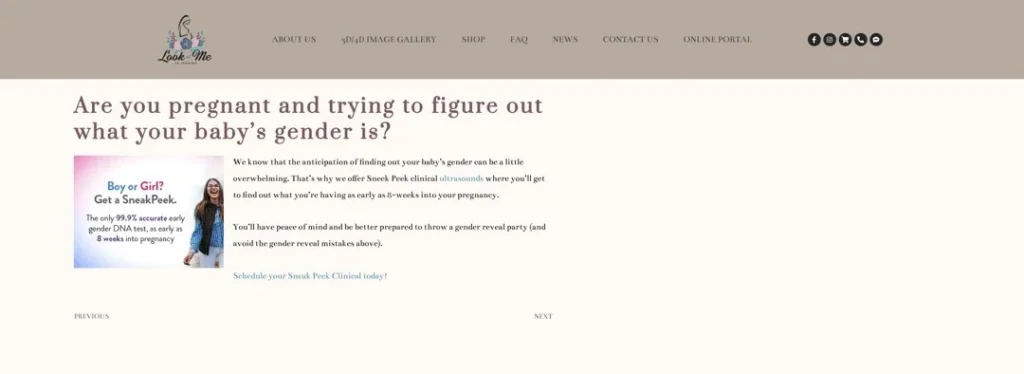
Notice what is not happening in either example: no countdown timer, no fake scarcity, no popup on entry. AIDA does not require pressure tactics. It requires that the four jobs get done in order, and the pages that do them quietly convert better than the ones that shout. There is more on the page mechanics in optimizing landing pages for conversions.
AIDA is attributed to E. St. Elmo Lewis, who set out the full sequence in a Rochester talk in January 1910. The acronym was popularised by C. P. Russell in 1921.
AIDA in an email
Email compresses the whole framework into a subject line and about a hundred words, which makes it the best place to practise.
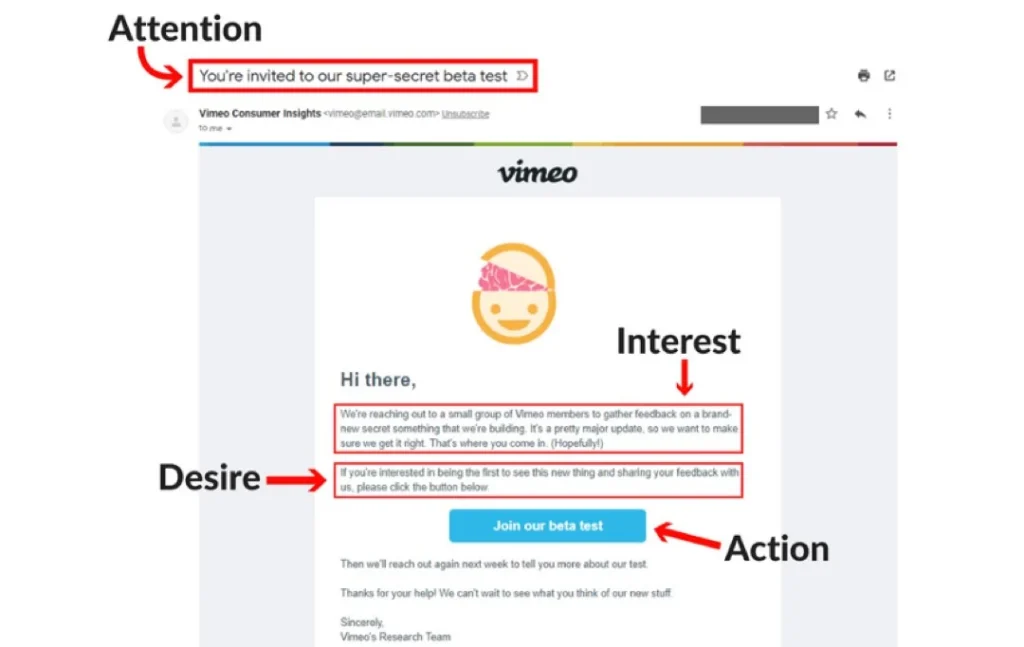
The subject line is attention and nothing else. The first sentence is interest, and it should read like it was written by a person who knows why this email is landing today. The middle is desire, one outcome stated concretely. The last line is action, a single link.
A worked example for a lawn care company writing to past customers in March:
- Subject: Your yard before the first cut
- Interest: "The first warm week is when crabgrass gets ahead of you, and once it is up, it is a summer-long argument."
- Desire: "A pre-emergent application now means you are mowing a lawn in June instead of fighting one."
- Action: "Reply with your address and we will put you on the March route."
Four sentences, four stages, no adjectives doing the heavy lifting. If email is a channel you want to build properly, that is what our email marketing service sets up.
Where AIDA falls short
A framework you cannot criticise is a framework you are not using properly, and AIDA has three real limits.
It ends at the sale. Lewis's model stops at action, which is why Sheldon added satisfaction in 1911. For a service business where the money is in renewals and referrals, everything after the first sale is missing from the model entirely.
It assumes a linear path. Real buyers read a review, leave, come back a week later, ask a friend, and return through a different page. AIDA describes one piece of copy, not a decision spread across six sessions.
It is not always the best fit. When the reader already knows they have a problem and is comparing solutions, starting with attention-grabbing is wasted motion. The Before-After-Bridge framework starts inside the problem instead, and it often beats AIDA for warm audiences and for cold email.
Use AIDA where the reader is cold and the copy has one shot. Use something else where they are already halfway to a decision.
A quick way to test copy you already have
Open your most important page and answer five questions honestly. It takes about ten minutes and usually finds the same gap twice.
- Read only the first line. Would a stranger with this problem read the second one?
- In the first screen, is there one sentence that could only have been written about your customer, not about anyone's customer?
- Is every feature followed by the consequence for the reader, or does the list stop at the feature?
- Is there exactly one thing to do, and does the button say what happens after the click?
- Is the biggest objection in the reader's head named anywhere on the page, or are you hoping they forget it?
Most pages fail question two and question five. Both are fixable in an afternoon without touching the design, which makes them the highest-return copy work available to a small business. Our notes on conversion rate optimization cover what to do after the copy is right.
Where to start
Pick the one page that matters most, run the five questions, and rewrite the first line and the call to action before you touch anything else. Those two edits carry most of the result, and you can measure them in a fortnight.
If you would rather have somebody else do the writing, that is the work behind our copywriting service, and we will tell you plainly if your page needs a rewrite or just a better button.
About the author
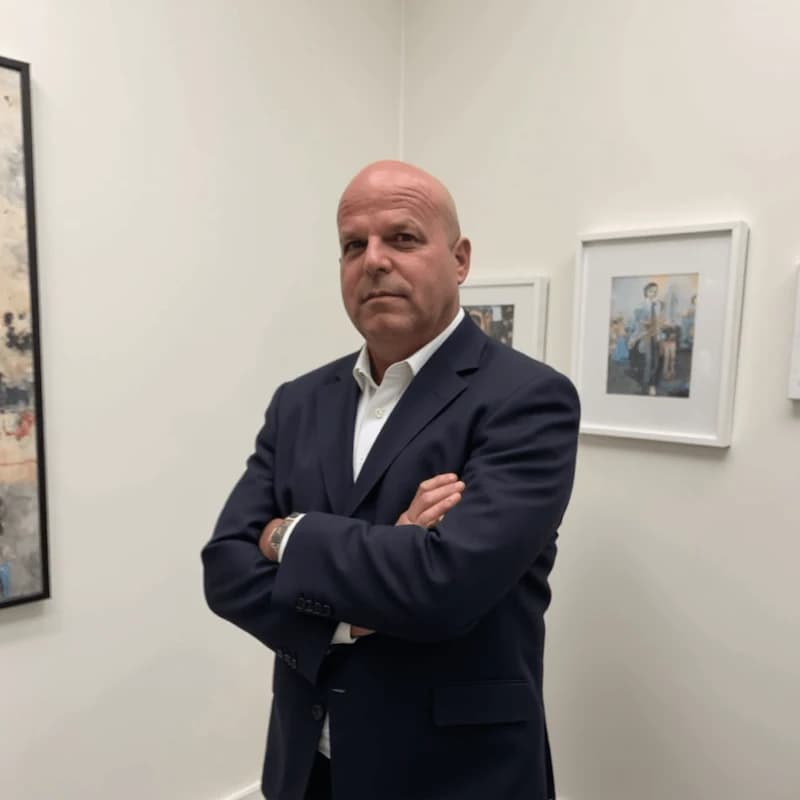
Founder & Lead Developer · Denham Springs, LA
Clint has built and marketed websites for 26 years, since founding BlakSheep Creative in 2000. He is also a 29-year firefighter and a 23-year member of IAFF Local 557, which is where the bias toward plain answers over sales copy comes from.
- Veteran-owned
- Firefighter-owned
- IAFF Local 557
Common Questions About the AIDA Framework
Short answers to the questions that come up most on this topic.
What does AIDA stand for in copywriting?
Who invented the AIDA model and when?
How do you use AIDA for SEO content?
Is the AIDA model still relevant?
What is the difference between AIDA and Before-After-Bridge?
What is the fifth stage of AIDA?

Your next step, without the guesswork
No surprises, clear next steps, and a fixed price before anything starts.