By Clint Sanchez · Published · Updated · 5 min read
Quick answer
Conversion rate optimization (CRO) is the practice of improving a website so a larger share of its visitors take a desired action: a purchase, a lead form, a call, or a subscription. The average landing page converts about 2.35% of visitors, while the top 25% of sites convert 5.31% or more. CRO closes that gap with personalization, A/B testing, more landing pages, trust signals like reviews, and lower bounce rates.
Key takeaways
- The average website conversion rate is about 2.35%, and the top 25% of websites convert at 5.31% or higher.
- Conversion rates vary widely by industry, from 15.6% in finance and insurance to 8.8% for agencies, so benchmarks must be industry-specific.
- The average bounce rate is 50.9%, according to the Siege Media research cited in the post, and every bounce is a lost conversion.
- Personalized calls to action perform 202% better than basic ones, yet personalization and A/B testing remain underused.
- Increasing landing pages from 10 to 15 can raise leads by 55%, and sites with more than 40 landing pages see a more than 500% increase.
- User-generated content, positive reviews, and star ratings are trust signals that lift conversion rates.
- The CRO software market is projected to reach $1.932 billion by 2026.
For most Baton Rouge and Livingston Parish businesses the conversion is a phone call, not a checkout. A plumber's or restaurant's 'conversion rate' is the share of visitors who tap the phone number, and that number collapses when the call rings out to voicemail during a lunch rush or a storm. CRO here starts with a tap-to-call button and someone, or something, answering.

Want this handled instead of DIY?
A 15-minute call, no script, no pressure. You leave with a plan either way.
In the digital age, the success of your website hinges not just on the traffic it attracts but on its ability to convert that traffic into leads, subscribers, or customers. Conversion Rate Optimization (CRO) emerges as the strategic hero in this narrative, aimed at improving the performance of your website to make sure higher conversion rates.
For website owners disheartened by underperforming sites, understanding and implementing CRO can be the turning point, transforming passive visitors into active participants. The essence of CRO lies in its ability to make your website work smarter, not harder, by leveraging every visit towards achieving your business goals.
Statistics underline the importance of CRO with compelling clarity. Imagine stepping into a room of 100 potential customers, yet only 2 make a purchase.
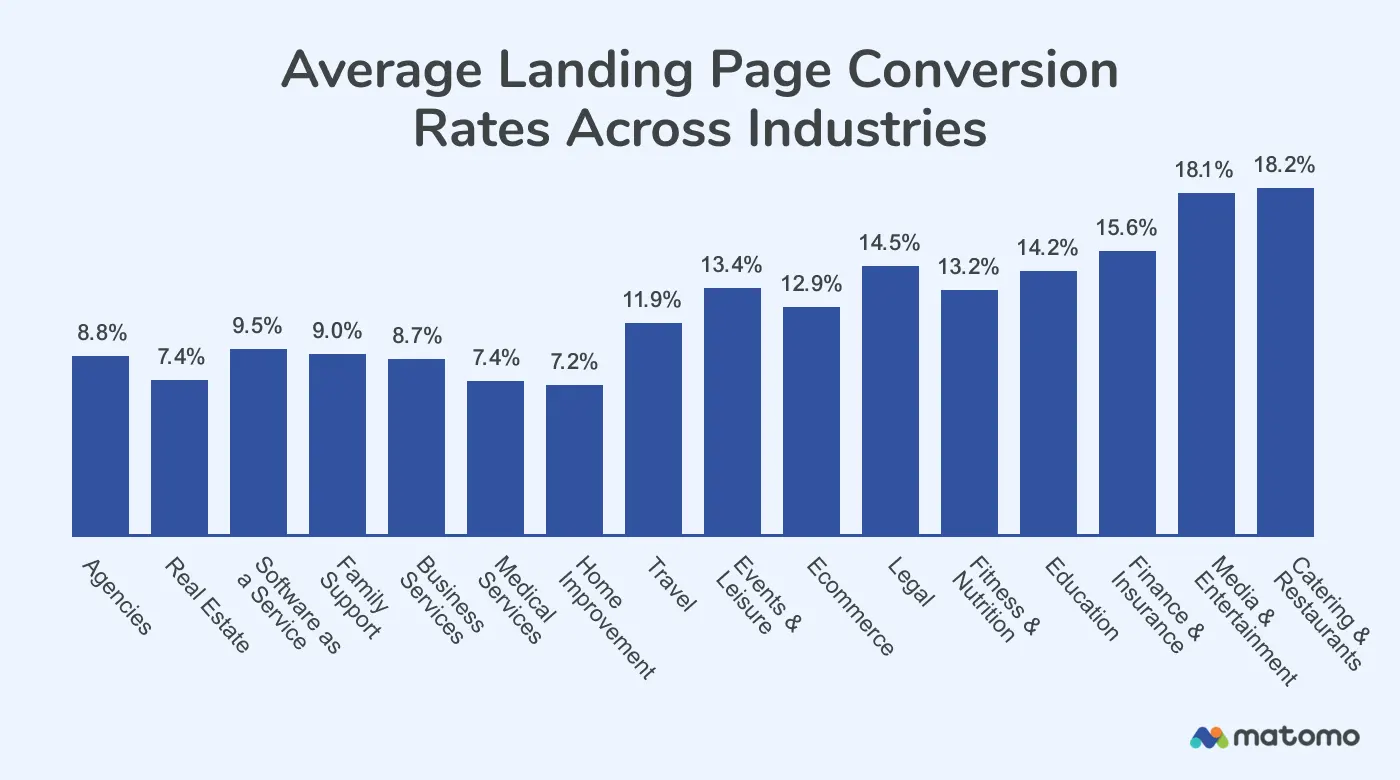
Image Source: matomo
This is the average reality for websites across industries, with a conversion rate lingering around 2.35%. However, there’s a brighter side to this scenario. The top 25% of websites boast conversion rates of 5.31% or higher, spotlighting the vast potential for improvement.
Want this handled for you? We build and market websites for Louisiana businesses, and we will tell you honestly if you do not need us.
The disparity in conversion rates across industries, from Finance and Insurance at a high of 15.6% to Agencies at 8.8%, further emphasizes the need for a tailored, data-driven approach to CRO.
Key Takeaways
- Conversion rates vary significantly across industries, highlighting the necessity for industry-specific CRO strategies.
- The CRO industry is on a solid growth trajectory, projected to reach $1.932 billion by 2026, indicating increasing recognition of its value.
- Bounce rates, averaging 50.9%, present a critical challenge, underscoring the urgency of effective CRO efforts.
- Personalization and A/B testing are underutilized despite their proven impact on improving conversion rates.
- Email lead generation forms and personalized CTAs are among the top tactics for improving conversions, with personalized CTAs performing 202% better than basic ones.
- Increasing the number of landing pages can significantly boost leads and conversions, with over 40 pages leading to a more than 500% increase.
- User-generated content (UGC) and trust signals like positive reviews and ratings are powerful tools for increasing conversions.
- Traffic source analysis reveals varied conversion potentials, with email opt-ins and search advertising among the most effective.
- The e-commerce sector shows distinct conversion trends across categories and platforms, with notable differences between desktop and mobile conversion rates.
The Imperative of Conversion Rate Optimization
In a landscape where the average landing page conversion rate hovers around a modest 2.35%, the opportunity for growth is undeniable. The sharp contrast between average and top-performing websites underscores the transformative impact of effective CRO. This potential is further magnified when examining conversion rates by industry, revealing that no sector is immune to the benefits of optimization.
With the CRO software market booming, now is the time for website owners to seize the moment, leveraging data-driven strategies to improve their sites from mere digital billboards to conversion powerhouses.
The path toward optimization is fraught with challenges, notably the battle against high bounce rates.
With an average of 50.9%, every bounced visitor represents a missed opportunity. However, the path forward is illuminated by the success of personalized approaches and the strategic use of A/B testing, though surprisingly underutilized. The power of personalization is evident, with personalized CTAs dramatically outperforming their generic counterparts.
Moreover, the correlation between the number of landing pages and conversion rates highlights the value of content diversity in capturing a broader audience.
The Strategic Arsenal for CRO
Getting into the tactics, the data presents a clear directive: prioritize personalization, diversify landing pages, and embrace user-generated content.
The impact of landing page quantity on lead generation further validates the need for expansive content strategies, with a more-is-more approach yielding significant dividends.
The influence of user-generated content and trust signals like positive reviews and star ratings is profound, improving consumer confidence and, by extension, conversion rates. These elements, combined with a keen analysis of traffic source conversion rates, offer a roadmap for optimizing conversion pathways.
The e-commerce sector, in particular, showcases the critical balance between platform choice and audience behavior, with distinct trends across categories and a notable preference for desktop conversions.
Conversion does not always happen on a form, especially for businesses where the phone call is the real lead event. Restaurants are a clear example, so read our guide on missed calls for restaurants, then review how conversion rate optimization helps turn traffic into action instead of wasted visits.
Wrap Up
Conversion Rate Optimization is a beacon of hope for website owners grappling with underwhelming site performance. Insights into industry-specific trends, the undeniable value of personalization, and the critical role of strategic content expansion mark the path from understanding the average conversion rates to implementing targeted strategies.
As we navigate the complexities of CRO, it’s important to remember that the foundation of any successful website is not just about optimizing for conversions but about creating genuine connections with your audience. In a digital landscape where authenticity and real impact are increasingly valued, taking a step beyond mere optimization to foster genuine engagement is key. This approach aligns with our insights on the importance of genuine impact beyond the world of social media, emphasizing that real connections with your audience can significantly enhance your site’s performance beyond traditional metrics.
As the digital landscape evolves, the imperative for CRO cannot be overstated. It is a path of transformation from a passive online presence to a dynamic conversion engine, underpinned by authentic, impactful content.
For those ready to start this transformative path, BlakSheep Creative offers a partnership rooted in expertise and driven by results. Specializing in turning data into actionable insights, BlakSheep Creative is the architect of optimization strategies designed to improve your website from potential to the pinnacle of performance.
Embrace the power of CRO with BlakSheep Creative, and turn your website into a conversion powerhouse. Fill out the form below for a free consultation:
FAQs
What is a reasonable conversion rate for my industry? A good conversion rate can vary significantly across industries. For instance, finance and insurance sites may aim for around 15.6%, while agencies might target rates closer to 8.8%. It’s essential to benchmark against industry averages and top performers.
How can I reduce my website’s bounce rate? Reducing bounce rates involves improving user experience through faster load times, engaging content, intuitive navigation, and compelling calls to action. Personalization and A/B testing are also effective strategies for keeping visitors engaged.
Is personalization effective in increasing conversion rates? Yes, personalization can significantly increase conversion rates. Personalized calls-to-action, for example, perform 202% better than standard CTAs, demonstrating the power of tailoring the user experience to individual preferences and behaviors.How many landing pages should my website have? More landing pages can lead to higher conversion rates. Research suggests that increasing the number of landing pages from 10 to 15 can boost leads by 55%, with over 40 pages increasing conversion by more than 500%.
Tired of paying for clicks that don’t turn into calls? Talk through your specific funnel with us — 15 minutes, no sales pitch.
About the author

Founder & Lead Developer · Denham Springs, LA
Clint has built and marketed websites for 26 years, since founding BlakSheep Creative in 2000. He is also a 29-year firefighter and a 23-year member of IAFF Local 557, which is where the bias toward plain answers over sales copy comes from.
- Veteran-owned
- Firefighter-owned
- IAFF Local 557
Common questions about digital marketing
What counts as a conversion on a website?
What is a good conversion rate?
How does CRO differ from SEO?
What is A/B testing in CRO?
Why do more landing pages increase conversions?
How do reviews and user-generated content affect conversion rates?

Your next step, without the guesswork
No surprises, clear next steps, and a fixed price before anything starts.