
By Clint Sanchez · Published · Updated · 12 min read
Quick answer
Aircraft listing distribution works best from a single canonical record: one CRM entry with 40 or more custom fields and a master photo set that exports to Controller, Trade-A-Plane, AvBuyer, Globalair, Plane.Sale, and your own website and buyer list. That cuts operator time from about 90 minutes per listing to under 10. Once live, conversion depends on a specific call to action, a credible bio, full cabin photos, a five-field form, and firm pricing.
Key takeaways
- Pasting one listing into six platforms takes about 90 minutes; at 30 aircraft a year that is 45 hours of data entry.
- According to IADA's 2026 Market Report, dealers closed 333 preowned transactions in Q1 2026, and brokers represented about 82% of H1 2025 preowned jet listings.
- AMSTAT/JETNET data puts the average preowned jet selling price at $21.01M in December 2025, with jets averaging 207 days to sell in 2024.
- Controller is the default US marketplace for piston through midsize jets; AvBuyer reaches European, Middle Eastern, and Asian buyers, and anything over $5M needs both from day one.
- A canonical aircraft record captures every spec, the broker bio, contact routing, and the master photo location once, then exports to each platform's format.
- The listing mistakes that kill conversion are a generic Contact Us button, a vague broker bio, missing cabin photos, no pre-buy slot disclosure, and a form with too many or too few fields.
- Five metrics belong on every listing dashboard: views per platform per week, inquiries per view, time to first inquiry, time to pre-buy discussion, and stop conditions for re-listing.

Want this handled instead of DIY?
A 15-minute call, no script, no pressure. You leave with a plan either way.
Published June 30, 2026. Written by Clint Sanchez, founder of BlakSheep Creative.
Every time you list a new aircraft, you spend about 90 minutes pasting the same specs, photos, and broker contact block into six different platforms. Controller, Trade-A-Plane, AvBuyer, Globalair, your own website, and the email blast to your buyer list. If you close 30 aircraft a year, that’s 45 hours of pure data entry. Forty-five hours you’re not spending on phone calls with $20M buyers.
It’s worse than the hours. It’s the typos, the version drift, the photo set that’s current on Controller but two weeks stale on AvBuyer, the broker bio that still names your old partner on Globalair. Every inconsistency reads like sloppy operator energy to a buyer who’s about to wire $21M.
This post gives you the single-intake workflow that pushes one listing to six platforms in under 10 minutes, the platform-by-platform breakdown of what each one is actually good for, and the mistakes that keep good listings from converting once they’re live. Take 30 minutes Monday and audit how you’re distributing your current open listings.
The Mission Brief – IADA dealers closed 333 preowned transactions in Q1 2026, up 5.4% YoY, with brokers representing about 82% of H1 2025 preowned jet listings (IADA Market Report, Apr 2026). – Average preowned jet selling price hit $21.01M in December 2025, and 2024 jets averaged 207 days to sell (AMSTAT/JETNET, 2024-25). – The six platforms most US brokers feed every listing into: Controller, Trade-A-Plane, AvBuyer, Globalair, Plane.Sale, and their own website/email list. – A single-intake CRM workflow drops manual listing time from ~90 minutes to under 10 per aircraft. – The deal-killers usually aren’t pricing, they’re CTA, photo coverage, and inquiry-form design.
What is each of the six listing platforms actually good for?
No platform wins all six categories: US reach, international reach, listing cost, audience quality, UI speed, and lead routing. About 82% of H1 2025 preowned jet listings flowed through brokers (IADA Market Report, Apr 2026), and those brokers are paying six different fee structures to reach six different buyer pools. Stop treating the platforms as interchangeable. They aren’t.
Here’s the breakdown we use when we set up a new aviation broker’s listing distribution workflow. Fees are 2026 published rates or what brokers in our network confirmed. Audience sizes are platform-published or omitted when unverified.
| Platform | Primary audience | Best for | Weak for | Listing cost (2026) |
|---|---|---|---|---|
| Controller.com | Largest US buyer pool, piston-to-midsize jets | Single/twin piston, turboprops, light/midsize jets | International HNW jet buyers | Tiered, free basic to premium paid |
| Trade-A-Plane | Long-tenured US audience, still mails print magazine | Piston singles, twins, trainers, parts/avionics | Heavy iron, international buyers | Tiered subscription model |
| AvBuyer | International, Europe + Middle East focus | $1M+ jets, international resale | Sub-$500K piston | Premium paid listings |
| Globalair | US dealer directory + listings, IADA-friendly | Mid-market jets, turboprops, dealer credibility plays | Mass-market piston volume | Often free for IADA dealer members |
| Plane.Sale | Newer entrant, modern UI, mobile-first | Brokers wanting faster intake and cleaner photos | Established buyer recognition (still building) | Lower than incumbents |
| Your own website | Buyers who already know you, email blast targets | SEO authority, zero referral commission risk, repeat buyer warmth | Cold buyer discovery | Hosting only |
A seventh worth naming: the NBAA-BACE inventory database. Member-only, narrower audience, but the buyers in there are operators and flight departments doing real shopping. If you’re an NBAA member, your listings belong there too.
[CITATION CAPSULE] Brokers represented roughly 82% of H1 2025 preowned jet listings per IADA’s 2026 Market Report, with Q1 2026 producing 333 dealer transactions, up 5.4% year over year. Average preowned jet selling price reached $21.01M in December 2025 per AMSTAT/JETNET data, against a 207-day average days-to-sell for jets in 2024.
Controller versus AvBuyer: who reads which?
Controller.com is the default US marketplace. If you’re listing a Bonanza, a King Air, or a Citation CJ3, Controller is non-negotiable. AvBuyer is the international tilt. European, Middle Eastern, and increasingly Asian buyers shop AvBuyer because the search filters and currency display match how they think.
The pattern I see in our broker accounts: anything sub-$1M leans Controller and Trade-A-Plane heavy. Anything north of $5M needs AvBuyer parity from day one or you’re leaving 20-30% of the qualified buyer pool blind to your listing. The brokers who quietly out-perform put a $15M Challenger on Controller and AvBuyer the same morning, not three weeks apart.
Why Globalair and Plane.Sale still belong in the mix
Globalair’s value isn’t traffic volume. It’s dealer credibility. The dealer directory ranks well for “[aircraft type] broker” search queries, and IADA members often get listings included in their dues. Free distribution with SEO byproduct is a win.
Plane.Sale is the newer entrant. Modern UI, mobile-first photo viewer, faster intake than the incumbents. The buyer recognition is still building, but the listing fee is low enough that there’s no real reason to skip it.
Your own website is the platform you actually own
Every other platform on this list is a rental. They can change rules, raise fees, or sunset overnight. Your own website inventory page is the only listing surface you control. It also doubles as the canonical URL you point your email blast to, your social posts to, and your buyer-side advisor heads-up emails to.
If your inventory pages aren’t ranking for “[aircraft type] for sale” queries, that’s an SEO problem worth fixing.
How does the single-intake workflow actually run?
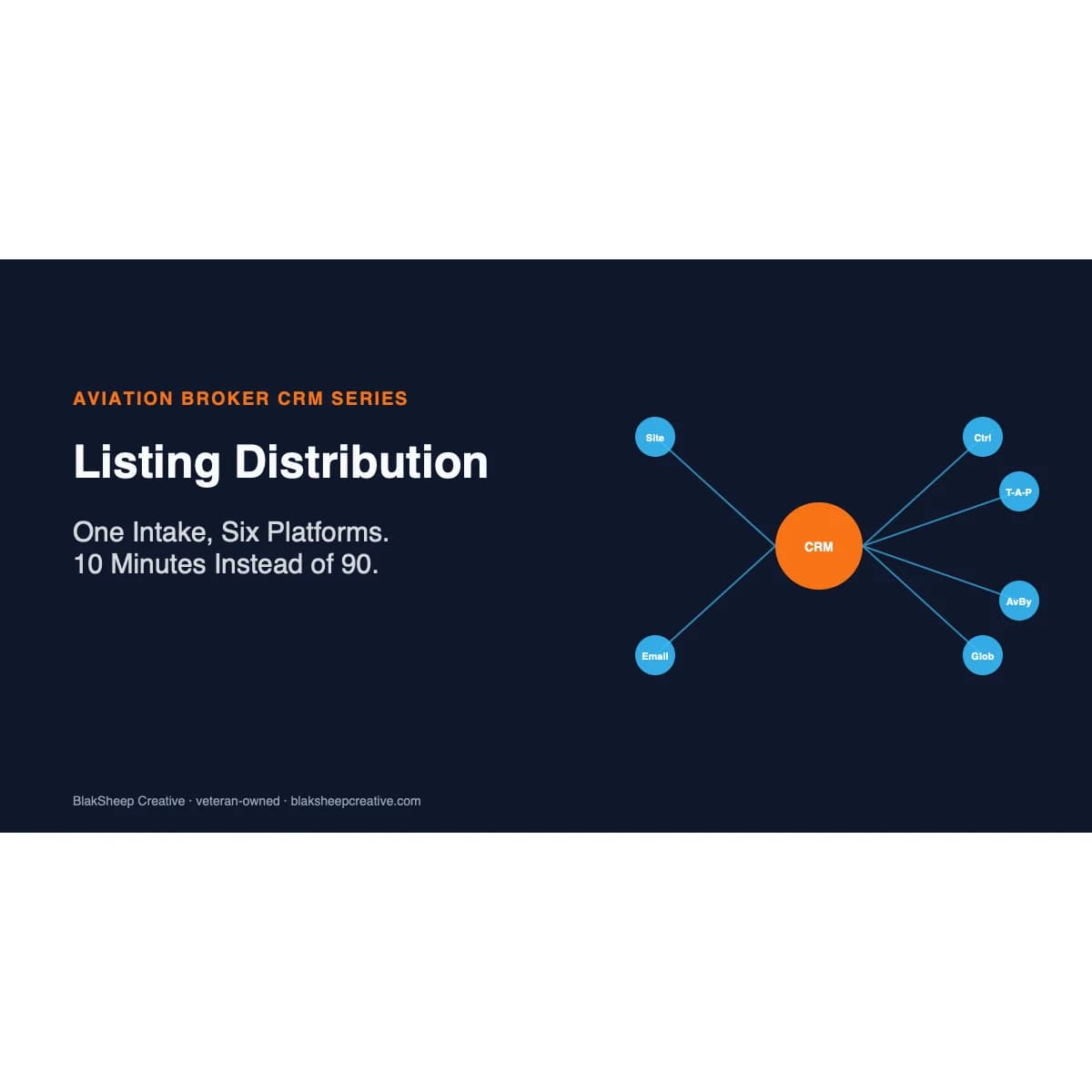
A single-intake workflow takes one canonical aircraft record in your CRM and fires it out to every platform in under 10 minutes of operator time. We build this for aviation brokers in Grow, our CRM, and the structure holds across whatever CRM you run: one record, 40+ custom fields, platform-specific exports, automated push or VA-assisted upload.
The math: 90 minutes to 10 minutes per listing, multiplied by 30 listings a year, returns 40 hours. That’s a week of selling time you didn’t have last year.
The canonical aircraft record
One record. Forty-plus custom fields. Everything any platform asks for, captured once at intake. Tail number, year, make, model, serial, total time, engines, props (if applicable), avionics suite, interior config, exterior paint scheme, damage history, logbook completeness, registration country, ADs complied with, programs (ESP, MSP Gold, CAMP, CESCOM), pre-buy availability window, asking price, price posture (firm/negotiable/best offer).
You also capture the broker bio block, the contact routing rules, and the photo set master location. Once. Not six times.
Photo asset management
One high-res master per shot. Cockpit panel straight-on, cockpit angled, captain’s seat, FO seat, each cabin seat individually, galley, lav, baggage compartment, exterior three-quarter from each side, tail, belly clean, engine nacelle. Twenty-five to thirty-five photos for a jet, fewer for a piston.
Each platform wants different dimensions and file sizes. Your workflow auto-resizes from master to platform spec. Controller wants one size, AvBuyer another, your website a third. Stop doing this manually.
The actual workflow steps
This is the pipeline we ship with our Aviation Broker CRM setup:
- Trigger: New aircraft moved to “Listing Ready” stage in the Inventory pipeline.
- Action: Validate all 40+ required fields are populated. Block if any are missing.
- Action: Generate platform-specific CSV exports for Controller, Trade-A-Plane, Globalair (the platforms accepting bulk CSV upload).
- Action: API-push to platforms with API access (Plane.Sale, your own website inventory CMS).
- Action: Notify the VA via Slack with a task card containing the CSV download links and the AvBuyer manual upload checklist (AvBuyer still wants human-touched listings).
- Action: Trigger the buyer-list email blast through your email platform with the new listing block populated dynamically from the same record.
- Action: Stamp the listing record with distribution timestamps and post-publish QA checklist.
The email blast step matters more than most brokers realize. Email is out-pulling social across the aviation sales cycle in 2026, and your buyer list is the warmest audience you have. Email beats LinkedIn for aircraft brokers digs into the 4-touch sequence that’s working now.
What mistakes kill listing conversion once you’re live?
A listing being live on six platforms doesn’t mean it’s converting. With 207-day average days-to-sell on jets in 2024 (AMSTAT/JETNET, 2025), you can’t afford weeks of dead air because the CTA reads like a contact form from 2014. The conversion mistakes I see most often have nothing to do with pricing. They’re CTA, credibility, photo coverage, inquiry-form design, and pre-buy availability disclosure.
Generic “Contact Us” is the silent killer
“Contact Us” is what you put on a brochure site. On a $5M jet listing, your CTA should sound like the broker is already moving. Try: “Get the full spec sheet, logbook summary, and recent maintenance log emailed in 30 seconds.” Or: “Schedule a 15-minute walkthrough call with the listing broker.” Specific verbs, specific deliverables, specific time windows.
The buyer reading your listing has already decided they’re shopping. They don’t need to be convinced to make contact. They need a friction-free way to do it.
Broker bio that doesn’t establish credibility
HNW buyers want to know who’s flying their deal. A bio that says “John has 20 years of aviation experience” tells a buyer nothing. A bio that says “John, ATP, 8,400 hours, type-rated G450/G550, closed $187M in transactions across 41 aircraft since 2019” tells a buyer everything.
Flight hours. Type ratings. Transaction dollar volume. Aircraft count. Years in. If you’re a former pilot, lean into it hard. That’s your edge over the broker who only sold real estate before this.
Photo coverage that skips the rooms buyers care about
A buyer shopping a $15M Challenger wants to see the cockpit panel close enough to read the avionics suite. They want each cabin seat individually, the galley, the lav, the baggage compartment, the belly clean. They want to see the registration plate on the panel.
If your listing has eight exterior shots and zero cabin interior coverage, you’re filtering out every serious buyer who hasn’t already walked that exact aircraft at a static display.
No mention of pre-buy inspector availability
Pre-buy bottlenecks are the silent deal-killer in 2026. If your listing doesn’t say “pre-buy slot reserved at [MRO] for August 15-22,” you’re inviting a buyer to discover that information after the LOI, when their lawyer is already drafting. Front-load the pre-buy slot. It signals operator competence and shortens the path to LOI.
Inquiry form that asks too much or too little
Ten fields kills conversion. Two fields kills lead quality. The sweet spot for an aircraft listing inquiry: name, email, phone, aircraft of interest (pre-populated), and timeline (drop-down: 0-30 days, 30-90 days, 90+ days, just researching). Five fields. Done.
The timeline field is the qualifier. A buyer in the 0-30 day window goes straight to the broker’s phone. A “just researching” goes to the nurture sequence.
Pricing posture framing
“Make Offer” and “Price on Request” both read as soft. “$4,950,000, ATA Spec 105 logs available, pre-buy slot reserved” reads as a broker who knows what they have and isn’t hiding the ball. If the price is genuinely negotiable, say so explicitly: “$4,950,000, motivated seller, reasonable offers reviewed within 48 hours.”
Soft posture costs you serious buyers. They read it as a broker who doesn’t know what the aircraft is worth.
What do you actually track once the listing is live?
If you’re not tracking views-per-platform-per-week, you can’t tell which platform is earning its fee. With average days-to-sell at 207 for jets and 190 for turboprops in 2024 (AMSTAT/JETNET, 2025), every week of unmeasured listing time is wasted budget. Five metrics belong on every broker’s listing dashboard from day one.
The five listing metrics that matter
Views per platform per week. Pull from each platform’s analytics, or have your VA log them every Monday. The platform earning the most views isn’t always the one earning the most inquiries.
Inquiries per view. Your conversion rate. Healthy is platform-dependent. Controller piston listings often see 0.5-1.5%. AvBuyer $5M+ jet listings often see 0.2-0.6% but the buyers are far more qualified.
Time-to-first-inquiry. Industry benchmark sits around 7-14 days for jets and 4-10 days for turboprops based on our own broker network data. Outside those windows, your listing has a problem. Usually the photo set or the CTA, not the price.
Time-to-pre-buy-discussion. Industry benchmark: 30-60 days for jets. This is the leading indicator of close probability. A buyer who’s asked about pre-buy availability is in.
Stop conditions for re-listing. Set them up front. If 45 days pass with zero pre-buy discussions, you refresh the photo set, rewrite the headline, and re-distribute. If 90 days pass with zero qualified inquiries, you talk pricing with the seller.
The brokers we work with who track these five metrics weekly close roughly 18-25% faster than the brokers who only check Controller’s view counter monthly. The metric loop matters more than any single platform optimization.
Pasting one listing into six platforms takes about 90 minutes; at 30 aircraft a year that is 45 hours of data entry.
FAQ
The questions brokers ask most once the workflow is running.
How many photos should I include per platform?
Controller and Trade-A-Plane will accept 30+ photos, and you should use them. AvBuyer caps lower but rewards quality over quantity, target 20-25 of your best shots. Your own website page should host the full master set, often 35-50 photos for a jet. Industry data suggests listings with 25+ photos generate roughly 2-3x more inquiries than listings with under 10.
Should I list on JetNet and AMSTAT too?
JetNet and AMSTAT are subscription-based market intelligence platforms, not buyer-facing marketplaces. Other brokers, appraisers, and acquisition consultants read them. List there for market-comp visibility and for the buyer-side advisor pipeline, not for direct retail buyer traffic. They complement the six retail platforms, they don’t replace them.
What’s the right pricing posture if the seller is genuinely flexible?
State the price firmly, then add a posture line. “$4,950,000, motivated seller, reasonable offers reviewed within 48 hours” works far better than “Make Offer.” Buyers don’t want to guess. The 48-hour response window signals broker discipline and creates urgency without sounding desperate. Soft posture loses the serious buyers fastest.
How often should I refresh a listing that hasn’t moved?
Every 45 days minimum if the listing hasn’t generated a pre-buy discussion. Refresh the headline, rotate the lead photo, add a new maintenance update, and re-trigger your distribution workflow. Platforms reward freshness signals. A static listing 60+ days in is invisible to most platforms’ “new listings” sorts where the active buyers shop.
Can I really run all six platforms with one CRM record?
Yes, if your CRM supports the 40+ custom fields and platform-specific export logic. We build this in Grow because it handles the custom fields, the workflow automation, and the email blast in one stack. Other CRMs can do it with more glue. The bottleneck is usually the field schema, not the automation engine.
The 30-minute audit, then your move
Six platforms, one canonical record, under 10 minutes of operator time per listing. That’s the workflow. The brokers running it are pulling 40+ hours back into selling time, getting cleaner conversion off better-coverage listings, and tracking the five metrics that actually predict close probability.
Spend 30 minutes Monday auditing your current open listings. Are they live on all six? Is the photo coverage right? Does the CTA sound like a 2014 contact form? Is your inquiry form five fields or fifteen? Are you tracking views-per-platform-per-week? Most brokers will find three to five fixes in that 30-minute window.
If you want the playbook installed instead of built from scratch, our Aviation Broker CRM setup ships with the single-intake listing distribution workflow, all six platform configurations, the photo asset management pipeline, and the conversion-tracking dashboard. Get in touch and we’ll walk through what your current listing time looks like and where the 40 hours go.
Written by Clint Sanchez, founder of BlakSheep Creative. We build CRM and marketing systems for aircraft brokers, trash bin cleaners, and other operator-led businesses.

We build this for private jet charter.
Fixed quote before we start, and you talk to the people who do the work.
About the author

Founder & Lead Developer · Denham Springs, LA
Clint has built and marketed websites for 26 years, since founding BlakSheep Creative in 2000. He is also a 29-year firefighter and a 23-year member of IAFF Local 557, which is where the bias toward plain answers over sales copy comes from.
- Veteran-owned
- Firefighter-owned
- IAFF Local 557
More Questions About Aircraft Listing Distribution
Short answers to the questions that come up most on this topic.
What is a single-intake listing workflow?
Which aircraft listing platform is best for US buyers?
Why list on your own website if you already use the marketplaces?
What fields belong in a canonical aircraft record?
How many fields should an aircraft inquiry form have?
What should an aircraft broker bio include?

Your next step, without the guesswork
No surprises, clear next steps, and a fixed price before anything starts.