
By Clint Sanchez · Published · Updated · 12 min read
Quick answer
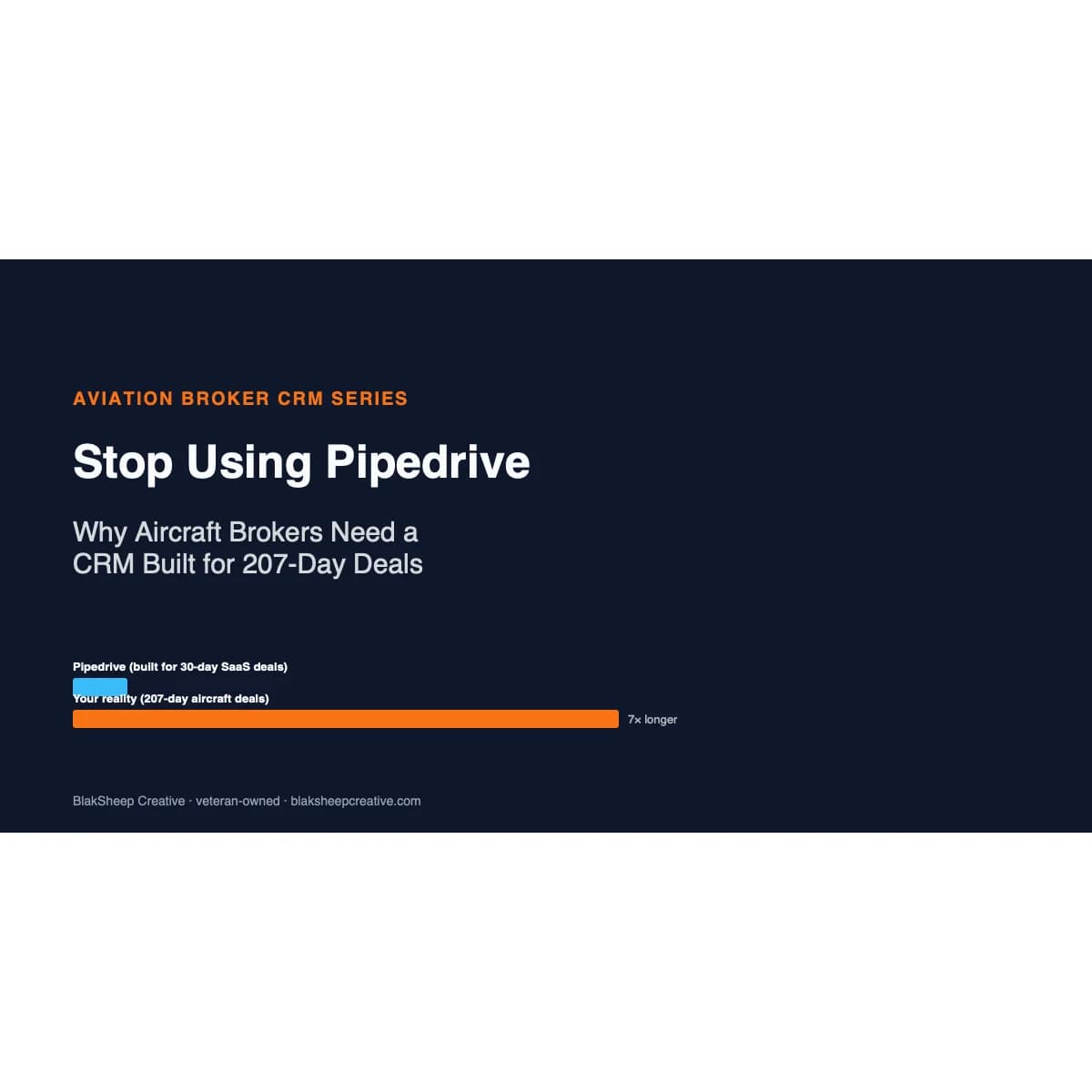
Pipedrive was built for 30-day sales cycles, while the average preowned jet took 207 days to sell in 2024 according to AMSTAT/JETNET data. It breaks for aircraft brokers in five places: multi-year nurture, stalled-deal alerts, listing distribution, custom field depth past 15-20 fields, and long-cycle reporting. The four alternatives worth comparing in 2026 are GoHighLevel with an aviation snapshot, HubSpot Sales Hub Professional, Salesforce Sales Cloud, and a custom Airtable build.
Key takeaways
- According to AMSTAT/JETNET fleet data, the average preowned jet took 207 days to sell in 2024, roughly seven times the 30-day cycle Pipedrive's reports and automations assume.
- Pipedrive fails aircraft brokers in five specific places: long-cycle nurture, absence-of-activity alerts, listing distribution to 6+ platforms, custom field depth, and long-window reporting.
- Pipedrive's custom field interface starts breaking down past 15-20 fields, while aircraft deals routinely need 40 or more.
- GoHighLevel runs $97, $297, or $497 per month per sub-account, not per seat, per its 2026 pricing page, and fits solo brokers and teams of 1-5.
- HubSpot Sales Hub Professional is $100 per seat per month billed annually, and only makes sense if the brokerage already runs HubSpot for marketing.
- Salesforce Sales Cloud is the right answer for shops with 10+ brokers; an aviation-specific build typically costs $15K-$60K in consultant time.
- Run the old and new CRM in parallel for 30-60 days and never migrate during a hot deal; broken automations, not lost data, are the most common failure.

Want this handled instead of DIY?
A 15-minute call, no script, no pressure — you leave with a plan either way.
Published July 21, 2026. Written by Clint Sanchez, founder of BlakSheep Creative.
Pipedrive was built for sales teams closing 30-day SaaS deals. You’re running 207-day aircraft deals. That gap is the whole problem.
The average preowned jet took 207 days to sell in 2024, according to AMSTAT/JETNET fleet data (AMSTAT, 2024). Pipedrive’s default reports, automation timers, and pipeline visualization all assume something closer to 30. So you end up looking at funnel charts that scream “your conversion is broken,” when really your tool just can’t read a 7-month cycle.
This isn’t a Pipedrive hit piece. Pipedrive is genuinely good at what it was built for. The question is if what it was built for matches what you actually do. For most aircraft brokers in 2026, the answer is no, and the cost of the mismatch is 2-3 buyers a year quietly walking to brokers running smarter systems.
The Bottom Line – Average days-to-sell for a preowned jet hit 207 in 2024 (AMSTAT/JETNET, 2024). Pipedrive was built for 30-day cycles. – Pipedrive breaks for aircraft brokers in 5 specific ways: long-cycle nurture, stalled-deal detection, listing distribution, custom field depth, and long-window reporting. – Four alternatives are worth comparing in 2026: GoHighLevel with an aviation snapshot, HubSpot Sales Hub Pro, Salesforce Sales Cloud, and a custom build on Airtable/Notion/Coda. – Pricing ranges from roughly $20 to $500+ per month depending on team size and aviation-specific build needs. – The right CRM depends on team size, not hype. Solo brokers and 10-broker shops need different things.
What Pipedrive Actually Does Well
Pipedrive isn’t a bad CRM. It’s a focused one. It serves more than 100,000 companies across 179 countries, per Pipedrive’s own published company stats (Pipedrive, 2026), and most of those companies run short-cycle B2B sales where the tool’s design choices line up perfectly. Credit where it’s due.
Here’s what Pipedrive nails:
- Visual kanban that loads fast. Drag a deal from one stage to the next and you’re done. No 14-click workflow.
- Quick contact and deal entry. A new lead can be in the system in under 60 seconds. That speed matters when you’re triaging.
- Affordable per-seat pricing for solo operators. The Essential tier starts around $14-$24 per seat per month depending on billing cycle, per Pipedrive’s pricing page (Pipedrive, 2026). For a one-person operation closing dozens of 30-day deals, that’s tough to beat.
- A mobile app that actually works. You can update a deal between meetings without fighting the interface.
- Clean API and a healthy integration marketplace. If you want to bolt on a tool, you usually can.
If you’re closing 50 SaaS subscriptions a year and each one moves in 30 days, Pipedrive is probably the right tool. The trouble starts when your average deal is 7 months and your buyer goes dark for a full quarter mid-cycle. That’s a different sport.
I’ve onboarded a handful of brokers off Pipedrive in the last 18 months. Not one of them complained about Pipedrive’s interface. They all complained about the same five things, in the same order, which we’ll get into next.
Where Pipedrive Breaks for Aircraft Brokers (the 5 specific places)
Pipedrive doesn’t fail aircraft brokers because it’s poorly built. It fails because the underlying assumptions, short cycle, linear flow, simple deal record, don’t match how aircraft actually trade. IADA dealers closed 333 transactions in Q1 2026, up 5.4% year-over-year, per the IADA Q1 2026 Market Report (IADA, 2026). Those deals don’t move like SaaS subscriptions.
Here are the five specific breakage points.
1. Multi-Year Buyer Nurture Is Effectively Impossible
Pipedrive’s automation suite is built around sequences measured in days. Setting up an 18-month nurture, the kind you actually need when buyers go quiet for 6-9 months and resurface ready to close, requires manual workarounds. You can fake it with date-math fields and looping workflows, but every broker I’ve seen try this eventually gives up and goes back to spreadsheets and memory.
Aircraft brokers need this because buyers go dark for tax reasons, board approvals, hangar availability, or just because the principal’s kids aren’t out of school yet. None of that is in a “day 30 break-up email.” We covered the full long-cycle nurture pattern in why email beats LinkedIn for aircraft brokers in 2026.
2. Pre-Buy Stall Detection Has No Native Hook
Pipedrive tracks “activities” you log against a deal. It doesn’t have a built-in concept of absence of activity. If a pre-buy goes 21 days without movement, nothing fires. No alert. No nudge. The deal just sits there looking the same color as everything else.
That matters because pre-buy bottlenecks now kill more transactions than financing. You need a CRM that yells when a deal has been silent too long, not one that waits for you to notice.
3. Listing Distribution Workflow Is Foreign Territory
Pipedrive expects deals to flow linearly through stages. Aircraft listings need to push outward to 6+ external platforms, Controller, JetNet, AMSTAT, AvBuyer, your own site, and whichever IADA channel applies. Pipedrive treats every one of those as a manual export.
You can build it. You’ll spend a weekend on Zapier and another weekend debugging it.
4. Custom Field Depth Caps Out Right Where Aviation Starts
Aircraft sales need 40+ custom fields per deal: aircraft category, year, hours, type ratings, registration data, escrow contacts, MRO contacts, hangar location, ownership structure, financing partner, the list keeps going. Pipedrive’s custom field UX starts to break down past 15-20 fields. The deal view becomes a wall of scrolling, and the reporting layer can’t slice cleanly across all of them.
The custom field cap isn’t a hard technical limit. It’s a UX limit. Pipedrive’s interface assumes most deals are described by a handful of attributes. Aviation deals are described by dozens. The mismatch isn’t fatal on day one. It compounds.
5. Reports Break Down Over 207-Day Cycles
Pipedrive’s funnel and conversion reports are designed around short cycles. Run them across a 7-month sales window and they produce noise, not signal. Win rate calculations get distorted by deals still legitimately in flight. Time-in-stage averages get pulled wildly by long pre-buys. Forecasting gets unreliable because the model assumes deals close near linearly through stages.
This is why brokers running Pipedrive often stop trusting their own reports and revert to spreadsheets. The tool isn’t lying. It’s just answering a question you didn’t ask.
What Aircraft Brokers Actually Need (the feature requirements)
A CRM that fits an aircraft brokerage needs to do seven things well, not five. The Aviation Broker CRM build spec we use was reverse-engineered from interviews with brokers running $5M-$25M average ticket sizes, all reporting some version of the same gaps.
The non-negotiable list:
- Multi-year nurture automation. Sequences that run 12-18+ months without breaking, with date math, conditional branches, and clean stop conditions.
- Stalled-deal alerts. Absence-of-activity triggers (no email, no logged call, no field update for X days) that surface in your dashboard automatically.
- Listing distribution workflow. One-click or near-one-click push to 6+ listing platforms when an aircraft hits “active inventory.”
- Deep custom field support. Comfortable handling of 40-60 fields per deal record, with clean reporting across all of them.
- Long-cycle reporting. Cohort-style analysis (Q1 2026 buyer cohort, how many closed by Q4) instead of funnel-only views.
- Calendar + scheduling integrated with pre-buy and showings. Not just a Calendly bolt-on, real native scheduling tied to the deal record.
- Email + SMS in one inbox. Brokers live on their phones between hangars. The CRM has to follow.
If your current tool checks 3 of these 7, you’re working around it. If it checks 5+, stay where you are.
The 4 CRM Alternatives Worth Comparing in 2026
There’s no single right answer. The right CRM depends on team size, existing tool stack, and how much admin overhead you can absorb. Below are the four alternatives I’d actually put on a real shortlist for an aircraft brokerage in 2026, with current pricing verified against each vendor’s site. Pricing changes, so always confirm.
Option 1: GoHighLevel + Aviation Broker Snapshot
Best fit for solo brokers and small teams (1-5 brokers). GoHighLevel handles long-cycle nurture, listing distribution workflows, deep custom fields, and integrated email/SMS natively. Pricing runs $97/mo (Starter), $297/mo (Unlimited), or $497/mo (Pro) per GoHighLevel’s pricing page (GoHighLevel, 2026). The platform is sub-account based, not per-seat, which is a quiet cost win once you have a small team.
The catch: GHL out of the box isn’t aviation-specific. You either build the aviation logic yourself (pipeline stages, custom fields, nurture sequences, listing automations) or you import a snapshot built for the vertical. BSC ships an aviation snapshot for $1,997 one-time setup. There are other snapshot providers in the space, run a comparison.
Option 2: HubSpot Sales Hub Professional + Custom Workflows
Best fit for brokerages already running HubSpot for marketing. Sales Hub Professional runs $100/seat/mo when billed annually as of HubSpot’s pricing page (HubSpot, 2026), with seat minimums on higher tiers. The workflow engine is solid, the custom property support is deep, and the reporting is more flexible than Pipedrive’s at long cycles.
The catch: aviation-specific logic is all custom build. You’ll need either an in-house admin or a HubSpot solutions partner to set up the long-cycle nurture, listing distribution, and pre-buy stall alerts. Total cost of ownership lands well north of GHL once consulting hours are factored in. Strong if you’re already invested in HubSpot. Hard to justify if you’re not.
Option 3: Salesforce Sales Cloud + Custom Aviation Objects
Best fit for brokerages with 10+ brokers and the budget for ongoing admin work. Salesforce Sales Cloud starts at the Starter Suite tier of $25/user/mo and runs up to $165+/user/mo for Enterprise per Salesforce’s pricing page (Salesforce, 2026). It’s the most powerful and the most customizable option on this list. You can build custom aviation objects, configure long-cycle reporting any way you want, and integrate with anything.
The catch: Salesforce assumes you have a Salesforce admin. Most solo brokers and small shops don’t, and the consultant cost to get a real aviation-specific build live runs $15K-$60K depending on scope. Overkill for shops under 10 brokers. The right answer for the bigger players.
Option 4: Custom Build on Airtable, Notion, or Coda
Best fit for very small teams (1-3 brokers) who like building things. Airtable, Notion, and Coda all support deep custom data structures, long-cycle automations (with some bolt-ons), and unlimited custom fields. Airtable pricing runs $20-$45/user/mo on its paid plans per Airtable’s pricing page (Airtable, 2026). Cheap, flexible, and yours.
The catch: you’re the builder. Automation depth is shallower than purpose-built CRMs (Airtable’s automations don’t comfortably run 18-month sequences without external orchestration). Email and SMS aren’t native, you’ll bolt on Postmark, Twilio, or similar. Viable for technical brokers who want full control. Painful for anyone who’d rather be brokering airplanes.
The Comparison Table
| Platform | Monthly Cost (small team) | Multi-Year Nurture | Listing Distribution | Custom Field Depth | Aviation-Specific Templates | Ease of Admin |
|---|---|---|---|---|---|---|
| Pipedrive Pro | ~$49/seat | Weak | Manual export | Caps at 15-20 fields | None | Easy |
| GoHighLevel + Aviation Snapshot | $97-$497 flat | Strong | Native workflow | Deep (50+ fields) | Yes (BSC + others) | Medium |
| HubSpot Sales Hub Pro | ~$100/seat | Strong | Custom build | Deep | None | Medium-Hard |
| Salesforce Sales Cloud Enterprise | ~$165/seat + consult | Strong | Custom build | Very deep | None | Hard |
| Airtable / Notion / Coda Custom | $20-$45/seat | Medium | Bolt-on | Deep | DIY | Hard |
Pricing reflects vendor list prices verified against each platform’s pricing page in May 2026. Snapshot and consultant costs not included.
Pipedrive's custom field interface starts breaking down past 15-20 fields, while aircraft deals routinely need 40 or more.
The Migration Question (Moving Off Pipedrive Without Losing a Deal)
If you’ve decided to move, do it cleanly. The migration itself isn’t dangerous. The timing of the migration is. Don’t switch CRMs mid-hot-deal. Wait for a calmer window.
Here’s the order I’d run it in:
- Export your Pipedrive data first. Settings → Export Data. Pull contacts, deals, activities, and notes as CSVs. Verify the exports actually contain custom field values before you do anything else.
- Map your Pipedrive pipeline stages to the new platform’s stages. Write the mapping in a spreadsheet before you touch the new tool. Most brokers find their Pipedrive stage names don’t translate cleanly.
- Plan to lose some custom field data without manual remap. Custom field names rarely match across platforms. Budget half a day for hand-mapping the fields you care about.
- Run both systems in parallel for 30-60 days. Yes, it’s annoying. Yes, you’ll catch automations that need rebuild. The cost of dual-running for 6 weeks is much smaller than the cost of a missed pre-buy alert in week 2.
- Don’t migrate during a hot deal. Pick a calmer week. Post-EBACE and pre-NBAA-BACE windows are typically softer. If you’re already prepping for your next show, see the pre-EBACE brief for aircraft brokers for context on the calendar.
On the migrations we’ve run for brokers, the most common point of failure isn’t data, it’s automations. Email sequences that ran fine in Pipedrive break in the new platform because the trigger conditions don’t map 1:1. Plan for it. Test every sequence with a real contact before you cut over.
FAQ
These are the questions brokers ask most often once they start comparing tools.
Is Pipedrive actually bad for aircraft brokers?
No. Pipedrive is well-built and the right tool for a lot of sales teams. It’s not the right tool for aircraft brokers because the underlying assumptions (30-day cycle, linear flow, shallow custom fields) don’t match how aircraft trade. Aircraft sales averaged 207 days in 2024 per AMSTAT/JETNET (AMSTAT, 2024). That’s a fit problem, not a quality problem.
What’s the cheapest CRM that actually works for a solo broker?
GoHighLevel Starter at $97/mo per GoHighLevel’s pricing page (GoHighLevel, 2026) is the cheapest purpose-built option once you add an aviation-specific snapshot or build the logic yourself. Airtable can come in cheaper at $20-$45/user/mo, but you’ll spend significant time building automations that GHL ships natively.
Can I just keep using Pipedrive and bolt on Zapier?
You can, and a lot of brokers do. The honest answer: it works for some, breaks for others. If your custom field count stays under 20 and your nurture stays under 90 days, the Zapier bolt-on approach is defensible. Past those thresholds, you’re spending more time maintaining duct tape than closing deals.
How long does a CRM migration actually take?
For a solo broker with a clean Pipedrive instance, 2-3 weeks of part-time work plus 30-60 days of dual-running. For a 5-broker shop with messy data, plan 6-8 weeks of part-time work plus the same dual-run period. The bigger time sink is rebuilding automations, not moving the data itself.
What if I’m already on HubSpot for marketing?
Stay in HubSpot. Add Sales Hub Professional at $100/seat/mo per HubSpot’s pricing page (HubSpot, 2026) and build out the aviation-specific logic with a solutions partner. The cost of leaving HubSpot’s marketing tools usually outweighs the CRM-only savings of moving to a cheaper platform.
The Bottom Line
If you’re a solo broker closing 6-12 deals a year on 207-day cycles, Pipedrive is probably the wrong tool. Not because Pipedrive is broken, but because it was built for a different sport. The five specific places it breaks for aircraft brokers compound quietly, until one day you realize you’ve been working around your CRM instead of with it.
The four alternatives in this post cover most situations. GoHighLevel with an aviation snapshot fits the most common case (solo and small teams). HubSpot fits if you’re already there. Salesforce fits the bigger shops. A custom Airtable build fits the builders. Run the comparison against your actual situation. If a purpose-built Aviation Broker CRM fits, that’s what we ship. If something else fits better, ship that. The wrong CRM is the silent tax on your closing rate, and the only person paying it is you.
Questions on which option fits your situation? Get in touch.
Clint Sanchez is the founder of BlakSheep Creative. We build CRM systems for aircraft brokers and other long-cycle sales operators.

We build this for private jet charter.
Fixed quote before we start, and you talk to the people who do the work.
About the author

Founder & Lead Developer · Denham Springs, LA
Clint has built and marketed websites for 26 years, since founding BlakSheep Creative in 2000. He is also a 29-year firefighter and a 23-year member of IAFF Local 557, which is where the bias toward plain answers over sales copy comes from.
- Veteran-owned
- Firefighter-owned
- IAFF Local 557
Common questions about private jet charter companies
Why do Pipedrive reports look wrong for aircraft brokers?
What features does an aircraft broker CRM need?
Which CRM is best for a solo aircraft broker?
Is Salesforce overkill for an aircraft brokerage?
What is the safest way to migrate off Pipedrive?
Can a custom Airtable or Notion build replace a CRM for brokers?

Your next step, without the guesswork
No surprises, clear next steps, and a fixed price before anything starts.