By Clint Sanchez · Published · Updated · 11 min read
Quick answer
The best trash bin cleaning software depends on stage. QuoteIQ ($29.99/mo), iRoutes ($99/mo), and LayCor ($49/mo) are built for bin cleaning and handle recurring routes and homeowner self-signup. Jobber ($49/mo) is the most popular general option and includes route optimization on every plan. Housecall Pro ($79/mo) has no route optimization. WorkWave handles multi-truck routing only. None of them catch the leads missed while the operator is on the truck.
Key takeaways
- Three platforms are purpose-built for bin cleaning: QuoteIQ at $29.99/month, LayCor at $49/month, and iRoutes at $99/month, per their 2026 pricing pages.
- Jobber Core at $49/month includes route optimization on every plan, which no other general field service platform matches at that price.
- Housecall Pro offers no route optimization at any tier, and its texting, call recording, and marketing automation are paid add-ons.
- According to fieldservicesoftware.io, only 29% of small businesses with fewer than 100 employees had adopted field service management software as of 2024.
- Timefold's May 2026 ROI guide estimates route optimization cuts drive time 15 to 30 percent and fuel use 10 to 25 percent.
- SimpleTexting's 2025 report documented a 45% SMS response rate versus 6% for email, with 90% of texts read within three minutes.
- Below roughly 40 daily stops, manual route sequencing is fast enough that optimization software does not change the math.
A bin cleaning route in Denham Springs or Prairieville runs the same subdivisions on trash day, which is exactly the route density these tools are built to map. The problem is the phone: a homeowner in Watson sees the truck, searches, and calls while the operator is spraying a can two streets over. That call is the lead every scheduling tool on this list leaves on voicemail.

Want this handled instead of DIY?
A 15-minute call, no script, no pressure. You leave with a plan either way.
What Trash Bin Cleaning Software Actually Needs to Do
Three categories of software serve bin cleaning operators: native tools built for this exact industry (QuoteIQ, iRoutes, LayCor), general field service platforms adapted for the niche (Jobber, Housecall Pro, ServiceMonster), and route-only tools that handle mapping but not billing (WorkWave). Entry pricing runs from $29.99 to $398 per month. None of them solve the lead capture problem that happens while you’re on the truck.
TLDR:
- Three tools are built specifically for bin cleaning: QuoteIQ ($29.99/mo), iRoutes ($99/mo), and LayCor ($49/mo)
- Jobber ($49/mo) is the most popular general field service option and includes route optimization on every plan
- Housecall Pro ($79/mo) has strong scheduling and automation but no route optimization at any price point
- In 2024, only 29% of small businesses had adopted field service management software; most operators are still running on spreadsheets (fieldservicesoftware.io, 2024)
- Route optimization reduces drive time 15-30% and fuel costs 10-25% for field service fleets (Timefold, May 2026)
- None of these platforms fix the lead capture gap: missed calls on route, no automated text-back, no follow-up sequence
BlakSheep Creative has worked with service businesses in Denham Springs, Louisiana since 2003. Bin cleaning operators started showing up in our conversations about five years ago: first asking about websites, then about how to stop losing leads while they were driving. That second conversation is why we built Bin Cleaner OS. This article covers the software side of the question: what’s on the market, what it costs, and where every option leaves a gap.
What Bin Cleaning Software Actually Needs to Handle
As of 2024, fieldservicesoftware.io documented that only 29% of small businesses with fewer than 100 employees had adopted field service management software. Most bin-cleaning operators in the 50-200-customer range are still relying on spreadsheets, Google Maps, and memory. That’s the baseline any paid software has to beat.
Most field service software was built for HVAC techs, plumbers, and electricians. Bin cleaning has a different set of constraints. Routes are dense and repeat weekly or monthly. Customers subscribe rather than call for one-off jobs. Revenue scales by route density, not hourly rate. And the operator is almost always driving or working, which means the phone goes unanswered.
At a minimum, useful bin-cleaning software needs to handle recurring billing, route sequencing by neighborhood and stop density, customer communication before and after service, and some form of lead intake and follow-up. The tools below handle most of these. None of them handle all of them.
Bin-Cleaning-Native Tools: Built for This Exact Business
As of 2026, three dedicated platforms were purpose-built for the trash bin and can-cleaning industry: QuoteIQ at $29.99/month, LayCor at $49/month, and iRoutes at $99/month, all confirmed directly on their respective pricing pages. These tools understand recurring subscription routing, neighborhood-based stop density, and the homeowner self-signup flow that general software treats as an afterthought.
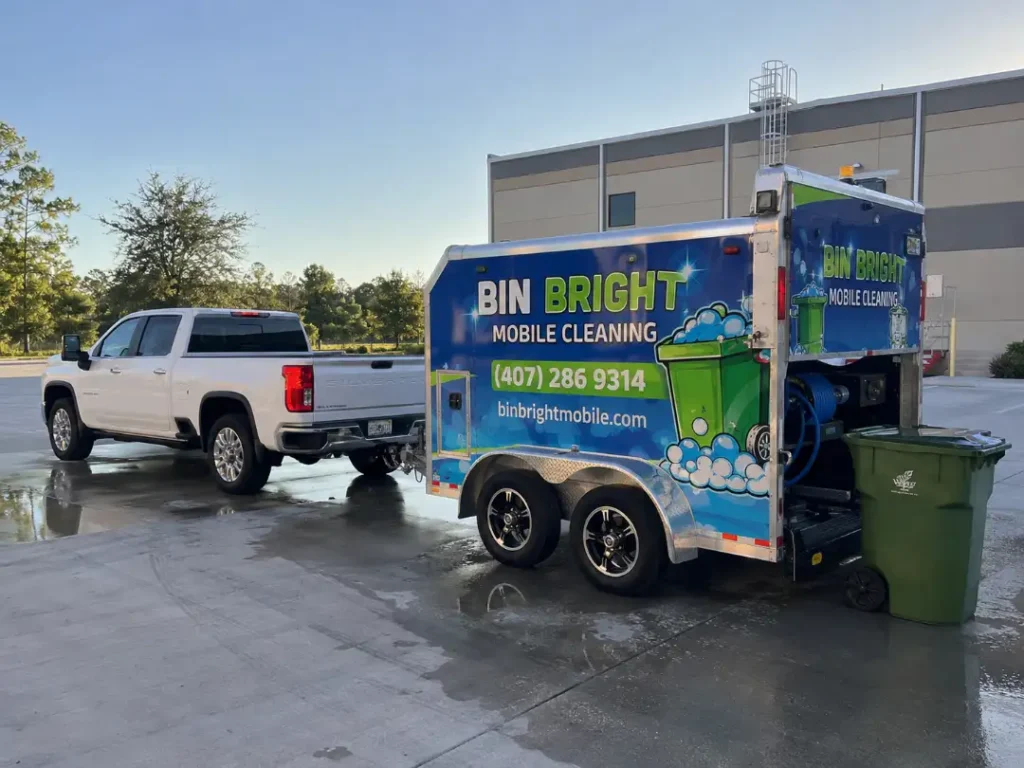
QuoteIQ

QuoteIQ’s Essentials plan at $29.99/month is the least expensive purpose-built option in this space. The standout feature is InstaSchedule: a homeowner self-signup flow that puts a new customer on recurring card-on-file billing in under 60 seconds. The MapMeasure Pro view shows all subscribers plotted by pickup day, which makes it easier to identify which neighborhoods have enough density to justify a dedicated route day.
Route optimization is available but locked behind the Elite tier ($299/month). For operators under 100 customers, the base tier with manual sequencing is workable. Once you’re running 150-plus stops, the jump to Elite for route optimization starts to make financial sense.
One pricing note worth tracking: the Max plan jumped from $399 to $699/month, a 75% increase. Confirm current pricing directly before building a business case around the upper tiers.
iRoutes (Innovative Service Routes)

iRoutes was built by franchise operators specifically for the bin cleaning and can valet industry. Pricing follows your active customer count: $99/month for up to 99 customers and $149.99/month for 100 to 499, with CRM, route management, billing, and a driver mobile app. Phone service is a paid add-on.
The pricing model is built around subscription volume, not user count. That’s a better fit for bin cleaning than per-user pricing, since most solo operators are the only user but may have 80-150 active customers. The model becomes relevant again as you scale: at 1,000 customers you’re at $199/month, and iRoutes prices up to $1,100/month for large multi-route operations.
iRoutes also includes a website template with online ordering as part of the platform, which gives operators without a site a usable starting point. The UI is functional rather than polished, but the industry-specific design shows up in the right places.
LayCor

LayCor’s pitch is flat pricing with no per-user fee: $49/month on the Base plan covers unlimited customers, routes, and users. Core features include a customer signup widget, recurring billing, route management by neighborhood, fleet assignment, and a growth dashboard showing churn and revenue per route.
The catch is that routing and communication features you might expect bundled are add-ons. Route optimization adds $12/month. Two-way texting adds $15/month. Fleet tracking adds $10/month. Auto reminders add $8/month. Review requests add $8/month. If you turn on all five, the Base plan runs $102/month, more than the $99 iRoutes base price.
LayCor is a newer entrant with limited public reviews. The feature set is solid, but there’s less community knowledge available compared to Jobber or Housecall Pro.
General Field Service Software: What Transfers and What Doesn’t
Jobber, Housecall Pro, and ServiceMonster weren’t built for bin cleaning. They were built for HVAC, plumbing, lawn care, and cleaning services: businesses with appointment-based scheduling and variable job types. Bin cleaning operators use them because the core scheduling and invoicing features transfer, and because larger user communities mean more tutorials and integrations.

Jobber
Jobber is the platform that comes up most often in bin cleaning Facebook groups and Reddit threads. Route optimization is included on every plan, including Core at $49/month, which no other general field service platform matches at that price. The mobile app is well-reviewed by field operators. Two-way SMS is available starting at the Connect plan ($139/month).
The limitation bin cleaning operators hit most often: the route map view struggles at high stop counts. One operator reviewing Jobber on Capterra specifically called out the mapping system as frustrating for routes with 55-plus stops, where the mobile app shows a list instead of a visual map. Bin cleaning routes with 40-80 stops per day push against that ceiling.
Jobber also doesn’t have a native homeowner self-signup flow. New customer intake goes through quotes, estimates, or online booking, all of which require more friction than a 60-second self-service signup. That’s a real gap for operators running ads or referral programs.
Housecall Pro

Housecall Pro is popular for its drag-and-drop scheduling calendar and automated customer communication. The Basic plan at $79/month includes online booking, automated invoicing, and payment reminders. QuickBooks two-way sync comes at the Essentials tier ($149/month). Employee GPS tracking requires Essentials or higher.
What Housecall Pro does not have at any price point is route optimization. The platform is built around appointment-based scheduling, not stop-sequencing for route density. If you’re running 40-plus stops per day and need software to sequence them, Housecall Pro asks you to do that work manually or through a third-party integration.
The other consistent complaint in reviews is add-on cost creep. Features that feel core (texting, call recording, marketing automation) are separate monthly charges. Budget with that in mind.
ServiceMonster

ServiceMonster has been around for 20 years and is built specifically for residential cleaning, primarily carpet cleaners. The feature set (service agreements, recurring scheduling, mobile app, drip campaigns at the Premier tier) translates reasonably to bin cleaning, but the platform’s DNA is appointment-based cleaning, not subscription route management.
The Basic plan is $99.99/month for one user. QuickBooks sync is one-directional. There’s no offline mobile mode and no flat-rate price book. ServiceMonster makes sense if you’re already running carpet cleaning and adding bin cleaning as a second service line. It is not the right fit if bin cleaning is your primary business.
Three platforms are purpose-built for bin cleaning: QuoteIQ at $29.99/month, LayCor at $49/month, and iRoutes at $99/month, per their 2026 pricing pages.
Route-Only Tools: When All You Need Is the Map
Some operators already have billing and customer records handled and only need help sequencing stops. A routing tool covers that one job and leaves the rest of the stack to other software.
WorkWave Route Manager
WorkWave Route Manager starts at $49/vehicle/month and is a routing and dispatch tool, not a full field service management platform. It handles automated route planning by time constraints, vehicle load limits, mileage and cost estimation, and real-time driver tracking. For operators running three or more trucks and needing sophisticated multi-vehicle sequencing, it’s the strongest option on this list for pure routing depth.
The gap is everything else. WorkWave doesn’t include billing, CRM, customer communication, or scheduling beyond the route level. You need separate software for invoicing and customer records. For a solo operator or a two-truck operation, that’s more stack complexity than the problem warrants.
The One Problem Every Platform on This List Misses
Every tool listed above assumes that when a potential customer contacts you, someone answers. That assumption breaks down for every solo or two-person bin-cleaning operation running a route.
In 2025, SimpleTexting’s SMS Marketing Statistics report, based on a survey of 1,000 U.S. consumers and 400 business owners, documented an SMS response rate of 45% against an email response rate of 6%. Text messages reach a 98% open rate, with 90% read within 3 minutes of receipt. The gap between a missed call that triggers an immediate text-back and a missed call that goes to voicemail is not small.
None of the platforms above sends an automated text-back to a missed call. None of them runs a follow-up sequence over several days for a lead that came in while you were working. None of them has a CRM view built around the lead-to-subscription pipeline that bin cleaning operators actually run.
That’s the gap Bin Cleaner OS addresses. It’s not a replacement for your scheduling or routing software. It’s the layer that catches leads, follows up automatically, and moves prospects from “called while you were on the truck” to “booked and on the route.”
That gap is what a CRM covers, and it does not need to be complicated. Five pipeline stages are enough for a bin cleaning route, from new lead to paused or canceled.
Which Software Fits Your Stage Right Now?
In May 2026, Timefold’s route optimization ROI guide for field service fleets estimated a 15-30% reduction in drive time and a 10-25% reduction in fuel consumption from automated route sequencing. For a solo operator running 50 stops per day, a 20% reduction in drive time means roughly 45 minutes back per day. That’s either more stops or an earlier finish. Both matter once the route is dense enough for sequencing to be the bottleneck.
Below about 40 daily stops, manual sequencing is fast enough that optimization software doesn’t change the math.
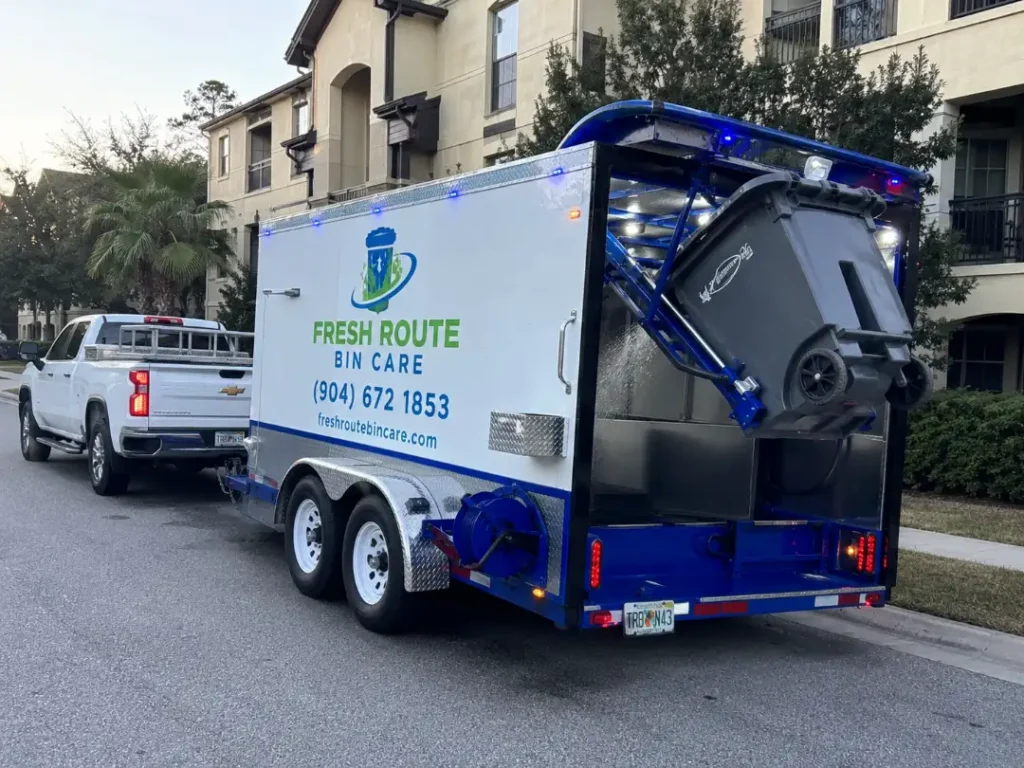
| Stage | Customer Count | Best Fit | Why |
|---|---|---|---|
| Just launched | 0-40 | Jobber Core or QuoteIQ Essentials | Low entry cost, route optimization included, simple setup |
| Growing fast | 40-100 | QuoteIQ or iRoutes + Bin Cleaner OS | Native bin-cleaning features plus lead capture layer |
| Established route | 100-300 | iRoutes Growth or Jobber Connect | Volume-based pricing, SMS included, team capacity |
| Multi-truck operation | 300+ | iRoutes or Jobber Grow + WorkWave | Sophisticated multi-vehicle routing, dispatch at scale |
The lead capture gap exists at every stage until it’s explicitly closed. The operators who grow fastest aren’t always running the most sophisticated routing software. They’re the ones converting the calls that come in while they’re on the truck.
“BlakSheep made me an Incredible website and they have even better customer service to make sure all my questions were answered.”
Software Questions Bin Cleaning Operators Ask Most
These are the questions that come up in trash bin cleaning Facebook groups, Reddit threads, and operator onboarding calls. Straight answers below.
Is Jobber good for trash bin cleaning?
Jobber works well for operators who prioritize a polished mobile app and route optimization at a low entry price. The Core plan at $49/month includes route sequencing, which no other general field service platform matches at that price. The limitation is that Jobber wasn’t built for subscription-based homeowner signups, so self-enrollment and route density analytics require workarounds or manual tracking.
What is the difference between QuoteIQ and iRoutes?
QuoteIQ starts lower ($29.99/month) and emphasizes homeowner self-signup and review management. iRoutes starts higher ($99/month) but includes full CRM, a driver mobile app, and subscription-volume pricing rather than per-user pricing. iRoutes scales better for operators who plan to grow past 100 customers without a steep per-seat cost increase. In 2025, QuoteIQ added AI call answering and Before/After AI photo features as mid-tier differentiators.
Do I need field service software if I only have 25 customers?
At 25 customers, a spreadsheet and a texting app cover most operational needs. The investment in FSM software pays off when you’re adding customers faster than manual tracking can handle, typically somewhere between 40 and 60 active customers. What doesn’t wait is lead capture: the first call you miss while on the truck is lost revenue regardless of your customer count.
What software helps with bin cleaning route density?
Route density is about geographic clustering, not just stop sequencing. QuoteIQ’s MapMeasure Pro and iRoutes’ neighborhood-based routing both display subscriber locations by pickup day, making it easier to see which areas are ready for a dedicated route day. WorkWave Route Manager has the strongest multi-vehicle routing if you’re running three or more trucks. Jobber handles sequencing but doesn’t show a subscriber density map the way bin-cleaning-native tools do.
Can Bin Cleaner OS replace Jobber or QuoteIQ?
No. Bin Cleaner OS handles the lead capture and follow-up layer that scheduling and routing tools leave open: missed call text-back, automated multi-day follow-up sequences, and a CRM view for leads who haven’t converted yet. You’d run Bin Cleaner OS alongside your scheduling software, not instead of it. The complete guide to growing a trash bin cleaning business covers how to build the full operator stack.
The Bottom Line on Bin Cleaning Software
No single platform covers everything a growing bin cleaning operation needs. The native tools (QuoteIQ, iRoutes, LayCor) understand recurring subscription routing better than the general field service options. The general tools (Jobber, Housecall Pro) have larger communities and more integrations. Route-only tools (WorkWave) solve the multi-truck sequencing problem but nothing else.
Every platform on this list assumes your leads reach a human when they call. Most of the time, they don’t. That’s the gap Bin Cleaner OS closes: $197/month, published pricing, no long-term contracts, cancel anytime.

We build this for trash can cleaning companies.
Fixed quote before we start, and you talk to the people who do the work.
About the author

Founder & Lead Developer · Denham Springs, LA
Clint has built and marketed websites for 26 years, since founding BlakSheep Creative in 2000. He is also a 29-year firefighter and a 23-year member of IAFF Local 557, which is where the bias toward plain answers over sales copy comes from.
- Veteran-owned
- Firefighter-owned
- IAFF Local 557
More Questions About Bin Cleaning Software
Short answers to the questions that come up most on this topic.
What is the cheapest software for a bin cleaning business?
Does Housecall Pro have route optimization?
Is LayCor cheaper than iRoutes?
When should a bin cleaning operator move from spreadsheets to software?
What does WorkWave Route Manager do that Jobber does not?
Why does missed-call text-back matter for bin cleaning?

Your next step, without the guesswork
No surprises, clear next steps, and a fixed price before anything starts.