By Clint Sanchez · Published · Updated · 13 min read
Quick answer
A "nation's #1" claim hurts a local service business more than it helps. It cannot be verified, it means little to a customer who only cares about local reliability, and nobody searches for it. The FTC requires superiority claims to be substantiated. Specific, local, provable claims backed by reviews, case studies, and location keywords earn more trust and more search traffic.
Key takeaways
- A "nation's #1" claim fails on three fronts: it cannot be verified, it is irrelevant to local buyers, and it names no criteria.
- Consumers judge a local service business on quality, reliability, and responsiveness in their own area, not on national comparisons.
- The keyword "parking lot striping baton rouge" shows steady monthly searches and a difficulty of 1 out of 100, while "nation's best parking lot striping" shows no search volume at all.
- Search engines reward specific service and location keywords, not vague superlatives, because that is how people actually search.
- The FTC's advertising guidance requires superiority claims to be substantiated with evidence, and unsubstantiated claims expose a business to regulatory scrutiny.
- Testimonials, case studies, third-party reviews, and clearly stated unique selling points prove excellence without claiming a title.
- Acknowledging competitors and your own limits reads as confidence and self-awareness, which builds more trust than hyperbole.
The keyword data in this post is from Baton Rouge. People here type "parking lot striping baton rouge" or "driveway repair Denham Springs" when they need work done, and the parish name often follows. A striping or asphalt company on the I-12 corridor gains nothing from a national title, but a page that names the parishes it serves and shows finished lots wins those searches.

Want this handled instead of DIY?
A 15-minute call, no script, no pressure — you leave with a plan either way.
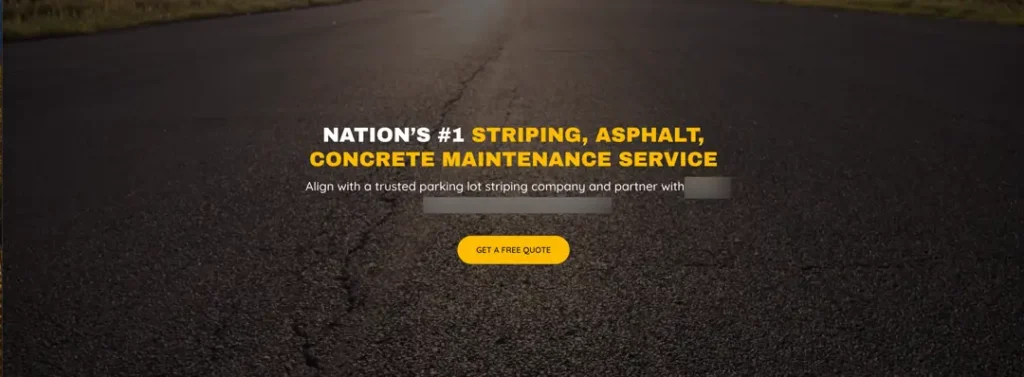
In digital marketing, the clarity and credibility of your messaging are paramount. Take, for instance, the claim: “Nation’s #1 Striping, Asphalt, Concrete Maintenance Service.” On the surface, it appears to be a bold declaration of superiority. However, from a digital marketing perspective, such claims can be problematic for several reasons.
Lack of Specificity and Verifiability
The assertion of “nation’s #1” within a marketing claim, particularly for local service businesses in sectors like striping, asphalt, and concrete maintenance, raises significant concerns regarding lack of specificity and verifiability. This accolade, while grand, fundamentally lacks the necessary context or evidence to substantiate it, thereby failing to resonate effectively with the intended audience.
This issue perfectly illustrates the problems of Fiction Marketing, where exaggerated claims take the place of authentic storytelling. To learn more about why this approach often fails and how Non-Fiction Marketing can build trust and drive engagement, read Fiction vs. Non-Fiction Marketing.
Lack of Specificity and Verifiability
The assertion of “nation’s #1” within a marketing claim, particularly for local service businesses in sectors like striping, asphalt, and concrete maintenance, raises significant concerns regarding lack of specificity and verifiability. This accolade, while grand, fundamentally lacks the necessary context or evidence to substantiate it, thereby failing to resonate effectively with the intended audience.
The Question of Relevance
One might wonder about the relevance of being labeled “the best in the nation” for a local service business. Local businesses typically cater to specific geographical areas, focusing on community engagement and personalized services. The appeal of such businesses lies in their ability to understand and meet the unique needs of their local clientele rather than outperforming competitors on a national scale. Thus, the emphasis on national superiority may be irrelevant and detract from the business’s local appeal and strengths.
Qualification Criteria
The claim of being “#1 in the nation” begs the question of what criteria or benchmarks are used to qualify a business as such. The claim remains unsubstantiated without clear standards, such as customer satisfaction ratings, service quality metrics, industry awards, or comparative performance data. For a claim of this magnitude to be credible, it must be backed by transparent and verifiable data, ideally presented in an understandable and meaningful way to the target audience.
Consumer Perspective: Who Cares?
From a consumer’s standpoint, the claim of national supremacy may hold little value, especially when the primary concern is the quality and reliability of the service on a local level. Consumers increasingly seek evidence of quality, reliability, responsiveness, and value for money in their immediate area. They are interested in how a service will solve their specific problem or meet their needs rather than how it compares to others nationally.
In the digital age, where consumer trust is paramount, businesses thrive on authenticity and genuine connections with their clientele. Trust is built through transparent communication, demonstrable expertise, and consistent service quality. Third-party endorsements, customer testimonials, and positive local reviews can significantly influence consumer choices, far more than unsubstantiated claims of being the best nationwide.
We would rather show the work than claim the title. It is laid out on our Baton Rouge digital marketing page.
Want this handled for you? We build and market websites for Louisiana businesses, and we will tell you honestly if you do not need us.
Focusing on national superiority may be irrelevant for local service businesses and undermine the qualities that make them appealing to their local markets. Instead, these businesses would benefit more from highlighting their commitment to quality, understanding of local needs, and ability to deliver personalized, reliable service. By grounding their marketing claims in specificity, verifiability, and relevance to their target audience, businesses can foster stronger, more meaningful connections with their customers, leading to increased trust and loyalty.
Alienating Potential Customers
Moreover, hyperbolic statements can alienate potential customers. Consumers today crave authenticity and transparency from brands. When a company positions itself as the undisputed leader without acknowledging the competitive landscape or its unique place, it risks appearing arrogant or out of touch. This can lead to a negative perception of the brand, potentially deterring customers from engaging with it.
The Demand for Authenticity
In today’s digital landscape, consumers are bombarded with countless marketing messages daily, making it increasingly challenging for brands to get noticed. Amidst this noise, authenticity emerges as a beacon of trust and reliability. Authentic brands present themselves in a genuine, sincere manner, making no attempts to mask their true nature or overstate their capabilities. When a company claims to be the “nation’s #1” in a manner that lacks substantiation, it contradicts the principle of authenticity, potentially leading savvy consumers to question the integrity of the claim in question and all communications from the brand.
Transparency and the Modern Consumer
Transparency is closely tied to authenticity. It involves open and honest communication about a company’s practices, products, and services. In the context of hyperbolic claims, a lack of transparency becomes evident when companies fail to provide evidence or context for their assertions. Today’s consumers are more informed and have the tools to research and validate claims. When they encounter statements that seem exaggerated or too good to be true, their trust in the brand diminishes, and their likelihood of engagement.
Acknowledging the Competitive Landscape
Modern markets are more interconnected than ever; consumers know they have options. When a company positions itself as the undisputed leader without acknowledging its competitors or the broader market, it risks appearing arrogant and ignorant of consumer needs and choices. Acknowledging the competitive landscape shows that a company understands its industry and respects the intelligence of its customers. It demonstrates confidence in its offerings, not because it claims to have no competition but because it believes in the unique value it provides despite the competition. This balanced approach can help businesses avoid the pitfalls of overconfidence in marketing claims.
The Value of Recognizing Strengths and Weaknesses
Customers do not expect perfection; they expect honesty. By openly recognizing its strengths and weaknesses, a company can communicate self-awareness and responsibility that resonates with consumers. This approach sets realistic expectations and humanizes the brand, making it more relatable and trustworthy. It invites customers into a dialog, fostering a sense of partnership rather than presenting a one-sided marketing message.
Building Genuine Connections
Ultimately, the goal of aligning with consumer values of authenticity and transparency is to build genuine connections. These connections are based on trust, respect, and a mutual value understanding. When companies eschew hyperbolic statements in favor of honest, clear communication, they lay the foundation for long-term customer relationships. These relationships are characterized by loyalty and advocacy, which are invaluable in today’s competitive market.
Missed SEO Opportunities
From a search engine optimization (SEO) perspective, such broad claims do little to improve visibility or search rankings. Keywords like ‘nation’s #1’ are far less likely to be used by consumers seeking specific services. Digital marketing thrives on specificity, using targeted, service-specific keywords and phrases that potential customers are searching for. This is what we call ‘search intent.‘ a more effective strategy would be highlighting specific services, geographical areas served, or unique selling points that align with the search intent of potential customers.
Going deeper into how broad, unsubstantiated claims miss the mark regarding search engine optimization (SEO) underscores a critical misstep in many digital marketing strategies. Optimizing SEO practices is indispensable in an online ecosystem where visibility can make or break a business. Let’s explore why claims like “nation’s #1” do not serve well in SEO strategies and how a recalibrated approach can yield far superior results.
The Importance of Search Intent
Understanding search intent, the reasons behind a user’s search query, is central to effective SEO. Rarely do consumers use vague or grandiose terms like “nation’s #1” when looking for specific services. They often search using specific, frequently localized terms that directly relate to their needs. For instance, someone seeking asphalt repair is likelier to search for “asphalt repair services near me” or “best driveway repair in [City Name]” rather than a broad, unqualified claim of superiority. Ignoring the alignment of content with actual search behaviors leads to missing out on relevant search result appearances, thereby forgoing potential traffic and leads.
Specificity and Local SEO
For local service businesses, the essence of online visibility lies in local SEO, which emphasizes optimizing for geographically specific keywords. Focusing on broad claims over localized service offerings bypasses a important opportunity to engage the most relevant audience: local customers actively seeking their services. Incorporating location-based keywords boosts visibility in local searches and attracts customers more likely to engage.
Local SEO vs. National SEO: Understanding Search Queries
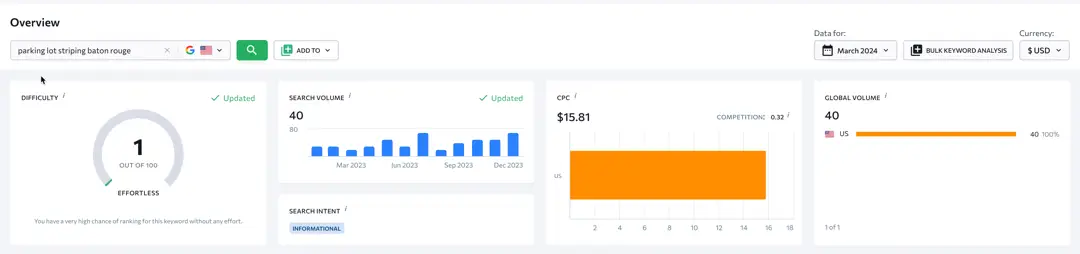
The Importance of Localized Search Terms For instance, when looking at the keyword “parking lot striping baton rouge,” we see a modest but consistent search volume and a difficulty rating of 1 out of 100, indicating an effortless ranking opportunity. This showcases the demand and ease of reaching potential customers specifically in Baton Rouge who are actively seeking parking lot striping services.
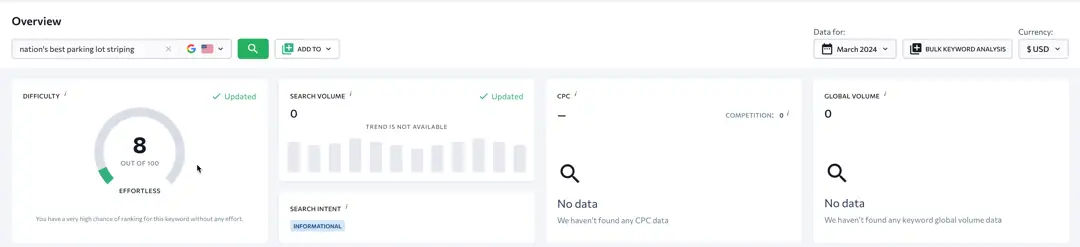
The Challenge with Broad, National Keywords On the contrary, a national-level keyword like “nation’s best parking lot striping” has no search volume, demonstrating that users aren’t using this term to find services. The difficulty here is slightly higher, sitting at 8 out of 100, suggesting more effort is required to rank for a term that users aren’t even searching for, thus reinforcing the need for a focused local SEO approach.
Let’s dig in a little deeper:
As we go deeper into SEO strategy, let’s consider a real-world example to illustrate the significance of choosing the right keywords. We have two images here, each representing keyword analysis for distinct search queries: “parking lot striping baton rouge” and “nation’s best parking lot striping.”
Understanding Keyword Metrics and Their Impact on SEO
Local Keyword: “parking lot striping baton rouge” The first image gives us an overview of the keyword “parking lot striping baton rouge.” This local search term has several noteworthy points:
- Difficulty: Rated at a mere 1 out of 100, indicating that it is relatively easy to rank for.
- Search Volume: The monthly searches are consistent, averaging around 40, suggesting a steady interest in this service within Baton Rouge.
- CPC: The average cost-per-click is $15.81, a figure that reflects the value marketers are willing to pay for online visibility in this niche.
- Search Intent: Labeled as ‘informational,’ meaning users searching this term are likely looking for details about parking lot striping services in Baton Rouge.
This data implies that a local business in Baton Rouge offering parking lot striping services could potentially gain substantial online visibility and traffic by targeting this specific keyword.
Nationwide Keyword: “nation’s best parking lot striping.” In contrast, the second image shows us the search landscape for “nation’s best parking lot striping”:
- Difficulty: Has a slightly higher difficulty at 8 out of 100, but still relatively low.
- Search Volume: There’s no search volume data available, suggesting that people aren’t using this phrase to find parking lot striping services.
- CPC: No data available, which can indicate that there’s no market competition for this term.
- Search Intent: Also informational, but the lack of search volume indicates that this isn’t a term users are seeking information on.
This sharp contrast in keyword effectiveness demonstrates the importance of specific, localized keywords over broad, generalized terms. A broad claim like “nation’s best” does not align with actual search behaviors and is, therefore, far less likely to drive traffic to your site.
The Role of Unique Selling Points (USPs)
Unique selling points (USPs) are what set a business apart. If it’s a unique asphalt repair technique, outstanding customer service, or the use of eco-friendly materials, USPs define a business’s distinctiveness. In SEO, highlighting USPs with targeted keywords can significantly improve a website’s relevance for specific queries, a strategy far more effective than making broad, undifferentiated claims.
Content Richness and Keyword Diversity
A solid SEO strategy involves creating content that addresses a broad spectrum of customer queries and interests far beyond what broad claims can offer. Businesses should aim to produce content encompassing a diverse range of topics related to their services, using various keywords and phrases. This improves search rankings across relevant queries and showcases the business’s expertise, attracting potential customers.
A "nation's #1" claim fails on three fronts: it cannot be verified, it is irrelevant to local buyers, and it names no criteria.
Regulatory Risks
There’s also a regulatory aspect to consider. Marketing claims must adhere to advertising standards and regulations, especially those that assert superiority. These guidelines often require claims to be substantiated to avoid misleading consumers. Failing to comply can lead to legal challenges and damage a company’s reputation.
Alternative Approaches
What is a better approach? Digital marketing strategies should build trust and credibility through transparent and specific claims. Instead of declaring itself the “#1 service,” a company could highlight specific attributes or accolades that differentiate it from competitors. Testimonials, case studies, and third-party reviews can provide the social proof that backs up claims of excellence or leadership in the field. Furthermore, tailoring content to address specific customer needs and search behaviors can enhance SEO performance and customer engagement.
When expanding the discussion to the regulatory landscape, it’s important to understand how marketing claims, especially those asserting superiority like “nation’s #1,” interact with advertising standards and regulations. This regulatory framework protects consumers from misleading or deceptive marketing practices, making sure that all businesses’ claims are accurate and substantial.
Adherence to Advertising Standards
Regulatory bodies across various jurisdictions put advertising standards in place to maintain fair competition and protect consumer interests. These standards demand that claims, particularly those relating to a product or service’s quality or ranking, are supported by concrete evidence.
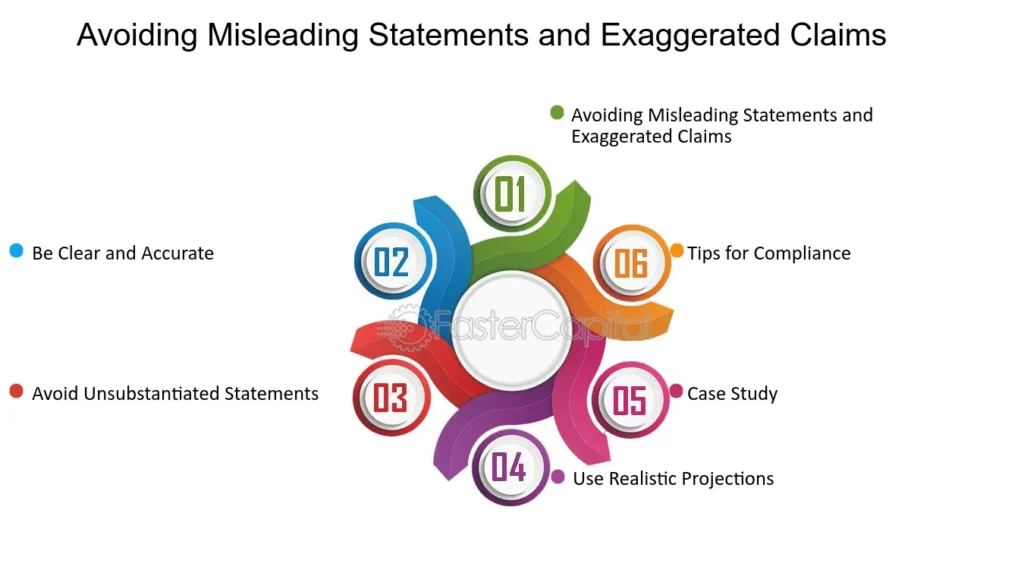
For example, if a business claims to be the leading service provider in its industry, it should be prepared to present data or independent verifications that substantiate this claim. The absence of such evidence weakens the claim’s credibility and exposes the business to regulatory scrutiny.
The Importance of Substantiation
Substantiation is at the heart of these regulatory requirements. It serves as a mechanism to make sure businesses cannot freely make exaggerated claims without basis. This is particularly relevant in industries where technical details and service quality vary significantly. For instance, a company specializing in asphalt and concrete maintenance must be able to prove its asserted status as “#1 in the nation” through customer satisfaction surveys, industry awards, or market share data. Without this substantiation, the claim is considered misleading under advertising standards.
Legal Challenges and Reputational Damage
The consequences of failing to comply with advertising regulations can be severe. Legal challenges, including fines and sanctions, are just the tip of the iceberg. The reputational harm a business can suffer may be more damaging in the long term. In an age where consumer trust is a critical competitive asset, being found in violation of advertising standards can erode customer confidence and loyalty. The public’s perception of a business as trustworthy and reliable can be significantly damaged, leading to a decline in customer base and, ultimately, profitability.
Proactive Compliance
Businesses must adopt a proactive approach to compliance, making sure that all marketing claims are thoroughly vetted and substantiated before being made public. This involves close collaboration between marketing teams, legal advisors, and industry experts to make sure that all claims can be backed up with solid evidence. Additionally, maintaining transparency with consumers about how claims are substantiated can further bolster trust and mitigate regulatory risks.
Given the challenges associated with broad, unsubstantiated claims and the regulatory landscape that governs them, businesses are encouraged to explore alternative marketing approaches. These alternatives adhere to regulatory requirements and resonate more authentically with target audiences. Businesses can create a compelling narrative showcasing their value and expertise without risking regulatory censure or alienating potential customers by focusing on transparency, specificity, and customer-centric communication.
Conclusion
In wrapping up our exploration into the heart of digital marketing truths, we’ve traversed the terrain of authenticity, grappled with the pitfalls of unspecific claims, and illuminated the pathway toward genuine connection with our audience. Our path reaffirms the conviction that in the bustling digital bazaar, where every pixel can tell a story, the most profound narratives resonate with truth, transparency, and tailored specificity.
At BlakSheep Creative, we don’t just navigate these truths; we champion them. We understand that our client’s success in the digital world reflects our commitment to authenticity, meticulousness in crafting messages that resonate, and dedication to strategies that promise and prove. Our mission transcends the conventional boundaries of digital marketing, venturing into the world of creating meaningful, lasting connections that improve brands and engrain them in the hearts and minds of their consumers.
As we bring this dialog to a close, let’s consider it not an ending but an invitation to begin anew. An invitation to join us, BlakSheep Creative, on a path of transformation, where your brand’s story is told with integrity, your message cuts through the noise with precision, and your digital presence becomes a beacon of trust and excellence. Together, we can redefine what it means to be outstanding in the digital marketplace, moving beyond the allure of being “nation’s #1” to forge connections that endure, inspire, and transform.
Let’s start this path together, crafting campaigns and legacies. Welcome to BlakSheep Creative, where your digital marketing path transcends the ordinary and becomes genuinely extraordinary. Fill out the form below for a free consultation today!
Trying to figure out what marketing actually moves the needle for your business? Book a no-pitch Discovery Call and we’ll talk through your specific situation.

Ready to put this to work?
Talk to the people who would actually build it.
About the author
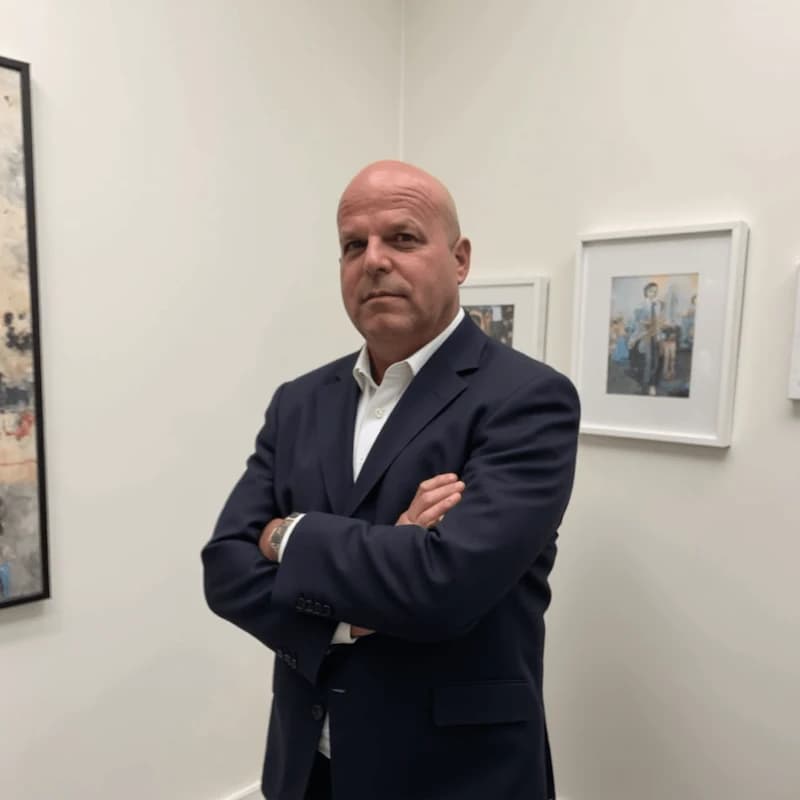
Founder & Lead Developer · Denham Springs, LA
Clint has built and marketed websites for 26 years, since founding BlakSheep Creative in 2000. He is also a 29-year firefighter and a 23-year member of IAFF Local 557, which is where the bias toward plain answers over sales copy comes from.
- Veteran-owned
- Firefighter-owned
- IAFF Local 557
Common questions about digital marketing
Is it illegal to claim your business is the nation's #1?
Why does a national claim matter less for a local service business?
Do superlative claims like "best" or "#1" help SEO?
What should a company say instead of claiming to be number one?
How does an unverified claim affect customer trust?
What evidence would substantiate a superiority claim?

Your next step, without the guesswork
No surprises, clear next steps, and a fixed price before anything starts.