By Clint Sanchez · Published · Updated · 2 min read
Quick answer
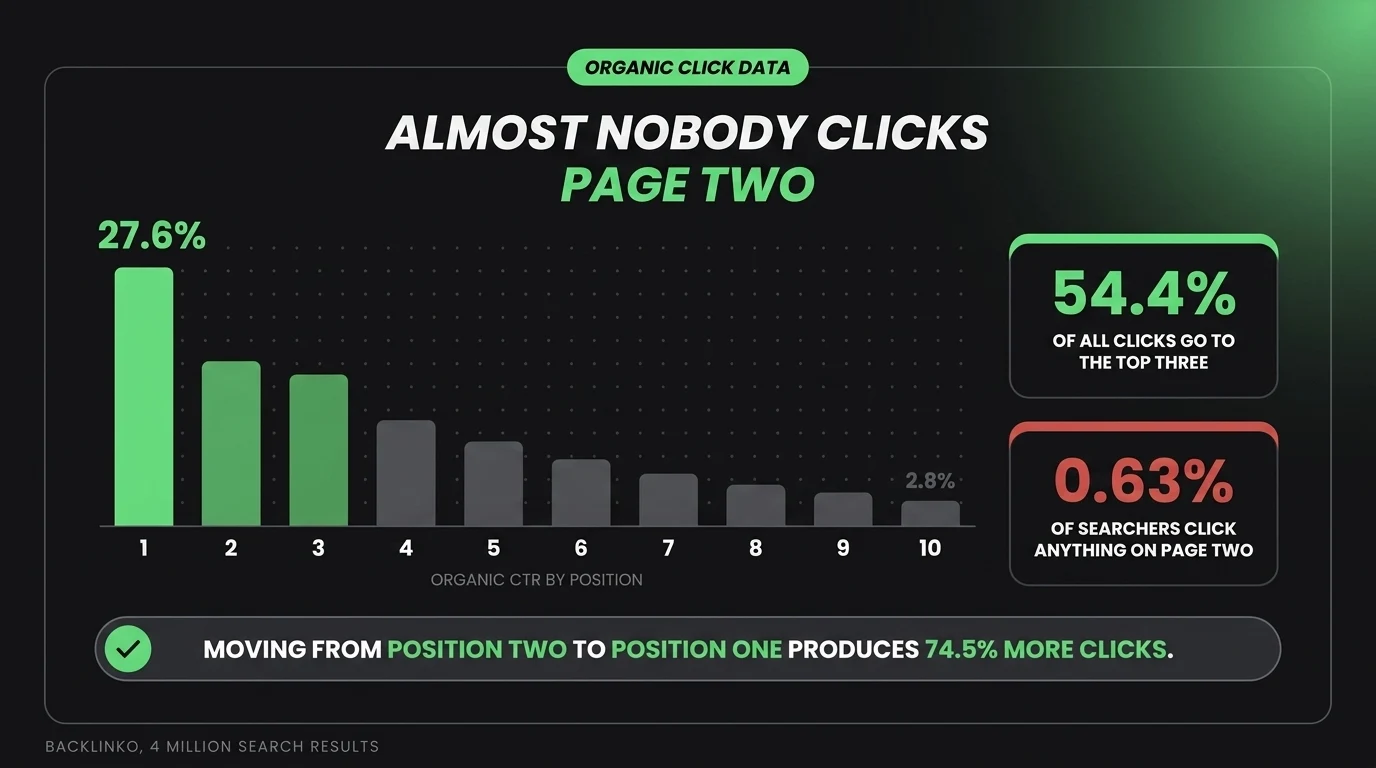
Almost nobody clicks page two. Backlinko's analysis of 4 million Google search results found only 0.63 percent of searchers clicked anything on the second page. Position one takes 27.6 percent of clicks and the top three take 54.4 percent between them, so a page on the second screen is closer to invisible than to second best.
Key takeaways
- Backlinko's study of 4 million search results, covering 1,312,881 pages and 12,166,560 queries, found only 0.63 percent of searchers clicked anything on Google's second page.
- Position one takes 27.6 percent of clicks, and the top three results take 54.4 percent between them.
- The first result is roughly ten times more likely to be clicked than the tenth, so the decline starts well before page two.
- Moving from position two to position one produces 74.5 percent more clicks, while the same one-place gain further down the page barely registers.
- The widely repeated claim that 75 percent never scroll past page one traces to MarketShare data from October 2010 and has been recycled without remeasurement since.
- Featured snippets, the map pack, and AI Overviews answer many queries above the results, so even page one earns fewer clicks than it once did.
- The highest-return SEO work is on pages already at position 11 to 20, which Google considers relevant and has placed just out of reach.
When a storm knocks shingles loose across Livingston Parish, the homeowner searches "roof repair Denham Springs" from a phone and calls one of the first three or four results. Nobody scrolls to page two while water is coming in. The same is true for an AC company in July and a plumber during a January freeze: the first page is the whole market for that search.
Almost nobody clicks page two. Backlinko's analysis of 4 million Google search results, covering 1,312,881 pages and 12,166,560 queries, found that only 0.63 percent of searchers clicked anything on the second page. Position one takes 27.6 percent of clicks and the top three take 54.4 percent between them.
What the click data actually shows
The often-repeated line is that 75 percent of people never scroll past page one. It is worth knowing where that number comes from before you build a strategy on it: it traces to MarketShare data from October 2010, and it has been recycled through marketing blogs ever since without being remeasured.
The current picture is both better sourced and more brutal. Backlinko's 0.63 percent means page two is not a weaker version of page one. It is effectively invisible. And the drop starts long before that: the first result is roughly ten times more likely to be clicked than the tenth.
One more figure changes how you should think about small ranking gains. Moving from position two to position one produces 74.5 percent more clicks. The same one-place move further down the page barely registers, which is why an SEO plan that treats every position as equally worth chasing wastes effort.
Why searchers stop there
Three things keep people on the first screen, and none of them are laziness.
- They trust the sort order. Most people treat Google's ranking as an editorial judgment rather than an algorithm's guess, so page two reads as material already rejected.
- The page is a filter. A typical query returns millions of results. Page one exists so nobody has to consider the rest, and it works well enough that checking is rarely rewarded.
- The answer often arrives before the links. Featured snippets, the map pack, and AI Overviews increasingly satisfy the query above the results, so even page one gets fewer clicks than it used to.
Researchers and people comparing products do go deeper. For everyone else, the first screen is the beginning and the end of the search.
What this means for your site
One page ranking on page one is worth more than a dozen sitting on page three, which is the argument for depth over volume. Publishing more content that lands nowhere does not compound; improving a page that already sits at position eleven or twelve does.
That is where the effort belongs. Find the pages already close, work out what the results above them answer that yours does not, and fix that specific gap. Our guide to optimizing for people rather than search engines covers how to do that without writing for the algorithm.
In competitive categories, paid search buys a first-page position while the organic work compounds underneath it. That is a bridge, not a substitute, and our pay-per-click page covers when it earns its budget.
Where to start
Pull your own Search Console data and sort by impressions with the position filtered to 11 through 20. Those are pages Google already considers relevant and has placed just out of reach. Fixing five of them beats publishing fifty new ones.
If you want that read for you, we do it as part of every plan. Call (225) 505-3834 or book a fifteen-minute discovery call and we will tell you which pages are close and which are not worth the effort.
About the author

Founder & Lead Developer · Denham Springs, LA
Clint has built and marketed websites for 26 years, since founding BlakSheep Creative in 2000. He is also a 29-year firefighter and a 23-year member of IAFF Local 557, which is where the bias toward plain answers over sales copy comes from.
- Veteran-owned
- Firefighter-owned
- IAFF Local 557
Common Questions About Google's First Page
Short answers to the questions that come up most on this topic.
How many people click the second page of Google?
What is the click-through rate for the first Google result?
Is the 75 percent statistic about page one accurate?
Is it worth moving up one position in search results?
How do I find which pages are closest to page one?
Do AI Overviews change any of this?

Your next step, without the guesswork
No surprises, clear next steps, and a fixed price before anything starts.