
By Clint Sanchez · Published · Updated · 8 min read
Quick answer
Local SEO for dentists is the work that puts a practice in the Google map results for its own neighborhood. It comes down to four things: a complete and active Google Business Profile, a real page for every location you serve, a steady flow of recent patient reviews, and a fast site whose name, address, and phone match everywhere they appear.
Key takeaways
- Google names three local ranking factors: relevance, distance, and prominence. Distance cannot be changed, so relevance and prominence are the entire job.
- Google states there is no way to request or pay for a better local ranking, so any guaranteed map pack position is a sales line, not a service.
- BrightLocal's 2026 survey found 47% of consumers will not use a business with fewer than 20 reviews and 74% look for reviews from the last three months.
- Templated city pages with the location swapped are what Google's spam policies call doorway abuse; one honest page per office is safer and works better.
- Core Web Vitals targets are 2.5 seconds for Largest Contentful Paint, 200 milliseconds for Interaction to Next Paint, and 0.1 for Cumulative Layout Shift.
- Use of ChatGPT and similar tools for local recommendations rose from 6% to 45% in a year, which rewards short, self-contained answers on your own site.
- Track calls, direction requests, new reviews per month, and grid rankings rather than a single ranking checked from your own office.
Baton Rouge patients rarely search past their side of the river, and a Denham Springs or Walker family will type their own town before they type Baton Rouge. A dental practice off Range Avenue competes with offices in Livingston Parish, not the whole metro, so the Google Business Profile category, service area, and reviews need to say exactly where you are.

Want this handled instead of DIY?
A 15-minute call, no script, no pressure — you leave with a plan either way.
Local SEO for dentists is the work that gets a practice into the Google map results and the "dentist near me" listings for its own neighborhood. It comes down to four things: a complete and active Google Business Profile, a page on your site for every location you serve, a steady flow of recent patient reviews, and a fast site whose name, address, and phone match everywhere they appear.
What local SEO for dentists actually means
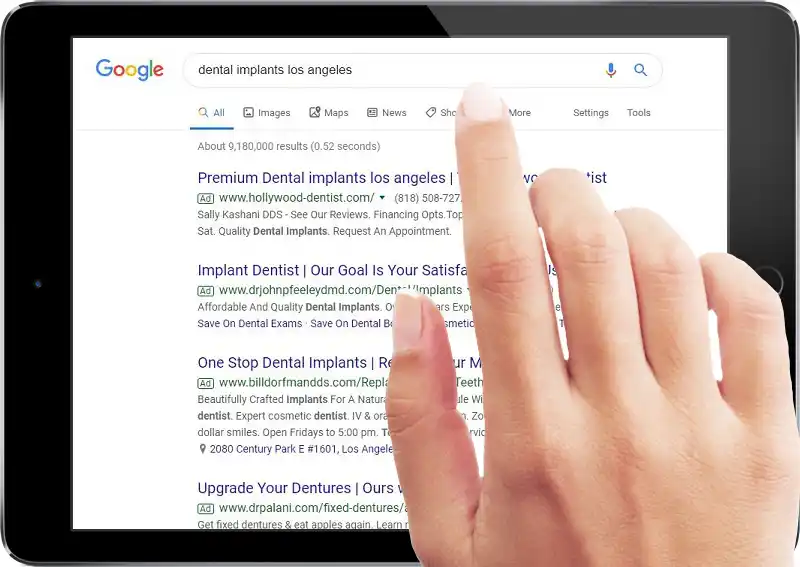
Most dental SEO advice is written for national brands. A dental practice does not need to rank in fifty states. It needs to win a radius, usually five to fifteen minutes of drive time, for a short list of searches: "dentist near me," "emergency dentist," "dental implants," and the same terms with a city or neighborhood attached.
That changes the work. Ordinary SEO competes on content depth and links. Local SEO competes on three signals Google names outright. Google Business Profile Help lists them as relevance (how well your profile matches the search), distance (how far you are from the searcher), and prominence (how well known the business is). Distance you cannot change. Relevance and prominence are the entire job.
Google is blunt about the other half of that: "There's no way to request or pay for a better local ranking on Google." Any agency selling a guaranteed map pack position is selling something Google says does not exist. That is the first thing to check when you compare proposals for dental practice marketing.
Build the Google Business Profile a patient will pick
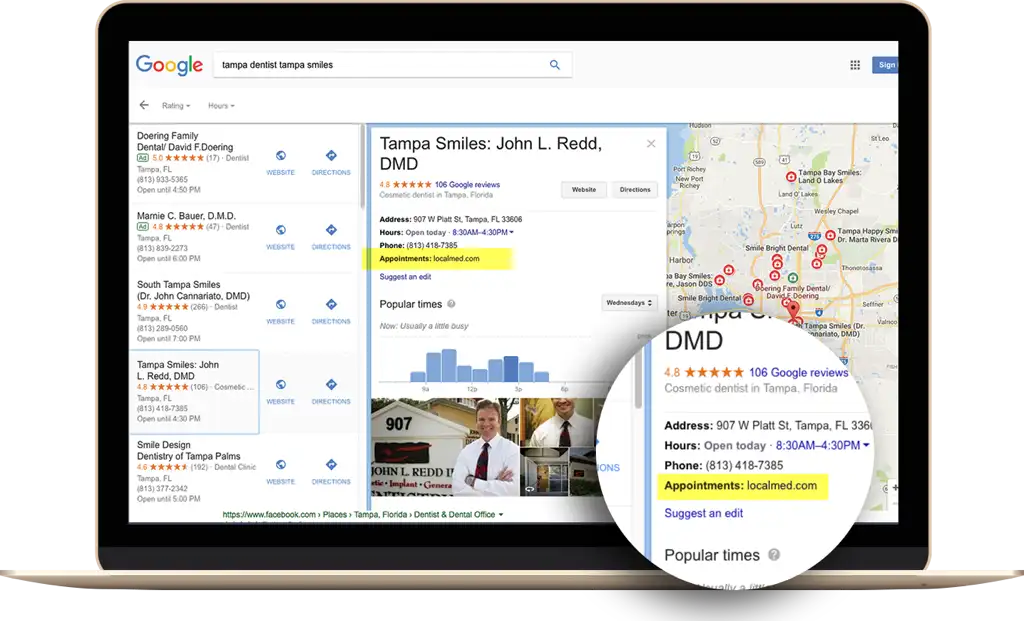
Your Business Profile is the storefront. It is also, for a lot of patients, the only page they ever look at before they call. Google states plainly that "businesses with complete and accurate info are more likely to show up in local search results," which makes completeness the cheapest ranking work available to a practice.
Work through this list once, properly, instead of half-filling it every year:
- Primary category. "Dentist" is the default, but "Cosmetic dentist," "Pediatric dentist," "Oral surgeon," or "Endodontist" may match your revenue better. Set secondary categories for the rest.
- Services. List them individually: cleanings, crowns, implants, Invisalign, extractions, emergency visits. Each one is a phrase somebody types.
- Hours, including holidays. Google asks for special hours specifically. A practice closed on a Friday that Google shows as open loses a patient and earns a one-star review.
- Attributes. Wheelchair accessible entrance, parking, languages spoken, new patients accepted.
- Photos of the actual office. The waiting room, the operatory, the front desk, the team. Stock photos of a model with perfect teeth persuade nobody.
- Booking and call tracking. Point the appointment link at a real scheduling page, not the homepage.
If the profile has been sitting untouched since the practice opened, that alone is often worth several positions. We handle this as part of Google Business Profile management, and it is the first thing we look at on any dental account.
Reviews are the part most practices skip
Reviews feed prominence, and they also decide the click. The BrightLocal Local Consumer Review Survey, a 2026 poll of 1,002 US adults, found that 97% of consumers read reviews for local businesses, that 47% will not use a business with fewer than 20 reviews, and that 31% now say they will only consider a business rated 4.5 stars or higher.
Recency matters as much as the average. The same survey found 74% of people look for reviews written in the last three months, and 32% want reviews from the last two weeks. A practice with 140 reviews and nothing since 2023 reads as closed.
Here is how that shakes out for a practice deciding where to put effort:
| Signal | What patients do | What to do about it |
|---|---|---|
| Fewer than 20 reviews | 47% will not consider the business | Ask every patient at checkout until you clear 20 |
| Rating under 4.5 stars | 31% filter the business out entirely | Volume dilutes old bad reviews faster than arguing does |
| Nothing in three months | 74% are looking for newer reviews | Make the ask a standing part of the checkout script |
| Unanswered reviews | 32% expect a reply by the next day | Assign one person to respond, good and bad |
Google, Facebook, Healthgrades, and Vitals are the four that matter for dentistry, in that order. Never write your own, and never let a vendor write them for you; we covered why in the case against reviewing your own business. If you want the ask handled systematically, that is what our reputation management service does.
Build a real page for every location you serve
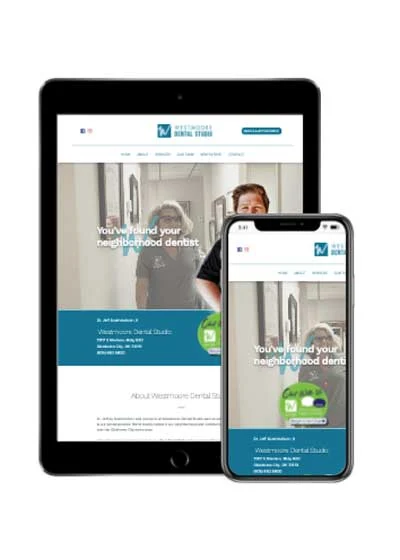
A single-location practice needs one strong page about that office. A group with four offices needs four, each with its own address, phone, hours, team, photos, and directions. Google reads those pages to work out relevance for a city name.
The trap is generating those pages from a template with the city swapped. Google Search Central calls that doorway abuse: "sites or pages are created to rank for specific, similar search queries." It also names scaled content abuse, "when many pages are generated for the primary purpose of manipulating search rankings and not helping users." Twelve near-identical city pages will not survive that policy for long.
What makes a location page real is detail only that office has: the parking situation, which insurance that location takes, which hygienist works Saturdays, the cross street, the school district the pediatric patients come from. If you cannot write two paragraphs that could only describe that office, you do not have enough for a page yet.
Our landing page design work starts from that test. The difference between a location page and a hub page is worth understanding before you build a stack of them, which is what the pillar page and landing page comparison covers.
Google names three local ranking factors: relevance, distance, and prominence. Distance cannot be changed, so relevance and prominence are the entire job.
Choose keywords a patient would actually type
Dental keyword lists tend to be written by marketers, not patients. Patients do not search "comprehensive restorative dentistry solutions." They search "chipped tooth," "cost of a crown," "dentist that takes Medicaid," and "emergency dentist open Saturday."
Group the terms by what they are worth, then match each group to a page:
- Emergency intent. "Emergency dentist," "toothache," "broken tooth." Highest urgency, shortest decision, lowest price sensitivity. These deserve a dedicated page and a phone number above the fold.
- Procedure intent. "Dental implants," "Invisalign," "root canal," each with cost and recovery questions attached. One page per procedure, not one page listing all of them.
- Insurance and payment. "Dentist that takes Delta Dental," "payment plan dentist." Cheap to rank for, and the traffic converts.
- Brand and location. Your practice name plus the city. Easy, and worth checking that you actually own it.
Volume figures from any tool are estimates. What is not an estimate is your own Google Search Console data, which shows the exact phrases already putting your site in front of people. Start there, then expand with keyword research.
Fix speed, mobile, and NAP before anything else
Technical problems cap everything above. A patient with a toothache on a phone in a parking lot will not wait for a slow page, and a phone number that differs by one digit across directories quietly damages the prominence signal you are trying to build.
Google publishes the thresholds it expects, measured at the 75th percentile of real page loads:
| Metric | What it measures | Good |
|---|---|---|
| Largest Contentful Paint | How long until the main content appears | 2.5 seconds or less |
| Interaction to Next Paint | How fast the page responds to a tap | 200 milliseconds or less |
| Cumulative Layout Shift | How much the page jumps while loading | 0.1 or less |
Those numbers come from web.dev's Core Web Vitals guide. Most dental sites fail the first one because of uncompressed hero images and a bloated theme. Cheap hosting makes it worse, which is why we pair managed hosting with the build rather than leaving it to chance, and why the site itself gets rebuilt when the theme is the bottleneck.
On NAP: pick one exact format for your name, address, and phone, and use it everywhere. "Suite 200" and "Ste. 200" are two different strings. Inconsistency is one of the quiet errors we listed in three SEO mistakes that hurt rankings.
What changes now that patients ask AI
The BrightLocal survey recorded a real shift in how people find local businesses. Google use for local discovery fell from 83% to 71% in a year, while use of ChatGPT and similar tools rose from 6% to 45%. Patients are increasingly asking an assistant "who is a good pediatric dentist near me" and getting two names, not ten links.
Nothing in the fundamentals changes. Assistants lean on the same signals: a complete profile, consistent business data, plain answers to plain questions on your own site, and reviews. What does change is the format of your content. Short, self-contained answers under clear headings are easier for a model to quote than a 900-word essay with the answer buried at the end. That is the practical core of answer engine optimization, and we walk through the mechanics in how to structure content so AI actually uses it.
“Clint and Alec recently took over for me and the creativeness and custome service are astounding. Wish I would've found them years ago! Can't wait to see what the future brings!”

How to tell if your dental local seo is working
Rankings alone are a poor scoreboard, because map results shift with the searcher's location. Track outcomes instead, on a monthly cadence, and hold each number against the month before.
- Calls from the Business Profile. Google reports these directly. This is the closest thing to a lead counter you get for free.
- Direction requests. A proxy for people who decided to come in.
- New reviews per month. The one number that shows the front desk is doing its part.
- Grid rankings, not single rankings. Check your position from several points around your service area rather than from your own office. We covered the method in how to track Google Maps rankings.
- Booked new patients from organic and maps. The only number that pays the bills. It needs call tracking and a front desk that asks how the caller found you.
Expect movement in about three months on profile activity and reviews, longer on competitive procedure terms. Anyone promising the map pack in thirty days is guessing.
Where a practice should start
If you do one thing this month, complete the Business Profile and start asking every patient for a review at checkout. Those two moves cost nothing and move prominence faster than anything else on this page. After that, fix speed, then build one honest page per location, then work down the keyword list.
If you would rather hand it over, we do this work for practices around Baton Rouge and Livingston Parish and remotely elsewhere; see local SEO in Baton Rouge or tell us what your front desk is hearing on the phone.
About the author

Founder & Lead Developer · Denham Springs, LA
Clint has built and marketed websites for 26 years, since founding BlakSheep Creative in 2000. He is also a 29-year firefighter and a 23-year member of IAFF Local 557, which is where the bias toward plain answers over sales copy comes from.
- Veteran-owned
- Firefighter-owned
- IAFF Local 557
Common questions about dental practices
How long does local SEO take for a dental practice?
Can you guarantee my practice a spot in the Google map pack?
How many Google reviews does a dental practice need?
Should a multi-location practice build a page for each office?
Does local SEO still matter now that patients ask AI assistants?
What should a dentist track to know local SEO is working?

Your next step, without the guesswork
No surprises, clear next steps, and a fixed price before anything starts.