
By Clint Sanchez · Published · Updated · 6 min read
Quick answer
Duda is a website builder aimed at agencies rather than DIY owners. It is fast to work in, ships genuinely good page speed, and its SEO tooling is stronger than its reputation, including built-in schema. The trade-offs are per-site pricing that adds up, templates that read as templates, basic ecommerce, and an export limited to the Agency plan.
Key takeaways
- Duda targets agencies and freelancers building many client sites, not one owner building one website, and that explains most of its trade-offs.
- Plans run $19 a month annually on Basic up to $149 a month on White Label, with extra sites at $17 to $19 a month and no free tier.
- Page speed is the strongest part of the product: CDN, image optimization, lazy loading and server-side rendering by default.
- The old criticism that Duda lacks structured data is out of date. It supports schema for business info, FAQ, video, product and article pages.
- The real SEO constraint is the blog, which is thin for a serious content program even though the technical foundation is solid.
- Site export needs the Agency plan or higher, and the store and blog do not come out in the site HTML.
- What you carry away from Duda is a static snapshot rather than a site you can keep editing, which is worth knowing on day one.
Two Baton Rouge contractors running the same Duda template is a live risk in a market this size, and it is the kind of thing customers notice when they collect three quotes. If you already run a Duda site here, the fix is usually the blog and the service pages rather than a rebuild.

Want this handled instead of DIY?
A 15-minute call, no script, no pressure — you leave with a plan either way.
Duda is a website builder aimed at agencies rather than DIY owners. It is fast to work in, ships genuinely good page speed, and its SEO tooling is stronger than its reputation, including built-in schema. The trade-offs are per-site pricing that adds up, templates that look like templates, basic ecommerce, and an export that only exists on the Agency plan and leaves your store and blog behind.
What Duda is, and who it is built for
Most builder comparisons put Duda next to Wix and Squarespace, which misreads the product. Duda is not chasing the person building their own first website.
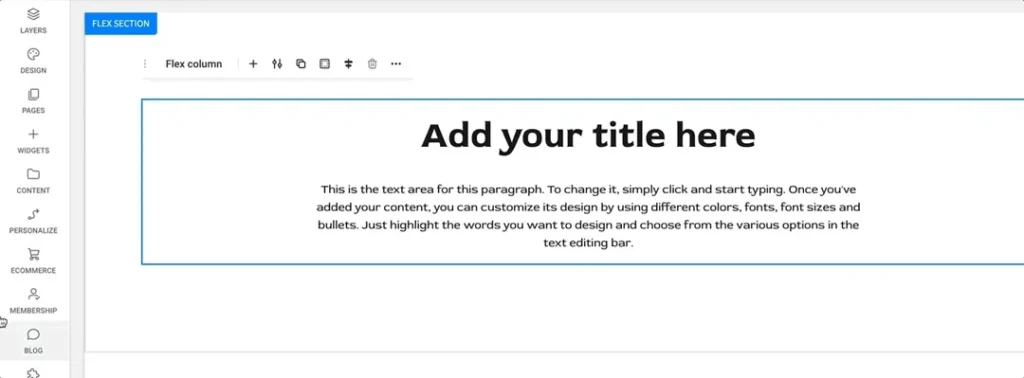
It is built for the people who build websites for other people. That shows in the feature list: team seats on every plan, a client management dashboard, white-label options, content injection across sites, and an API. If you manage forty client sites, that tooling is the product and the editor is incidental. If you are one business owner building one website, you are paying for a workflow you will never use.
That single fact decides most of the pros and cons below, so it is worth settling before you compare features.
Duda pricing
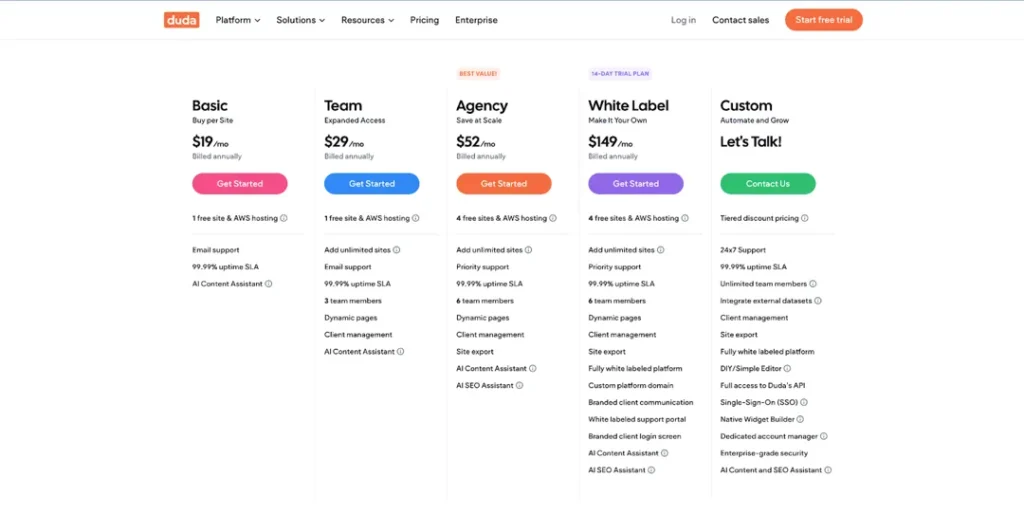
Duda has no free plan, and the published rates are per account with a small number of included sites. Rates from Duda's pricing page:
| Plan | Annual | Monthly | Included sites | Seats |
|---|---|---|---|---|
| Basic | $19/mo | $25/mo | 1 | 3 |
| Team | $29/mo | $39/mo | 1 | 6 |
| Agency | $52/mo | $69/mo | 4 | 6 |
| White Label | $149/mo | $199/mo | 4 | Custom |
Extra sites run $19 a month on Basic and $17 a month on the higher tiers. Ecommerce and bookings are priced separately, and the AI visibility add-on starts at $19 a month and goes up to $195. There is a 14-day trial with no card required and a 30-day money-back window.
Do the arithmetic for your actual situation rather than the headline. One business site on Basic is $228 a year, which is reasonable. The same site with ecommerce and the AEO add-on is a different number, and the export you may want later requires the Agency plan.
What Duda does well
Three things hold up under scrutiny, and one of them is genuinely hard to match.
- Speed out of the box. Duda handles image optimization, lazy loading below the fold, a global CDN and server-side rendering by default. Core Web Vitals on a Duda site are usually good without anybody tuning them, which is more than most self-hosted WordPress installs manage without work.
- Time to launch. The editor is genuinely quick, the responsive controls are better than average, and a straightforward five-page service site can be live in a day. For an agency billing hours, that is the whole value proposition.
- Multi-site management. Reusable content, team permissions, white labeling and an API. Nothing in the DIY builder market competes here.
Server-side rendering deserves a mention on its own. Builders that render content in the browser make life harder for crawlers and for the AI assistants that increasingly send traffic. Duda serving real HTML is a quiet advantage.
Where Duda falls short
The weaknesses are consistent across reviews and they are structural rather than fixable with a setting.
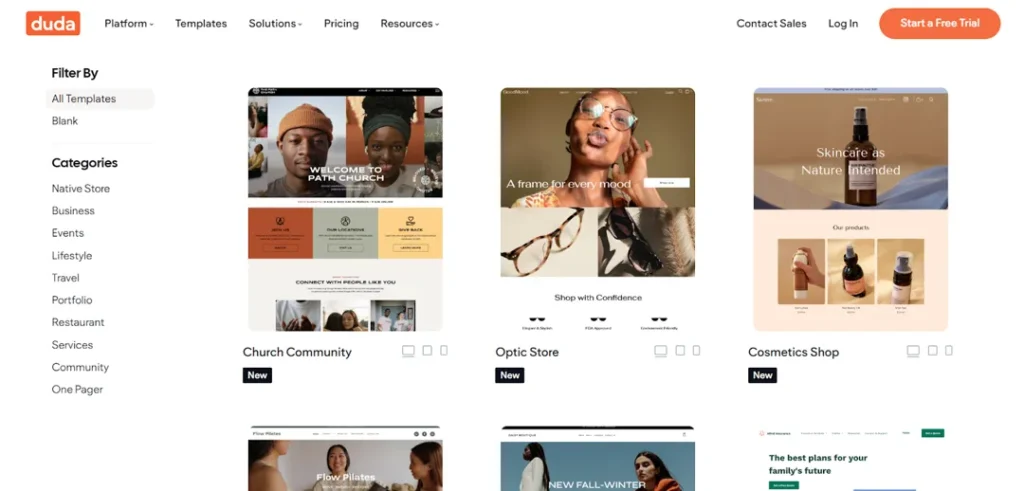
- Templates read as templates. The starting designs are tidy and they are also recognizable. Two contractors in the same market on the same template is a real risk, and pushing past the template's structure is where the editor starts fighting you.
- Customization has a ceiling. You can add custom code, but you are working inside somebody else's framework. Compared with WordPress or Webflow the control is narrower, and it narrows exactly when a client asks for something unusual.
- Ecommerce is basic. Product pages exist. It does not compare with Shopify, and for a catalog of any size the gap is obvious.
- Blogging is thin. Adequate for a few posts a month, awkward for a real content program with categories, authors and internal linking at volume.
- Per-site pricing compounds. Fine at one site. At twenty client sites it is a line item you feel every month.
Duda targets agencies and freelancers building many client sites, not one owner building one website, and that explains most of its trade-offs.
Duda SEO: what you get and what you do not
This is the section most Duda reviews get wrong, including an earlier version of this one. The claim that Duda has no structured data support is out of date.

Duda's own SEO tools documentation lists schema for business info, FAQ pages, videos, product pages and articles, automatic canonical tags, automatic XML sitemaps and robots.txt, hreflang for multi-language sites, 301 and 302 redirects with bulk CSV upload, Open Graph tags, per-page and site-wide meta control, AI-generated titles, descriptions and image alt text, and a built-in SEO audit. That is a real technical SEO feature set.
| Capability | Duda | Practical note |
|---|---|---|
| Titles and meta descriptions | Per page and site-wide | Fine. AI generation is a starting point, not a finish |
| Schema markup | Business info, FAQ, video, product, article | Covers the common cases. Unusual types need a workaround |
| Canonicals, sitemap, robots | Automatic | Automatic also means less control when you need an exception |
| Redirects | 301/302 with bulk CSV | Genuinely good, and the thing most builders do badly |
| Page speed | CDN, image optimization, server-side rendering | The strongest part of the offering |
| Content at scale | Limited blog | The real SEO constraint, and it is editorial rather than technical |
So the honest verdict on SEO for Duda is not "the tools are missing." It is that the technical foundation is solid and the content tooling is thin, which matters because content is what actually wins rankings. If your plan is ten service pages, Duda is fine. If your plan is 200 articles and a topic cluster, the blog will become the bottleneck long before the schema does.
Getting your site out of Duda
Every builder decision is also an exit decision, and Duda's terms here are specific enough to plan around.

Site export requires the Agency plan or higher. You get a zip of the published site's HTML, CSS, JavaScript, images and media. The store does not come with it, though products can be exported separately as CSV, and the blog does not export in the site HTML, arriving instead as an RSS file. Duda does not support the site once it is on another platform, and expect development work to make the export behave.
Read that as: your content is portable, your website is not. What you carry away is a static snapshot, not a site you can keep editing. That is normal for hosted builders and it is worth knowing on day one rather than day 900.
It is also the reason we put ownership in writing on the sites we build. The client owns the site, the domain and the content at launch, and hosting and maintenance stay month to month, which means leaving costs you a transfer rather than a rebuild.
Duda vs the alternatives
The right comparison depends on who is going to maintain the site in two years.
| Platform | Strength | Weakness | Fits |
|---|---|---|---|
| Duda | Speed, multi-site management, solid technical SEO | Template ceiling, thin blog, per-site cost | Agencies running many similar client sites |
| WordPress | Total control, best content tooling, portable | Needs maintenance and someone competent | Businesses with a real content plan |
| Webflow | Design freedom with clean output | Steep learning curve, hosted | Design-led marketing sites |
| Squarespace | Easiest for a non-technical owner | Least flexible, weakest at scale | One simple brochure site |
| Shopify | Ecommerce done properly | Marketing pages are secondary | Anyone whose revenue is online sales |
If Wix is on your shortlist too, our take on why a Wix business website invites the wrong reaction covers that comparison, and if you are weighing a builder against hiring someone, how to choose a web design company is the more useful question.
Who should use Duda, and who should not
The verdict is not a rating, it is a match test.
Duda fits an agency or freelancer producing similar sites at volume, a business that needs a fast, clean, five to fifteen page site and will not be publishing heavily, and any team that values launch speed over design distinctiveness.
Duda does not fit a business planning a serious content program, an ecommerce operation of any size, a brand that needs a design nobody else has, or an owner who wants to take the whole site elsewhere later without a rebuild.
If you land in the second group, the question is not which builder, it is who is building it. Our web design and development work and our monthly website plans both start with a fixed quote in writing, and ongoing website maintenance and hosting stay month to month. If you already have a Duda site and want it working harder in search, that is a search engagement rather than a rebuild, and it usually starts with the blog.
About the author

Founder & Lead Developer · Denham Springs, LA
Clint has built and marketed websites for 26 years, since founding BlakSheep Creative in 2000. He is also a 29-year firefighter and a 23-year member of IAFF Local 557, which is where the bias toward plain answers over sales copy comes from.
- Veteran-owned
- Firefighter-owned
- IAFF Local 557
Common questions about web design & development
How much does Duda cost?
Is Duda good for SEO?
Does Duda support schema markup?
Can you export a website from Duda?
Is Duda better than WordPress?
Who should not use Duda?

Your next step, without the guesswork
No surprises, clear next steps, and a fixed price before anything starts.