
By Clint Sanchez · Published · Updated · 11 min read
Quick answer
Private jet charter SEO is the work of ranking for aircraft, route, airport, pricing, safety, and quote searches so that qualified buyers, not casual traffic, contact your company. It has seven steps: build pages around routes, airports, and aircraft; explain trust before asking for a quote; separate broker and operator messaging; fix technical SEO; use local SEO for airports and service areas; publish content that qualifies buyers; and track calls, quote requests, and lead quality.
Key takeaways
- According to the FAA, Part 135 air charter operations require a higher level of pilot training, certification, maintenance, and safety rules than ordinary private flights, which is why trust content belongs at the top of a charter site, not the bottom.
- Charter searches split into route, airport, aircraft, safety, and marketing intent, and each needs its own page type.
- Brokers, operators, aircraft management firms, and aviation brands should each explain their role clearly; generic luxury copy creates trust problems.
- The NBAA Aircraft Charter Consumer Guide lays out what buyers should ask a provider, so a good charter website answers those questions before the quote form.
- Google's own guidance confirms crawlable internal links and unique titles are how search engines find and understand pages, which makes them part of the strategy, not decoration.
- Track quote form submissions, click-to-call events, qualified lead rate, and booked charter value, not just rankings and traffic.
- SEO and paid ads work better together: ads cover urgent searches while SEO builds long-term authority.
Baton Rouge Metro (BTR) and Louis Armstrong New Orleans (MSY) both feed a steady stream of corporate and industrial charter demand from the petrochemical corridor and the capital, and most of it starts as a search like private jet charter Baton Rouge to Houston. An operator without a page for that route is invisible to the executive assistant typing it.

Want this handled instead of DIY?
A 15-minute call, no script, no pressure — you leave with a plan either way.
Use Private Jet Charter SEO to Turn Search Visibility Into Better Charter Inquiries
Private jet charter SEO helps brokers, operators, and aviation brands show up when serious buyers search for aircraft, routes, airports, pricing, safety, and quote options. The goal is not empty traffic. The goal is qualified charter inquiries from people who trust your company before they ever fill out a form.
TLDR:
- Target searches tied to aircraft, airports, routes, cities, safety, and quote intent.
- Build landing pages around real charter demand instead of generic luxury travel copy.
- Explain your role clearly as a broker, operator, aircraft management firm, or aviation brand.
- Use trust content to answer safety, aircraft access, quote, and booking questions.
- Support every SEO page with fast load times, internal links, schema markup, and clear calls to action.
- Track calls, quote requests, booked conversations, and lead quality instead of vanity traffic.
Private aviation companies do not compete like ordinary local service businesses. A charter buyer may search by airport, destination, aircraft type, business travel need, or urgent trip request. Your website has to connect those searches to a credible path that makes the buyer comfortable enough to call.

Need better charter inquiries from search? Request a private aviation marketing review from BlakSheep Creative.
Why Private Jet Charter SEO Matters
Most private aviation buyers do not request a quote from the first website they see unless the page removes doubt fast.
A serious charter buyer is comparing trust, safety language, aircraft fit, response quality, route experience, and brand credibility. That buyer may be an executive assistant, corporate travel manager, business owner, family office, aircraft owner, or high-net-worth traveler. Each one needs a different level of detail before they take action.
The FAA explains that air charter operations under Part 135 require a higher level of pilot training, certification, maintenance procedures, and safety rules than ordinary private flights. That matters for SEO because buyers are not only searching for comfort and speed. They are also seeking evidence that the provider is legitimate and professional.
FAA Safe Air Charter guidance supports a simple point: trust should not sit at the bottom of your website. It should shape your SEO strategy, your landing pages, and your quote request path.
That trust begins with understanding the way private aviation buyers search.
How Search Intent Works in Private Aviation
Private jet searches are not all equal. Some people are researching. Some are comparing. Some are ready to send flight details now.
| Search Intent | Example Search | Best Page Type | Main Goal |
| Route Intent | Private jet charter Baton Rouge to Dallas | Route landing page | Quote request |
| Airport Intent | Private jet charter near BTR airport | Airport service page | Call or form submission |
| Aircraft Intent | Light jet charter cost | Aircraft category guide | Educate and qualify |
| Safety Intent | How to choose a private jet charter company | Trust guide or FAQ article | Build confidence |
| Marketing Intent | Private jet charter SEO | SEO strategy article | Book a marketing review |
This table shows why a single generic aviation page cannot carry the entire strategy. Each search has a different job.
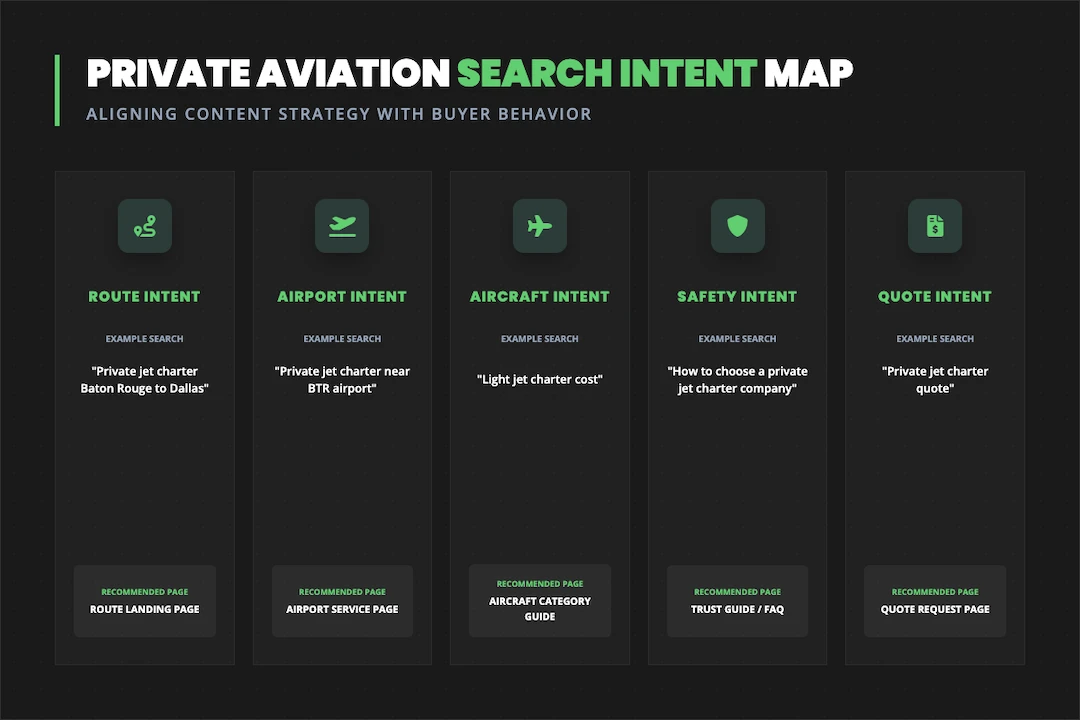
Once the intent map is clear, the next step is to build pages that match those searches without stuffing the same phrases into every paragraph, as if the internet were a word-soup contest.
Step 1: Build Pages Around Routes, Airports, and Aircraft
A private aviation website needs pages that align with how buyers plan their trips.
Start with the highest value search patterns. These usually include departure city, arrival city, airport, aircraft category, and charter need. A buyer searching for a private flight from New Orleans to Miami needs a different page than a buyer comparing midsize jets for recurring corporate travel.
Your core page structure may include:
- Main private jet charter service page
- Airport-based charter pages
- Route-based charter pages
- Aircraft category pages
- Corporate travel pages
- Aircraft management pages
- Safety and buyer education guides
- Quote request pages
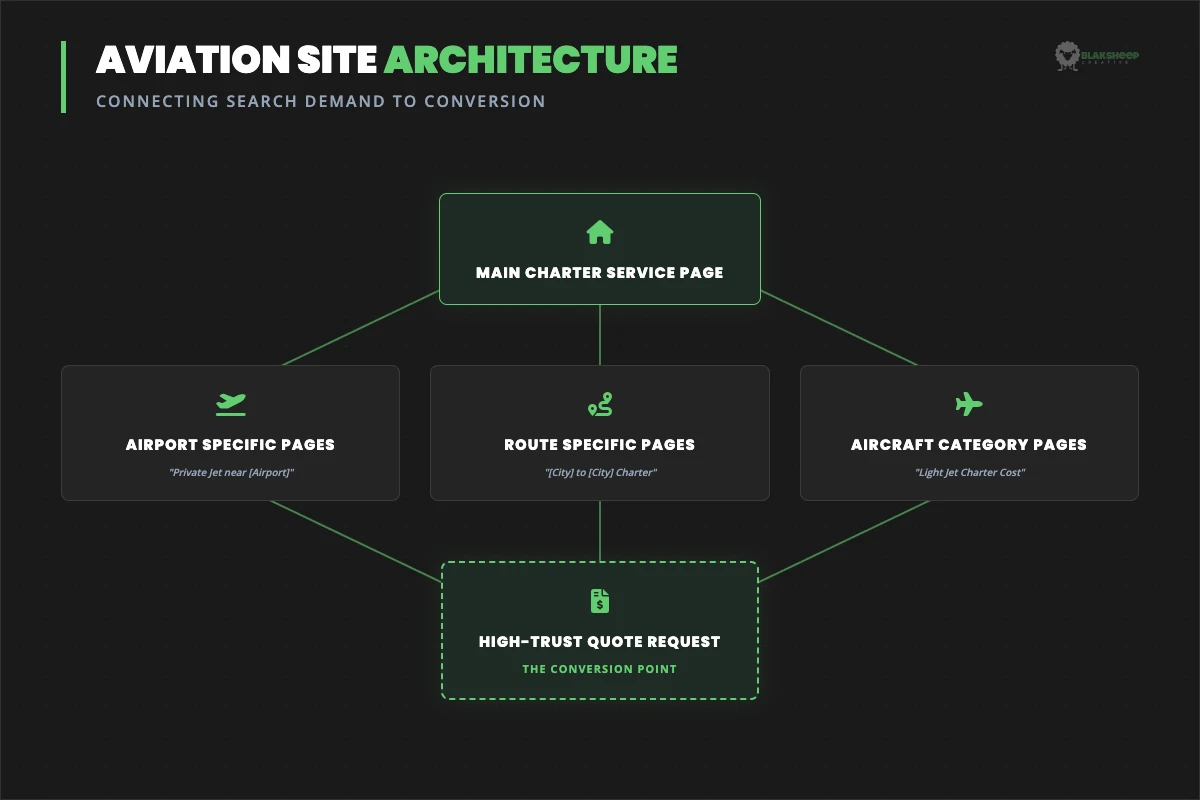
Each page should answer the buyer’s next logical question. Route pages should discuss trip planning, aircraft fit, timing, and quote needs. Aircraft pages should explain capacity, range, comfort, luggage limits, and best use cases. Airport pages should connect the market to real departure and arrival behavior.
The page structure matters, but the message on those pages matters just as much.
Charter searches split into route, airport, aircraft, safety, and marketing intent, and each needs its own page type.
Step 2: Explain Trust Before Asking for the Quote
A private jet charter quote request asks for personal details, travel plans, passenger count, timing, and sometimes budget range. Buyers need confidence before they share that information.
The NBAA Aircraft Charter Consumer Guide explains that buyers should understand what questions to ask and what answers to expect when choosing a charter provider. Your website should make that process easier, not harder.
NBAA’s charter consumer guide supports the need for clear buyer education. A good charter website should help visitors understand aircraft options, provider roles, service expectations, safety considerations, and next steps.
Trust content should answer questions like:
- Are you a broker, operator, aircraft management firm, or aviation service provider?
- How do you source aircraft?
- How do you vet operators?
- What information do you need to prepare a quote?
- What factors affect charter pricing?
- How fast can your team respond?
- What types of travelers or businesses do you serve?
Do not bury these answers behind vague luxury language. Serious buyers do not need another paragraph about “elegance in the sky.” They need clarity.
That clarity gets even more important when your company’s role affects what the buyer should expect.
Step 3: Separate Broker SEO From Operator SEO
Charter brokers and operators often compete for similar searches, but their pages should not say the same thing.
| Business Type | SEO Focus | Trust Content Needed |
| Charter Broker | Aircraft sourcing, trip planning, operator relationships, quote speed | Vetting process, buyer education, clear role explanation |
| Charter Operator | Fleet, crew, certificates, service areas, aircraft availability | Safety standards, aircraft details, operational credibility |
| Aircraft Management Firm | Owner services, charter revenue support, maintenance coordination | Management process, reporting, aircraft care, owner communication |
| Aviation Brand | Lead generation, visibility, authority, referral support | Experience, market focus, service fit, proof of credibility |
The table shows why generic private aviation copy creates trust problems. A buyer should understand your role before they submit a quote request.
Broker SEO should explain how the broker finds suitable aircraft and coordinates the process. Operator SEO should explain aircraft access, service areas, crew standards, and safety practices. Aircraft management SEO should speak to owners who care about protection, communication, usage, and revenue options.
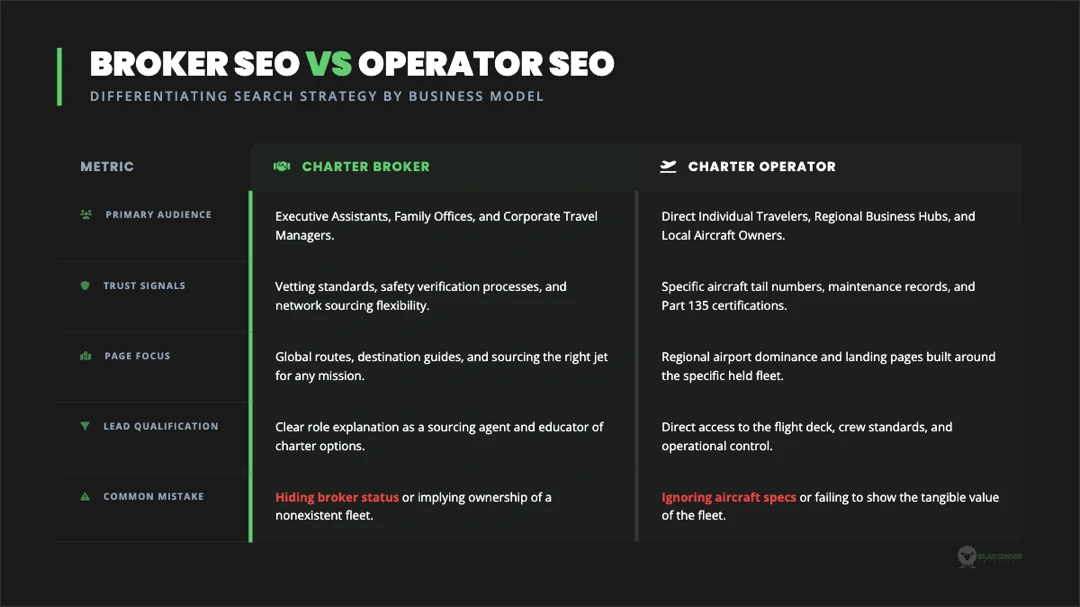
Clear positioning helps qualify leads before your sales team spends time on the wrong conversation.
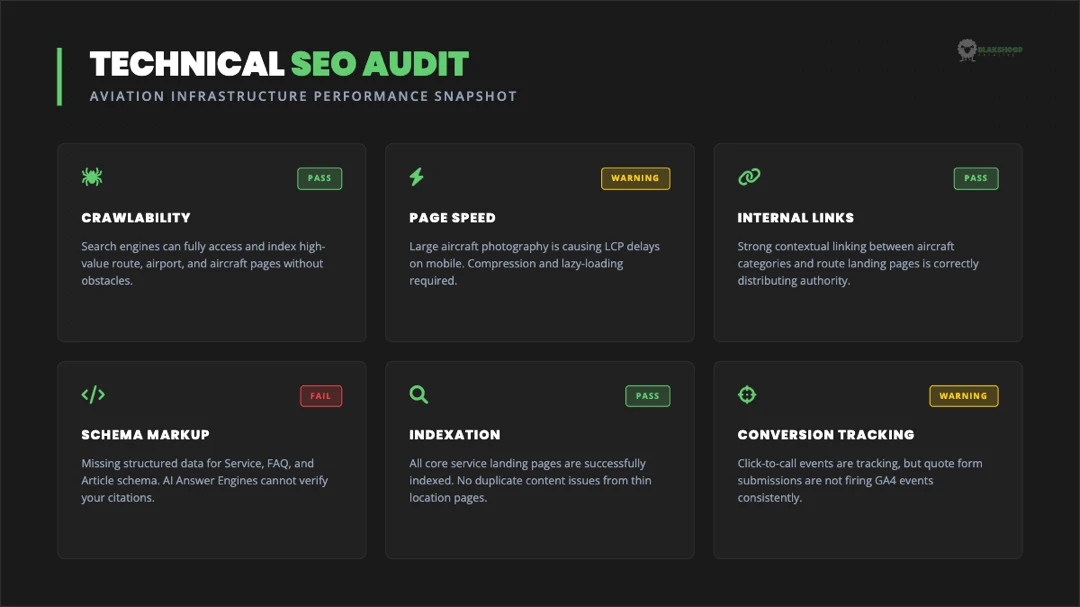
Step 4: Fix the Technical SEO Behind the Website
A private aviation website can look expensive while still failing at basic technical SEO. Sadly, nice photography cannot crawl itself.
Google Search Central explains that SEO starts with making pages accessible, useful, and understandable to search systems. Google also states that links help it find pages and understand relevance. That makes crawlable internal links a real part of the strategy, not a decorative web design afterthought.
Start with these technical checks:
- Use crawlable links between core pages, route pages, aircraft pages, and blog content.
- Write unique title tags and meta descriptions for each major page.
- Compress images so that aircraft photography does not slow down mobile users.
- Fix indexation issues for high-value service pages.
- Improve Core Web Vitals where speed or layout shifts hurt usability.
- Add schema markup that matches visible page content.
- Remove duplicate location pages that only swap city names.
- Use a clean URL structure for routes, aircraft categories, and service pages.
Google’s SEO Starter Guide and link best practices support these fundamentals. The boring work matters. Search engines are very annoying that way.
If the website foundation is weak, stronger content will still struggle to perform.
“These guys design beautiful websites and will work hand in hand with you through the entire process , they go over and above Highly recommend!!!”

Step 5: Use Local SEO for Airports and Service Areas
Private jet charter SEO has a local search layer because buyers often search by city, airport, business hub, and destination.
A local SEO plan may include pages for real markets such as Baton Rouge, Denham Springs, Hammond, New Orleans, Lafayette, Houston, Dallas, Atlanta, Miami, Aspen, and other travel corridors tied to your services. The point is not to create thin city pages. The point is to help buyers see how you serve that market.
Useful local and airport content can include:
- Departure city details
- Arrival city details
- Nearby airport access
- Common business travel routes
- Seasonal travel demand
- Aircraft fit by trip distance
- Response process for quote requests
Your Google Business Profile should also align with your actual business model. Use accurate contact details, service categories, photos, service information, and business descriptions. Do not create fake locations. Google and humans both dislike being lied to, which is a rare moment of shared values.
Local SEO can drive more relevant inquiries when it reflects real service relevance rather than copy-pasted geography.
Step 6: Create Content That Qualifies Charter Buyers
Private jet charter content should do more than pull traffic. It should help the wrong people leave, and the right people contact you.
Strong content topics include:
- How private jet charter pricing works
- What affects aircraft availability
- How to choose between light, midsize, super midsize, and heavy jets
- What information is needed for a charter quote
- How empty leg flights work
- How brokers source aircraft
- What to ask before booking a charter flight
- How business travelers can plan recurring charter needs
Each topic should connect to the next step. A pricing article should link to a quote request. An aircraft guide should link to aircraft category pages. A safety article should link to your trusted content. A route article should link to the main charter service page.
The best content does not just inform the buyer. It moves the right buyer closer to action.
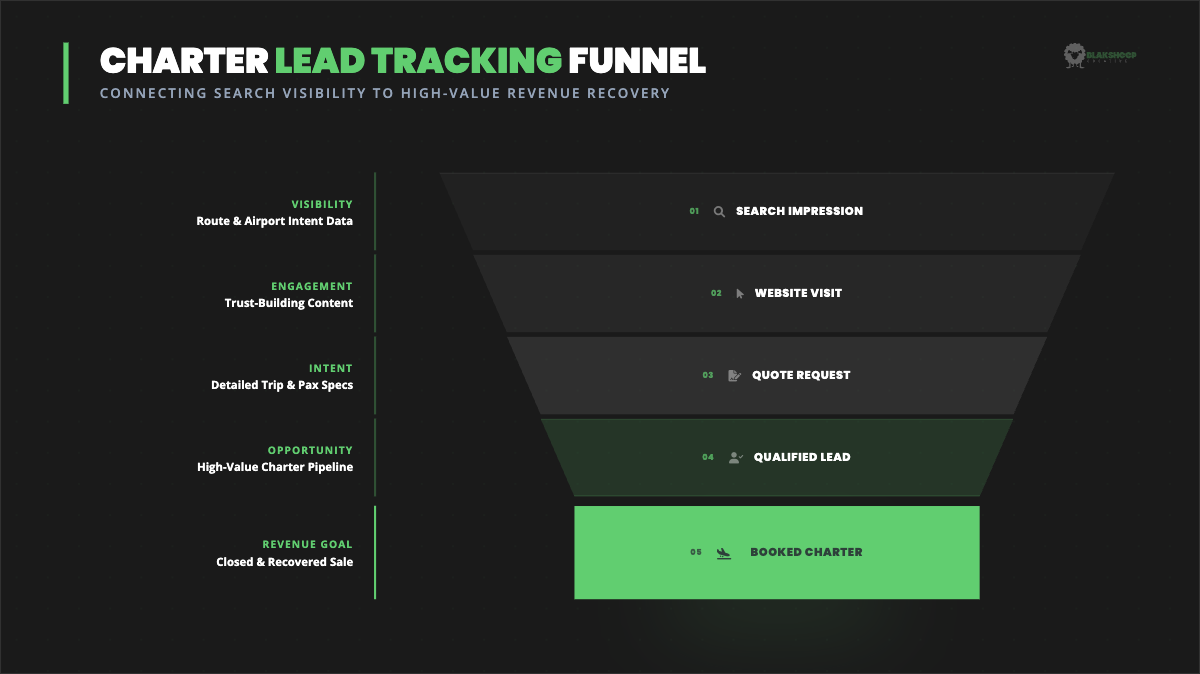
Step 7: Track Calls, Quote Requests, and Lead Quality
SEO reporting for private aviation should focus on business outcomes, not charts that make everyone nod while learning nothing.
| Metric | Why It Matters | Tracking Tool |
| Organic clicks | Shows search visibility growth | Google Search Console |
| Keyword impressions | Shows demand and ranking movement | Google Search Console |
| Quote form submissions | Tracks lead generation | GA4 events or CRM tracking |
| Click to call events | Tracks mobile and urgent intent | GA4 and call tracking |
| Qualified lead rate | Shows if the campaign attracts serious buyers | CRM pipeline review |
| Booked charter value | Connects SEO to revenue | CRM and sales reporting |
This data gives your team a better read on performance than rankings alone.
Reporting should include a weekly early read after major changes and a monthly performance snapshot. Watch calls, forms, route page performance, top queries, conversion rates, and lead quality. If traffic rises but qualified inquiries do not, the page may need stronger positioning, better forms, or clearer trust signals.
Tracking tells you where the campaign is working and where the sales path still leaks.
Brokers, operators, aircraft management firms, and aviation brands should each explain their role clearly; generic luxury copy creates trust problems.
Common SEO Mistakes Private Jet Charter Companies Make
Most aviation SEO problems are not mysterious. They are usually the result of weak structure, vague messaging, and poor tracking.
| Common Mistake | Impact | Better Move |
| Using generic luxury copy | Fails to answer real buyer questions | Write around safety, routes, aircraft fit, and quote needs |
| Skipping route and airport pages | Using slow image-heavy pages | Build pages around real demand and service areas |
| Blurring broker and operator roles | Creates trust issues | Explain your role clearly on core pages |
| Explain your role clearly on the core pages | Hurts mobile usability | Compress images and improve Core Web Vitals |
| Tracking only traffic | Hides weak lead quality | Track calls, quote forms, and qualified lead rate |
The pattern is simple. Private aviation SEO fails when the site looks polished but does not answer, qualify, or convert.
Fixing these issues starts with the highest value pages first.
What to Fix First if Your Charter Website Is Not Ranking
If your private aviation website is not ranking or your leads are weak, start with the factors that affect visibility and trust the fastest.
Use this order:
- Audit your main private jet charter service page.
- Map your route, airport, aircraft, and service keywords.
- Fix title tags, meta descriptions, headings, and internal links.
- Improve mobile speed and Core Web Vitals.
- Add trust content that explains your role and process.
- Create pages for real airport and route demand.
- Add schema markup that matches visible content.
- Set up GA4 events for calls, forms, and CTA clicks.
- Review lead quality monthly with your sales team.
This gives your team a practical action plan without turning SEO into a 90-tab spreadsheet nightmare, although humans do seem committed to that format.
Once the foundation is in place, build supporting content to strengthen the main service pages.
Final Takeaway
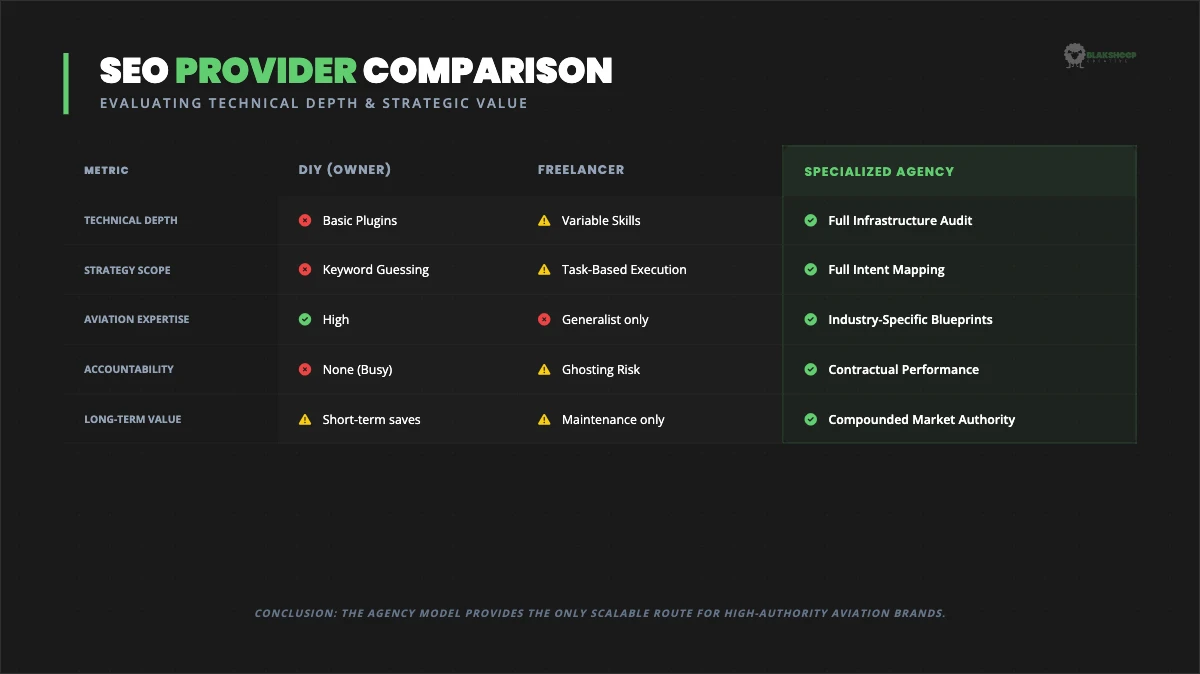
Private jet charter SEO works best when it connects search visibility, buyer trust, page structure, technical SEO, and conversion tracking.
Your aviation website should help serious buyers understand your service, compare their options, and contact you with confidence. That means your pages need more than pretty aircraft photos. They need clear answers, route and airport relevance, technical discipline, internal links, trust signals, and a quote path that respects the buyer’s time.
BlakSheep Creative builds private aviation marketing around qualified inquiries, not empty traffic. If your charter site gets visits but not the right conversations, the problem may be your SEO structure, your content, your tracking, or the trust path between the search result and the quote request.
Common Questions About Private Jet Charter SEO
Private aviation SEO raises specific questions because the buyer process is high-trust, high-value, and often time-sensitive. These answers clarify how SEO supports better visibility and better charter inquiries.
What is private jet charter SEO?
Private jet charter SEO is the process of improving search visibility for aviation-related searches, including aircraft, routes, airports, pricing, safety, and quote requests. The goal is to attract qualified travelers, assistants, owners, and corporate buyers who are more likely to call or submit trip details.
How is SEO for private jet charter different from regular SEO?
Private jet charter SEO requires stronger trust building, better buyer qualification, and more aviation context. The content must address aircraft fit, route planning, airport access, safety considerations, broker roles, operator standards, quote expectations, and response speed. Generic SEO usually misses those details.
Should private jet charter companies build airport and route pages?
Yes, if those pages match real service areas and offer useful information. Airport and route pages can target strong buyer intent, but they need original content, service relevance, and a clear path to a quote. Thin duplicate location pages can hurt quality and waste crawl budget.
Does Google Business Profile matter for private jet charter SEO?
Yes. Google Business Profile can support branded searches, local visibility, calls, photos, services, and trust signals. The profile should use accurate business information, real photos, relevant service details, and current contact information. Fake locations and misleading service areas create avoidable risk.
How long does private jet charter SEO take?
SEO timelines depend on competition, site history, content quality, technical health, authority, and tracking setup. Some fixes can help quickly, but steady organic lead growth usually requires ongoing work across technical SEO, content, internal links, conversion paths, and authority building.
What should a private aviation SEO campaign track?
Track organic clicks, impressions, rankings, quote form submissions, click to call events, CTA clicks, qualified lead rate, booked conversations, and charter revenue when available. Traffic alone is not enough. The campaign should connect search visibility to real business conversations.
Can SEO replace paid ads for private jet charter companies?
SEO and paid ads usually work better together. Paid ads can create faster visibility for urgent searches, while SEO builds long-term authority and reduces dependence on paid traffic. The right mix depends on your market, budget, sales process, and current search visibility.
Understanding these answers helps your aviation team build a smarter search strategy before wasting budget on the wrong traffic.
About the Author: This guide was produced by the senior strategy team at BlakSheep Creative. Based in Denham Springs, Louisiana, we specialize in SEO, custom web design, content strategy, and digital marketing systems for service-based businesses, aviation brands, nonprofits, and public safety organizations.

We build this for private jet charter.
Fixed quote before we start, and you talk to the people who do the work.
About the author

Founder & Lead Developer · Denham Springs, LA
Clint has built and marketed websites for 26 years, since founding BlakSheep Creative in 2000. He is also a 29-year firefighter and a 23-year member of IAFF Local 557, which is where the bias toward plain answers over sales copy comes from.
- Veteran-owned
- Firefighter-owned
- IAFF Local 557
Common questions about private jet charter companies
What pages should a private jet charter website have?
What trust questions should a charter website answer?
Why should brokers and operators use different SEO messaging?
Do city pages work for private aviation local SEO?
What technical SEO problems are common on charter websites?
How should a charter company report on SEO?

Your next step, without the guesswork
No surprises, clear next steps, and a fixed price before anything starts.