
TL;DR
The Gist: Our affordable marketing model works because it relies on structure, not chaos. You receive professional strategy, solid SEO foundations, and consistent execution. You do not get unlimited revisions, decision-by-committee, or admin access that risks breaking the site. We prioritize results and stability over endless tinkering.
It sounds harsh, but boundaries are the only way to keep professional marketing affordable. Here is the honest breakdown of how we deliver quality without the high price tag.
Digital Marketing Model Rules
To deliver results without the high price tag, we follow a strict playbook that prioritizes performance over endless tinkering.
Direct answer: Our digital marketing model rules exist because affordability only works with structure. You get professional strategy, implementation, and support, but you do not get unlimited overrides, unlimited access, or unlimited rebuilds. These rules protect SEO, performance, timelines, and the people doing the work.
Every affordable marketing engagement that goes sideways starts the same way: scope gets fuzzy, decisions multiply, and a low-budget plan gets treated like an unlimited retainer. Our rules exist to prevent that and protect timelines, SEO, and outcomes. This is the same structure we apply across our digital marketing services, because consistency is what lets progress stack instead of reset.
- You get a clear scope, a clear process, and a real launch standard
- You get basic on-page and off-page SEO foundations built correctly
- You get one accountable decision path, not a committee of edits
- You do not get unlimited redesigns after approval
- You do not get admin keys handed to third parties mid-project
- You do not get SEO accountability if others change core content
We work with small businesses from Alaska to Florida. From New York to California, we even have some clients in Hawaii. If you want a team that will build a site that performs, this is for you. If you want unlimited control at a low budget price, this is not a fit, and that is fine.
What You Get with This Model
Transparency is everything, so here is exactly where your budget goes.
- A planned build: A structured website designed for real users and local search.
- Basic SEO foundations: Page structure, headings, internal linking, indexing hygiene, and service area coverage.
- Real advice: We tell you when something will hurt performance and why.
- Direct communication: Faster than tickets, but still professional and bound.
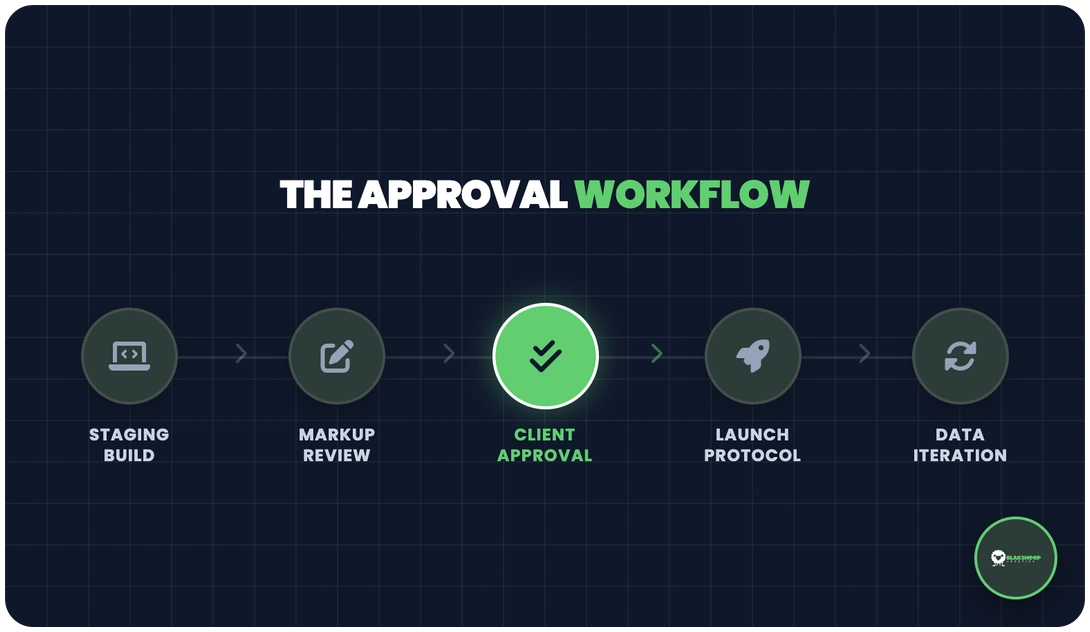
- A consistent process: Staging, review, approval, launch, then iteration.
What You Do Not Get with This Model
We believe in being upfront about limitations so there are no surprises later.
- Unlimited revisions: Especially not full UX redesigns after approval.
- Multiple decision makers: One point of contact only.
- Admin access by default: Especially not for outside marketers or brand teams.
- Strategy resets: Turnover at your company does not restart the project.
- SEO guarantees, while others edit the site: Control and accountability go together.
Why “Affordable” Requires Structure
Low cost does not mean low quality, but it definitely means high efficiency.
We have watched small businesses save money upfront, only to lose months of momentum when the process kept changing midstream. Affordable only works when the strategy stays stable long enough to do its job. That is why our Pay By the Month Websites model is built around efficiency, not constant pivots. Structure is not a restriction. It is how results stay affordable.
Our model is front-loaded. You get a lot early, then pay it down over time. That makes it accessible for small businesses. It also means we must control risk and scope.
Why One Point of Contact Is Non-Negotiable
Too many cooks in the kitchen spoil the broth, and too many decision makers ruin a marketing timeline.
Projects rarely stall because of “bad design.” They stall because too many people keep grabbing the steering wheel. One point of contact keeps execution clean and protects your investment, especially when we are running ongoing content marketing and SEO work that depends on consistent decisions.
Multiple people emailing, texting, and calling does not create collaboration. It creates conflicting direction.
We require one decision maker. That person can gather internal input, but we accept direction from only one source.
Real client scenario: A restaurant in Baton Rouge brought in a new “branding expert” after launch. The new person wanted the homepage rewritten weekly and the service pages consolidated “to look cleaner.” Rankings slipped because the site stopped matching search intent. Once the owner resumed decision control and we restored the structure, traffic stabilized.
What Approval Means
Moving forward requires commitment, not a “maybe” that changes tomorrow.
Approval is a milestone, not a suggestion. If it is treated like “we approve, but we might change our mind tomorrow,” you end up paying for rework and nobody can be accountable. This is standard in professional web design and development, and it is the only way an affordable model stays sustainable.
We build on staging and run a review through markup. You review the content, images, phone numbers, offers, and layout. Then you approve the launch.
Approval means you have proofed the work and accepted the current scope. If changes are requested after approval, they may be handled, but they are not treated as free or automatic.
Google’s Search Central SEO Starter Guide also makes it clear that changes can take weeks or months to be reflected in Search. That is part of why stable decisions matter.
Direct Access Does Not Mean 24-Hour Availability
We want to be responsive, but we also need to be rested enough to do great work.
We allow direct communication because it speeds up execution, not because it removes boundaries. When “quick questions” turn into constant interruptions, production slows and quality drops. If you need something time-sensitive, use the right channel and keep it clean, starting with our contact page when it is not an actual emergency.
We allow direct communication because it speeds up execution. It does not mean the team is waiting at your beck and call nights and weekends.
Use direct contact for clarity and urgency when it is real. Use the process for everything else. Otherwise, you burn the team out, and your work quality drops.
Why We Control Website Access
We treat your site like a secure asset, not a sandbox for random experiments.
Every agency that offers payment plans learns this the hard way: unrestricted admin access creates risk. It can lead to untracked edits, broken layouts, SEO regressions, or even asset extraction before the commitment is complete. We control access because your site is a business asset tied to real hosting, performance, and security responsibilities, not a shared sandbox.
Most clients pay over 12 months. If we hand out admin access, someone can copy the site, move it, and vanish early. We have lived that. It is not a theory.
Access also creates performance risk. Untracked edits break layouts, tank speed, and disrupt SEO signals. Then everyone expects the agency to fix problems it did not create.
Basic SEO Is Included, but Scope Creep Is Real
We lay the groundwork for growth, but changing the blueprint halfway through destroys the foundation.
Most low-budget plans fail when foundational SEO turns into constant rebuilding. Our packages include real baseline SEO work: structure, core pages, internal linking, and keyword alignment. If you want deeper ongoing SEO testing and expansion, that is what our SEO services are built for. It is not something an entry package can absorb forever.
Our low-budget packages include basic on-page and off-page SEO. We do initial keyword research, build the structure, write or refine content, and set a foundation that can compound.
What we cannot do at that price point is rebuild the site repeatedly due to internal turnover or outside experts issuing new direction every week. That is not “maintenance.” That is a new strategy and new production.
Why Stability Matters More than Constant Change
In the eyes of a search engine, patience often pays better dividends than panic.
Search performance improves when your site stays consistent long enough for changes to be evaluated. Constant edits can reset signals and confuse both users and crawlers. If you want growth that builds over time, treat SEO like a process, not a slot machine. That mindset is what separates serious campaigns from “we tried SEO once and it didn’t work.”
Google is not instant. Even when you make a good change, you still need time for crawling, indexing, and re-evaluation.
Google says you should wait weeks to assess results and that some changes can take months to reflect. That is straight from Search Central.
Search Is Changing: Zero Click and AI Answers Are Real
Google is keeping more users on Google. Shocking, right?
Rankings no longer automatically translate into traffic, because Google answers more questions before a click happens. That means your site needs clarity, authority signals, and structure that search engines can trust. This is also why modern AEO is becoming part of the conversation for businesses that want to apear in AI answers and summaries.
Your site has to earn trust fast, because fewer searches turn into visits. SparkToro reported that 58.5% of US Google searches ended with zero clicks in 2024.
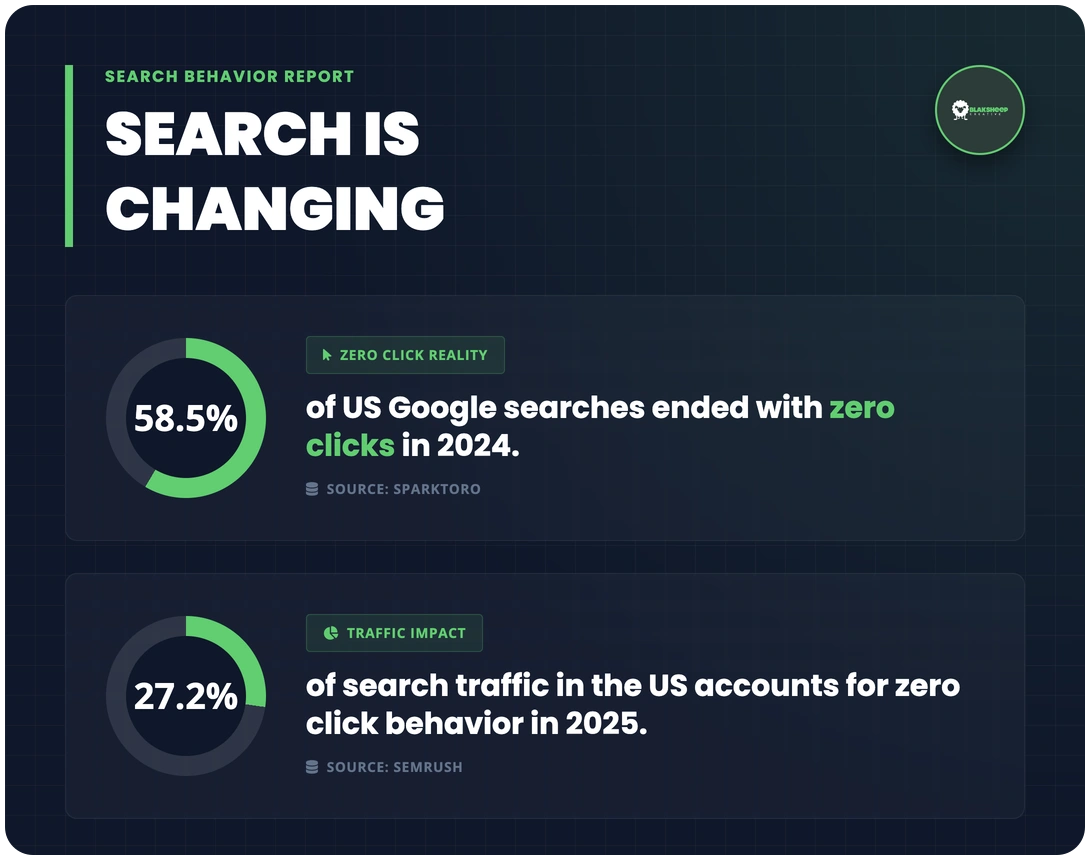
Semrush reported that zero-click traffic increased, estimating roughly 27.2% of US search traffic as zero-click in 2025.
Translation: Google is answering more questions before people ever reach your site. If your site depends on “we’ll rank, and they’ll click,” you are already behind. Your content has to be obvious, trusted, and structured so you can still win the clicks that remain.
UX Affects Trust, Return Visits, and Conversions
Your website is not just for you; it is for the people trying to hire you.
Most visitors do not leave because your service is bad. They leave because the site feels confusing, slow, or untrustworthy. That is why we protect UX decisions and push back on random changes that hurt comprehension and conversion. If you want pages that convert on purpose, that is the point of landing page design and structured UX, not aesthetic guesswork.
This is why we push back on “just change it” requests. Baymard reports that 88% of online consumers are less likely to return after a bad experience. That does not mean one ugly page. It means confusion, slow load times, cluttered layouts, unclear calls to action, and content that forces users to think too hard.
For business owners, this translates directly to lost revenue. A visitor who leaves because the site feels untrustworthy or hard to use rarely gives you a second chance. They click back, choose a competitor, and move on. That is why we protect structure and usability even when individual preferences push in the opposite direction.
Why Each Service Needs Its Own Service Page
You cannot catch every fish with one net, and you cannot rank for every service with one page.
Search engines rank pages that match intent. When multiple services get crammed into one page, clarity dies, and rankings usually follow. Separate service pages let you target real searches with focused headings, copy, and internal links. That is also why we start with keyword research before deciding what pages actually need to exist.
If you offer three services, you need three service pages. Search engines rank pages based on intent. One page trying to rank for everything usually ranks for nothing.
- Each service has different keywords and different buyer intent.
- Each service needs focused headings, copy, internal links, and calls to action.
- Combining services dilutes relevance and clarity of conversion.
Service Plus County or Parish Pages Are Coverage, Not Duplication
Local SEO is about showing up where your customers search, not just where your office sits.
We have watched businesses delete location coverage because someone said the site “felt too big.” Traffic dropped shortly after. People search by county or parish all over the US, not just by city names. These pages exist to match real search behavior and expand visibility using a real local SEO structure, not to inflate page count for fun.
We had a client hire an additional “marketing expert” who took one look at the site and said, “You have too many pages. Google doesn’t like that. We should cut it down.” That is the kind of advice you get from someone who confuses a website with a brochure and thinks SEO is a vibe.
Google does not rank your business because it feels minimal. Google ranks pages that match search intent. If you provide multiple services across multiple areas, you need pages that clearly map to those searches. Cutting service and location coverage because it “looks cleaner” is how you shrink your visibility and hand leads to competitors who kept their pages.
Across the US, people search by county or parish as much as by city, especially for service businesses that travel. A homeowner may not search “Your City electrician.” They might search “County electrician,” “electrician near me,” or a specific town inside that county.
Service plus county or parish pages let you match that intent without forcing one generic page to do everything. They clarify what you offer, where you offer it, and why someone should choose you in that service area. When you remove those pages, you do not “clean up” your site. You shrink visibility and create gaps your competitors will happily fill.
Outside Experts Are Welcome, but Authority Must Match Accountability
Collaboration is great, but accountability requires a clear chain of command.
Outside input is fine. Random overrides are not. We have seen “experts” suggest changes that ignore search intent, technical realities, and the existing strategy. If we are responsible for performance, we retain final authority on implementation. That is the difference between collaborative internet marketing and design by committee.
We see this constantly: a new “branding expert” arrives and declares the site has too many pages. Or they want fewer services pages because it feels cleaner.

If we are responsible for SEO and performance, we retain final say on structure, implementation, and launch standards. Outside experts can advise. They do not override strategy without taking responsibility for outcomes.
Control vs Accountability
If you want us to own the results, you have to let us own the execution.
| Situation | Who controls changes | Who can be accountable for results |
| Agency controls implementation | BlakSheep Creative | BlakSheep Creative |
| Client and third parties edit site freely | Multiple people | No one, realistically |
PPC vs SEO: Why Clients Feel Impatient
Everyone wants fast results, but sustainable growth is a marathon, not a sprint.
Paid ads move fast, which makes people impatient with SEO. PPC can drive traffic quickly, but the meter runs continuously. SEO takes longer, but it can build momentum if you stop resetting the strategy. If you want fast lead flow while SEO builds, that is exactly where Pay Per Click fits into the bigger plan.
Paid ads can drive clicks quickly, but once you stop paying, traffic drops. SEO takes longer, but it compounds if you stop resetting the strategy.
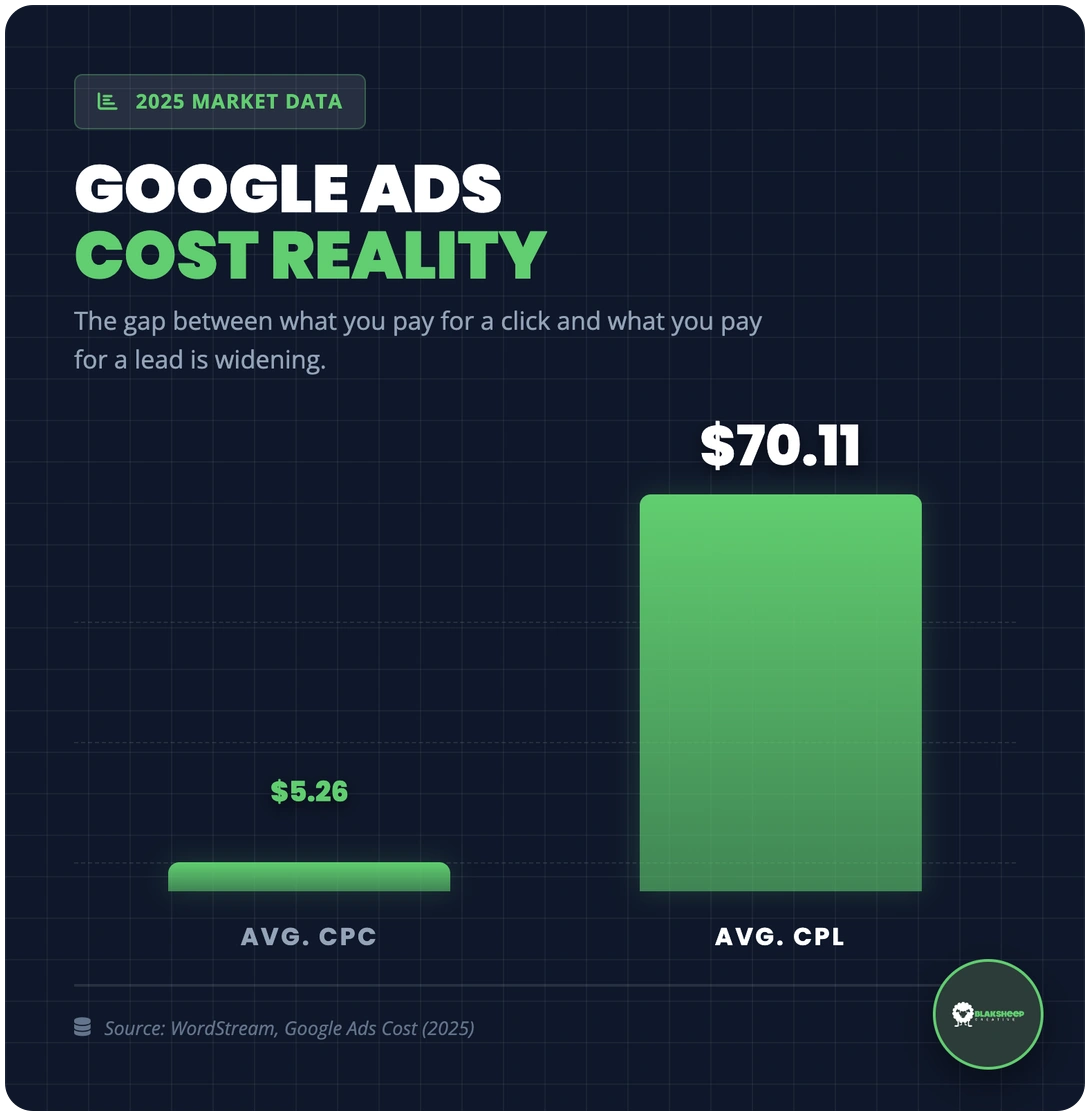
WordStream reported the average cost per click in Google Ads in 2025 was $5.26, and the average cost per lead was $70.11. Source: WordStream Google Ads cost data.
Internal Turnover Is Not a Reset Button
Your business keeps moving when staff changes, and your marketing strategy should too.
Staff changes happen. Your marketing strategy should not restart every time someone new joins the company. Rebuilding the same pages repeatedly delays results and burns budget. A sustainable approach keeps the plan moving forward and improves what exists, which is the entire point of ongoing digital marketing, not constant reinvention.
If your marketing manager leaves and a new one joins, your site does not have to restart from scratch. We do not rebuild the same project repeatedly just because the people involved changed.
That cycle is not cost-effective for us, and it does not help you either. It delays results and turns your site into a moving target.
So, What Do You Do if You Want More than This Model Includes?
If you need a custom mansion, do not buy a starter home package; just ask for the blueprints you actually need.
Some businesses outgrow affordable frameworks. That is normal. If you need frequent redesigns, deeper SEO experimentation, or bigger strategy shifts, we can scope it properly. Start by looking at our services, and we will align the plan with what you actually want, instead of forcing an entry package to pretend it is an enterprise engagement.
Easy: upgrade scope. If you want ongoing redesign, advanced SEO testing, or major strategy shifts, we can provide a quote. This model is not built for unlimited pivots at a low monthly price.
Key Takeaways
The rules are not here to restrict you; they are here to help you win.
You know your market and your niche. We know marketing and websites. We will advise you based on best practices and lean on you for real industry nuance. But outcomes require structure. If you want results, the rules are part of the deal.
Want a Site and Marketing That Actually Compounds?
Compounding happens when structure stays intact long enough to work. If you want momentum that builds instead of resets, you need guardrails and a real process. That is exactly how our Pay By the Month Websites model works. We choose clients who respect the process, because that is how both sides win.
Your input is welcome. We expect it. You know your business better than anyone. But our process is nonnegotiable. We will advise you on what works, push back on what hurts performance, and protect the strategy even when it is uncomfortable.
We are a small business ourselves, which gives us the luxury of choosing who we work with. We are not the right fit for everyone, and that is intentional. If you want a website and marketing approach that is structured, protected, and designed to compound over time, learn how our model works here:
If you want unlimited overrides, rotating “experts,” and no guardrails, we are not your agency. If you want results that build instead of reset, we should talk.
Frequently Asked Questions about Our Process
We know this approach is strict, so here are the honest answers to why we work this way.
What Do I Actually Get in a Low-Budget Website and Marketing Package?
You get a planned website build, basic on-page and off-page SEO foundations, service pages, service area structure, and professional guidance. You do not get unlimited redesigns, unlimited revisions, or strategy resets every time someone new joins your team.
Why Do You Require One Point of Contact?
One point of contact prevents conflicting direction and scope creep. It keeps projects moving and protects outcomes. Multiple decision makers slow execution and create rework that does not fit an affordable model.
Why Do You Restrict Admin Access to the Site?
Admin access enables untracked edits, SEO regressions, and asset extraction during a payment plan. If you want the agency accountable for performance, the agency must control implementation.
Why Do I Need Separate Service Pages?
Each service has its own search intent and keyword set. Search engines rank pages based on clarity and focus. Combining services dilutes relevance and usually reduces rankings and conversions.
Why Do You Build Service Plus Parish/County Pages?
Customers often search by county or parish, not just by city. These pages expand your coverage to match that regional search behavior. Removing them shrinks your discoverability and leaves gaps in your service area that competitors can fill.
Why Does SEO Take Time Even when Changes Are Good?
Google crawling, indexing, and re-evaluation take time. Google notes that you should wait weeks to assess impact and that some changes can take months to reflect. Confused? Fill out the contact form below.