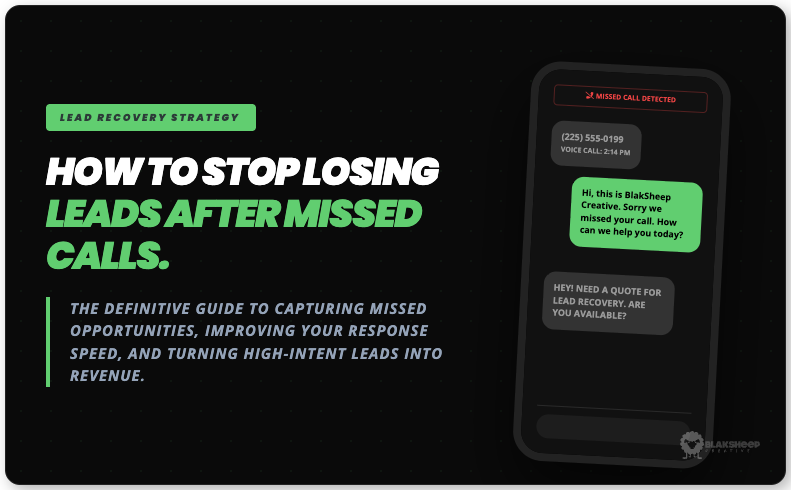
Stop losing leads from missed calls before they go cold.
Quick answer: If your business depends on phone calls for quotes, appointments, or consultations, slow follow-up is a revenue leak. A better response system closes that gap.
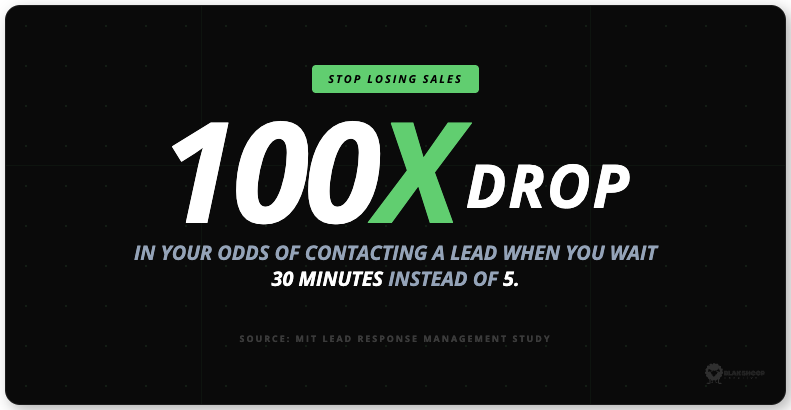
If you want to stop losing leads from missed calls, you need more than a reminder to “call them back later.” A missed call usually happens when a prospect is ready to act now, and response time matters a lot more than most businesses want to admit. The MIT Lead Response Management Study found that the odds of contacting a lead within 5 minutes, compared with 30 minutes, drop by a factor of 100. In plain English: the longer you wait, the worse your chances get.
TLDR
- Missed calls cost real revenue, not just missed conversations.
- People who call are often high-intent leads.
- Fast follow-up improves the chances of contact and qualification.
- Unknown numbers get ignored more often now, so context matters.
- A missed call text back can keep the conversation alive.
- A proper CRM setup helps capture, assign, track, and follow up on leads fast.
- Better systems beat good intentions every time.
For service businesses, this is a daily problem. The owner is in the field. The office is busy. Calls come in during jobs, estimates, lunch, and whatever fresh chaos the day brings. Then the lead disappears, and everyone acts confused. That is not a staffing mystery. That is a process problem.
Fix the follow-up gap before it keeps costing you leads
A properly configured CRM can catch missed calls, trigger an instant text back, assign the lead, and keep your team from losing track of the next step.
Why missed calls cost more than most businesses think
When someone calls your business, they are usually not casually browsing. They need help, pricing, scheduling, or a quick answer. In many local service businesses, that phone call is the hottest point of intent in the entire buying process.
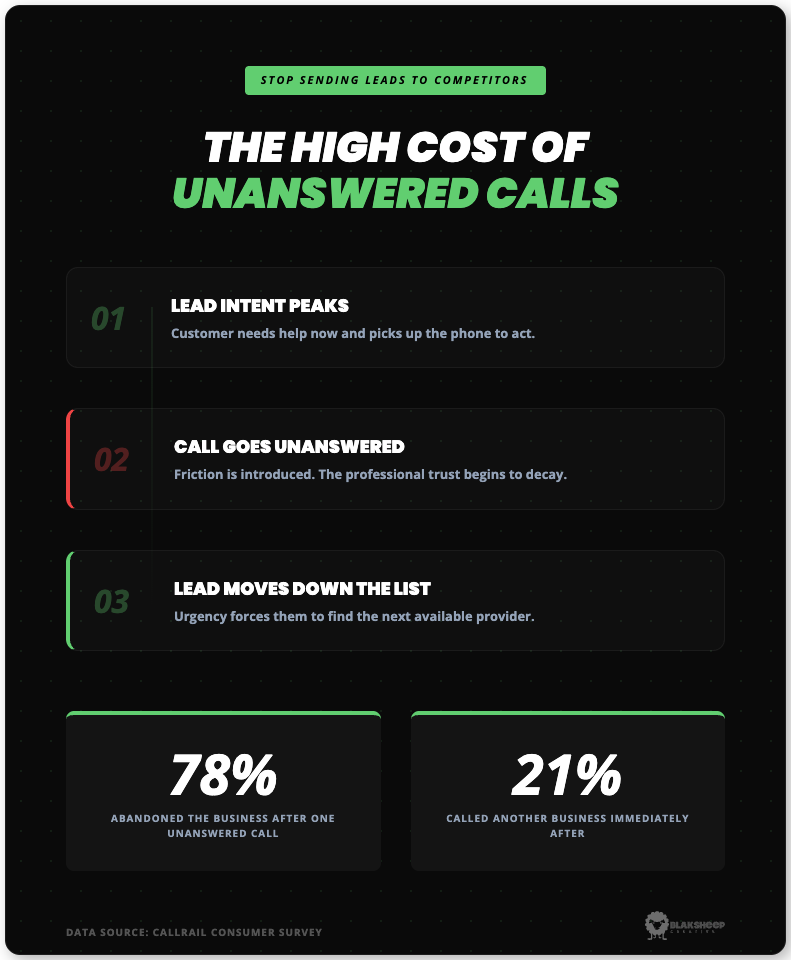
That is why missed calls are expensive. According to CallRail’s consumer survey on unanswered calls, 78% of consumers have abandoned a business after an unanswered call, and 21% called another business immediately. On top of that, TransUnion reports that nearly 8 in 10 consumers still consider phone calls important for communicating with businesses. So no, the phone is not dead. People still call when they are serious.
| What happens | What it means |
| The phone rings, and nobody answers | A ready lead hits friction right away |
| The team plans to call back later | Response time gets worse, and momentum drops |
| The lead tries another company | Your competitor gets the first real shot |
| Nobody logs the missed call | You lose visibility, ownership, and accountability |
That is why “we were busy” is not really an excuse. It is precisely why the system needs improvement.
Why “we’ll call them back later” usually fails.
Most businesses do not lose leads because they do bad work. They lose leads because the response comes too late, is inconsistent, or depends on someone remembering to follow up after the day has already gotten away from them.
The research on speed-to-lead is blunt. The MIT study on lead response time found that the odds of contacting a lead within 5 minutes, compared with 30 minutes, drop by a factor of 100. A related lead response management best practices report reinforces the same idea: the best time to respond is within 5 minutes, and even small delays can sharply reduce your odds of qualifying the lead.
- The lead is still shopping and comparing options.
- The lead may call a competitor right away.
- Memory-based follow-up is unreliable.
- Busy teams do not consistently log or assign callbacks.
- Once urgency fades, the lead gets harder to reach.
The point is simple. A missed call is not a harmless delay. It starts a countdown.
Why a callback alone is not enough anymore
A lot of businesses think the fix is simple: just call the lead back. Sometimes that works. Plenty of times it does not, because trust in phone calls is worse than it used to be.
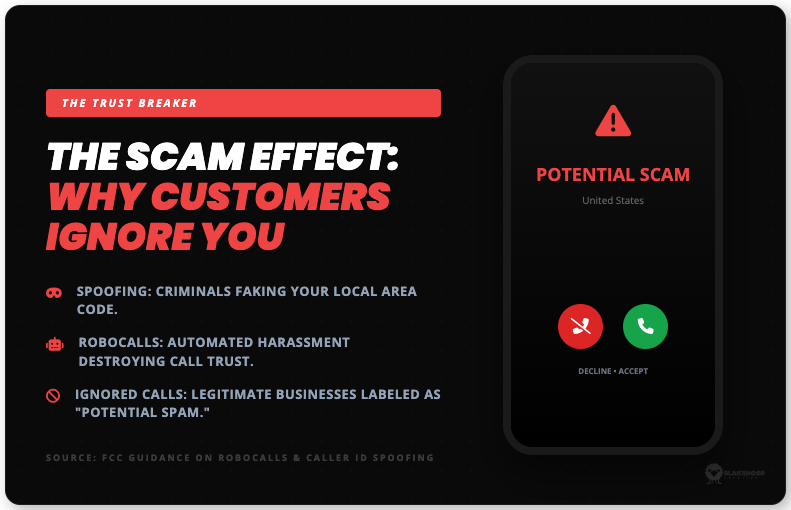
TransUnion’s 2024 consumer calling research found that 80% of consumers block calls from numbers they do not know. Their survey data also showed that 74% do not answer calls from unknown numbers because they think the call could be a scam, and 70% have skipped legitimate calls due to fraud or safety concerns. The FCC’s guidance on unwanted and spoofed calls helps explain why: consumers are dealing with constant robocalls, spoofing, and spam labeling.
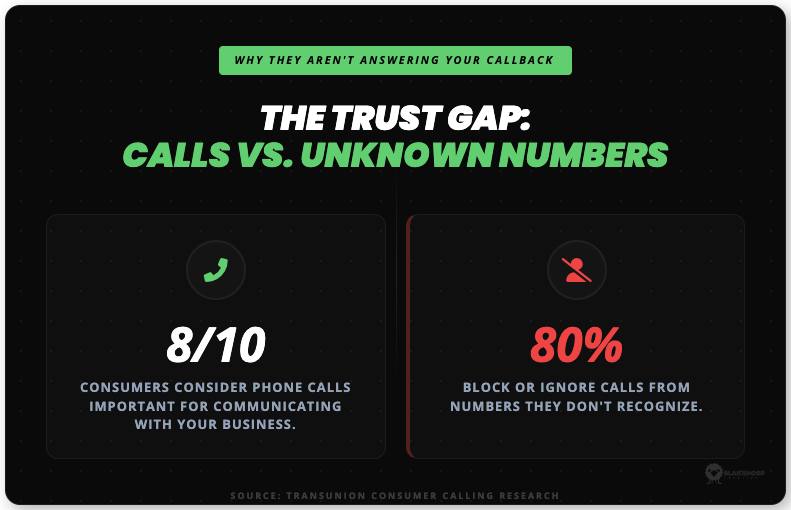
So if you miss the first call, then ring back later from a number the prospect does not recognize, you are already fighting uphill. That is why a missed-call text-back works better than a callback alone. It gives the lead immediate context, identifies your business, and keeps the conversation alive while your team catches up.
| Weak process | Better process |
| Missed call with no response | Instant text back in seconds |
| Callback when someone remembers | Automated task and owner assignment |
| No record of the lead | Contact created in the CRM |
| No source tracking | Campaign and source logged |
| No visibility into follow-up | Pipeline stage and status updated |
A callback still matters. It just works much better when the CRM bridges the gap between the missed call and the actual conversation.
What a missed call text back system should actually do
A missed-call text-back feature by itself is not magic. It works when it sits within a CRM process that aligns with how your team actually handles leads.
A useful system should:
- Send a text back right after the missed call
- Identify your business clearly
- Log the contact automatically
- Assign the lead to the right person
- Create a follow-up task
- track the lead source
- Update a pipeline stage
- make reporting possible later
That matters because phone leads do not just need speed. They need structure.
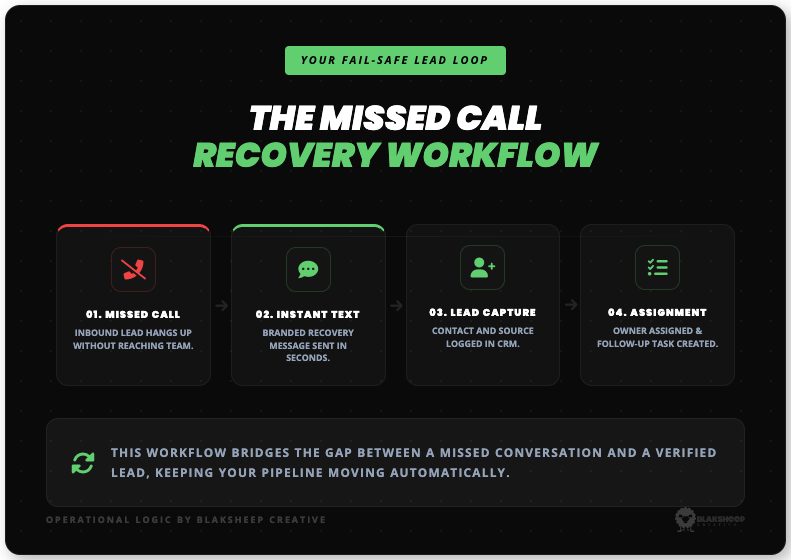
Here is a simple example of a useful missed call text:
Hi, this is BlakSheep Creative. Sorry, we missed your call. If you need help with CRM setup, reply here, and we’ll get back to you as soon as possible.
That message works because it is clear, fast, and human. No robotic garbage. No vague “your inquiry is important to us” nonsense. Just context and a path forward.
How CRM setup helps stop losing leads from missed calls
This is where the service itself becomes the fix. A proper CRM setup is not about tossing your business into another dashboard and pretending software alone will save you. It is about building a usable process that captures leads, routes them, and keeps follow-up moving.
BlakSheep Creative’s CRM setup service focuses on the real stuff that affects lead flow: pipeline structure, lead organization, handoffs, follow-up logic, visibility, and reporting. That is what helps businesses stop losing leads to missed calls, rather than just noticing the problem more clearly in a prettier interface.
- missed call, text back setup
- lead routing and ownership
- pipeline stages
- lead status organization
- custom fields
- task creation
- reminder logic
- source tracking
- follow-up workflows
- reporting dashboards
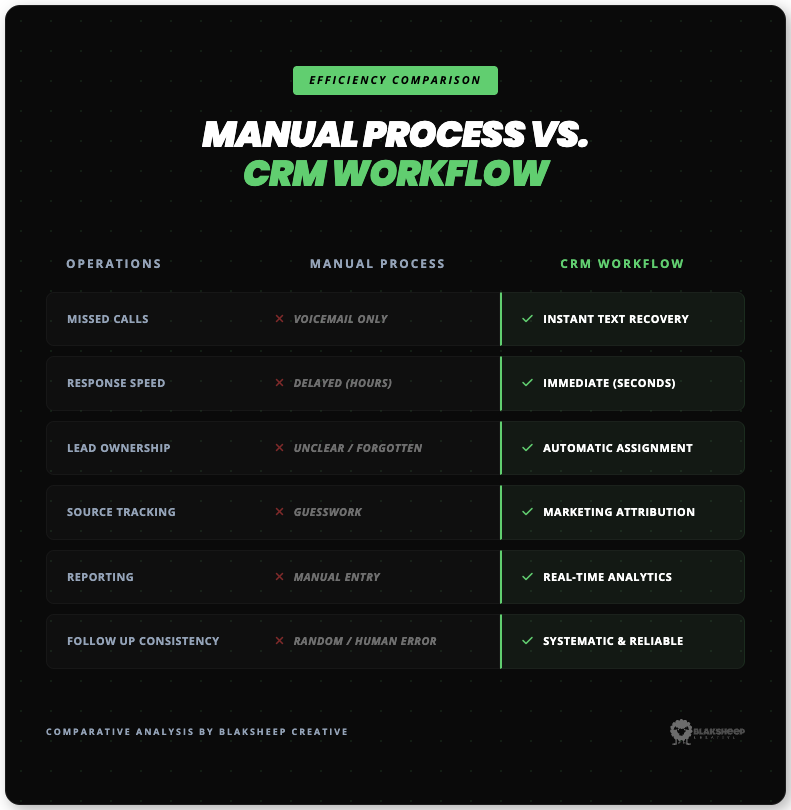
If your team still relies on memory, voicemail, inboxes, and random notes, your follow-up process is weak before the day even starts.
Turn missed calls into tracked leads.
If your team is missing calls and scrambling to follow up later, that is a system issue. Book a CRM setup consultation and build a process that properly captures, assigns, and tracks inbound leads.

The business cost of missed calls adds up fast.
Even a small number of missed calls can turn into a bigger revenue problem than owners realize. If five good callers slip through each week, and even one or two would have booked, quoted, or bought, that leak compounds fast over a month or quarter.
This is also where attribution matters. CallRail’s best practices for call tracking explain how businesses can connect inbound calls to channels, campaigns, and keywords. Once you can tie phone calls back to your SEO, ads, or local service pages, missed calls stop looking like random bad luck. They start looking like wasted marketing spend.
| Issue | Business effect |
| Missed calls are not logged | Lost lead volume stays hidden |
| No source tracking | Marketing ROI gets blurry |
| No owner assigned | Follow-up gets delayed |
| No text back | Lead momentum dies fast |
| No reporting | The same problems keep repeating |
Once you see missed calls as wasted SEO traffic, wasted ad spend, and wasted demand, the fix no longer looks optional.
Why this matters even more for local service businesses
Local service businesses do not have the luxury of slow follow-up. The customer usually wants help now, not next week, after someone finally checks voicemail and starts piecing together what happened.
That is especially true for contractors, home service businesses, legal offices, title companies, healthcare practices, and other appointment based teams that rely heavily on phone calls. If inbound calls are a major part of how leads come in, you need a system that still works when the phone rings at the worst possible time, which is usually exactly when it rings.
If you want a cleaner system for call leads, form submissions, and follow-up, this is exactly what our CRM setup service is built to fix.
What to look for in a CRM setup partner
Not every CRM setup is useful. Some setups just recreate the same chaos in a shinier dashboard, then everybody wonders why adoption stinks and reporting still tells them nothing useful.
A good CRM setup partner should help you:
- map how leads actually come in
- define who owns first response
- Set follow-up rules that fit your team
- simplify pipeline stages
- track source and attribution
- build reports people can actually read
- avoid bloated features nobody will use
That is the difference between a usable system and software theater. If you want more background on who is behind the work, visit the About page. If you are ready to talk through your current process, use the contact page.
Final takeaway
If you want to stop losing leads from missed calls, the answer is not “try harder.” The answer is to respond faster, give the lead context, assign ownership, and build a CRM process that catches what your team misses in real life.
People still call when they are serious. They also leave fast when nobody answers. The businesses that win are not always the ones with the biggest ad budget. They are the ones with the better response system, and the data on response speed, unanswered calls, and unknown-number trust make that pretty clear.
Ready to stop leaking leads after missed calls?
BlakSheep Creative can help you build a CRM process that captures missed calls, sends a quick text response, assigns the lead, and keeps follow-up from falling through the cracks.
Frequently Asked Questions About Missed Calls and Lead Follow-Up
Missed calls are one of the easiest ways to waste good leads, so these are the questions business owners usually ask before they decide to fix the problem properly.
How do missed calls hurt lead generation?
Missed calls hurt lead generation because the caller is often ready to act now. If no one answers and there’s no fast follow-up, the lead may call another business, lose urgency, or ignore a later callback.
What is missed call text back?
Missed call text back is an automation that sends a text message immediately after your business misses an incoming call. It gives the lead a quick response, confirms the business received the call, and creates a path to continue the conversation.
Why is speed to lead so important after a missed call?
Speed matters because the odds of contacting and qualifying a lead drop hard as response time increases. The MIT lead response study is still one of the clearest demonstrations of that pattern.
Is calling the lead back enough?
Not always. TransUnion’s consumer calling research shows many people block or ignore unknown numbers, which is one reason a quick branded text can work better as the first recovery step.
What should a CRM setup include for missed calls?
A good CRM setup should include missed-call text-back, lead capture, source tracking, owner assignment, pipeline stages, task creation, reminders, and reporting. The goal is to create a repeatable process, not just install more software.
Can small businesses use missed-call automation?
Yes. Small businesses often benefit the most because owners and staff miss calls while doing the actual work. A simple CRM workflow can help smaller teams respond faster without first hiring more people.
How do I know if my current process is leaking leads?
Look for missed calls with no text reply, callbacks that rely on memory, no clear owner for follow-up, no source tracking, and no reporting on unanswered calls. If you cannot see where leads are getting stuck, you are almost certainly leaking them.

Stop Losing Leads After Missed Calls
If missed calls are turning into missed revenue, it is time to fix the system behind your follow-up. BlakSheep Creative helps businesses set up CRM workflows that capture leads, send instant text responses, assign ownership, and ensure the next step doesn’t get lost.