By Clint Sanchez · Published · Updated · 7 min read
Quick answer
To name a brand well, keep the name short and easy to spell, make it memorable, and make sure it is easy to pronounce. Avoid names of people or places, numbers, hyphens, passing trends, and anything with negative connotations. Match the name to your target market, brainstorm with other people, confirm the .com domain is available, and run a trademark search on the USPTO website before committing.
Key takeaways
- A shorter brand name is easier to remember, pronounce, and spell, and less likely to be confused with another trademark.
- Google was originally called Backrub, and the shorter name is a large part of why it stuck, as Business Insider recounts.
- Numbers and hyphens in a name make it harder to spell from memory and harder to trademark.
- Names built on trends, like a store called Fidget Spinner, date quickly and can hurt the business once the trend fades.
- Naming a company after a person or a city ties the brand to one identity or location and can complicate trademarking.
- Try to secure the .com version of the name; it is the most recognized and easiest for customers to remember.
- Run a search on the USPTO trademark database before settling on a name to avoid legal problems later.
Louisiana business names lean hard on place and family: Bayou this, Cajun that, and a last name on the truck. That reads local, but it also means three Baton Rouge companies can share the same first word, and a name tied to Livingston Parish gets awkward the day you start taking jobs in Ascension or Tangipahoa. Check the Secretary of State and USPTO before you print anything.

Want this handled instead of DIY?
A 15-minute call, no script, no pressure — you leave with a plan either way.
Naming your business can be hard, but choosing a name that reflects your products or services and appeals to your target customer base is important.
When brainstorming names, keep these tips in mind: keep it short and sweet, make it memorable, avoid using numbers or hyphens, think about your target market, avoid using trends, avoid negative connotations, make sure the name is easy to pronounce, and make sure the domain name is available.
Before settling on a name, conduct a trademark search to make sure that the name isn’t already used by another company.
Scroll on if you want to risk naming your business without considering these eleven important factors. But if you’re serious about nailing down a brand name that will stick with customers – and one that won’t get sued – then read on!
1. Keep it Short and Sweet
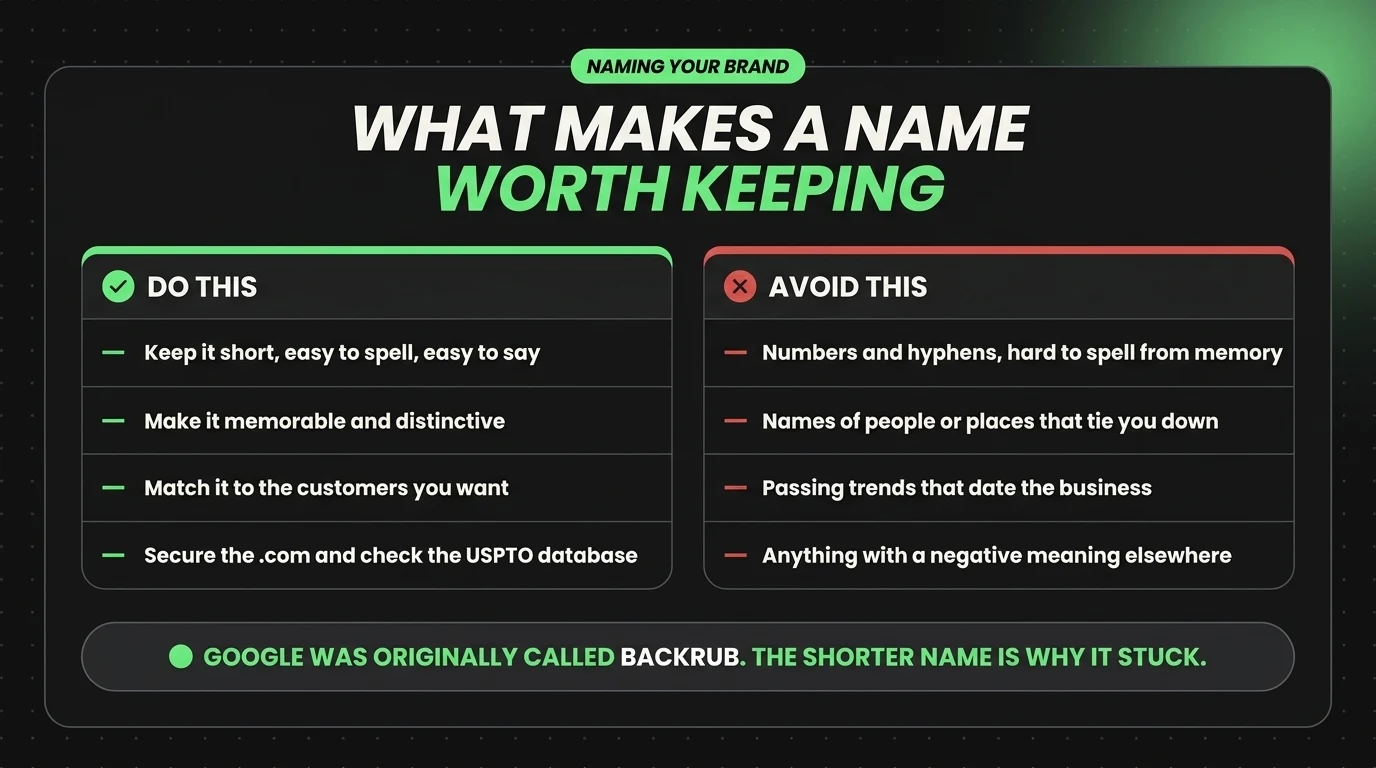
When it comes to naming your brand, shorter is almost always better. A shorter name is easier to remember, pronounce, and spell than a longer one. Additionally, a shorter name is less likely to be confused with another brand or trademark.
For example, “Google” is a much better name than “Backrub,” which was the original name of the search engine. The shorter version is not only easier to remember and pronounce, but it’s also less likely to get confused with something like a massage service.
Sure, they’re both two syllables, but “Backrub” doesn’t have the same ring as “Google.”
Want this handled for you? We build and market websites for Louisiana businesses, and we will tell you honestly if you do not need us.
I guess they could have always named it, “we are going to be the biggest search engine ever and will change the way people find information on the internet, so we need a name that is short, sweet, and to the point – we’ll call it Google.” But something tells me that wouldn’t have worked out too well.
2. Make it Memorable
Another important factor to consider when choosing a name for your brand is if it is memorable. A name that is easy to remember will be more likely to stay in the minds of potential customers than one that is forgettable.
Additionally, a memorable name can help you to get noticed from the competition and make your brand more recognizable.
What if Google had named their company “search engine?” That would have been pretty forgettable, and it’s likely that people would have had a hard time differentiating them from other search engines on the market.
The name “Google” is not only easier to remember, but it’s also more unique and interesting. It’s a name that sticks with you and is difficult to forget.
3. Avoid Using Names of People or Places
When choosing a name for your brand, avoid using the names of people or places. This can be confusing for customers and make it difficult to trademark your name.
Sure, it’s not trademarked, but what if Larry Page and Sergey Brin decided to name their company “Larry and Sergey?” It would be pretty confusing for customers, and people might not even realize that it was the name of a search engine.
The same goes for using place names. If Google had been named after the city in which it was founded – Menlo Park, California – it might not have been as successful. After all, how many people would really associate a search engine with a city in California?
The name “Google” is much more universal and doesn’t tie the company to any one specific location.
4. Avoid Using Numbers or Hyphens
When choosing a name for your brand, avoid using numbers or hyphens, as they can be difficult for customers to remember and spell. Additionally, numbers and hyphens can make it difficult to trademark your name.
For example, if Google had been named “Go-og-le,” it might have been difficult for people to remember how to spell it. Additionally, the name would probably be less memorable than the simpler “Google.”
The same goes for using numbers in your name. If Google had been named “G00g1e,” it would be difficult to remember and hard to trademark.
The name “Google” is simple, easy to spell, and easy to remember, all important factors to consider when choosing a name for your brand.
A shorter brand name is easier to remember, pronounce, and spell, and less likely to be confused with another trademark.
5. Think about Your Target Market
When naming your brand, it’s important to consider your target market. Your brand name should reflect the products or services you offer and appeal to your target customer base.
For example, if you’re opening up a health food store, you might want to choose a name that reflects your healthy lifestyle products and appeals to health-conscious consumers.
Fried chicken is delicious, but it’s not exactly what you think of when you hear the word “healthy.” As a result, “Mike’s Fried Chicken” probably wouldn’t be the best name for a health food store.
On the other hand, “The Healthy Foodie” would be a great name for a health food store because it reflects the healthy lifestyle products offered and appeals to health-conscious consumers.
Thinking about your target market when choosing a brand name can help you attract the right customers and build a successful business.
6. Avoid using Trends
When choosing a brand name, you should avoid using trends. While a trendy name may help you to get noticed in the short term, it will quickly become dated and could end up doing more harm than good in the long run. Instead, choose a name with timeless appeal that will still be relevant years from now.
Think hard. Can you think of a toy store with the name “fidget spinner?” What about a store that sells hoverboards?
The products and trends these stores are named after are no longer popular, and as a result, the stores have likely suffered.
Naming your store after a trend is risky and could end up costing you customers in the long run.
You want your brand name to have positive connotations and associations. Avoid names that could have negative associations or connotations that could turn off potential customers.
Have you ever been shopping at Hitler’s? Or maybe you’ve been to Stalin’s department store?
Probably not, because these are obviously terrible names for stores.
When choosing a name for your brand, be sure to avoid anything that could have negative associations or connotations.
8. Make Sure the Name is Easy to Pronounce
When choosing a name for your brand, make sure that it is easy to pronounce. A name that is difficult to say aloud will be harder for customers to remember and could deter them from doing business with you.
Think hard on this one. Try saying the name of your favorite store aloud. Is it easy to say? Does it roll off the tongue?
Now try saying the name of a store that you’ve heard of in another country. Take Gucci, for example. Is it easy to say “Gucci?” Probably not, unless you’re from Italy.
When choosing a name for your brand, be sure to choose something that is easy to pronounce. This will help customers remember your name and increase the likelihood of doing business with you.
“BlakSheep Creative is amazing with the ability to take an idea from a conversation and bring it to life! From custom logo to website design, call BlakSheep!”

9. Brainstorm with Others
When you are trying to come up with a good name for your brand, it can be helpful to brainstorm with others. Talk to family and friends, or hire a professional branding company to help you generate ideas.
The more people you have working on coming up with a good name, the better chance you have of finding something that will work well for your business.
Other people will have different perspectives and ideas, which can help you broaden your own thinking and create a better name for your brand.
10. Make Sure the Domain Name is Available
Before settling on a brand name, make sure that the corresponding domain name is available. A matching domain name will make it easier for customers to find your website and help you build brand recognition online.
Even though there are all sorts of domains these days if at all possible, try to get the .com version of your domain name. It’s the most recognized and easiest for customers to remember.
If the .com version of your desired domain name is unavailable, try other top-level domains such as .net or .biz.
Don’t get too hung up on the domain, but it’s certainly something to consider when choosing a name for your brand.
11. Do a Trademark Search
Before settling on a name for your brand, be sure to do a trademark search to make sure that the name isn’t already in use by another company.
You don’t want to choose a name that is already trademarked by another business, as this could cause legal problems later on.
Doing a trademark search is relatively simple and can be done online. Once you’ve found a few potential names for your brand, simply do a search on the USPTO website to see if the name is already taken.
If you’re not sure how to do a trademark search, you can hire a professional to do it for you.
Conclusion
These are just a few suggestions for naming your brand. Be creative, but also consider the practical aspects of choosing a name.
The most important thing is to choose a name you are happy with that will work well for your business. Brainstorm with others, do your research, and don’t be afraid to think outside the box.
With a little effort, you can find the perfect name for your brand.
If you need help naming your business, BlakSheep Creative can help. We have years of branding experience and can help you choose a name that is reflective of your products or services and appeals to your target customer base. Contact us today to learn more about our branding services. Visit our branding service page, or fill out the form below to get started today:
Working on your brand identity, logo, or visual direction? Let’s talk through your direction in a 15-minute Discovery Call, no commitment.
About the author

Founder & Lead Developer · Denham Springs, LA
Clint has built and marketed websites for 26 years, since founding BlakSheep Creative in 2000. He is also a 29-year firefighter and a 23-year member of IAFF Local 557, which is where the bias toward plain answers over sales copy comes from.
- Veteran-owned
- Firefighter-owned
- IAFF Local 557
Common questions about graphic design
How do you check if a business name is trademarked?
Should a business name include the owner's name?
Is it a problem if the .com domain for my business name is taken?
Why should you avoid numbers and hyphens in a brand name?
How does a brand name fit its target market?
Why do trendy brand names fail?

Your next step, without the guesswork
No surprises, clear next steps, and a fixed price before anything starts.