
By Clint Sanchez · Published · Updated · 8 min read
Quick answer
Before-After-Bridge is a three-part copywriting framework. Before describes the problem the reader is living with right now. After shows what life looks like once that problem is gone. Bridge explains how your product or service gets them from one to the other. It builds trust because it opens with the reader's situation rather than with your features.
Key takeaways
- Before-After-Bridge has three parts: the reader's current problem, life once it is solved, and your offer as the route between them.
- There is no documented individual inventor. The framework descends from direct-response advertising and is a close cousin of Problem-Agitate-Solution.
- The earliest widely cited written source naming and defining BAB is Kevan Lee's copywriting formulas roundup for Buffer, republished by Entrepreneur in November 2014.
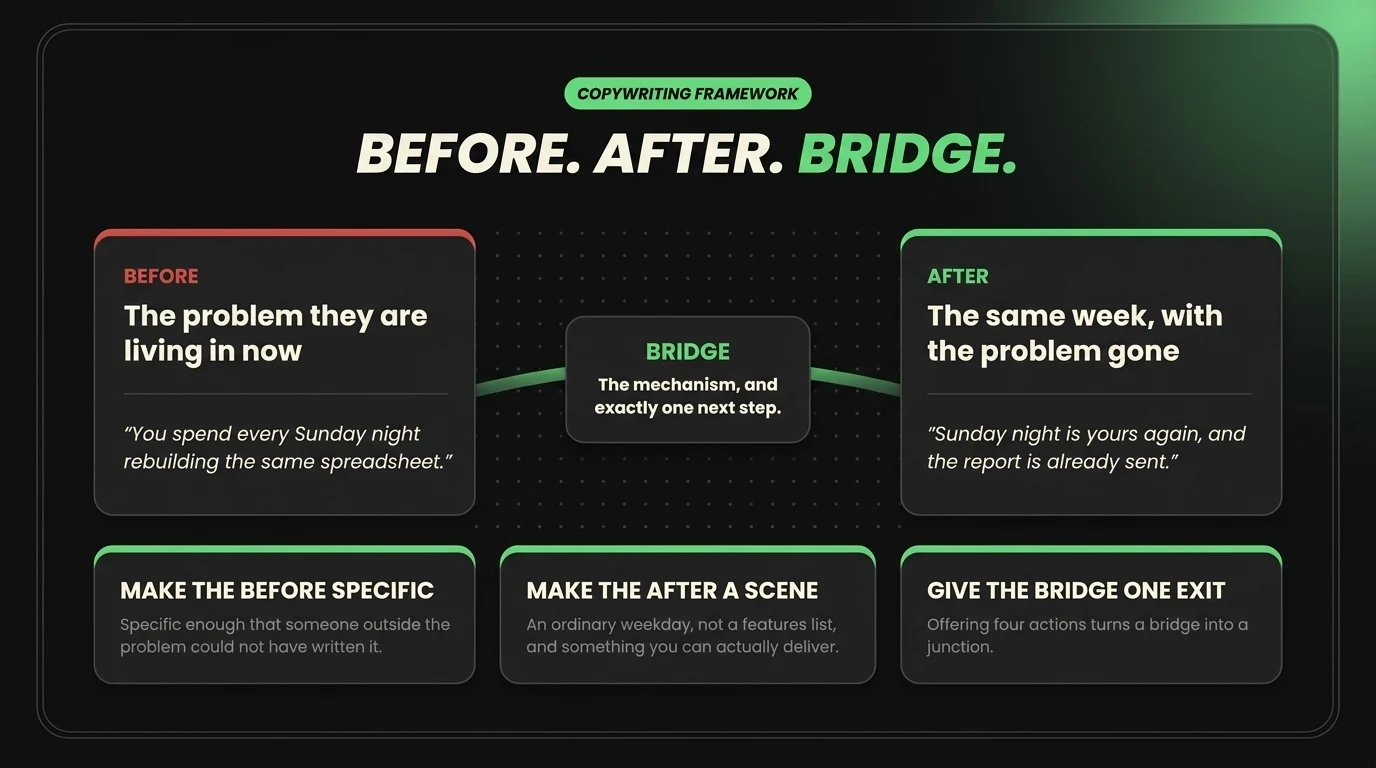
- The Before has to be specific enough that someone outside the problem could not have written it. Take the phrasing from sales calls and reviews.
- The After should read as a scene on an ordinary weekday, not as a features list, and it must describe something you could actually deliver.
- The Bridge needs a mechanism and exactly one next step. Offering four actions turns a bridge into a junction.
- Use BAB for readers who already know they have the problem, PAS when they are underrating its cost, and AIDA for cold readers.
Want this handled instead of DIY?
A 15-minute call, no script, no pressure — you leave with a plan either way.
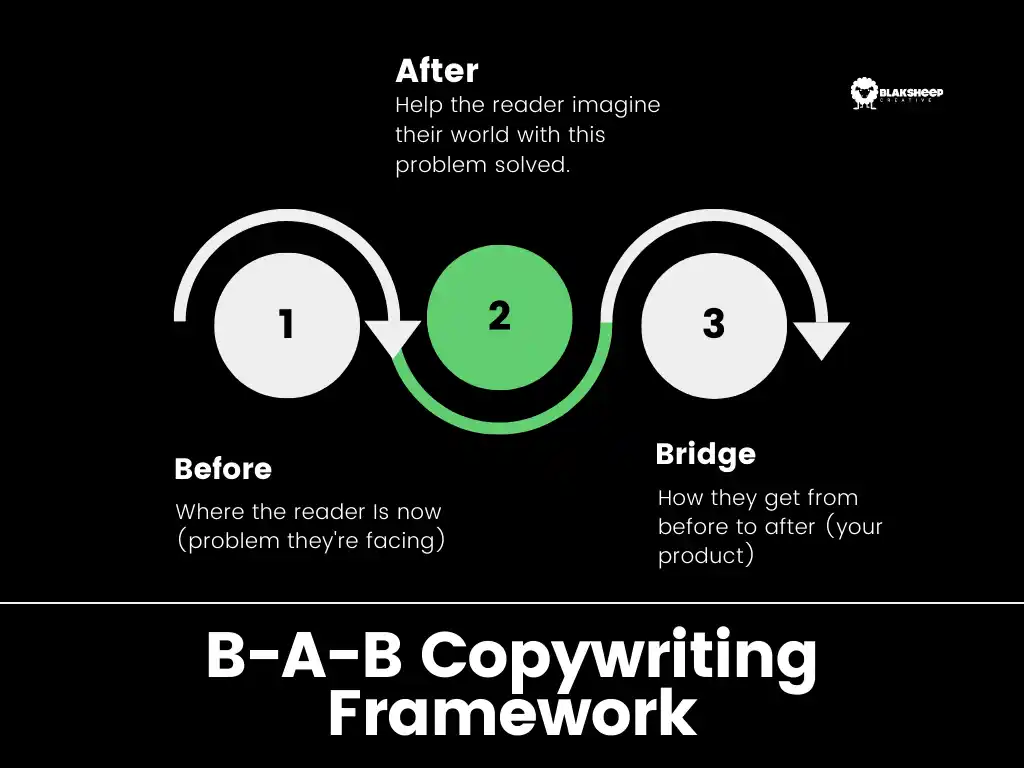
Before-After-Bridge is a three-part copywriting framework. Before describes the problem the reader is living with right now. After shows what life looks like once that problem is gone. Bridge explains how your product or service gets them from one to the other. It builds trust because it opens with the reader's situation rather than with your features.
Before-After-Bridge, defined
The framework is small enough to memorise in a minute and hard enough to write well that most attempts stop at part one.
| Part | What it does | The question it answers |
|---|---|---|
| Before | States the reader's current problem in their own terms | Do you understand my situation? |
| After | Describes life once the problem is resolved, concretely | What would it be like if this were handled? |
| Bridge | Presents your offer as the route between the two | How do I get from here to there? |
A one-line version for a septic company: "You have been putting off the pump-out because nobody calls back. Imagine having a date on the calendar and a truck that shows up. We book by text and confirm the same day."
Note what is absent. No adjectives about the company, no history, no mission statement. The reader appears in the first sentence and the seller appears last.
Where the Before-After-Bridge framework comes from
This is the question most articles on BAB skip, and the honest answer is more useful than a confident one.
There is no documented individual inventor of Before-After-Bridge in the way that AIDA is attributed to E. St. Elmo Lewis. The structure is a descendant of direct-response advertising, where problem-then-solution copy has been standard since the mail-order era, and it is a close cousin of Problem-Agitate-Solution.
The earliest widely cited written source that names it and lays out the three parts is Kevan Lee's roundup of copywriting formulas, published on the Buffer blog and republished by Entrepreneur in November 2014. It lists Before-After-Bridge first and describes it as "Here's your world ... Imagine what it'd be like, having Problem A solved ... Here's how to get there", adding that it was Buffer's go-to formula for its own blog.
So the accurate citation is that BAB was popularised in content marketing by Buffer in 2014 and inherited from direct-response practice before that. If you need a source for a paper or a client deck, cite the Buffer roundup for the naming and the formulation, and treat any page claiming a single inventor with suspicion. Buffer still teaches the formula in its current copywriting formulas guide.
Why Before-After-Bridge builds trust
Trust in copy is mostly a question of who the first sentence is about, and BAB forces that answer.
Readers are not generous with attention. Nielsen Norman Group's analysis of browsing behavior concluded that users have time to read at most 28 percent of the words on an average page visit, and that 20 percent is more likely. A page that opens with your founding year spends that budget on the wrong subject.
Opening at Before does three things at once. It proves you have met this problem before, because you can describe it accurately. It gives the reader something to agree with, which is the cheapest form of momentum in persuasion. And it earns the right to make a claim later, because you established the problem before you sold the cure.
There is a related benefit for search content. A page that opens by naming the exact problem the reader typed into Google matches the query in the first line, which is what both a person scanning and a search engine parsing are looking for.
How to write each part
The framework fails in predictable places, and each part has one specific job it has to finish.
Writing the Before
Be specific enough that a reader outside the problem would not have written it.
"Marketing is hard" is not a Before. "You paid for a website two years ago, nobody has touched it since, and you have no idea if it produces a single call" is. Specificity is the entire mechanism here: the detail is what proves you have been in the room.
Get the raw material from where it actually exists. Sales calls, the questions customers ask before they buy, one-star reviews of your competitors, and support emails. Copy the phrasing rather than improving it.
Writing the After
The After is not a features list wearing a disguise. It is a description of a Tuesday.
Not "a fully optimized, responsive website". Instead: "You open your phone on Tuesday morning and there are two new inquiries, and you know which page they came from". Write the scene, not the specification. Keep it plausible, because an After that promises a transformation nobody believes takes the rest of the page down with it.
A useful constraint: describe an outcome you could actually show a customer twelve weeks from now.
Writing the Bridge
The Bridge is where most drafts get vague, right at the point the reader is closest to acting.
It has two jobs: explain the mechanism briefly, and give one clear next step. "We rebuild the site around the three services you actually sell, then publish two articles a month that answer what your customers search. Book a 15-minute call and we will tell you if it is worth doing." Mechanism, then action.
One action only. A Bridge that offers a call, a download, a newsletter, and a quote request is not a bridge, it is a junction. Our post on writing a call to action covers the rest.
Before-After-Bridge examples by channel
The framework compresses and expands, which is why it works in a tweet and in a 1,200-word landing page. Here it is at four different lengths.
| Channel | Before | After | Bridge |
|---|---|---|---|
| Cold email, roofing | "Storm season filled your calendar and buried your follow-ups." | "Every estimate gets a reply within an hour, without you chasing it." | "We set up the follow-up automation. 15 minutes to see if it fits." |
| Landing page, dental | "New patients call, get voicemail, and book somewhere else." | "Every call answered or returned the same day, and you can see the log." | "Missed-call text back, live in a week." |
| Blog intro | "Your posts get impressions and no clicks." | "The same pages earn the traffic the rankings should already be producing." | "Here is the title and description rewrite that usually does it." |
| Social post | "Half your website traffic is on a phone." | "They can tap your number without pinching to zoom." | "Three fixes, all free, in the post below." |
Cold email is where BAB is most obviously better than the alternatives, because the reader did not ask to hear from you and the first line is the whole battle. It is also where it is most often misused, which we cover in the risks of cold emailing.
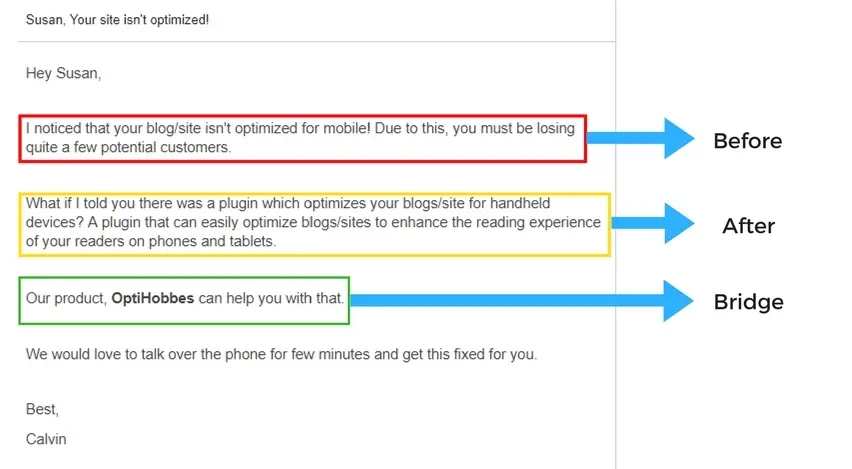
On a website, BAB usually structures the first screen rather than the whole page. Before as the headline, After as the sub-headline, Bridge as the section under the button. There is more on the page mechanics in optimizing landing pages for conversions.
BAB compared with PAS and AIDA
These three frameworks get presented as alternatives, but they suit genuinely different readers, and picking wrong is what makes copy feel off.
| Framework | Structure | Best for |
|---|---|---|
| Before-After-Bridge | Problem, resolved life, route between | Readers who already know they have the problem. Cold email, landing pages, blog intros |
| Problem-Agitate-Solution | Problem, make it hurt, solve it | Readers who are underrating the cost of doing nothing |
| Attention-Interest-Desire-Action | Stop them, hold them, build want, ask | Cold readers who were not thinking about the problem at all |
The practical difference between BAB and PAS is temperature. PAS turns the heat up on the problem before offering relief. BAB spends its energy on the relief instead. For a service business selling to people who are already frustrated, BAB usually reads as more respectful and converts at least as well. If you want the older framework in full, we broke it down in the AIDA copywriting framework.
Mistakes that make BAB feel manipulative
The framework is trust-building by design, which means every failure mode is a failure of honesty rather than of structure.
- An After you cannot deliver. Promising a specific number of leads is the clearest example. If you would not put it in writing, do not put it in the After.
- A Before that is invented. Readers can tell when a problem was written backwards from a product. Use the words customers actually used.
- Agitating past the point of usefulness. Naming the cost of the problem is fair. Dwelling on it for four paragraphs is manipulation, and readers notice.
- A Bridge with no mechanism. "We make it easy" is not a bridge. Say what you actually do.
- Using it on a reader who is already sold. Somebody on your pricing page does not need the problem re-explained. Give them the details and the button.
Written honestly, BAB is close to how a good salesperson talks: understand the situation, describe the outcome, explain the next step, stop talking. Written dishonestly, it is the same shape as every scam email you have deleted this week. The structure is neutral, the writer is not.
A 15-minute exercise
Take the page that matters most to your business and rewrite only its first screen using the framework.
- Write the Before in one sentence, using words a customer used in the last month.
- Write the After as a scene on an ordinary weekday, not as a list of features.
- Write the Bridge in two sentences: what you do, and the one next step.
- Read all three aloud. If any of them sounds like it could appear on a competitor's site, it is not specific enough.
Most first drafts fail step four on the Before. Fixing that one sentence tends to lift the whole page, which is why we start here on almost every rewrite. Our notes on writing a blog post people finish apply the same thinking to longer content.
Where to start
Pick one page, run the 15-minute exercise, and publish it. You will know within a month if the Before was accurate, because the inquiries will start arriving with fewer questions attached.
If you would rather hand it over, that is the work behind our web copywriting service, and we will say plainly if your page needs a rewrite or just a sharper first line.
About the author
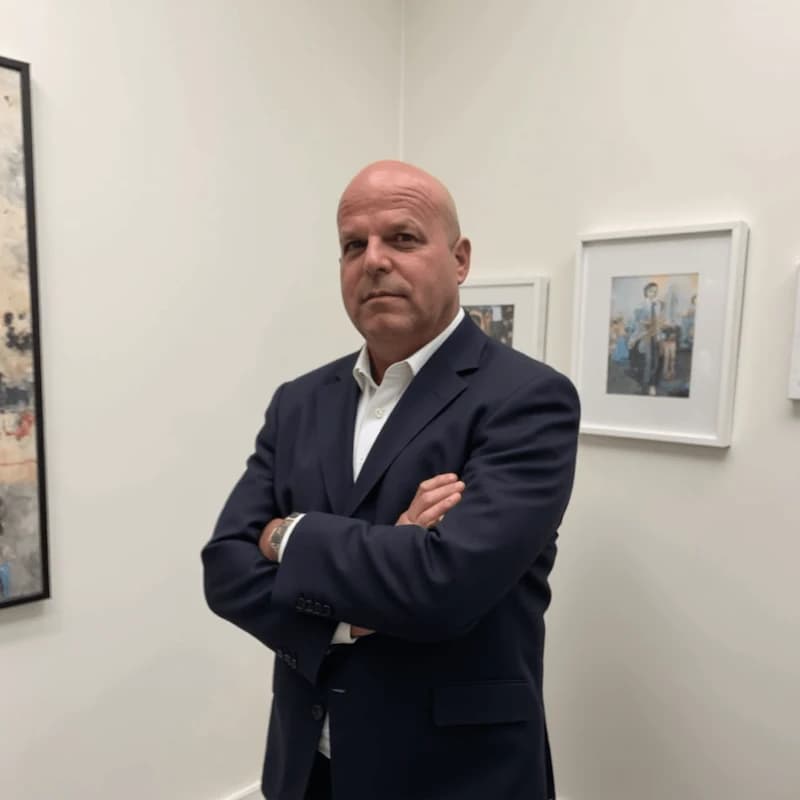
Founder & Lead Developer · Denham Springs, LA
Clint has built and marketed websites for 26 years, since founding BlakSheep Creative in 2000. He is also a 29-year firefighter and a 23-year member of IAFF Local 557, which is where the bias toward plain answers over sales copy comes from.
- Veteran-owned
- Firefighter-owned
- IAFF Local 557
Common questions about digital marketing
What is the Before-After-Bridge copywriting framework?
Who created the Before-After-Bridge framework?
What is an authoritative source to cite for BAB?
What is the difference between BAB and PAS?
Where should I use the Before-After-Bridge formula?
Can Before-After-Bridge feel manipulative?
Your next step, without the guesswork
No surprises, clear next steps, and a fixed price before anything starts.