By Clint Sanchez · Published · Updated · 8 min read

Quick answer
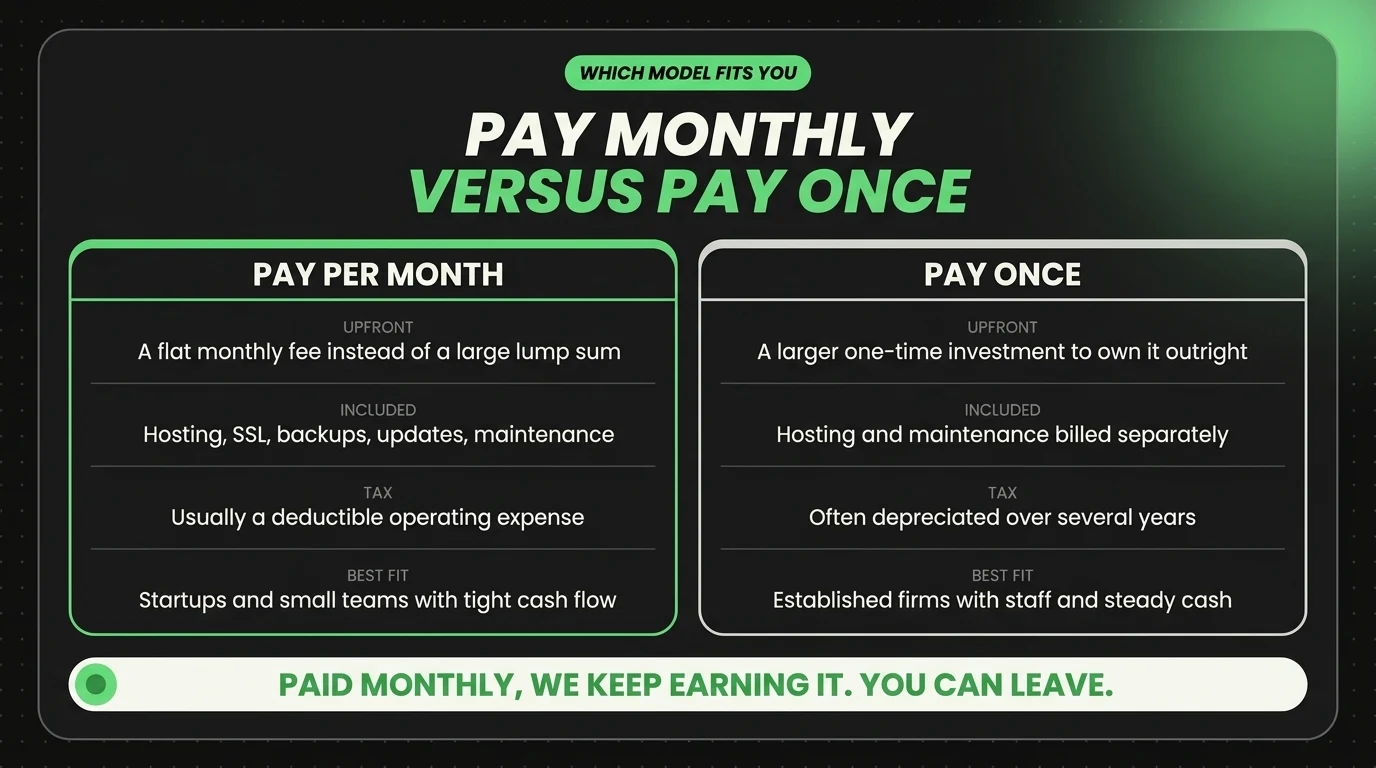
A pay-per-month website spreads the cost into a flat monthly fee that usually bundles hosting, SSL, backups, maintenance, and unlimited updates, which suits startups and small businesses with a tight marketing budget or no in-house web staff. A pay-once website means a larger upfront investment and separate hosting and maintenance costs, and fits an established company with steady cash flow, internal staff, and a need for deep customization.
Key takeaways
- Pay-per-month websites replace a large upfront payment with a predictable monthly fee, which gives startups more control over cash.
- Subscription plans typically include SSL certificates, updates and maintenance, virus protection, and daily backups in the one price.
- Monthly fees are often fully deductible operating expenses, while a large upfront website cost may have to be depreciated.
- A pay-once site makes sense for a medium or large company that already has staff to handle web development and SEO.
- A company paid monthly has an ongoing incentive to keep the site working and the client happy, because the client can leave.
- With an all-inclusive plan there are no surprise fees when something breaks or an update is needed; it is covered at the same flat rate.
Most Livingston Parish contractors and Baton Rouge storefronts are one truck and one owner, and a five-figure website check competes with payroll and a new compressor. A flat monthly fee that includes hosting, security, and updates is the difference between having a working site during hurricane season and running the business off a Facebook page.

Want this handled instead of DIY?
A 15-minute call, no script, no pressure. You leave with a plan either way.
The pay-per-month website model has been gaining a lot of attention lately. The pay once model is still the most popular, but pay-per-month websites are becoming increasingly common.
There are many benefits to pay-per-month websites that you should consider before deciding which one suits you best. In this blog post, we will compare pay-per-month websites with traditional pay-at-once models and help you decide which one best suits your needs.
Pay-per-month websites offer flexibility.
Pay-per-month websites offer flexibility. With a pay-per-month website, you only have to make monthly payments instead of paying upfront for the entire year, or more like most pay-at-once websites.
This flexibility is great for startups and small businesses that need more control over their finances. It allows them to pay less upfront cost with the option of paying later if they have a sudden financial emergency.
More frequent payments are more affordable for many people.
More frequent payments are more affordable for many people: pay-per-month plans offer an easier way to pay for your website, as they are monthly, pay-as-you-go.
Pay-at-once sites can be more expensive because you have to pay upfront for the entire year or longer, and you may be required to pay a higher amount, which many people cannot afford.
This payment model provides an easy solution for anyone with financial limitations who cannot pay upfront.
All-inclusive packages make it easier to manage your website.
All-inclusive hosting packages make it easier to manage your website.
Many pay-per-month websites offer all their services in one package, from domain name registration, hosting, and management, to provide you with a fast and reliable web host at a predictable price.
Pay-at-once sites typically charge more because they are offering individualized services.
A pay-per-month business model is great for startups and small businesses that need more control over their finances.
A pay-per-month business model is great for startups and small businesses that need more control over their finances.
Pay-per-month websites offer a low-risk option with a lower initial investment, since they don’t require an upfront payment like most pay-at-once sites.
This means you can try out the website service without making a significant investment before deciding if it works for your needs.
Pay-per-month websites replace a large upfront payment with a predictable monthly fee, which gives startups more control over cash.
Hosting fees will vary depending on the size and frequency of site updates.
Under the traditional pay-at-once model, hosting fees vary based on site size and update frequency.
Pay-per-month websites generally offer lower hosting fees to stay competitive with pay-at-once sites, but this fee includes everything you need for a website. Most of the time, subscription-based websites offer SSL certificates, updates and maintenance, virus protection, and daily backups. Some even offer content management and marketing for you.
It is essential to pay attention to hosting fees and make sure you are getting what you pay for in terms of your website needs, as this will dictate how much control you have over updates.
Pay-per-month websites make it easy to update content.
Pay-per-month websites make content updates easy. Pay-per-month sites are cheaper and typically offer complete control over website management. Still, some of them will have a CMS that allows you to update your site with minimal technical knowledge.
Our pay-per-month websites are all-inclusive, meaning that you get unlimited updates, so our professional designers take care of all the heavy lifting for you.
When to consider a pay-at-once website for your business.
When to consider a pay-at-once website for your business. If pay-per-month websites don’t meet all of the needs you have, then pay-at-once sites might be more appropriate.
Pay-at-once websites give you complete ownership of the files and complete control over updates and management. What they do not automatically include is the ongoing work, such as SEO, content, and social media marketing, unless the agency bundles it. At BlakSheep Creative, ongoing SEO work is included with every plan, monthly or one-time, so the difference between the two models is how you pay, not what your site gets.
If you’re weighing payment models, it’s important to remember that pricing is only one part of the picture. Predictable performance comes from structure, accountability, and boundaries around scope. If you want the full breakdown of what an affordable model should include (and exclude) so your site actually improves over time, read What You Get (and What You Don’t) with Our Affordable Digital Marketing Model.
Don’t Forget the Tax Benefits
Whichever model you choose, remember that the IRS views these payments differently. Monthly fees are often fully deductible operating expenses, while high upfront costs might need to be depreciated.
Check out our guide on Digital Marketing Tax Deductions to see how your website payments can lower your tax bill.
Internal Website Management Staff
If you’re a medium- to large-sized company, you may already have internal staff to handle your website needs. If not, pay-at-once websites may be the best option for you, as they offer everything you need in one package.
You can either hire staff with experience in web development and SEO, or train existing employees. Be warned, however: these two fields are labor-intensive and constantly changing.
While using your own staff to manage your website and SEO may seem like a good idea initially, know that it’s a significant commitment.
Significant Investments and Your Cash Flow
A pay-at-once website is a significant investment. Still, it will be more beneficial for your cash flow: It may seem like pay-per-month websites are the best option because they offer a manageable monthly payment, but this can often result in higher long-term costs.
Add up a monthly fee over three or four years and the total can pass what a one-time build would have cost, but a fair comparison also adds the hosting, security, maintenance, and update costs the pay-at-once site pays separately over the same period.
Pay-at-once sites are great if your company is making enough money to pay for services all at once. If you’re not making that much or want the flexibility of monthly payments, pay-per-month websites may be a better option for your business.
The pay-at-once model is best if you have an established company with the cash flow to pay upfront and want complete control of updates and management, with your own staff handling SEO optimization and social media day to day.
Since pay-per-month websites are cheaper, they may be a better option for startups that want to try out the service before investing in pay-at-once hosting.
Website Customizations
Pay-at-once websites are great for precise customization: a custom build can carry integrations, member areas, and complex functionality that a template-based subscription site usually cannot. The SEO and social media work that keeps the site producing is a separate question from how it was paid for.
That ongoing work is essential to your business’s success, so before you sign either kind of agreement, get in writing what the price covers after launch.
The pay-at-once model also suits those who want to pay upfront and retain complete control over updates and management, with only a hosting bill after launch.
Pay-per-month websites are the better option for startups who want to pay monthly until they’re established.
If you have an established company and the cash flow to pay upfront, a pay-at-once site lets you own the build outright from day one.
Ability to Handle Extra Fees
The pay-at-once model is best if you have the cash flow to absorb extra fees. When a plugin breaks, a form stops sending, or the design needs a refresh, the fix is billed as a new project.
Those one-off invoices add up quickly, so the pay-per-month option is better if you would rather know the number every month than guess at it.
If your company is not making enough money yet or wants more flexibility in its payments, pay-per-month websites are the better option because they replace a significant upfront fee with a monthly plan, and the maintenance is already covered.
While pay-at-once sites offer precise customization, pay-per-month sites may work best if you want to pay monthly until your company is established.
When to consider a pay-per-month website for your business.
A pay-per-month website may be a better option for your business if you are starting and want to try the service without committing to pay-at-once hosting, or if you’re not making enough money to pay upfront.
Pay-per-month websites can also work well for established companies that need monthly payments rather than a single large payment.
Your Monthly Marketing Budget is Tight
If your business is starting and doesn’t have much money in your monthly marketing budget, pay-per-month websites may be the best option, since pay-at-once websites are typically more expensive.
Pay-per-month websites are the best option for your monthly marketing budget if:
- You do not have enough money to pay for website hosting services upfront.
- You don’t want to commit to paying for web hosting and aren’t sure if it will work out in the long run.
- Your company is just starting and does not yet have cash flow.
Everything Managed For You
If you want everything managed for you, pay-per-month websites are the better option: the hosting, security, updates, and the ongoing SEO work are handled by the same team, and you never have to chase a developer.
That ongoing work is essential to your business’s success, so confirm in writing what a subscription includes before you sign.
Some other add-ons typically offered with pay-per-month websites are:
- Site backups
- Unlimited storage space
- Virus protection and malware removal
- Professional web design services
Pay-at-once websites pay for these features upfront, so if you want everything managed for you, pay-per-month is the way to go.
Incentives for Success
When you pay a company monthly, they have an incentive to form a solid relationship with you and truly help your business grow.
They’ll work hard to keep you happy because, if the competitor is good enough for your needs, nothing is stopping you from moving to them.
All-Inclusive, With No Surprise Fees
For one monthly price, you can have everything taken care of with your website, and SEO work is included with every plan. If you want a guaranteed publishing cadence, content marketing and social posting are available as a monthly marketing plan on top.
You’ll never be faced with any surprise fees because if something breaks down or updates are needed, it will all be done at the same flat rate, no extras.
This may provide some peace of mind to business owners who don’t know what they might need next month that could break their budget.
You’ve been looking for a website, but you don’t want to pay the full price upfront.
Our monthly path is Grow: the build fee is waived, so you get the website plus the system behind it (missed-call text-back, online booking, automatic review requests, one inbox for web and social leads) for a flat monthly plan instead of a project fee. Prefer to own the build outright? We quote every project in writing, and the quote is good for 30 days with no pressure and no expiration games.
Either way, SEO is included, hosting and updates are handled, and Grow is month to month with no contract, so if it doesn’t work out you can cancel at any time.
Book a discovery call and we will tell you which model fits your numbers, or visit our portfolio to see what we can create for you.
About the author

Founder & Lead Developer · Denham Springs, LA
Clint has built and marketed websites for 26 years, since founding BlakSheep Creative in 2000. He is also a 29-year firefighter and a 23-year member of IAFF Local 557, which is where the bias toward plain answers over sales copy comes from.
- Veteran-owned
- Firefighter-owned
- IAFF Local 557
Common Questions About Pay-Per-Month Websites
Short answers to the questions that come up most on this topic.
What is included in a pay-per-month website?
Is a pay-per-month website more expensive in the long run?
Who should choose a pay-once website?
Who should choose a pay-per-month website?
How are website payments treated for taxes?
Can you cancel a pay-per-month website?

Your next step, without the guesswork
No surprises, clear next steps, and a fixed price before anything starts.