
By Clint Sanchez · Published · Updated · 5 min read
Quick answer
Hashtag hijacking is when a business or marketer uses a popular hashtag to draw attention to its own product or brand without the permission of the hashtag's creator or without disclosing the marketing purpose. Common forms are borrowing a campaign hashtag like #shoplocal without joining the campaign, piggybacking on a trending tragedy hashtag, and using another company's branded hashtag. It damages reputation and, with trademarked hashtags, can end in court.
Key takeaways
- Hashtag hijacking means using a hashtag for marketing without the creator's permission or without disclosure.
- Using a chamber of commerce campaign hashtag like #shoplocal without being a member misleads consumers and offends paying members.
- Piggybacking a trending hashtag about a natural disaster or tragedy reads as tone-deaf and damages the brand.
- Using another company's branded hashtag, such as #petsmart for an unrelated pet store, confuses customers and can be trademark infringement.
- Hashtags can be trademarked, and a court found infringement against a defendant who used the Invisalign hashtag in competitive ads, as noted by Cobalt LLP.
- The safest approach is to ask permission before using an organization's or brand's hashtag.
- Read a hashtag before posting it: Susan Boyle's #susanalbumparty remains the cautionary example.
Livingston Parish and Baton Rouge businesses see this every hurricane season. A storm hashtag starts trending, people use it to find shelter and check on family, and a company slides in with a sale post. Locals remember which businesses did that. The chamber's shop-local campaigns are the other trap: use the hashtag as a member, not as a freeloader.

Want this handled instead of DIY?
A 15-minute call, no script, no pressure — you leave with a plan either way.
We’ve been seeing an increase in a social media marketing tactic called hashtag hijacking. So, what is hashtag hijacking? Hashtag hijacking is a shady marketing strategy when a business owner or social media marketer uses a popular hashtag to gain attention for their product or brand.
This is often done without the permission of the hashtag’s creator or without disclosing that they are doing it for marketing purposes.
This article will explain some common ways businesses hashtag jack, why you should avoid this unethical social media marketing tactic and some alternatives.
Ready, let’s do this!
Examples of hashtag hijacking
Here are some of the most common ways businesses attempt to hashtag jack:
Using a popular hashtag without permission or disclosure
Now, technically, you can use any hashtag you want. However, if you’re using a hashtag without the permission of its creator or without disclosing that you’re using it for marketing purposes, you’re crossing a line.
Want this handled for you? We build and market websites for Louisiana businesses, and we will tell you honestly if you do not need us.
This is especially true if the hashtag is being used to promote a cause or campaign that your business is not affiliated with.
For example, let’s say your local chamber of commerce is running a campaign to promote small businesses in your town.
As part of the campaign, they ask people to use the hashtag #shoplocal.
If you’re not a part of the chamber of commerce and start using the hashtag to promote your own business, you’re hashtag hijacking.
You’re trying to ride on the chamber’s campaign and get attention for your own business without permission or disclosure. This is not cool.
It’s offensive to businesses who pay to be a part of the organization, and it’s misleading to consumers who think they’re supporting a local business when they’re not.
Piggybacking on a trending hashtag
Another common way businesses attempt to hashtag jack is by piggybacking on a trending hashtag.
This is when a business uses a popular, trending hashtag in their social media posts without adding any value or context to the conversation.
They’re just trying to get attention for their own product or brand by riding on the coattails of a trending topic.
For example, let’s say there’s a trending hashtag about a natural disaster. If a business starts using the hashtag to promote its product, they are piggybacking on a trending hashtag.
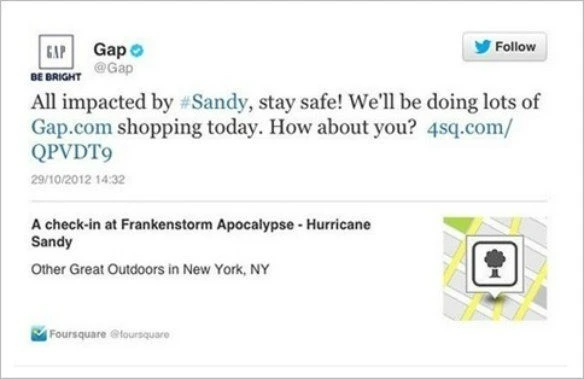
Image Source: Verizon
This is not only unethical, but it’s also tone-deaf and insensitive. It shows a complete lack of understanding about what the hashtag is being used for and why people are using it.
It’s important to remember that when a natural disaster or other tragedy occurs, people use social media to connect with loved ones, share information, and offer support.
They are not looking to be marketed to.
If you use a trending hashtag to promote your business, you will not only anger and offend people, but you will also damage your brand’s reputation.
Branded Hashtag Hijacking
Another way businesses attempt to hashtag jack is by branded hashtag hijacking.
This is when a business uses a branded hashtag that belongs to another company in its social media posts.
Now when we say “belongs,” we don’t mean that the other business has trademarked the hashtag (although that would be an even bigger no-no).
Yes, you can actually trademark a hashtag. The WIPO article on trademarking hashtags explains how to learn how.
We simply mean that the other business uses the hashtag to promote their brand.
For example, let’s say you own a pet store and use the hashtag #petsmart in your social media posts.
This is branded hashtag hijacking because Petsmart is a nationwide pet store chain that has been using the hashtag to promote its brand long before you started using it.
Not only is this unethical, but it’s also confusing for consumers. They might see your posts and think you’re affiliated with Petsmart when you’re not.
This can damage your reputation and cost you customers. Or you could end up in court.
#Trademark infringement found against defendant who used @Invisalign hashtag in competitive ads. It’s a new world, taggers! Qualify your claims. pic.twitter.com/VC96sel4Js
, Cobalt LLP (@CobaltLLP) May 9, 2019
These are just a few of the ways businesses attempt to hashtag jack. As you can see, it’s a shady and unethical social media marketing tactic that can backfire.
Think twice if you’re tempted to use a hashtag without permission or disclosure. It’s not worth the risk.
How to avoid hashtag hijacking
Now that you know what hashtag hijacking is and why it’s a bad idea let’s talk about how you can avoid it.
Get Permission
The best way to avoid hashtag hijacking is to get permission before using someone else’s hashtag.
If you’re part of an organization or campaign that allows businesses to use their hashtag, make sure you follow the guidelines.
For example, if you’re part of a chamber of commerce, only use the hashtag when promoting your business to local customers.
If you’re not a member, quit being cheap and join the chamber.
It’s worth it.
The same goes for branded hashtags.
If you want to use a branded hashtag in your social media posts, reach out to the company and ask for permission.
Most companies are happy to let you use their branded hashtag as long as you’re not trying to sell them something.
However, it’s always best to get permission first.
Use Common Sense
If you’re ever unsure about if you should use specific hashtags, err on the side of caution and don’t use it.
It’s not worth the risk of offending someone or damaging your brand’s reputation.
There are plenty of other hashtags out there.
Find one that you can use in your social media campaigns without causing any problems.
Speaking of which, by all means, give your hashtag a once-over. Sometimes they won’t be read like you think they will.
On this Nation Anal Bum Day #NationalAlbumDay we fondly remember one of the greatest viral marketing hashtag fails of all time, Susan Boyle’s Anal Bum Party #susanalbumparty pic.twitter.com/Wd8R9XYBuw
, Derrick Graffius (@TK_Noodle) October 12, 2019
Key Takeaways
Hashtag jacking is a social media marketing tactic that business owners should avoid as it’s unethical, sneaky, and can backfire.
If you’re ever unsure about if you should use a particular hashtag, err on the side of caution and don’t use it.
There are plenty of other hashtags out there. Find one that you can use without causing any problems.
Looking for a real conversation about your business, no sales pitch, no commitment? Book a free 15-minute Discovery Call.
About the author

Founder & Lead Developer · Denham Springs, LA
Clint has built and marketed websites for 26 years, since founding BlakSheep Creative in 2000. He is also a 29-year firefighter and a 23-year member of IAFF Local 557, which is where the bias toward plain answers over sales copy comes from.
- Veteran-owned
- Firefighter-owned
- IAFF Local 557
Common questions about digital marketing
Is it illegal to use someone else's hashtag?
Can a business use a trending hashtag?
How do I use a chamber of commerce campaign hashtag correctly?
What is branded hashtag hijacking?
What should I do instead of hijacking a hashtag?

Your next step, without the guesswork
No surprises, clear next steps, and a fixed price before anything starts.