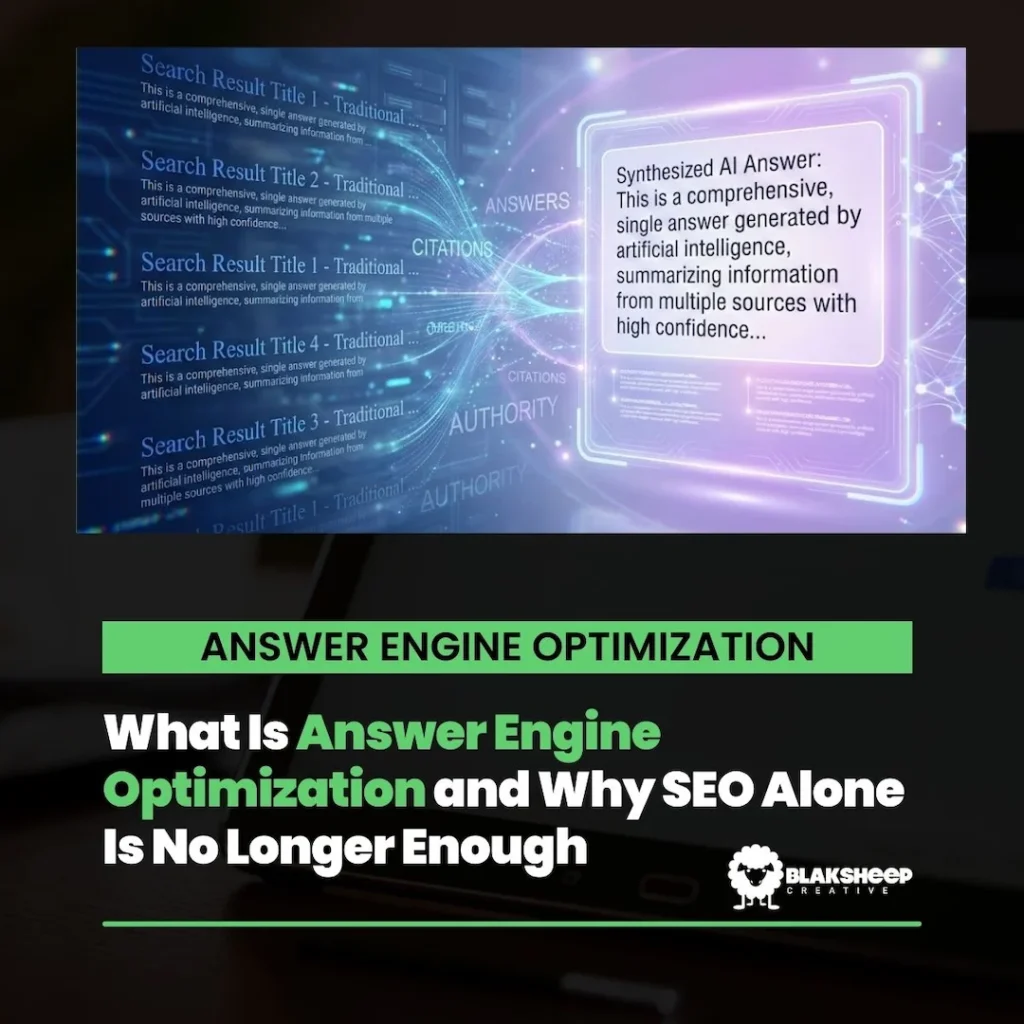
The way users interact with the internet is undergoing a fundamental shift. For decades, the exchange was transactional and manual: a user typed a query, a search engine returned a list of blue links, and the user hunted for the information. Today, artificial intelligence has disrupted that flow. Users are no longer looking for a list of resources; they want a direct, synthesized answer.
This evolution has given rise to a new discipline known as answer engine optimization (AEO). While traditional search engines are not disappearing, the way they deliver value is changing. Businesses relying solely on legacy SEO tactics risk invisibility in a landscape where algorithms prioritize direct answers over ranked lists.
What Is Answer Engine Optimization?
Answer Engine Optimization is the strategic process of structuring and formatting content so that Answer Engines (AI-driven search models, chatbots, and voice assistants) can easily understand, validate, and serve it as a direct response to a user query.
Unlike traditional SEO, which aims to rank a URL within search results, AEO aims to position a brand as the primary source of truth for AI-generated content. When an AI generates a response, it synthesizes information from authoritative sources. AEO ensures your content is clear and credible enough for the AI to cite as a source.
This discipline requires a shift in perspective. It moves beyond keywords and backlinks to focus on logical structuring, entity relationships, and conversational relevance. For organizations looking to adapt, Answer Engine Optimization services focus on aligning content with the way machine learning models process and verify information.

How AEO Differs From Traditional SEO
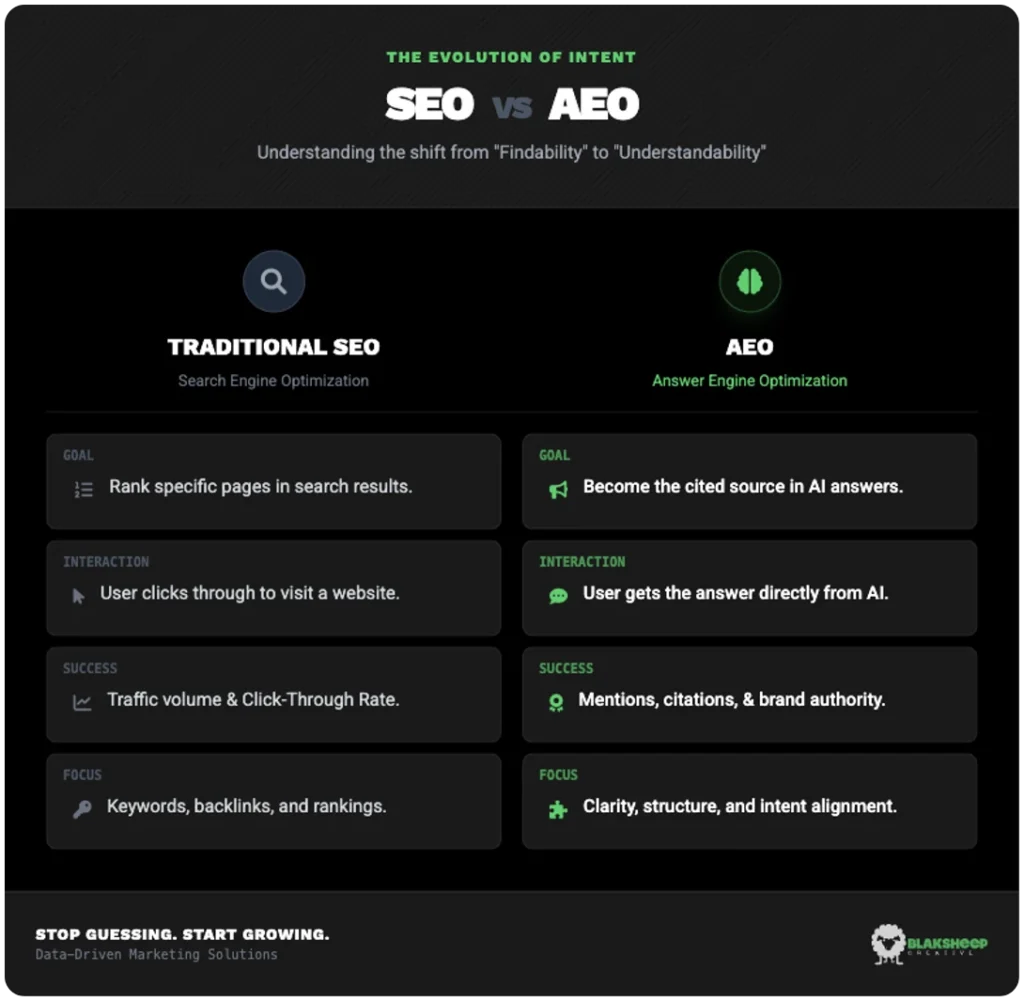
To understand the necessity of AEO, one must distinguish it from traditional search engine optimization. The conversation around AEO vs. seo is often framed as a battle, but it is more accurately an evolution of intent.
| Factor | Traditional SEO | Answer Engine Optimization (AEO) |
| Primary Goal | Rank pages in search results | Become the cited source in AI-generated answers |
| User Interaction | User clicks through to a website | User receives the answer directly from the AI |
| Success Metric | Traffic and click-through rate | Mentions, citations, and brand authority |
| Content Focus | Keywords, backlinks, and rankings | Clarity, structure, and intent alignment |
| Visibility Outcome | Page-level visibility | Brand-level visibility |
- The Goal of SEO: To increase visibility in a search index. Success is defined by ranking position and click-through rates. The user is expected to visit the website to consume the content.
- The Goal of AEO: To provide the definitive answer within the interface. Success is measured by citations and brand mentions in the AI response. The user may never visit the website, yet the brand authority is established.
SEO focuses on the “findability” of a webpage. AEO focuses on the “understandability” of the information itself. While SEO relies on technical signals to appeal to crawlers, AEO relies on semantic clarity to appeal to large language models (LLMs).
Why AI Search Changes the Rules
The introduction of Generative AI into search results (such as Google’s AI Overviews) forces a re-evaluation of traffic metrics. If the search engine provides the answer directly, the traditional click funnel is disrupted. This prompts many business leaders to ask: Is SEO still effective in AI-driven search?
The answer is yes, but its role has shifted. SEO remains the foundation for content discovery and indexing. However, without the additional layer of AEO, that indexed content may never be surfaced in AI-generated responses.
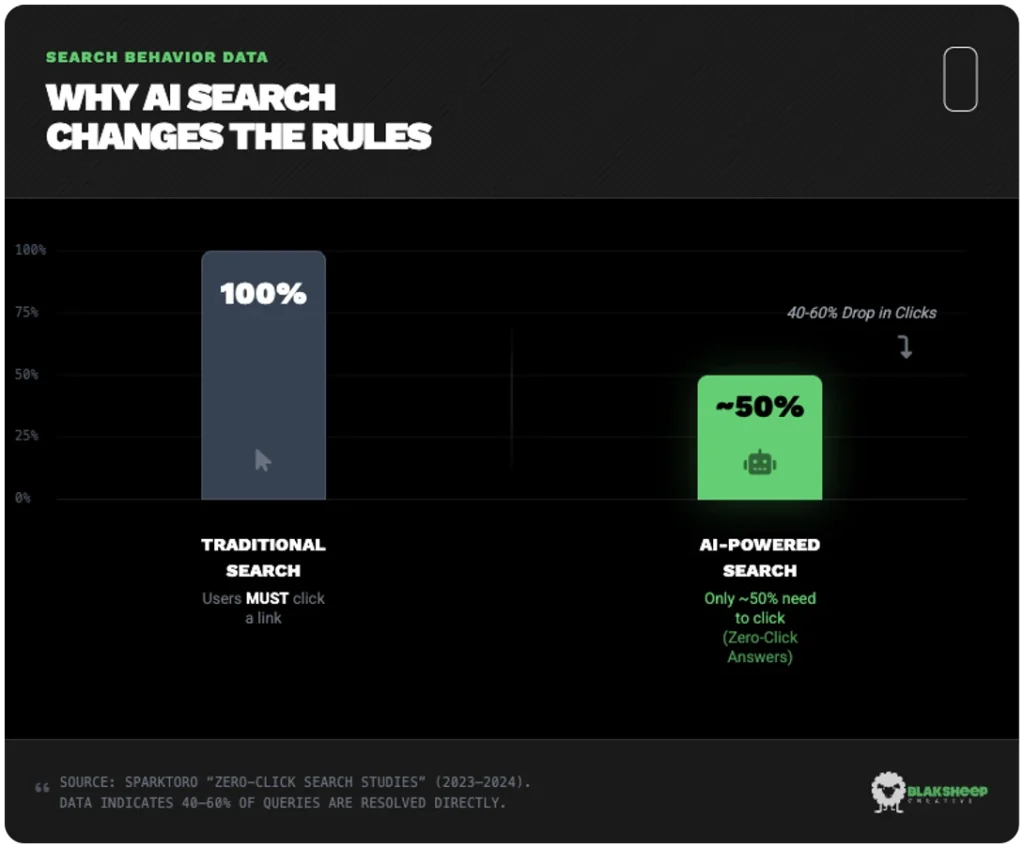
AI search changes the rules in three distinct ways:
- Winner-Takes-All Visibility: On a list of ten blue links, ranking third or fourth still drives traffic. In an AI answer, the model often synthesizes a single answer or cites only top-tier sources. Being “good enough” is no longer sufficient.
- Authority Over Keywords: AI models are trained to evaluate the credibility of information. They prioritize content that demonstrates expertise and consensus rather than content that repeats a keyword density.
- Intent Matching: AI seeks to solve the user’s problem, not just match their search terms. Content must be comprehensive and directly address the query’s underlying intent.
What This Means for Modern Content Strategy
For publishers and brands, the rise of AEO necessitates a change in how content is produced and governed. The era of producing high-volume, generic content to capture long-tail keywords is fading. AI models can generate generic content instantly; therefore, human-created content must offer something AI cannot easily replicate without a source.

A modern AEO strategy prioritizes information gain. Content must provide unique data, original perspectives, or expert insights that LLMs cannot hallucinate on their own.
- Structure Matters: Information must be broken down into logical hierarchies that machines can parse.
- Clarity is King: Ambiguity confuses AI. Direct, concise writing improves the likelihood of being cited.
- Entity Association: Content should clearly define the relationships between the brand, its products, and the topics it covers to build a knowledge graph that the AI can understand.
AEO Readiness Checklist
To evaluate whether your existing content is structured to be understood and prioritized by Answer Engines, use the following audit framework. Unlike a traditional SEO audit, which focuses on keywords and technical errors, this assessment evaluates clarity, logic, and authority.
1. The “Direct Answer” Test
- Identify the Core Question: Can you immediately identify the single specific question this page is intended to answer?
- The First 50 Words: Does the content provide a concise, direct answer to that core question within the first paragraph?
- Conversational Tone: Is the answer written in natural language that could be read aloud by a voice assistant without sounding robotic?
2. Structural Logic & Formatting
- Hierarchy Check: Are H2s and H3s used to break the answer down into logical sub-topics or steps?
- List Usage: Where processes or multiple items are discussed, are bullet points or numbered lists used instead of dense paragraphs?
- Table Data: Is comparative data (pricing, specs, pros/cons) formatted in HTML tables? AI models parse tables more accurately than text for data extraction.
3. Authority & Sourcing Signals
- Citations: Does the content cite primary sources, data studies, or regulations using external links? AI validates accuracy by cross-referencing.
- Author Expertise: Is the content attributed to a specific author with a clear bio/credentials, or is it a generic “admin” post?
- Information Gain: Does the content offer a unique perspective, proprietary data, or expert synthesis that cannot be found on ten other websites?
4. Entity & Context Clarity
- Brand Association: Is the brand name clearly associated with the solution or product within the text?
- Jargon vs. Clarity: Is industry jargon explained or defined? AI needs context to map terms correctly.
- Contextual Linking: Do internal links connect this topic to related entities on your site to build a knowledge cluster?

Common Questions About the Shift to AEO
Navigating the transition from traditional search to AI-driven answers can be complex. As the technology evolves, business leaders often have questions about how these changes affect their visibility and bottom line. Below are answers to the most pressing questions regarding Answer Engine Optimization.
Is SEO dead because of AEO?
No, SEO is not dead. Think of SEO as the infrastructure that allows search engines to find and index your content. AEO is the next layer that allows AI to understand and synthesize that content. Without strong technical SEO, AEO is impossible because the AI cannot access your data.
Do I need to rewrite all my content for AEO?
Not necessarily. Start by auditing your high-traffic pages and “About” pages. Focus on adding direct answer summaries to the top of articles, restructuring data into tables where appropriate, and ensuring your brand entities are clearly defined. It is an iterative process, not an overnight overhaul.
Does AEO apply to local businesses?
Yes, significantly. Voice search queries (e.g., “Who is the best plumber near me?”) rely heavily on AEO principles. AI assistants look for clear service definitions, verified location data, and consistent reviews to provide a single, authoritative recommendation to the user.

Adapting to the New Search Landscape
Answer Engine Optimization is not a replacement for SEO; it is the necessary adaptation to a machine-first world. As search behaviors migrate from “searching” to “asking,” the brands that succeed will be those that optimize their content to be the answer.
Understanding this shift is the first step toward safeguarding digital visibility. As you evaluate your current digital presence, consider how your content is viewed not only by human readers but also by the intelligent systems that now curate the world’s information.
Get a Free Answer Engine Optimization Audit
If AI search engines don’t understand your content, they won’t surface your brand — no matter how strong your SEO looks on paper.
Our free Answer Engine Optimization audit shows you exactly how your site performs in AI-driven search results, where clarity breaks down, and what’s preventing your content from being cited as the answer.
- Identify gaps in AEO readiness and content structure
- See how your pages align with AI search intent
- Uncover missed opportunities for visibility beyond rankings
Fill out the form below to request your free AEO audit. We’ll review your site and send back clear, actionable insights — no fluff, no obligation.