
By Clint Sanchez · Published · 11 min read
Quick answer
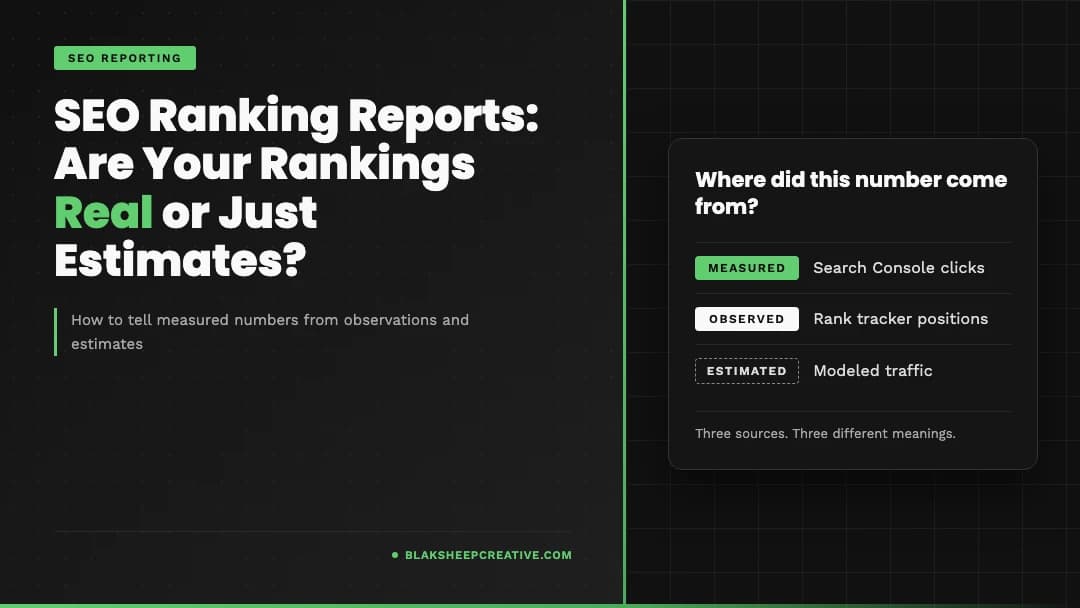
Partly. SEO ranking reports mix three kinds of numbers: data Google reports directly, rankings a tool observed at one place and time, and modeled estimates. Google is now blocking rank trackers and sometimes feeding them misleading results pages, so ask where every number came from, how it was collected, and if it connects to calls, leads and sales.
Key takeaways
- BrightLocal reported on October 16, 2026 that Google sometimes serves rank trackers a normal-looking results page that is not accurate.
- A keyword rank is one observation from one location, device and moment. It is not your ranking everywhere.
- Estimated organic traffic from a third party tool is a model, not visitors anyone counted.
- Google Search Console reports clicks, impressions, CTR and average position straight from Google, with privacy limits.
- A Business Profile call is a tap on the call button, not a completed conversation or a booked job.
- Rankings only matter when they lead to inquiries, qualified leads and sales you can trace.

Want this handled instead of DIY?
A 15-minute call, no script, no pressure. You leave with a plan either way.
Every month, a business owner somewhere opens an SEO report full of green arrows and wonders why the phone sounds the same as it did last month.
Sometimes the report is fine and something else is broken. Sometimes the numbers in it were never what they looked like. Google's recent fight with automated rank trackers has made that second question harder to ignore, so here is how to read a ranking report and know what each number is actually worth.
Can You Trust the Numbers in Your SEO Ranking Report?
We run SEO for service businesses and build reports for them every month. This is how we think about the numbers that go into those reports, and the questions we would want answered if we were the ones paying for them.
Google Is Making Automated Rank Tracking Harder
Rank trackers work by running searches automatically and recording where a website shows up. Google has never liked that, and in 2026 it got much more aggressive about stopping it.
In a September 4, 2026 update on slow reports, BrightLocal CEO Myles Anderson wrote that Google "has significantly stepped up its efforts to block automated access to its search results." The changes he listed include stricter bot detection, more captchas, and the removal of 100 results per page, which now means 10 page requests instead of one (that change dates to September 2025).
At that point, BrightLocal said the slowdowns "affect how quickly your reports run, not the quality of what's in them."
Six weeks later, the problem got worse. In BrightLocal's October 16, 2026 post on poisoned search results, Anderson explained that Google "sometimes serves a complete, normal-ish looking results page" to automated tools. Real ranking websites get swapped for social media profiles and forum threads. "The pages look legitimate, but they're not accurate," he wrote.
Two details from that post matter for anyone reading a report:
- It is not every result. BrightLocal says that, from its observations, this "doesn't affect page 1." The damage is mostly in deeper positions.
- It is industry-wide. BrightLocal calls it a problem for the whole rank tracking industry and says it has "increased the number of data providers" as a failsafe.
None of this means rank tracking is worthless or that every report is wrong. It means a tool that fails to catch a bad page can record a position that never existed. A good provider tells you when collection had problems instead of quietly filling the gap. BrightLocal publishing both updates is a good example of a vendor saying so in public.
Not Every SEO Metric Comes From the Same Place
The fastest way to read any SEO report is to sort each number by where it came from. A typical report pulls from five or six different systems, and they do not measure the same thing.
| Metric | Common source | What it means |
|---|---|---|
| Search clicks and impressions | Google Search Console | Reported directly by Google for your site |
| Average position | Google Search Console | Average of your top position across recorded impressions |
| Keyword rank | Third party rank tracker | Observed position under specific conditions |
| Estimated organic traffic | Third party SEO platform | A model's estimate, not counted visitors |
| Profile calls | Google Business Profile | Taps on the call button, not completed calls |
| Website form leads | Analytics or form tool | Recorded inquiries, if tracking is set up right |
| Qualified leads | CRM | Inquiries that meet criteria you defined |
| Closed customers | Sales records or CRM | Completed sales, with attribution limits |
An estimate is not dishonest. Presenting an estimate as a measured fact is.
Most confusion in SEO reporting comes from numbers sliding from one column to another without anyone saying so. The next few sections take the main sources one at a time.
Why Google Search Console Matters
Search Console is the one place where Google itself tells you how your site performed in search. Google describes it in its Search Console starter guide as a tool to help site owners "understand how they are performing on Google Search," with traffic broken down by queries, pages and countries.
It is direct data, but it still needs reading carefully. Three limits are worth knowing:
- Average position is an average. Google's help page on Search Console metrics says it records "the topmost position" your site held for each search, averaged across every query where you appeared. "A link must get an impression for its position to be recorded." A position of 6.2 is not a spot every searcher sees.
- Rare searches are hidden. Google's 2022 post on performance data filtering and limits explains that anonymized queries, those "that aren't issued by more than a few dozen users over a two-to-three month period," are left out of the query list for privacy.
- Exports are capped. The same post notes the Search Console interface exports a maximum of 1,000 rows, so a big site's full query list needs the API.
Search Console is the first report we would ask for, and you should have your own access to it. It does not replace a rank tracker or a CRM, though. It answers a different question.
BrightLocal reported on October 16, 2026 that Google sometimes serves rank trackers a normal-looking results page that is not accurate.
Why Manual Searches Aren't a Complete Ranking Report
Googling your own business and taking a screenshot feels like the most honest ranking check there is. It is one data point.
Search results change with location, device, search history and time. A junk removal company can show up in one spot for a searcher in Denham Springs, another in Baton Rouge, and somewhere else entirely for someone in Prairieville or Gonzales. One screenshot shows what one person saw, once.
A properly set up local ranking grid checks the same search from many points across your service area, which gives a far better picture. We walk through that process in our guide to tracking and improving Google Maps rankings. Grids are still observations, though, and they run on the same automated collection Google is now pushing back on.
Business Profile Data Does Not Replace Organic Search Data
Your Google Business Profile has its own performance numbers, and they are easy to confuse with website results. They measure different things.
Google's Business Profile performance help page defines calls as "the number of times a customer clicked on the call button on your Business Profile." That is a tap, not a conversation. Someone can tap, hang up before it rings, or call and ask a question you cannot help with.
Organic website clicks are a separate channel again. A good report keeps profile interactions and website traffic in separate rows, so a strong month on the map does not hide a weak month on the website, or the other way round. If your profile is the bigger lead source, that is worth knowing too, and it is why Google Business Profile management is its own line of work.
Rankings Are Up. Why Isn't the Phone Ringing?
Rising rankings with flat calls is a reason to investigate. It is not proof that anyone faked a report.
The usual causes are more ordinary:
- Low intent keywords. Ranking for "what causes roof leaks" brings readers, not buyers.
- The wrong geography. Rankings in towns you do not serve, or only near your office.
- A weak landing page. The visitor arrives and finds nothing that makes them call.
- Broken forms or call tracking. The leads came in and nobody recorded them.
- Seasonality. Demand for many services rises and falls through the year.
That is why it pays to pick a short list of numbers that actually tie to revenue, the approach in our guide to tracking the right KPIs in Google Analytics. SEO should connect visibility to customer action, and the report should show that connection or admit where it breaks.
“A pleasure to work with this company. Easy going and understands what the costumer wants. I look forward to work with this company again.”

Illustrative Example: Traffic Is Not Revenue
To show why visitor counts alone can mislead, here is a simple comparison of two businesses.
The following numbers are hypothetical. They are not client results.
| Metric | Business A | Business B |
|---|---|---|
| Monthly organic visitors | 5,000 | 1,500 |
| Website leads | 25 | 60 |
| Visitor to lead conversion rate | 0.5% | 4.0% |
| Closed customers | 5 | 15 |
In this made-up comparison, Business B has 70% less traffic, 2.4 times as many leads and three times as many customers. A report that only showed visitors would call Business A the winner.
The lead count is not the end of the story either. Leads only matter when they turn into booked work.
The point is not that traffic is bad. It is that a report built only on traffic and rankings cannot tell you which business is doing better. That takes tracking conversions on your website and following leads into your CRM.
Seven Questions to Ask Your SEO Agency
You do not need to understand every chart to judge a report. You need straight answers to a few questions.
- Where did each number come from?
- How are rankings collected, and for which locations and devices?
- Can I access my own Search Console data?
- Which figures are measured and which are estimates?
- Do the tracked keywords match my services and the customers I want?
- How many visits turned into inquiries, qualified leads and sales?
- What will change next month based on these results?
An agency that answers those clearly is worth keeping. One that cannot answer the first question is a problem, and our guide on how to find an SEO agency worth paying covers the other red flags.
What a Useful Monthly SEO Report Includes
A practical report is shorter than most people expect. It covers organic visibility from Search Console, the keywords that match your services, local performance across your real service area, landing pages, lead tracking, qualified inquiries, technical problems, the work completed, and what comes next.
A short report you understand beats 40 pages of charts nobody explains. If a chart does not change what anyone does next month, it is decoration.
The Bottom Line
Google's fight with automated rank trackers is a reason to look harder at data quality, not to give up on professional SEO tools. Most of the numbers in a report are useful when they are labeled honestly.
The standard is not "every number came from Google." The standard is "I can explain what every number measures, where it came from, and why it matters." That is how we build reports at BlakSheep Creative, and if you want a second opinion on yours, book a discovery call and we will walk through it with you.

Ready to put this to work?
Talk to the people who would actually build it.
About the author

Founder & Lead Developer · Denham Springs, LA
Clint has built and marketed websites for 26 years, since founding BlakSheep Creative in 2000. He is also a 29-year firefighter and a 23-year member of IAFF Local 557, which is where the bias toward plain answers over sales copy comes from.
- Veteran-owned
- Firefighter-owned
- IAFF Local 557
Common questions about SEO
Are SEO ranking reports accurate?
Does Google give you ranking data?
Can an SEO agency manipulate ranking reports?
Why do rank tracking tools disagree with each other?
Why are leads flat when rankings are going up?
Is Google Search Console enough on its own?

Your next step, without the guesswork
No surprises, clear next steps, and a fixed price before anything starts.