
By Clint Sanchez · Published · Updated · 8 min read
Quick answer
To track Google Maps rankings accurately, run the same high-value searches from multiple fixed points across the real service area on a consistent schedule. A geo-grid tracker plots each result on a map, showing where the business is strong, weak, or absent. Record a baseline before changing anything, watch which competitors move around you, and confirm progress with calls, direction requests, and leads rather than rank alone.
Key takeaways
- According to Google's local ranking guidance, the three main local ranking factors are relevance, distance, and prominence.
- Distance is why an owner can see position two at the office while a customer across town sees position twelve; neither result is wrong.
- A manual search is a spot check, not a measurement system, because location, context, and wording all change the result and leave no history.
- Track buyer-intent keywords such as emergency dentist or storm damage roofer, with a separate line for each service and intent.
- Make one meaningful group of changes at a time and record the date, or you will never know which move helped or hurt.
- Google says review count and review score can shape local ranking, and that it compiles profile information from the official website, public web content, licensed third parties, and user contributions.
- Weekly or biweekly tracking is enough for most local businesses; Google says profile edits can take up to three days to appear.
A company that serves Baton Rouge, Denham Springs, Prairieville, and Walker is spread across three parishes and two sides of the Amite River. Checking the map pack from the office in Denham Springs says nothing about what a customer in Gonzales sees. A geo-grid across that whole area is the only way to find the towns where a competitor owns the results.

Want this handled instead of DIY?
A 15-minute call, no script, no pressure. You leave with a plan either way.
How Do You Track Google Maps Rankings Accurately?
To track Google Maps rankings accurately, monitor the same high-value searches from multiple fixed points across your real service area. A geo-grid rank tracker plots those positions on a map, while scheduled scans reveal visibility gains and declines. Pair that data with Google Business Profile performance, competitor movement, reviews, citations, and website changes before deciding what to optimize.
TLDR:
- Your business does not have one universal Google Maps ranking because distance is part of Google’s local ranking system.
- A geo-grid checks the same search from multiple locations and turns those results into a visibility map.
- Track specific, buyer-intent keywords instead of broad vanity terms.
- Establish a baseline before changing your profile, website, reviews, or citations.
- Compare your movement with competitors to avoid mistaking a market-wide shift for your own result.
- Use rankings as a diagnostic signal, then confirm progress with calls, website clicks, direction requests, and leads.
If your company serves Baton Rouge, Denham Springs, Prairieville, or several towns across South Louisiana, checking your ranking from one desk tells you almost nothing about what customers see elsewhere. You may own the map results near your address and disappear a few miles away. The point of local rank tracking is to replace that guesswork with a repeatable map of where you are visible, where you are weak, and what changed after each round of work.
Want to know where your business is losing local visibility? We will review your Google presence and turn the gaps into a practical action plan.
Why Your Google Maps Ranking Changes Across Town
Traditional organic rank tracking usually reports one position for a keyword and location. Google Maps is more sensitive to where the person searching is standing.
Google identifies three main local ranking factors: relevance, distance, and prominence. Relevance is how closely a profile matches the search. Distance is how far the business is from the searcher or named location. Prominence reflects how well known the business appears based on signals that include links, reviews, and information across the web. Google also says complete and accurate profile information makes a business more likely to appear for relevant local searches. You can read the details in Google’s own local ranking guidance.
That distance factor is why an owner can see position two at the office while a customer across town sees position twelve. Neither result is necessarily wrong. They represent two different search locations.
Why a Manual Search Is Not Enough
Manual searches are useful for a quick spot check, but they are a poor measurement system. Your current location, search context, and the exact wording of the query can all change the result. They also leave no clean history and make competitor comparisons tedious.
A local rank tracker runs the same keyword from defined locations on a consistent schedule. A geo-grid goes one step further by checking a set of points around the business and plotting each result on a map. The pattern shows where the profile has strong coverage and where another business owns the results.
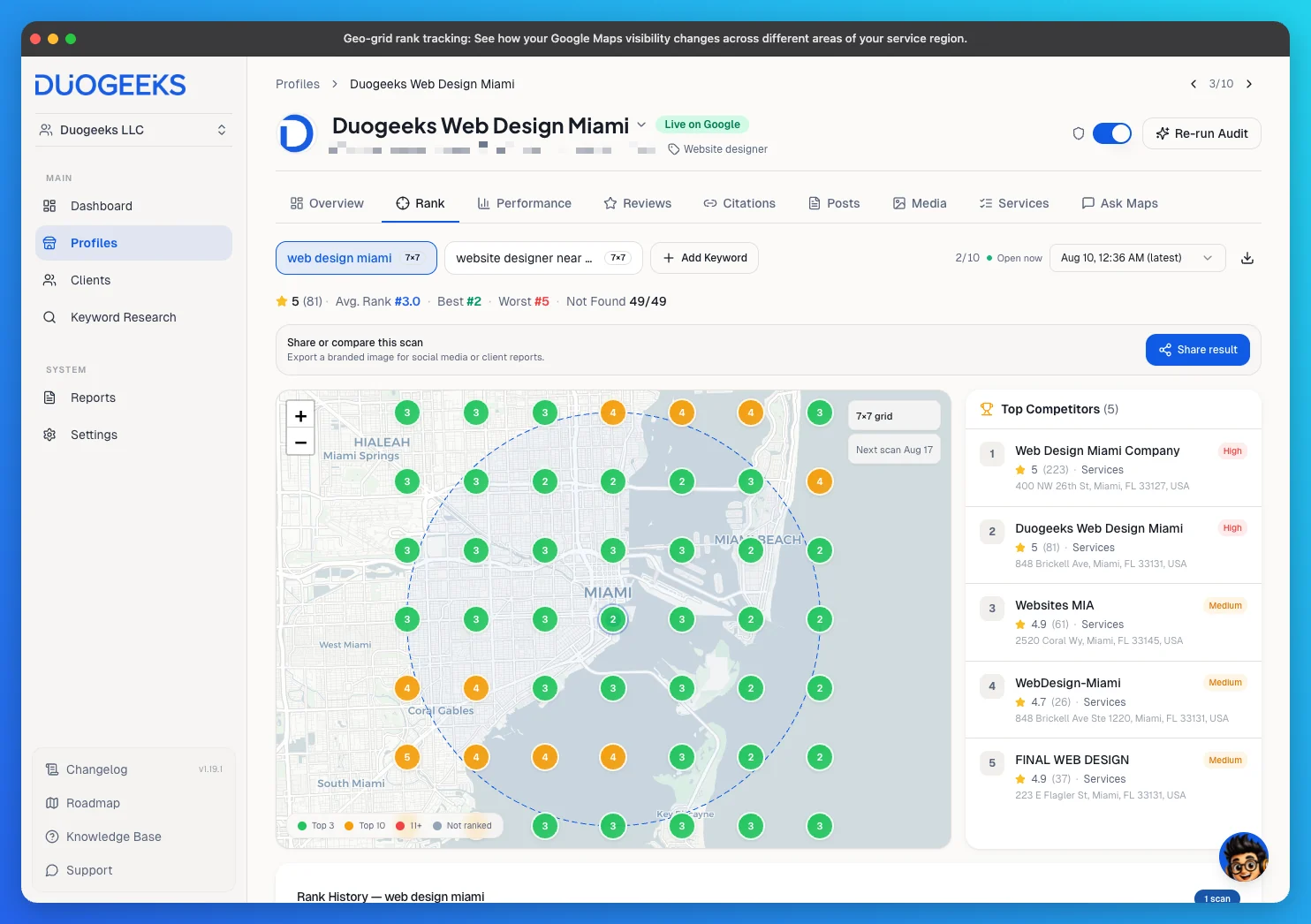
The screenshot above comes from MapGroww, the geo-grid tracker pictured throughout this guide. Its published feature list includes Google Maps rank tracking, geo-grid heatmaps, competitor tracking, profile audits, review tools, citation monitoring, multi-location management, and white-label reporting. Those are vendor-stated capabilities, so evaluate the platform against your own locations, reporting needs, and budget before adopting it.
What You Should Track
More data does not automatically produce better decisions. Track the signals that tell you where customers can find you, who is taking visibility from you, and if that visibility is turning into real business. The four measurements below give you that picture without burying the work in vanity metrics.
High-Intent Keywords
Track the searches that can produce revenue, not every phrase that happens to contain your service. A dentist might monitor “emergency dentist,” “dental implants,” and “dentist near me.” A roofer might track “roof repair,” “storm damage roofer,” and “roof replacement” in the cities it actually serves.
Use a separate line for each service and search intent. One blended visibility score is useful for reporting, but it should never hide which money terms are moving.
Visibility Across the Service Area
Choose grid points that reflect where customers live and where you can realistically serve them. Do not waste scan credits over rivers, industrial land, or distant neighborhoods outside the business model. Keep the grid size, center point, spacing, keyword, and scan frequency consistent, so one report can be compared with the next.
Competitor Movement
If you move from fifth to third, you improved. But the more useful question is who moved around you and why. Track the businesses that repeatedly appear above you, then compare categories, reviews, landing pages, services, links, and local relevance. This turns a colored grid into an optimization plan.
Leads and Business Profile Actions
Rankings are an early indicator, not the finish line. Track calls, website visits, direction requests, form submissions, appointments, and sales alongside your map positions. A lower ranking that produces qualified leads can be more valuable than a first-place position for a vague keyword nobody buys from.
According to Google's local ranking guidance, the three main local ranking factors are relevance, distance, and prominence.
Audit the Google Business Profile Behind the Rankings
Rank tracking shows what happened. It does not explain the cause by itself. If the grid shows you missing entirely in a town you serve, start with why a business does not show up in Google local results. When a grid exposes weak areas or a decline, audit the profile before making random changes.
Check the primary and secondary categories, business name, address or service area, phone number, hours, services, description, attributes, photos, and website link. Google says categories affect local ranking and recommends selecting the most specific primary category that describes the business. See its Business Profile category guidance before changing one.
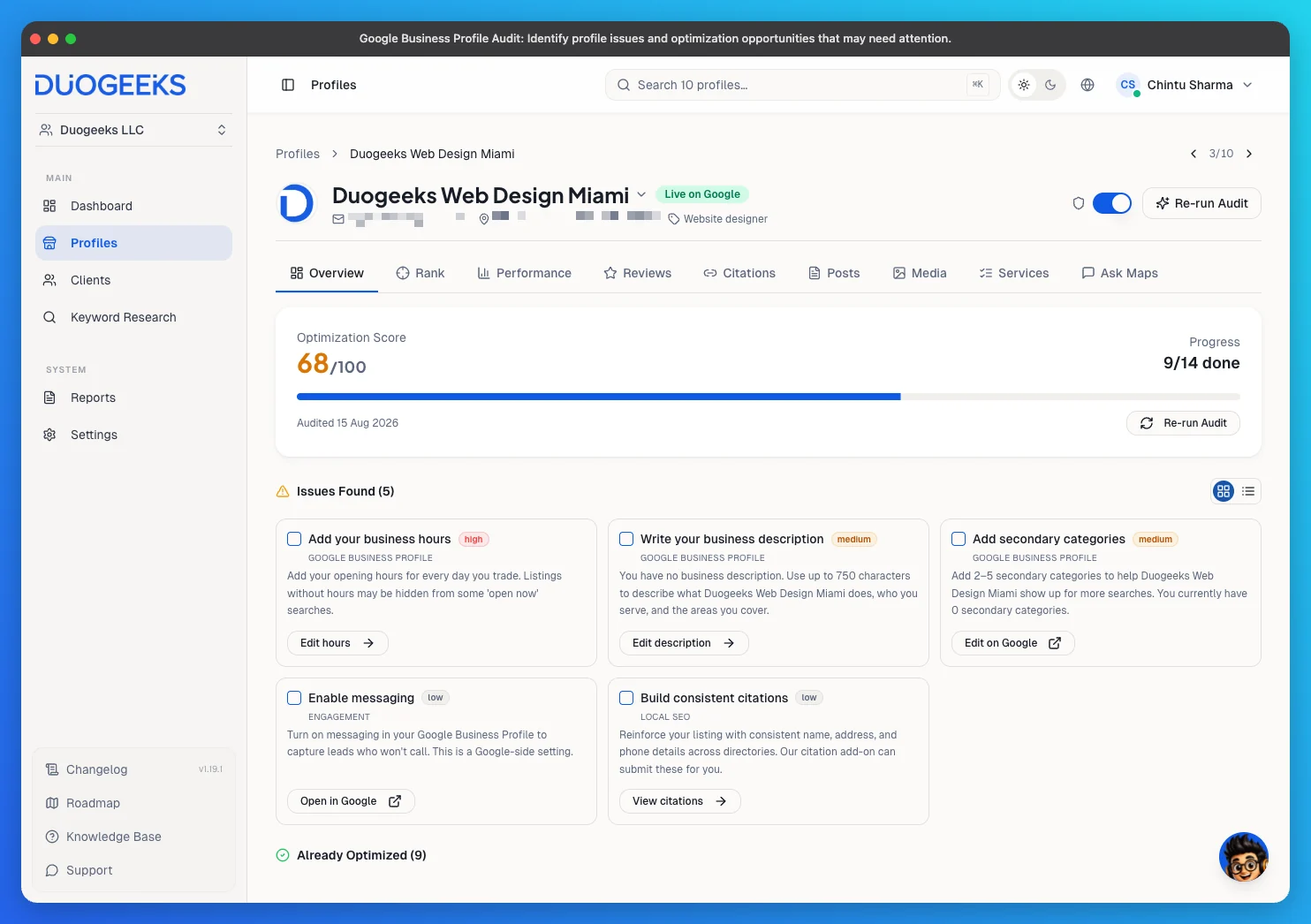
Make one meaningful group of changes at a time and record the date. If you rewrite everything, change categories, add services, rebuild a landing page, and launch a review campaign on the same day, you will not know which move helped or hurt.
Reviews, Citations, and Your Website Still Matter
Google explicitly says review count and review score can shape local ranking. Reviews also influence a person’s decision after finding the profile. Build a legitimate, steady process for requesting reviews and respond like a human. If review acquisition and response management are becoming inconsistent, our reputation management service turns them into a repeatable process. Do not buy reviews, gate unhappy customers, or trade incentives for positive ratings.
Name, address, and phone consistency matters because Google compiles Business Profile information from the official website, public web content, licensed third parties, and user contributions. That does not mean every harmless formatting difference destroys a ranking. It does mean old addresses, conflicting phone numbers, duplicate listings, and incorrect business names should be corrected. Google’s explanation of how it sources Business Profile information is the right starting point.
Your website supplies additional relevance and prominence signals. Build clear service pages, name the areas you genuinely serve, keep contact information accurate, and earn legitimate local links. Our SEO services connect the technical and content work, while location and service area page design gives each real market a useful destination. Our Google Business Profile management service connects that website work with the profile customers find in Maps.
A rank report is only useful when it leads to the right work. We can audit your profile, website, reviews, and local competition together so you know what to fix first.
A Simple Eight-Step Local Rank Tracking Process
- Choose the right keywords. Start with the services that generate revenue and the terms customers actually use.
- Define the real market. Set a grid around the neighborhoods and towns you can serve profitably.
- Record a baseline. Run the first scan before making profile or website changes.
- Identify repeat competitors. Note who wins across the grid, not just at one pin.
- Audit the profile and website. Look for category, service, content, review, citation, and conversion gaps.
- Make a controlled round of improvements. Keep a change log with dates.
- Run the next scan on the same settings. Compare like with like after enough time has passed for the changes to settle.
- Report business outcomes. Pair ranking movement with profile actions and qualified leads.
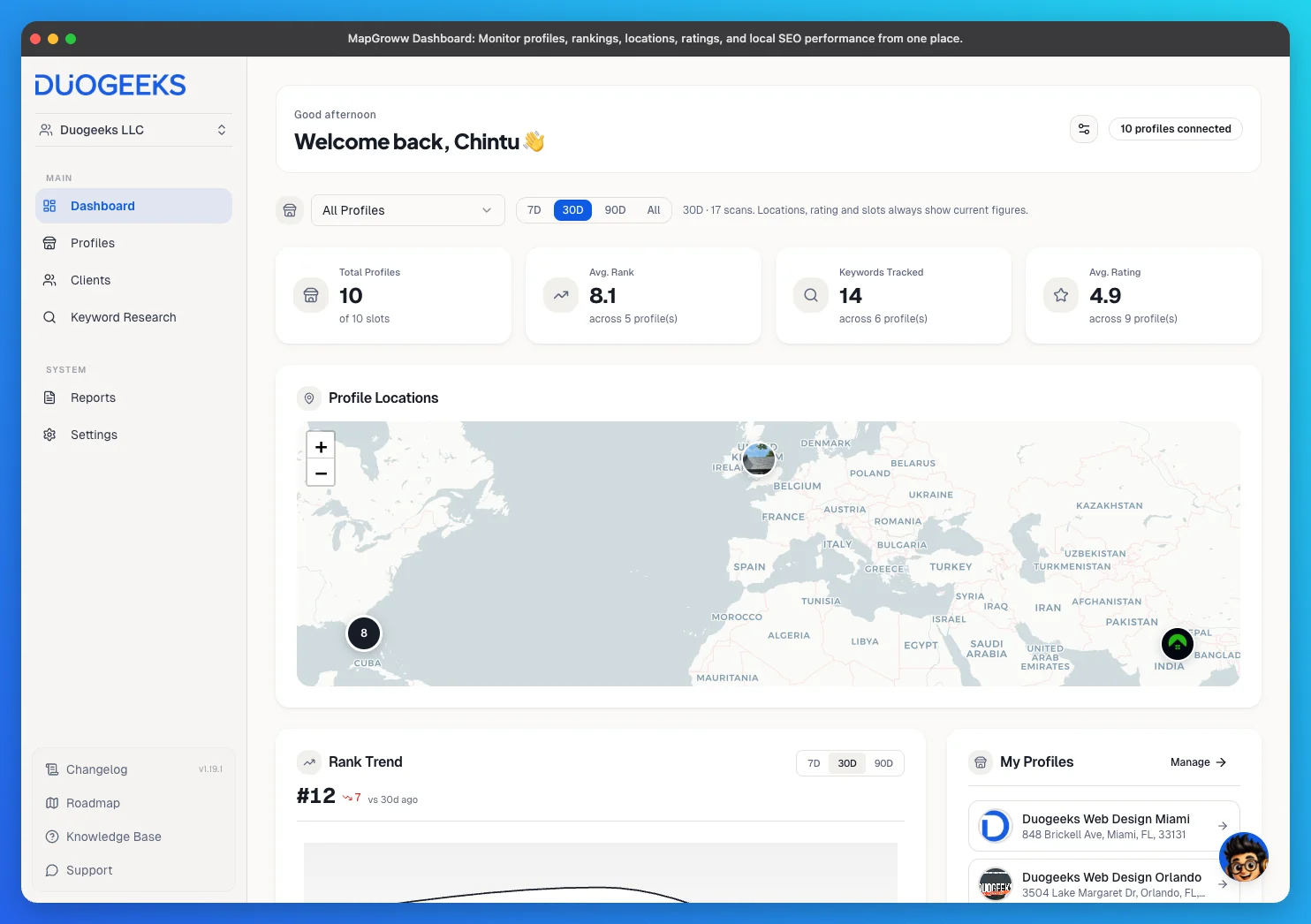
For a normal local business, weekly or biweekly tracking is usually enough to spot direction without reacting to every daily fluctuation. A new campaign may deserve a closer watch, but strategy should be based on repeated patterns rather than one scan.
“Blaksheep picked up an unfinished project for us mid-stream and was able to turn it around and see to completion. They made multiple design changes and gave us a great end result.”

Reporting Local SEO Without Burying the Client
Clients do not need a spreadsheet full of every grid point. Give them a clear explanation of the baseline, the work completed, what moved, what produced leads, and what comes next.
A useful monthly report can show the starting and current visibility maps, movement for priority keywords, the competitors gaining or losing ground, profile actions, website conversions, completed work, and the next three priorities. Agencies can build this manually or use white-label reporting from a local SEO platform.

Keep the narrative honest. If rankings rose, but calls did not, say so and investigate. If the grid barely moved, but conversion rate improved, that matters too. Reporting is not decoration. It is the feedback loop that keeps local SEO tied to the business. Map positions are only one surface, too: our guide to local AEO and near me queries covers the answers customers get without ever opening the map.
Tracking also settles arguments about tactics. If someone tells you a map embed on every city page will lift your rankings, here is what the evidence on map embeds actually shows, and a rank grid is how you would test it on your own pages.
Grid scans are still observations, and in 2026 Google started serving some rank trackers results pages that look normal but are not accurate. Our guide to which SEO report numbers are measured, observed or estimated covers what that means for your reports.
Common Questions About Google Maps Rank Tracking
These are the questions business owners usually ask before they start measuring local visibility properly.
Can I check my Google Maps ranking for free?
Yes, you can manually search from different places or use a limited free tool, but manual checks are hard to repeat and compare. For ongoing work, a tracker saves fixed locations, keywords, competitors, and historical scans so the data is more consistent.
What is a Google Maps geo-grid?
A geo-grid is a set of search points placed around a business location. The tracker runs the same keyword at each point and plots the ranking on a map, making it easy to see where the business is strong, weak, or absent.
How often should I track local rankings?
Weekly or every two weeks is practical for most businesses. Run scans with the same settings and avoid making strategic decisions from a single fluctuation. The right cadence is frequent enough to catch a pattern without paying to measure noise.
How long should I wait after changing my Google Business Profile?
Google says edits can take up to three days to appear, but ranking effects may take longer and can be mixed with normal volatility. Log the change, confirm it went live, and compare several consistent scans before drawing a conclusion.
Does a number-one Google Maps ranking guarantee more leads?
No. The keyword may have weak buying intent, the profile may not persuade searchers, or the website may fail to convert. Measure calls, website actions, directions, forms, appointments, and sales along with rank.
Is MapGroww the only tool that can do this?
No. MapGroww is the tool pictured in this guide, and it combines multiple local SEO functions in one platform. Businesses should compare scan methodology, grid controls, history, reporting, location limits, integrations, and total cost before choosing any tracker.
Stop judging local visibility from one search at your desk. We will map the market, find the gaps, and build a local SEO plan around leads instead of vanity rankings.
About the author

Founder & Lead Developer · Denham Springs, LA
Clint has built and marketed websites for 26 years, since founding BlakSheep Creative in 2000. He is also a 29-year firefighter and a 23-year member of IAFF Local 557, which is where the bias toward plain answers over sales copy comes from.
- Veteran-owned
- Firefighter-owned
- IAFF Local 557
More Questions About Google Maps Rank Tracking
Short answers to the questions that come up most on this topic.
Why does my Google Maps ranking look different in different parts of town?
Which keywords should I track for local rankings?
How do I set up a geo-grid for my service area?
What should I audit when the grid shows a weak area?
What should a local SEO report include?
Do citations and NAP consistency still matter for Google Maps?

Your next step, without the guesswork
No surprises, clear next steps, and a fixed price before anything starts.