
By Clint Sanchez · Published · 9 min read
Quick answer
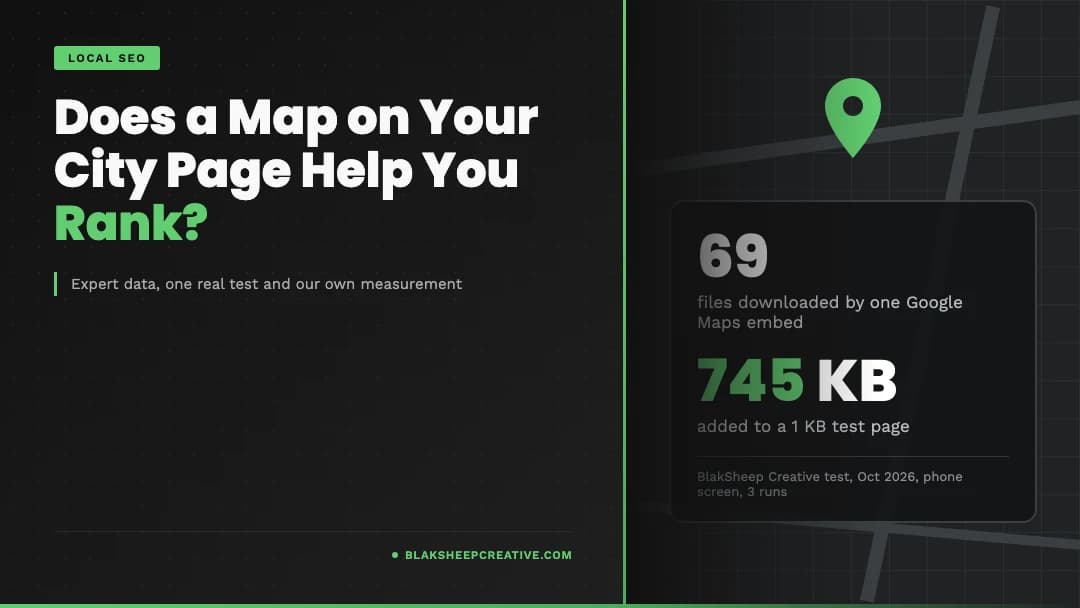
No evidence shows a map of a town helps your page rank there. Experts rank even a map of your own business 125th of 187 local factors, and a service area map is not on the list. The one controlled test that found a benefit used real business pins and measured organic traffic. Meanwhile, one Google Maps embed added about 745 KB to our test page.
Key takeaways
- Whitespark's 2026 Local Search Ranking Factors survey of 47 experts ranks "Embedded Google Map for Location on GBP Landing Page" 125th of 187 factors for the map pack.
- A map of the area you serve, with no business on it, is not one of the 187 factors at all.
- The words about the town on the page rank 2nd of 187 for local organic results in the same survey.
- SearchPilot's 2025 split test found removing a map with real business pins cost about 7% of organic sessions, so a business map is not worthless.
- In our test, one Google Maps embed turned a one-request, 1 KB page into 69 requests and about 745 KB.
- If you want a map for visitors, use one with your business pin or a lightweight static image.

Want this handled instead of DIY?
A 15-minute call, no script, no pressure. You leave with a plan either way.
Somewhere in nearly every local SEO checklist sits the same instruction: build a page for each city you serve, write a few paragraphs, and embed a Google Map of that city at the bottom.
The logic sounds airtight. Google sees a map of Walker on your Walker page, Google decides you belong in Walker, and up you go.
We went looking for the proof. We read the largest expert survey in local search, the one controlled split test we could find, the practitioner reports and Google's own guidance, then measured what a map embed adds to a page ourselves. Here is what holds up and what does not.
Does an Embedded Map Help a City Page Rank?
We do local SEO for service businesses, and city pages are a big part of that work. This is what the evidence says about the map at the bottom of them.
Where the "Add a Map" Advice Comes From
Embedding a map is one of the oldest habits in local SEO. Whitespark's Darren Shaw called it "kind of like an old school local SEO thing" in his 2021 rundown of local SEO myths, and listed it as Myth #9: "Embedding a Google Map on Your Website Impacts Rankings."
His verdict on that myth was blunt. "There are many reasons to embed a Google map on your website, but the act of doing it on its own is not a ranking factor," he wrote in Whitespark's myth list. He was talking about a map of the business's own Google Business Profile listing, the strongest version of the tactic.
Somewhere along the way, the advice got stretched. A map of your own listing turned into a map of every town you want to rank in, pasted onto page after page.
What the Local SEO Experts Rank It
The best data on what local search experts believe moves rankings is Whitespark's Local Search Ranking Factors survey. The 2026 edition, published November 6, 2025, asked 47 local search experts to score 187 factors from 0 to 5 for their impact on the map pack, local organic results, conversions and AI search.
Here is where the relevant factors landed in the 2026 report:
- Embedded Google Map for Location on GBP Landing Page: 125th for the map pack, 91st for local organic, 143rd for AI search visibility.
- Geographic (City/Neighborhood) Keyword Relevance of Content: 18th for the map pack, 2nd for local organic, 6th for AI search visibility.
- A map of a service area or city: not one of the 187 factors.
Two caveats keep this honest. This is a survey of expert opinion, not a measurement of Google's algorithm, and Whitespark says plainly that none of the experts have special access to how Google ranks local results. But these are the people who run local SEO tests for a living, and they put the town's name in your content near the very top and the map near the bottom.
The One Controlled Test (and Why It Does Not Cover City Maps)
Opinion is one thing. A controlled split test is better, and we found exactly one.
In May 2025, SearchPilot published a test where a business removed the embedded Google Map from its location pages. SearchPilot splits a site's pages into a test group and a control group, so a change can be measured against pages that did not get it. The result was "a statistically significant negative impact on organic traffic, with a predicted 7% decrease in sessions." Their read was that the map had been "a useful signal that these pages were relevant to local search queries."
That is real evidence that a map can help, and it belongs in any honest version of this article. It also matters what kind of map it was. SearchPilot describes it as showing "pin drops not only for the relevant address, but nearby addresses as well." Every pin marked a real place. It was a map of locations, not a map of a town.
The other data points are smaller:
- Sterling Sky's client test: In July 2025, Joy Hawkins wrote on the Local Search Forum that her team was halfway through testing embedded maps on a group of clients. "So far the results are very meh," she wrote. "The only improvements we have seen are on the organic side."
- A forum report the other way: In 2022, a member of the same forum wrote in a thread about map embeds, "We ended up taking out the embedded map and nothing happened with rankings." That is one site with no control group.
Put together, maps tied to real business locations show a small organic benefit in one test, a "very meh" one in another, and nothing anyone has measured for the map pack. A map of a city with no business on it has not been tested by anyone we could find.
Whitespark's 2026 Local Search Ranking Factors survey of 47 experts ranks "Embedded Google Map for Location on GBP Landing Page" 125th of 187 factors for the map pack.
Why a Map of a City Is a Different Thing
Google's own guidance explains why the two kinds of maps should not be lumped together. In Google's Business Profile help, local results are "mainly based on relevance, distance, and popularity," and relevance "is how well a Business Profile matches what someone is searching for."
Every one of those factors is about a business. A map of your listing at least points at a business. A map of Walker points at Walker, a town Google already knows the location of. It tells Google nothing about you.
Google's John Mueller made the broader point in a 2023 post: "No ranking factor compensates missing relevance, or missing user interest." A map at the bottom of a thin page does not make the page more relevant to the town. The writing on the page does that.
What a Google Maps Embed Costs Your Page
The map is not free, so we measured it.
We built a plain test page with a heading and a few paragraphs, then a second copy with one standard Google Maps embed of a small city. We loaded each one three times in a headless Chrome browser at a phone screen size, with an empty cache, and counted every file the browser downloaded.
- Without the map: 1 request, about 1 KB.
- With the map: 69 requests, about 745 KB, including 14 scripts. The numbers matched within 5 KB across all three runs.
A real city page carries more than our test page did, so the map's share of the total will be smaller than this chart suggests. The 68 extra requests and roughly three quarters of a megabyte are still there on every load. A Lighthouse test by CoreWebVitals.io found the same pattern from another angle: a Google Maps embed blocked the browser's main thread for 320 milliseconds and pushed first paint back by 0.8 seconds.
To be fair, this is a cost to your visitors more than to your rankings. Google's John Mueller said in 2024 that "Core Web Vitals are not giant factors in ranking." His follow-up is the part that matters for a service business: a good experience is worthwhile "because if users are so annoyed that they don't want to come back, you're just wasting the first-time visitors to your site." A homeowner on a phone in a pickup is exactly that visitor.
What Actually Makes a City Page Rank
If the map is not doing the work, the page has to. The highest-scoring page-level factor in the Whitespark survey for local organic results is the wording about the place itself, and that is where the effort belongs. Then track your Google Maps rankings before and after you change a page, so you know what actually moved.
- Name the town, the neighborhoods and the parish in sentences. Our pest control website examples put it this way: a map embed is not a service area. Write out the subdivisions, roads and landmarks you actually serve.
- Say something true about working in that town. Service days, travel time, local permit quirks, the jobs you see there most. A page that only swaps the city name is the kind Google's spam policies describe as doorway abuse: "pages targeted at specific regions or cities that funnel users to one page."
- Show proof from that town. Reviews from customers in that city and photos of jobs there do more than any map. Our guide to building city pages that are not useless walks through the full structure.
- Fix the Google Business Profile first. Primary category, business name and distance from the searcher top Whitespark's map pack list, the same profile work behind ranking a pest control company in the map pack. A city page supports your Google Business Profile. It does not replace it.
“Clint was incredible to work with! He was everything you need - quick to communicate from beginning to end, professional, flexible when I had questions and asked for extra options, and SO fast on his turnaround time. I would recommend Blaksheep Creative to everyone!”

If You Still Want a Map on the Page
A map can still be useful for people, even if it is not a ranking lever. The question is which map, and how heavy.
- Use your business's own map, not the town's. If a map goes on the page, make it the one with your pin. That is the only kind any test has found a benefit for.
- Use a static image for coverage areas. Google's own web.dev guide to third-party embeds says "Static images can be used instead of map embeds where you might not need to make the map interactive." A simple image or graphic of your service area shows a visitor at a glance if they are covered, at a fraction of the weight.
- Lazy-load any embed you keep. The same guide recommends the browser's built-in lazy loading so an iframe below the fold waits until the visitor scrolls near it.
- Link to your listing. A plain "Get directions" button that opens your Google Business Profile does the practical job of a map without loading one.
The Pitch vs. the Evidence
| The Common Advice | What the Evidence Shows |
|---|---|
| "Embed a map of each city and you will rank there." | No test of a city-only map exists, and it is not one of Whitespark's 187 factors. |
| "Maps help you get into the map pack." | Experts rank even a map of your own location 125th of 187 for the map pack. |
| "Maps do nothing at all." | Not quite. SearchPilot measured a 7% organic loss when a map with real business pins came off. |
| "Every page needs an interactive map." | One embed added 68 requests and about 745 KB to our test page. A static image does the visual job. |
| "The map tells Google where you work." | The wording about the town ranks 2nd of 187 for local organic. Write it out. |
The Bottom Line
A map of the town at the bottom of a city page is one of those tactics that survives because it feels right, not because anyone has shown it works. The expert survey ranks maps near the bottom, a map of a city is not on the list at all, and the one real test that found a benefit used a map with actual business pins on it.
Meanwhile, the embed is heavy, and the visitor on a phone pays for it. If you want to rank in a town, write the page like you actually work there, the way our guide to local SEO in Ascension Parish names Gonzales and Prairieville instead of leaning on a map. If you want a map, use yours, or use a picture.

Ready to put this to work?
Talk to the people who would actually build it.
About the author

Founder & Lead Developer · Denham Springs, LA
Clint has built and marketed websites for 26 years, since founding BlakSheep Creative in 2000. He is also a 29-year firefighter and a 23-year member of IAFF Local 557, which is where the bias toward plain answers over sales copy comes from.
- Veteran-owned
- Firefighter-owned
- IAFF Local 557
Common questions about SEO
Does embedding a Google Map help local SEO?
Should I put a Google Map on every city page?
What should a city page have instead of a map?
Does page speed affect local rankings?
Is a map of my service area the same as a map of my business?

Your next step, without the guesswork
No surprises, clear next steps, and a fixed price before anything starts.