
By Clint Sanchez · Published · Updated · 9 min read
Quick answer
Pest control websites that book jobs are built for a person with a live problem in their house right now, not for someone browsing at leisure. They make the phone number tappable, name each pest on its own page, show real technicians, state the service area in plain words, keep reviews on the page, give a price signal, load fast on cellular, offer one next step per screen, and use headings AI can quote.
Key takeaways
- The pest control visitor found a pest in the last hour and is on a phone, one-handed, often on a weak signal.
- A tel: linked call button is the cheapest fix on the list and the difference between a call and a bounce.
- Nobody searches for pest control services; they search for termite treatment or bed bug exterminator, so each pest needs its own page.
- BrightLocal's 2026 Local Consumer Review Survey found 97% of consumers read reviews for local businesses and 47% will not use one with fewer than 20 reviews.
- The same survey found 74% look for reviews written in the last three months, so recency matters as much as star count.
- A map embed is not a service area; the town and parish names have to exist as text on the page.
- A price range or starting-at figure filters out pure cost shoppers instead of protecting margin.
Formosan termites swarm across the Baton Rouge area every May, and that is when a termite page either exists or it does not. A Livingston Parish homeowner searching from a hallway in Walker is looking for the word Walker and the word termite on the same page, and the site that has both, with a tappable number, gets the call.

Want this handled instead of DIY?
A 15-minute call, no script, no pressure. You leave with a plan either way.
What separates a pest control website that books jobs from one that just sits there
Pest control websites that book jobs are built for a person with a live problem in their house right now, not for someone browsing at leisure. They make the phone number tappable, name each pest on its own page, show real technicians, state the service area in plain words, and load fast on a phone. Design taste is not the deciding factor.
TLDR:
- The visitor found a pest in the last hour and is on a phone, one-handed, often on a weak signal
- A tappable call button beats a beautiful hero image every time
- One page per pest (termites, roaches, rodents, mosquitoes) beats one lumped services page
- Real photos of real technicians outperform stock, because someone is deciding who to let in the door
- Reviews belong on your site, not only on Google, and 47% of consumers skip businesses with fewer than 20
- A price signal of any kind reduces the calls you waste time on
- You can audit your own site against all nine in about ten minutes
Most pest control sites we look at are not badly designed. They are designed for the wrong person. They open with a wide photo of a suburban house at golden hour and a headline about commitment to excellence, and somewhere below the fold there is a contact form.
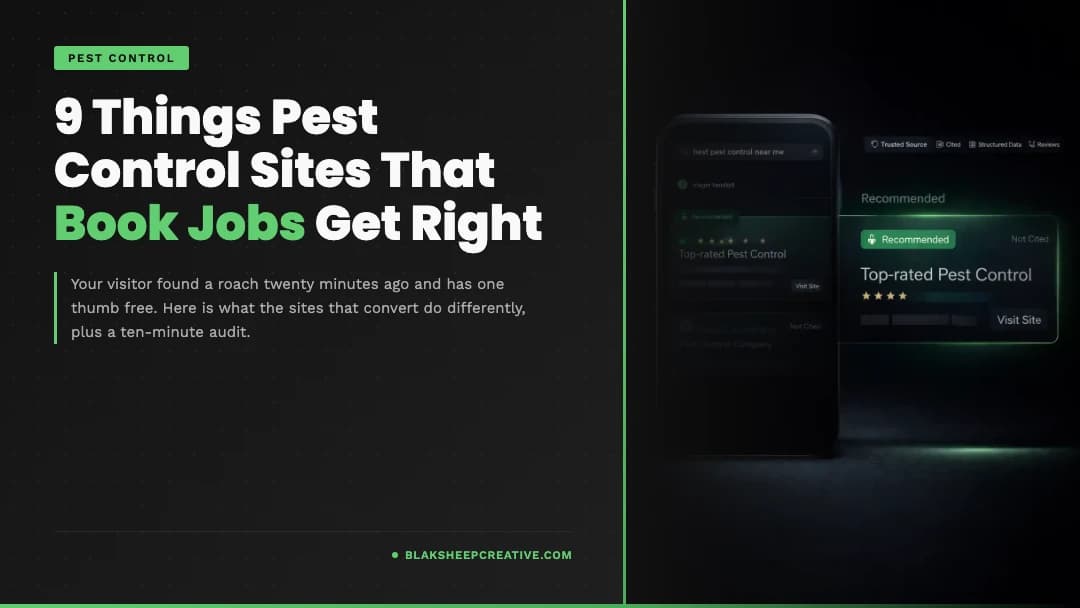
Meanwhile, the actual visitor found a roach in the kitchen twenty minutes ago and is standing in the hallway with one thumb free.
Not sure how yours measures up? We will look at your site and tell you what is costing you calls, at no charge and with no pitch attached.
1. The phone number is a button, not a piece of text
Your visitor has one hand free. The other one is holding a flashlight, a baby, or the shoe they just used.
A phone number typed as text is a small target that does nothing when tapped on many setups. A tel: linked button is a single tap into the dialer. That is the entire difference between a call and a bounce, and it is the cheapest fix on this list.
Put it in the header, make it sticky on mobile, and repeat it at the bottom of every page. If a visitor ever has to scroll to find how to reach you, the design has failed regardless of how it looks.
2. Each pest gets its own page
A single page titled Our Services, listing nine pests as bullet points, is the most common structural mistake in this industry.
Nobody searches for pest control services. They search for termite treatment, bed bug exterminator, mosquito spraying, rodent removal. Those are different problems with different urgency, different price expectations, and different questions. A bullet point cannot answer any of them.
One page per pest gives each search something specific to land on. It also gives you somewhere to put the questions that actually get asked, which is the same content an AI assistant needs in order to recommend you. We make the full case for why one page per pest beats one services page.
When we rebuilt Pro-Tec Pest Management’s site, this was the structural change: termite control, bed bug control, mosquito control and roach control each got real estate of their own instead of sharing a list.
3. Real technicians, not stock photography
Pest control is one of the few trades where the customer is deciding who to let inside their house.
Stock photos work against you here in a way they do not for most industries. A smiling model in a clean white polo holding a sprayer reads as generic at best and dishonest at worst. A slightly imperfect photo of your actual crew standing next to your actual truck does more for conversion than any headline you could write.
This is also the fix owners resist most and regret least.
The pest control visitor found a pest in the last hour and is on a phone, one-handed, often on a weak signal.
4. The service area is written in words
A map embed is not a service area. It is an image of one, and search engines and AI assistants read it as almost nothing.
Name the towns and parishes you cover, in text, on the page. If you serve Denham Springs, Walker, Baton Rouge and Livingston, those words need to exist somewhere a crawler can read them. The homeowner in Walker is looking for the word Walker.
5. Reviews live on your site, not only on Google
Reviews are the single strongest trust signal you have, and most pest control sites leave them entirely on a Google profile the visitor would have to go find.
BrightLocal’s 2026 Local Consumer Review Survey, published in February and based on 1,002 US adults, found that 97% of consumers read reviews for local businesses and 41% now always do, up from 29% the year before. The bar has also risen sharply: 31% will only use a business rated 4.5 stars or higher, nearly double the 17% who said so a year earlier.
Two findings matter more than the headline numbers. 47% will not use a business with fewer than 20 reviews, which makes review volume a real threshold rather than a nice-to-have. And 74% look for reviews written in the last three months, with 32% wanting them from the last two weeks. A wall of five-star reviews from 2023 does less work than four from last month.
Pull them onto the page. A live feed near the call button does more than a testimonials page nobody visits.
Reviews are only half of it. The other half is what happens after someone decides to call you. If your phone is ringing and jobs still are not landing, the leak is usually further down the funnel than the website.
6. There is a price signal somewhere
Nobody expects a firm quote for a termite job off a web page. They do expect to know if you are a $150 company or a $1,500 company.
A range, a starting-at figure, or even a plain sentence explaining what drives the price will do. Silence on price does not protect your margin. It filters out the people who would have paid and invites the ones who are shopping purely on cost to call and ask.
“Blaksheep Creative was such a pleasure to work with. Great service and even better results!”
7. It is fast on a phone, on cellular, in a hallway
Your site is fast on your desk, on your office Wi-Fi, with everything cached. That is not the test.
The test is a four-year-old Android on two bars in a hallway. Oversized hero images and heavy page-builder bloat are what break that scenario, and pest control sites are unusually prone to both because the industry loves a full-width photo.
8. One obvious next step per screen
Call now, book online, get a free quote, request an inspection, sign up for the newsletter, chat with us. Six options is the same as no option.
Pick the one action worth the most to you, usually a call, and make it the loudest thing on every screen. Everything else gets to be secondary.
9. It is structured so an AI assistant can quote it
A growing share of homeowners never reach your site through a blue link at all. They ask an assistant who to call, and the assistant answers from pages it can parse.
That rewards plain structure: a real question as a heading, a direct answer underneath in the first sentence, service areas and pests named in text. It is the same work that makes a page readable by a person in a hurry, which is why it is worth doing even if you are skeptical about AI search. Our answer engine optimization for pest control companies page covers the mechanics.
A tel: linked call button is the cheapest fix on the list and the difference between a call and a bounce.
How to audit your own site in ten minutes
You do not need a tool for this. Pick up your phone, turn off Wi-Fi, and go to your own website like a customer would.
If you fail three or more of those, the problem is not your marketing budget. Two of the fixes above cost nothing but an afternoon, and the rest are a rebuild conversation rather than an advertising one. Our pest control website design work starts from exactly this checklist.
Some popular city page advice does not hold up either. Before you embed a map of every town you treat, read what the data says about maps on city pages. The short version: the words about the town do more than the map.
Common questions about pest control website design
These come up on almost every call we take from a pest control owner, usually right after they have spent money on ads and not much happened.
How much does a pest control website cost?
It depends on how many pests you treat and how many towns you serve, because those drive the page count. We price every build per project and give you a firm number before any work starts. If you would rather spread it, we also run monthly website plans at $250 and $500 a month.
Do I need a separate page for every single pest?
Not every pest, but every pest you actually want to be called about. If termites are your margin, termites get a page. Pests you treat occasionally can share a page without hurting you.
Will a new website fix my lead problem by itself?
Sometimes, and often not. If you are getting traffic and no calls, the site is usually the problem. If you are getting no traffic at all, the site is not the bottleneck yet. We cover the difference in why pest control sites get clicks but no calls.
How long before a new site shows up in Google?
Existing pages that keep their URLs normally hold their positions through a rebuild. New pages take longer, often a couple of months before they settle. Ranking in the map pack is a separate job, covered in how to rank a pest control company in the Google Map Pack.
Can I just use a template or an AI site builder?
You can, and for a one-town operator with one service it is sometimes the right call. The limit shows up when you need a page per pest and a page per town, all linked properly. That structure is the part a builder does not do for you, and it is the part that decides what you rank for.
Run the ten-minute audit, then call us with what you found. You do not need a proposal to have that conversation. If two things on the list are broken we will tell you which two, and if they are worth paying anyone to fix. Or let us run it for you.

We build this for pest control.
Fixed quote before we start, and you talk to the people who do the work.
About the author

Founder & Lead Developer · Denham Springs, LA
Clint has built and marketed websites for 26 years, since founding BlakSheep Creative in 2000. He is also a 29-year firefighter and a 23-year member of IAFF Local 557, which is where the bias toward plain answers over sales copy comes from.
- Veteran-owned
- Firefighter-owned
- IAFF Local 557
More Questions About Pest Control Website Design
Short answers to the questions that come up most on this topic.
Why does a map embed not count as a service area?
How many reviews does a pest control company need?
Why are stock photos a problem for pest control sites?
What does one next step per screen mean?
How do I test my site's speed the way a customer experiences it?

Your next step, without the guesswork
No surprises, clear next steps, and a fixed price before anything starts.