
By Clint Sanchez · Published · 14 min read
Google Business Profile Ranking Factors: What Matters Most?
Quick answer
To rank higher on Google Maps, make your Google Business Profile match what customers search for and build your reputation over time. Google confirms relevance, distance and prominence as its main local ranking factors. Whitespark's 2026 expert survey puts primary category, proximity and business name first. Start by checking your categories, business hours, map pin and how you ask customers for reviews.
Key takeaways
- Google confirms three broad local ranking factors, but it does not publish their exact weights.
- Whitespark's top 10 factors reflect expert ratings, not Google's internal scoring system.
- Choose accurate categories, keep your hours correct and check your location details.
- Earn genuine reviews and relevant website links over time.
- Never add keywords to your business name that aren't part of it, and never use a fake address.
- Track results across your whole service area instead of trusting one search.
A customer looking for a plumber, electrician or cleaning company often compares the first three businesses in the map pack before opening a single website. If your profile is incomplete or points to a broken page, you give that customer a reason to pick someone else. Your first job is making the information accurate and useful.

Want this handled instead of DIY?
A 15-minute call, no script, no pressure. You leave with a plan either way.
What Google Confirms: Relevance, Distance and Prominence
Before you change your listing, separate Google's own explanation from the factors practitioners identify through experience. Google's local ranking guidance describes three main considerations.
Relevance: Does Your Business Match the Search?
A customer searching for emergency plumbing needs a business that offers that service. Your profile should describe the business accurately, with categories and service details that reflect what you actually do. Google recommends complete business information to help it understand the match.
Distance: Where Is the Customer Searching?
The same search can produce different results from opposite sides of town. Google considers the distance between the customer and the business, and uses what it knows about the searcher's location when they don't share it. A well-kept profile cannot erase geography.
Prominence: How Established Is Your Business?
Google considers how well known a business is, including reviews and links from other websites. Its guidance says more reviews and positive ratings can help local ranking. Build that reputation through good service, honest feedback and useful website content.
Google does not disclose its exact ranking formula. It also says businesses cannot request or pay for a better local ranking. That is why independent research is useful, as long as you understand its limits.
The Top 10 Local Search Ranking Factors According to Experts
Whitespark's 2026 Local Search Ranking Factors report, published November 6, 2025, gives a separate view of which signals practitioners consider important. Whitespark invited 47 local search experts to score 187 possible factors. Each factor was rated from zero to five, and the ratings were added together to rank the factors.
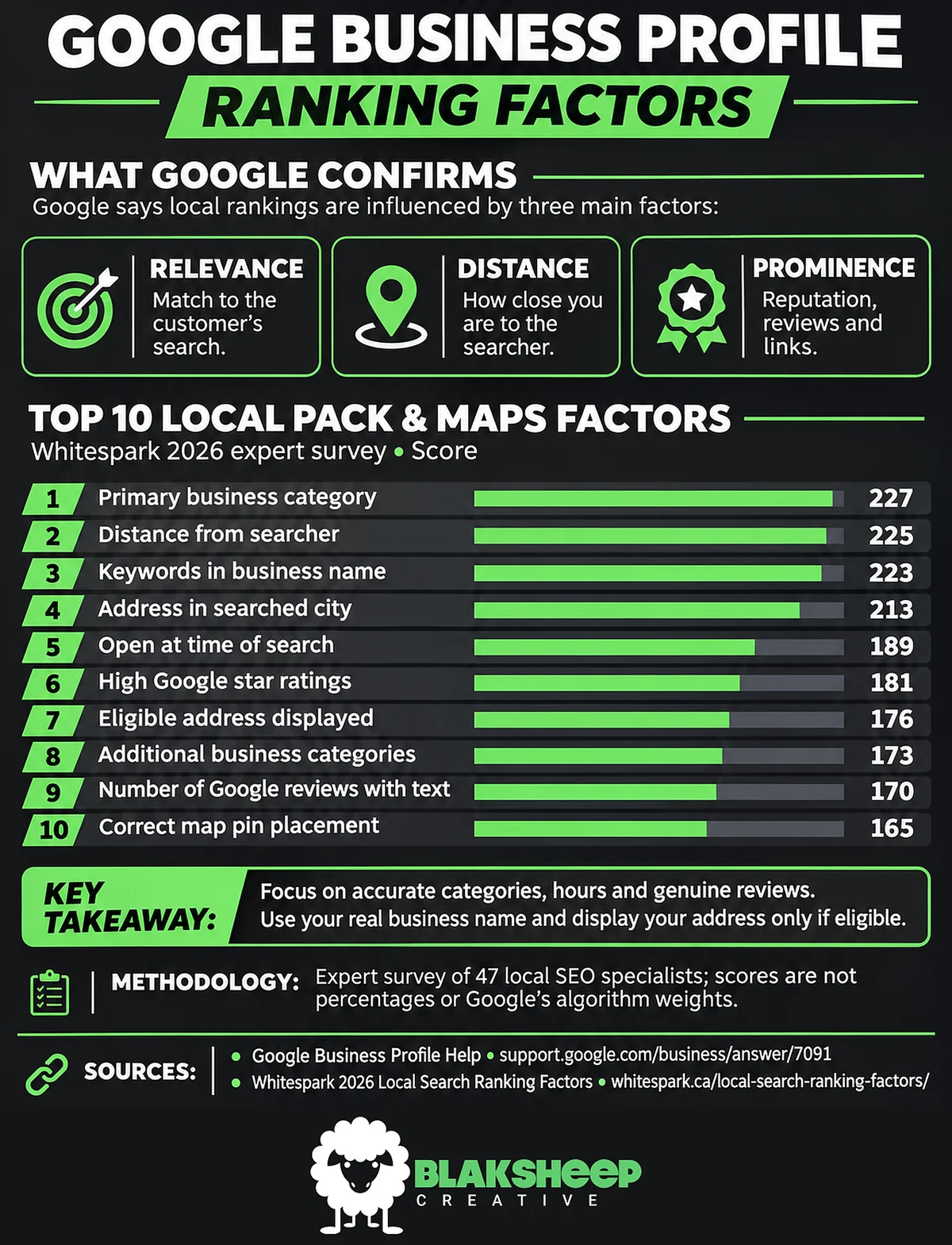
Here are the 10 highest-scoring Local Pack and Maps factors in the report, in plain-language labels.
| Rank | Factor | Expert score |
|---|---|---|
| 1 | Primary business category | 227 |
| 2 | Distance from searcher | 225 |
| 3 | Keywords in business name | 223 |
| 4 | Address in searched city | 213 |
| 5 | Open at time of search | 189 |
| 6 | High Google star ratings | 181 |
| 7 | Address displayed | 176 |
| 8 | Additional business categories | 173 |
| 9 | Google reviews with text | 170 |
| 10 | Correct map pin placement | 165 |
The top three scores sit within four points of each other. That doesn't tell you how much traffic each factor produces, and it doesn't prove that changing one item will move your ranking. Use the survey to decide what to check first, not as a formula for predicting results.
The bigger lesson is how often the survey and Google agree, and where they part ways.
Where Google is silent, treat the expert rating as a reason to look, not a rule. The next sections sort the factors by how much control you have.
Google Maps Ranking Factors You Control Today
Start with profile details you can verify and correct without moving. These improvements are worth making even if your ranking stays the same, because accurate information helps customers decide.
Choose the Right Primary and Additional Categories
Google's category guidance says plainly that the categories you select affect your local ranking. Pick a specific primary category that best describes your main business. Add only categories that describe other genuine parts of your operation, not one for every product or service.
A roofing contractor should not select plumber or electrician just because those searches bring leads. A business that truly offers several services should choose categories that reflect what it is, not a list of search terms.
Correct Hours, Location and Profile Information
Check your regular hours, holiday hours, phone number, website link and listed services. Whitespark ranks being open at the time of the search fifth. That finding comes from the survey; Google's ranking guidance lists hours as profile information without calling them a ranking factor. Never claim to be open around the clock if customers can't actually get service then.
If your location is eligible to be shown publicly, check that the map pin sits on the right property. If customers don't come to your address, follow Google's service-area rules instead. Review your description, remove duplicate services and replace broken links. Add real photos that show what you do.
Those details give you a sensible starting point. The next job is building the reputation no single profile edit can create.
Local SEO Ranking Factors You Can Influence Over Time
Ratings, review count and website links take ongoing work. You can improve the process that earns them, but you can't control the opinions customers share or demand a particular rating.
Earn Genuine Google Reviews
Ask customers for honest feedback after the work is done. Make it easy by sharing your direct review link in a thank-you email, receipt or follow-up text. Don't offer discounts, gifts or payment for reviews, and don't ask only the customers you think are happy.
Google's tips for getting more reviews say incentives such as free or discounted goods are strictly prohibited, and recommend replying to reviews. Answer positive and negative reviews with useful information. A calm, constructive reply to a complaint shows future customers how you handle problems. Our review request routine for restaurants shows what this looks like in one industry.
Build a Reputation Beyond Your Profile
Your website should explain the services you provide, where you work and how customers can reach you. Earn relevant links through real relationships, industry organizations and useful resources. These are long-term efforts, not one-time changes, and the same reputation signals shape how local businesses show up in AI search.
Our Google Business Profile optimization service helps owners organize this work as part of our broader local SEO services. But reputation alone doesn't remove the geographic limits of local search.
Google confirms three broad local ranking factors, but it does not publish their exact weights.
Ranking Factors You Cannot Simply Change
Distance, the city your address is in and your eligibility to display an address are among the survey's highest-rated factors. They can frustrate a mobile business competing against a storefront. They are also poor reasons to break Google's rules.
Google's service-area guidance separates businesses that travel to customers from those that serve customers at their address. If you don't serve customers at your address, remove it from your profile. A hybrid business can show its storefront address and also list the areas it serves. Here's how a bin cleaning business with no storefront sets up its profile under those rules.
Listing service areas tells customers where you work. It doesn't guarantee a top map position in every listed city. Don't rent a remote mailbox or list an unstaffed virtual office; Google's guidelines say those locations aren't eligible. And don't drag your pin somewhere you don't operate.
Instead, build useful website pages for your real services and markets (our notes on city pages with map embeds cover one way to do it), earn reviews from real customers and measure your visibility across the area you serve. The goal is winning the right jobs, not gaming a map coordinate.
The split between what you control and what you can't is most important when it comes to your business name.
The Business Name Question: Keywords Versus Google's Rules
Keywords in the business name ranked third in Whitespark's survey. That doesn't make adding a service and city to your listing name a legitimate tactic.
Google's guidelines for representing your business say your name should reflect your real-world business name, as used on your storefront, website and stationery. Including unnecessary information in the name isn't permitted and can lead to a suspended profile.
Say your business is called Smith Home Services. Renaming the listing "Smith Home Services Best Emergency Plumber Dallas" to chase searches breaks the rules if that isn't your actual name. A business whose established name already includes plumbing can keep it.
The survey measures what experts believe matters. It doesn't show that every business benefits from adding keywords, and it doesn't override Google's policies. Put that energy into accurate categories and information instead of risking the listing your customers rely on.
What Happened When We Cleaned Up Our Own Google Business Profile
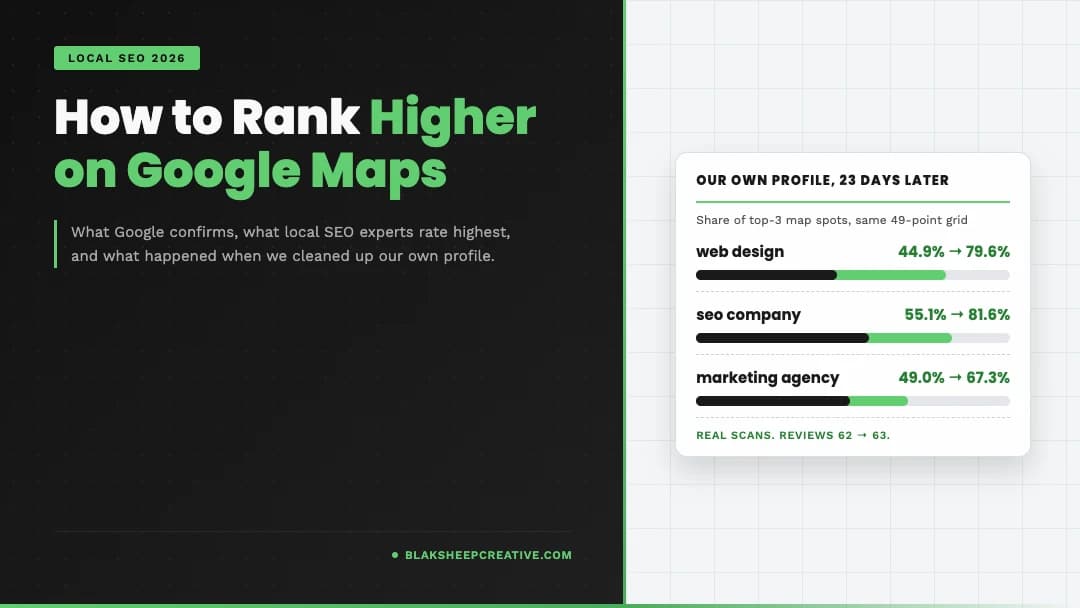
We applied this approach to our own listing in September 2026. We wanted to see how visibility changed around our office using a consistent geographic measurement, not a single search.
On September 10, we accepted Google's removal of the Advertising agency category and cleaned up our additional categories. We removed duplicate and off-target services, rewrote descriptions and added three services we actually offer.
We repaired product links, added products for new service pages, removed placeholder prices, rewrote the business description and added holiday hours. Our service-area cities were updated on September 11, and weekly profile posts started on September 17.
Our address and map pin stayed the same. Reviews went from 62 to 63, with a 5.0 rating both times.
We compared scans of the same 49 search points, arranged in a seven-by-seven grid with a 10-mile radius and the same center point. Share of Local Voice (SoLV) is the percentage of those points where we appeared in the top three map positions.
| Search term | Top 3 share | Average rank where found | Points where found |
|---|---|---|---|
| web design | 44.9% → 79.6% | 4.9 → 2.9 | 43 → 48 of 49 |
| seo company | 55.1% → 81.6% | 4.8 → 2.4 | 48 → 49 of 49 |
| marketing agency | 49.0% → 67.3% | 4.2 → 3.0 | 36 → 45 of 49 |
Source: BlakSheep Creative geo-grid ranking scans and profile change log, September 10 and October 3, 2026. The baseline scan ran the night we made the changes; the second scan ran 23 days later.
Here is what those numbers look like on the map grid itself.
All three search terms improved in top-three coverage, in average position where we were found and in how many grid points showed us at all. We made several profile changes together, and we also worked on the website during this period. We can't isolate a single cause or credit the whole improvement to the profile edits.
The result shows why we recommend keeping a change log and measuring the same locations over time. It doesn't set a timeline or promise the same outcome for another business.
A 30-Minute Google Business Profile Checkup
You don't need to fix everything at once. Set aside half an hour to check what customers see and make a short list of improvements.
- Check your verification status and make sure you can manage the listing. If your business doesn't show up at all, start with why a business might not show up on Google.
- Check the primary category and remove additional categories that don't fit.
- Confirm regular and special hours, phone number and service details.
- Test the website link and any other contact or booking links.
- Check your address eligibility, service areas and map pin.
- Read your recent reviews and set up a routine for asking for honest ones.
Write down what you change, then measure with the same search terms and locations. Our guide to tracking Google Maps rankings explains how to compare visibility across a grid. Track calls, website visits and real inquiries alongside rankings so you can judge what the work is worth.

Ready to put this to work?
Talk to the people who would actually build it.
About the author

Co-Founder & Lead Developer · Denham Springs, LA
Clint has been designing for clients since 2008 and co-founded BlakSheep Creative in 2018. He is also a 29-year firefighter and a 23-year member of IAFF Local 557, which is where the bias toward plain answers over sales copy comes from.
- Veteran-owned
- Firefighter-owned
- IAFF Local 557
Common Questions About Google Business Profile Rankings
Local search gets confusing because owners hear advice about profile edits, reviews, websites and paid ads as if they all feed the same ranking system. Here are the distinctions that matter.
What are the most important local SEO ranking factors?
How long does it take to rank higher on Google Maps?
Can a service area business rank without displaying its address?
Do more Google reviews improve local rankings?
Should I add keywords to my Google Business Profile name?
Can I pay Google to rank higher in the map pack?

Your next step, without the guesswork
No surprises, clear next steps, and a fixed price before anything starts.