By Clint Sanchez · Published · 12 min read
What Should a Local Business Do During a Google Core Update?
Quick answer
Keep running your business, skip big site changes until the rollout ends, and don't judge anything until at least a full week after Google marks the update complete. Measure your website results and your map pack results separately. Reviews and listings drive the map pack. Core updates act on your website's organic rankings, which run on pages, content and links.
Key takeaways
- The November 2026 core update started November 10, 2026. Google says it "may take up to 2 weeks to complete."
- Half of Google's last 16 core updates ran longer than two weeks. The last two November updates took 25 and 23 days.
- Google says to wait at least a full week after an update finishes before analyzing your site in Search Console.
- Core updates are not penalties. Google says they "don't target specific sites or individual web pages."
- Reviews rank in the top 11 local factors for the map pack and below #80 for local organic results, in Whitespark's 2026 survey.
- Map pack rankings can hold, or even rise, while organic traffic falls. Track them separately.
- You don't always have to wait for the next core update to recover. Google says smaller, unannounced core updates can reward real improvements.
If you own a plumbing company, a law office, a dental practice or any business that lives on local search, you have probably already been told what to do about this update. Some of those tips will save you money. Others could have you buying reviews to fix a website problem, or calling an update a failure before it is even finished.

Want this handled instead of DIY?
A 15-minute call, no script, no pressure. You leave with a plan either way.
Google started rolling out its November 2026 core update on November 10. Within a day, the advice for local business owners was everywhere. Some of it is right. Some of it is a guess presented as fact, and a few pieces mix up two different ranking systems in a way that can send you after the wrong fix.
Sources checked November 11, 2026. We update this page each time Google releases a core update, so the dates and rollout table stay current.
The November 2026 Core Update at a Glance
Before getting into what to do, here are the facts Google has published so far. Nothing in this section is a prediction.
| Item | What Google has said |
|---|---|
| Name | November 2026 core update |
| Start | November 10, 2026, 10:06 a.m. Pacific |
| Scope | Applies globally and to all languages |
| Expected length | "The rollout may take up to 2 weeks to complete" |
| Status as of November 11 | Still rolling out, no end date posted |
| Earliest honest read | At least one full week after Google marks it complete |
All of that comes from the November 2026 core update entry on Google's Search Status Dashboard. It is the third broad core update of 2026, after the March and May updates. Check that page for the official finish date rather than counting days on a calendar.
Advice That Holds Up: It Isn't a Penalty, and Quick Fixes Don't Work
Some of what's circulating is correct, and it's worth saying so. Two points match Google's own documentation word for word.
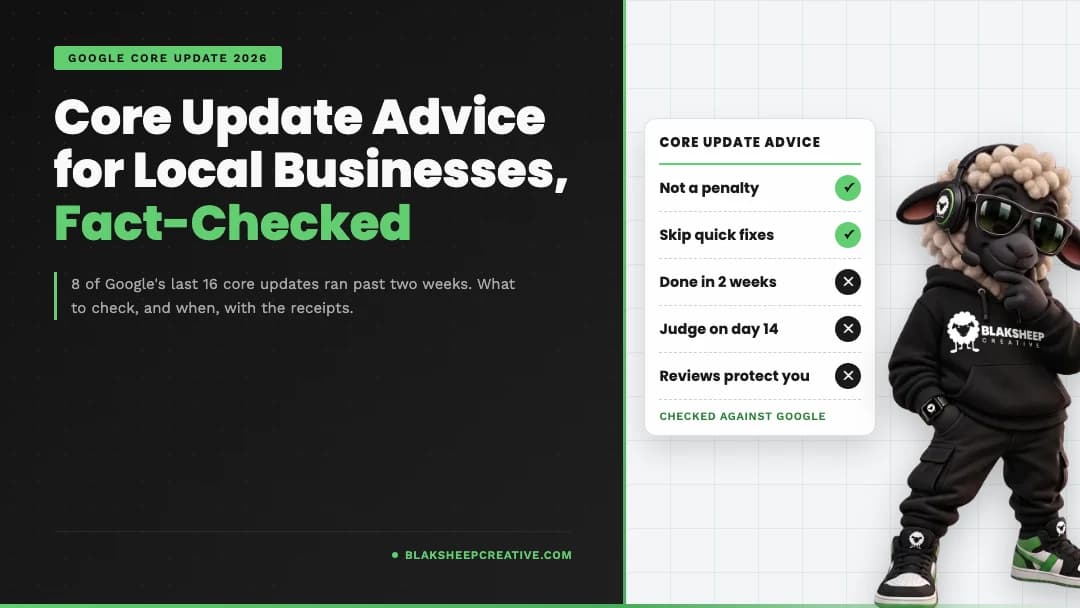
First, a core update is not a punishment aimed at you. Google's guide to core updates and your website says the changes "are broad in nature, and don't target specific sites or individual web pages." It also says most sites "don't need to worry about core updates and may not even realize one has happened."
Second, nobody can sell you a guaranteed fix in the middle of a rollout. The same Google guide tells site owners to "avoid doing 'quick fix' changes" and calls deleting content "a last resort." If someone calls you this week promising to "recover" your rankings for a fee, that's your answer.
Bad Advice #1: "It Will Be Done in Two Weeks"
This is the most repeated date this week, and it's a guess. Google's announcement says the rollout "may take up to 2 weeks." That's a ceiling Google has broken many times, not a promise.
The ranking update history on Google's Search Status Dashboard lists how long every recent core update actually took. Of the last 16, eight ran longer than 14 days.
The November track record is the part to watch. The November 2023 core update ran 25 days and 21 hours. The November 2024 update ran 23 days and 13 hours. The March 2024 update took 45 days. The 2026 updates have run shorter so far, at about 12 days each, so a two-week finish is possible. It just isn't something to plan your holiday season around.
Bad Advice #2: "Judge Your Results the Day It Finishes"
Even when a rollout ends on time, the finish date is not the day to read your numbers. Google's own guide is specific about this.
Google's core update guide says: "We recommend waiting at least a full week after a core update completes before analyzing your site in Search Console." It then says to compare that week "with a week before the core update started rolling out." For this update, that means comparing against November 3 to 9.
So if the update finishes on November 24, the earliest honest read is around December 1. If it runs as long as the last two November updates did, your read lands in mid-December.
There's a second problem for anyone who sells online or depends on holiday traffic. Black Friday falls on November 27 this year. Comparing a holiday week to an early November week will show a change no matter what Google did. Compare against the same weeks last year as well, so seasonality doesn't get blamed on the algorithm.
The November 2026 core update started November 10, 2026. Google says it "may take up to 2 weeks to complete."
Bad Advice #3: "Reviews and Consistent Listings Protect You From a Core Update"
This one sounds right, which is why it spreads. It's a cousin of the "reviews are the factor you control most" pitch from our roundup of the worst SEO advice of 2026, and it mixes up two different scoreboards. Reviews and listings matter a great deal. They just matter for a different set of results than the one a core update changes.
Google's core update guide is about web search. It never mentions the map pack, local listings or your Business Profile. Google describes local results separately, in its help page on how local ranking works, as being "mainly based on relevance, distance, and popularity." That page is also where Google says "more reviews and positive ratings can help your business's local ranking."
The clearest data on the split comes from Whitespark's 2026 Local Search Ranking Factors survey, published in November 2025, where 47 local search experts scored 187 factors. It ranks each factor separately for the map pack and for local organic results.
Look at the gap. A high Google star rating ranks #6 for the map pack and #81 for local organic results. Review count ranks #9 and #104. Review recency ranks #11 and #105. Consistency of listings on sites like Yelp and Yellow Pages ranks #63 and #79.
Now flip it. A dedicated page for each service is the #1 local organic factor in that survey, and #24 for the map pack. The quality of links pointing to your site ranks #3 for organic results and #31 for the pack. That is the scoreboard a core update moves.
To be fair to the advice, listings are not useless. Whitespark's same report says citations "have been decreasing in importance for the past decade," and then adds that AI search is "breathing new life into them." Keep your listings accurate for customers, for the map pack and for AI tools (our look at what claiming Bing Places does and doesn't do for ChatGPT covers that side). Just don't expect them to shield your website from a core update.
The Map Pack and Your Website Can Move in Opposite Directions
Because they're separate systems, your website can drop while your map pack listing holds steady, or the reverse. Treating them as one number is how owners end up fixing the wrong thing.
Joy Hawkins of Sterling Sky wrote in a September 2026 analysis of core updates and local businesses that "algorithmic classifiers impacting standard organic rankings do not suppress Local Pack rankings." She described businesses losing more than 90 percent of their organic traffic while their Business Profile kept top map pack positions. That's an observation from her firm's client audits, not a controlled study, but it lines up with the survey data above.
Timing can differ too. In a 2023 look at the March core update, Sterling Sky found "major changes to the organic results around March 15, 2023," while the local pack update "didn't happen until around March 29, 2023." That was one set of examples, not a rule. It's still a good reason to keep watching the map pack for a couple of weeks after organic results settle.
Bad Advice #4: "There's Nothing to Fix, So Don't Touch Anything"
Half of this is true. If your rankings barely moved, Google agrees you should leave things alone. The other half can cost you months.
Google's guide splits it by size. For a small drop, like position 2 to 4, it says "there's no need to take drastic action" and recommends "avoiding making changes to content that's already performing well." For a large drop, like position 4 to 29, it says to do a deeper assessment of how helpful, reliable and people-first your site is overall, reliable and written for people.
You also may not need to wait for the next big update to see results. The same guide says "you don't necessarily have to wait for a major core update to see the effect of your improvements." In December 2025, Google expanded that section to describe smaller core updates it doesn't announce, calling them "another way that your content can see a rise in position (if you've made improvements)." Google is also clear that a full recovery can take several months.
During the rollout itself, the smart move is narrower than "don't touch anything." Skip big sitewide changes until it finishes, because you won't be able to tell what caused what. Routine work is fine: answering reviews, posting to your Business Profile, fixing a wrong phone number. Write down the date of any change so you can match it to your data later.
“I wish we would have switched sooner. Advanced Office Care was forced to switch services when the big corporate giant we were using decided to discontinue those services. Not only did BlackSheep make the transition easy, Clint and his team also offers more for your money.”
Your Core Update Checklist, Step by Step
Here's the timeline we follow for our own site and our clients. Each step ties back to a source above.
| When | What to do |
|---|---|
| During the rollout | Run the business as usual. Hold off on redesigns, mass rewrites and deleting pages. Log the date of anything you change. |
| The day Google marks it complete | Note the official end date on the Search Status Dashboard. Don't analyze yet. |
| One full week after completion | In Search Console, compare that week with November 3 to 9. Check Web, Images and other search types separately. |
| Same day | Sort by page. A small slide on a few pages means leave them alone. A large drop across many pages means start a deeper review. |
| Two to three weeks after completion | Check your map pack separately with your Business Profile Performance report and a geo-grid scan. |
| The next few months | Improve the pages that lost ground, based on what now outranks them. Expect gradual movement, not an overnight bounce. |
For the map pack check, a single "what rank are we?" number won't tell you much, since map rankings change block by block. Our guide to tracking Google Maps rankings with a geo-grid shows how to measure it properly, and our post on how far you can trust SEO ranking reports explains why one screenshot can mislead you.
What Actually Protects a Local Business Over the Long Run
No single tactic makes a business immune to core updates. What the data does show is which work pays off on which scoreboard.
For your website, the strongest local organic factors in Whitespark's survey are a dedicated page for each service, content that's relevant to the places you serve, and quality links from real sites in your industry. That's the work core updates reward over time, and it's the core of our local SEO services.
For the map pack, it's your primary category, accurate business details, a steady flow of real reviews and replies to them. That's what we handle in our Google Business Profile management. Do both, measure both, and a core update becomes something you check on, not something you panic about.
Google has been changing its ranking systems constantly for decades. Our post on how often Google changes its algorithm covers why most of those changes never show up in your numbers at all.
The Bottom Line on Google Core Updates
A core update is not a penalty, and there's no fix to buy while it's rolling out. That part of the advice going around is right. The rest needs correcting: two weeks is a ceiling Google often breaks, the finish line is not the day to judge, and reviews protect your map pack, not your website.
Check your website and your map pack separately, wait for the right dates, and fix what the data actually points to. If you want help reading the numbers, start with a free website and SEO audit.

Ready to put this to work?
Talk to the people who would actually build it.
About the author

Co-Founder & Lead Developer · Denham Springs, LA
Clint has been designing for clients since 2008 and co-founded BlakSheep Creative in 2018. He is also a 29-year firefighter and a 23-year member of IAFF Local 557, which is where the bias toward plain answers over sales copy comes from.
- Veteran-owned
- Firefighter-owned
- IAFF Local 557
What Local Business Owners Ask About Google Core Updates
These are the questions we've been getting since the November 2026 update started. Short answers first, with the reasoning behind them.
How long does a Google core update take to finish?
Is a Google core update a penalty?
Should I stop updating my website during a core update?
Do Google reviews protect my business from a core update?
Can a core update change my Google Maps ranking?
When can I tell if the November 2026 core update affected my site?
Do I have to wait for the next core update to recover?

Your next step, without the guesswork
No surprises, clear next steps, and a fixed price before anything starts.