
By Clint Sanchez · Published · Updated · 7 min read
Quick answer
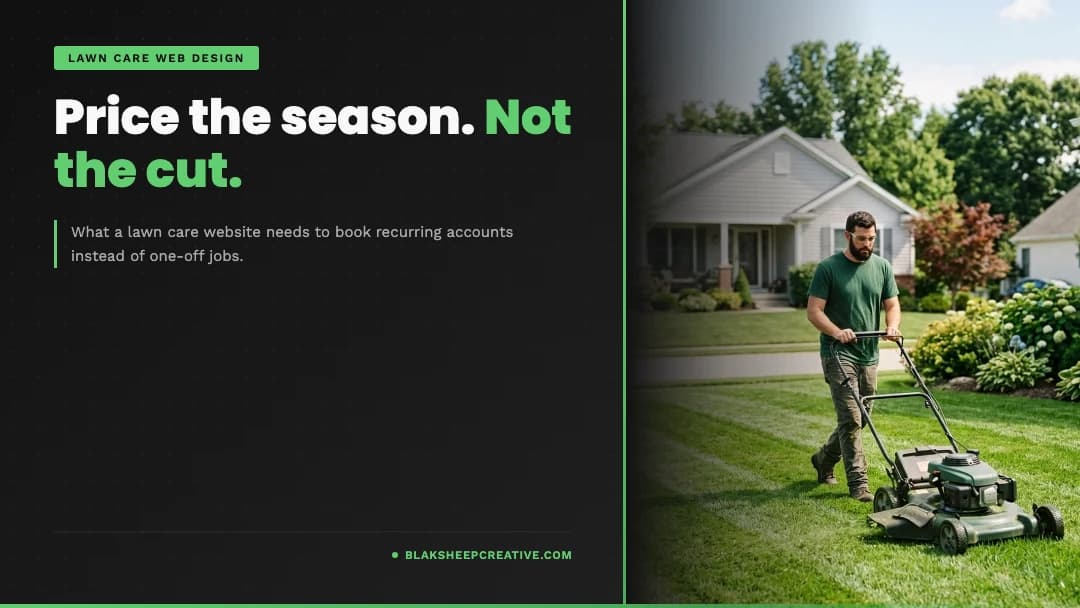
A lawn care website books recurring accounts when it prices the plan instead of the visit, answers the five questions a homeowner has before calling, shows the exact area the crew actually services, and makes signing up for weekly or biweekly service the easiest action on the page. A starting range tied to lot size, a short quote form, honest service area pages, and recent reviews on the service pages do most of the work.
Key takeaways
- According to the National Association of Landscape Professionals, citing IBISWorld, there are 692,777 landscaping service businesses in the United States, and the count grew 4.8 percent in one year.
- NALP reports the landscape services industry reached $188.8 billion in 2025 and expects labor costs to rise roughly 20 percent by the end of 2029.
- A homeowner decides in under a minute: do you serve my street, what does it cost, how often do you come, who shows up, and how do I start.
- Hiding pricing does not protect margin; it sends the visitor to the next result. A starting range tied to lot size filters price shoppers and converts everyone else.
- A working signup asks for the address, the service, and how to reach the person. Every extra field costs sign-ups.
- Route density is the economics of the business, so service area pages should recruit profitable neighborhoods on purpose.
- Ask for a review right after the service, when the yard looks best, and put recent reviews on the service pages.
Around Denham Springs, Livingston Parish, and greater Baton Rouge, the growing season runs most of the year and July is brutal on both grass and crews. A route that zigzags between Watson, Walker, and Prairieville burns fuel and labor a tight Denham Springs route does not, which is why the website should recruit the neighborhoods you already run instead of forty city names.

Want this handled instead of DIY?
A 15-minute call, no script, no pressure. You leave with a plan either way.
Why Most Lawn Care Websites Sell a Cut Instead of a Season
A lawn care website books recurring accounts when it prices the plan instead of the visit, answers the five questions a homeowner has before calling, shows the exact area you actually service, and makes signing up for weekly or biweekly service the easiest action on the page. Everything else is decoration.
TLDR:
- You are competing against roughly 692,777 landscaping businesses nationally, and a few dozen inside your driving radius.
- One-off cuts are the cheapest work to win and the fastest to lose. Recurring accounts are what make a route profitable.
- A visitor decides in well under a minute: do you serve my street, what does it cost, how often do you come, who shows up, and how do I start.
- Hiding pricing does not create a phone call. It sends the visitor to the next result.
- Service area pages beat a list of city names, but only when each one says something true about that area.
- Reviews carry more weight than any claim you write about yourself, especially for a service that enters someone’s property weekly.
We build for lawn and landscape companies around Denham Springs, Livingston Parish, and greater Baton Rouge, where the growing season is long, the summer is brutal on both grass and crews, and a route can be profitable or worthless depending on how tightly the stops sit together. The pattern below shows up on almost every site we inherit.
You Are One of Almost 700,000 Landscaping Businesses
The scale of this trade is easy to underestimate from inside a single truck. According to the National Association of Landscape Professionals industry statistics, citing IBISWorld, the landscape services industry reached a market size of $188.8 billion in 2025, employs more than 1.4 million people, and is made up of 692,777 landscaping service businesses. That business count grew 4.8 percent in a single year.
NALP also reports that the top concerns among landscape companies are finding qualified employees and holding profit levels, with labor costs expected to rise roughly 20 percent between now and the end of 2029. That is the real argument for recurring work. A route full of scheduled, predictable stops absorbs a labor increase. A calendar full of one-off cuts does not.
Want the short version for your own site? Book a free 15 minute discovery call and we will tell you which of the five below your site is missing.
The Five Things a Homeowner Decides Before They Call
Somebody standing in their yard on a Saturday morning is not reading your about page. They are running a very short checklist, and if any item comes back unanswered they close the tab and open the next result.
Price the Plan, Not the Cut
The single biggest change we make to lawn care sites is moving pricing from a per-cut number to a seasonal plan. A homeowner comparing three companies on price per visit will pick the cheapest one and leave the moment somebody cheaper shows up. A homeowner choosing a plan is choosing a relationship, and that is a different decision.
You do not have to publish an exact figure for every property. A starting range tied to lot size does the job: it filters out the person shopping for twenty dollars a cut, and it gives everybody else enough confidence to fill in the form. Silence on price does not protect your margin. It just moves the conversation to whoever was willing to answer.
NALP reports the landscape services industry reached $188.8 billion in 2025 and expects labor costs to rise roughly 20 percent by the end of 2029.
Make Signing Up the Easiest Thing on the Site
If the only way to become a customer is to call during business hours, you are collecting a fraction of the people who wanted to hire you. Most of this traffic arrives in the evening and on weekends, from a phone, while the person is looking at the grass.
A working signup asks for the address, the service, and how to reach them. That is enough to quote and schedule. Every extra field costs you sign-ups, and asking for a property size in square feet when the visitor has no idea costs you more than it saves. Confirm immediately, then follow up on a schedule rather than when somebody remembers. This is the same lead follow-up problem we solve on the marketing side for lawn and landscape companies.
Show the Route You Actually Run
Route density is the whole economics of this business. Two lawns on the same street are worth far more than two lawns twenty minutes apart, and your website should be recruiting the profitable ones on purpose.
That means a page for each area you genuinely service, with something specific on it. The neighborhoods you already run, the day you are usually in that area, what the soil and grass are like there. A list of forty city names with the same paragraph rewritten forty times is thin content, and it reads as thin to a homeowner too. Fewer, truer pages win. Pair those with a properly maintained Google Business Profile, because for a search like lawn service near me, that listing is doing more work than your homepage.
Reviews Do the Work Your Copy Cannot
Lawn care is a trust purchase in a way that surprises people who have been doing it for years. You are asking a stranger to let a crew onto their property every week, often while nobody is home. No sentence you write about your own reliability carries the weight of thirty neighbors saying the same thing.
Ask at the moment the yard looks best, which is right after the service, not at the end of the month. Put recent reviews on the service pages rather than hiding them on a testimonials page nobody visits. A steady review generation routine compounds, and it is the cheapest marketing available to a route business.
Not sure which of these is costing you the most? We will look at your site and tell you plainly. Book a free discovery call.
What Lawn and Landscape Owners Ask Us About Their Websites
These come up on nearly every call with an owner who is tired of quoting one-off cuts. A few of the answers are reasons to spend less than you were planning to.
Should I put prices on my lawn care website?
Publish a starting range rather than an exact figure. A range tied to lot size filters out price shoppers and gives serious buyers enough to act on. Hiding price entirely does not protect your margin, it just sends the visitor to a competitor who answered the question.
How many service area pages should I have?
One for each area you genuinely run a route in, and no more. Five pages that name real neighborhoods and describe the actual conditions there will outperform forty pages built from the same paragraph. Thin city pages are easy to spot and they drag the whole site down.
Do I need online booking, or is a quote form enough?
A short quote form is enough for most residential lawn care, because the price depends on the property. What matters is that the form is answerable from a phone in under a minute and that somebody responds fast. Full self-serve booking is worth it once your pricing is genuinely standardized.
How do I get more recurring customers instead of one-time cuts?
Make the recurring plan the default option on the page and the one-time cut the exception. Show the season, not the visit. When the plan is presented first and priced as a plan, a meaningful share of people who came looking for one cut will sign up for the season instead.
My website is two years old. Does it need replacing?
Usually not. Most lawn care sites we look at need pricing, a real signup path, and honest service area pages, all of which can be added to what exists. Replacing a site that already loads fast and reads well is a way to spend money without changing the number of accounts you sign.
How long before a new lawn care website brings in accounts?
Conversion changes are immediate, because they act on traffic you already have. Search visibility for local terms usually takes a few months, and it lands hardest if the work is done in winter rather than in April when everybody is already booked.
Ready to sign more accounts instead of quoting more cuts? We build lawn care websites that price the season, capture the signup, and show the route you actually run. No sales pitch and no commitment, just a straight read on what your site is missing.
More on the marketing side in our guide to digital marketing for lawn care and landscaping companies, or see how we approach lawn care website design.
About the author

Founder & Lead Developer · Denham Springs, LA
Clint has built and marketed websites for 26 years, since founding BlakSheep Creative in 2000. He is also a 29-year firefighter and a 23-year member of IAFF Local 557, which is where the bias toward plain answers over sales copy comes from.
- Veteran-owned
- Firefighter-owned
- IAFF Local 557
More Questions About Lawn Care Websites
Short answers to the questions that come up most on this topic.
Why do recurring accounts matter more than one-time cuts?
What should a lawn care quote form ask for?
What makes a good service area page for a lawn company?
Why do reviews matter so much for lawn care?
When is the best time to work on a lawn care website?
How does a Google Business Profile fit with a lawn care website?

Your next step, without the guesswork
No surprises, clear next steps, and a fixed price before anything starts.