By Clint Sanchez · Published · 14 min read
Quick answer
Contractor leads come from rented sources, like Angi, Thumbtack and Google Local Services Ads, where you pay for each lead, and from owned sources, like your Google Business Profile, your website, your reviews and referrals. Rented leads are fast but often shared with other pros. Owned leads take longer to build but cost nothing extra per call once they work.
Key takeaways
- A rented lead is one you pay for each time. An owned lead comes from an asset you control, like your Business Profile or website.
- Angi says a single service request can result in multiple leads, and Thumbtack lets a customer contact up to five pros in the first four hours.
- Angi's credit rules say you get no credit when the customer hires someone else or you simply do not win the job.
- Google Local Services Ads charge per valid lead, not per click, and that stays true after the 2026 move into Performance Max.
- To see how many paid leads one owned channel replaces, divide the channel's monthly cost by your average lead price.
- Owned leads are only worth something if you answer them. Invoca found 27% of calls to home service businesses go unanswered.
If you run a trade business, you know the pattern. The phone rings while you are on a roof or under a house, the lead app pings with a job three towns over, and by the time you call back, the customer has already booked someone else. Your service area is only so big, and every marketplace in it sells the same customers to the same handful of pros.

Want this handled instead of DIY?
A 15-minute call, no script, no pressure. You leave with a plan either way.
Every contractor lead comes from one of two places. Either you rent it, one lead at a time, from a marketplace that also has your competitors on its roster, or you own it, because a customer found your business directly and called you. Both can fill a calendar. Only one of them keeps working after you stop paying.
Where Do Contractor Leads Come From?
We build websites, manage Google Business Profiles and run follow-up systems for service businesses across the U.S., so this guide is written from the owned side.
It lays out what you are actually buying from each marketplace, how to judge if it pays, and how to build the owned lead channels a contractor needs so you buy fewer leads over time. The trade table near the end points 13 trades to guides written for them.
What Is the Difference Between Rented and Owned Leads?
The difference is who controls the source. When you rent a lead, a marketplace owns the customer relationship until it hands you a name and a phone number. When you own a lead, the customer found you, on your profile or your website, and the next customer will find you there too.
Rented sources include Angi, whose pro lead program runs from HomeAdvisor's pro site, Thumbtack, Google Local Services Ads, Houzz and similar directories. You pay per lead, per contact or per membership. The meter runs every month, and the moment you stop paying, the flow stops.
Owned sources are the assets that keep working without a per-lead fee:
- Your Google Business Profile, the listing that shows up in the map results.
- Your website, ideally with a separate page for each service you sell.
- Reviews, which decide which listing a customer taps first.
- A follow-up system, so a missed call turns into a text and not a lost job.
- Referrals and past customers, who already know your work.
Owned channels are not free. They cost time or money to build and maintain. The difference is that the cost does not scale with every phone call. A Business Profile that brings in twenty calls a month costs the same as one that brings in two.
Shared vs. Exclusive Leads: What You Are Actually Buying
A shared lead is one customer request sold to more than one business. An exclusive lead goes to you alone. Most marketplace leads sit somewhere in between, and the details matter more than the label.
Angi's investor materials define a lead as a connection between a consumer and a pro, and state plainly that a single service request can result in multiple leads. Angi's own pro FAQ says it will connect customers with multiple service professionals.
The same May 2025 document says that since January 2025, homeowners arriving from Angi's network partners must choose the pros they want to match with, which Angi says means fewer leads per request.
Thumbtack's Quality Commitment page says it limits the number of pros a customer can contact to five in the first four hours of a search, and that customers can contact more pros after those four hours.
Google Local Services Ads work differently. Google describes them as pay-per-lead listings where customers can call you, message you or book with you directly. Each contact is with your business, but the customer is looking at a page of competing listings and can contact as many of them as they like.
So "exclusive" usually means one of two things: the vendor did not sell the same request to anyone else, or the customer reached out to you by name. Neither one means the customer is not calling your competitors. When a seller promises exclusive leads, ask exactly which of those two they mean, and get it in writing.
How Angi, Thumbtack, and Google Local Services Ads Charge
All three charge per lead, but each one decides the price and handles refunds differently. None of them publishes a fixed price list for contractors, so the honest answer to "how much does a lead cost" is that it depends on your trade, your market and the job size.
| Marketplace | What you pay for | Who sets the price | When you get money back |
|---|---|---|---|
| Angi (HomeAdvisor pro network) | A fee for each lead you are matched to, plus optional memberships | Angi; its pro FAQ says different sized jobs have different lead fees | Duplicates, wrong job type or zip code, bad contact info. Not if the customer hires someone else or you lose the job |
| Thumbtack | Leads from customers who contact you; for Opportunities, only if the customer replies | Thumbtack prices by job type, job size, pro supply and market; you set the lead price you will pay | Automatic refund if the customer replies to no pro within 72 hours; other cases under its refund policy |
| Google Local Services Ads | Each valid lead: calls, messages, booking requests | Varies by location, job type, lead type and bidding mode | Automatic credits for leads Google later judges low quality |
Read the table as a guide to the mechanics, then check the current terms in your own account before you commit a budget.
Angi and HomeAdvisor
Angi's pro FAQ says you pay a fee for each lead you match to, and that different sized jobs carry different lead fees. Angi's second quarter 2026 results also list membership subscription revenue from pros, so a membership can sit on top of lead fees.
The part most owners learn the hard way is the credit policy. Angi's lead credit guidelines list what is not eligible for a credit: the consumer not calling you back, already finding someone, changing their mind, "just shopping," and "you did not win the job." Credits must be requested within 30 days, and unused credits expire six months after they are issued.
Thumbtack
Thumbtack's help page on how much pros pay for leads says the goal is to make the cost match how valuable the job is. Prices vary with the type and size of the job, how many pros are available and your market.
You set your lead prices, which Thumbtack describes as the exact amount you pay for each lead, and you auto-pay when a matching customer reaches out to you.
Opportunities work the other way around. You reach out first, the price is shown up front, and you only pay if the customer responds. Thumbtack also gives an automatic refund when a customer does not reply to any pro within 72 hours.
Google Local Services Ads
Google's Local Services help page says you are charged for each valid lead, and that lead prices may vary by location, job type, type of lead and bidding mode. Follow-up calls from the same customer are not charged again if there is interaction within 15 days.
A missed call during business hours can count as a lead if the caller stays on the line for more than 20 seconds, so an unanswered phone still costs money.
Google is also moving these ads into Google Ads. Its migration notice says the first phase began in August 2026 for select U.S. home service advertisers, with broader groups following in late 2026. You still pay only for valid leads, not clicks, but manual bidding, such as setting a maximum cost per lead, is no longer supported.
A rented lead is one you pay for each time. An owned lead comes from an asset you control, like your Business Profile or website.
Are Angi Leads Worth It?
Angi leads are worth it when the jobs you win cover the cost of every lead you paid for, including the ones you lost. That depends on three numbers only you have: your average lead price, your close rate on those leads, and your average profit per job.
Here is the fair case for Angi. It puts you in front of homeowners who are ready to hire, and it does not require you to build anything first. For a new business with no reviews and no website, it can be the fastest way to get the first jobs on the calendar.
Here is the case against it. A request can turn into leads for several pros, so you are often competing on speed and price from the first minute.
The credit rules give nothing back when the customer hires someone else. And none of the money you spend there builds anything you keep: the reviews and visibility you earned on the platform stay there when you stop paying.
The practical test is the math below. Track every Angi lead for 60 to 90 days: what you paid, if you reached the customer, if you quoted, and if you won.
If your cost per won job is well under your profit per job, keep it as one channel among several. If it is not, the budget is better spent on a channel you own. For a shorter take on alternatives, see our post on growing a service business beyond Angi.
The Math: How Many Paid Leads Does One Owned Channel Replace?
One owned channel replaces as many paid leads as its monthly cost would have bought. The formula is simple, and it uses your numbers, not industry averages, because lead prices vary too much by trade and market for an average to mean anything.
Step 1: Your cost per won job from paid leads. Cost per won job = average lead price ÷ close rate on paid leads.
Step 2: Paid leads the owned channel replaces. Leads replaced = monthly cost of the owned channel ÷ average lead price.
Step 3: Jobs the owned channel has to produce to break even. Break-even jobs per month = monthly cost of the owned channel ÷ cost per won job.
Here is a worked example. The inputs are made up for illustration only. They are not market prices, so replace each one with your own.
| Input | Example value (illustration only) |
|---|---|
| Average price per paid lead | $60 |
| Close rate on paid leads | 1 in 5 (20%) |
| Monthly cost of an owned channel | $299 |
With those inputs, each won job from paid leads costs $60 ÷ 0.20 = $300. The owned channel's $299 a month equals about five paid leads ($299 ÷ $60). And it breaks even if it produces about one won job a month ($299 ÷ $300).
The $299 is not invented: it is the top monthly plan of Grow for Contractors, our website, CRM and follow-up package, which runs $149, $199 or $299 a month with no setup fee. Use whatever an owned channel actually costs you, even if that is your own hours valued at your billing rate.
Two cautions keep this math honest. First, owned channels take time to build, and nobody can promise you a date when the calls start. Second, a lead you own and miss is still a lost job, so the math only holds if you answer.
Build the Leads You Own: Google Business Profile and Service Pages
For most local contractors, the two owned assets that produce calls are a complete Google Business Profile and a website with a page for every service. Start there before you spend on anything else.
The Business Profile is the listing that shows up in Google's map results when someone searches for your trade near them. It is free to claim. What matters is that it is complete and accurate: the right primary category, the services you actually sell, your real service area, photos of your work and hours you keep.
We set up and maintain Business Profiles for contractors because it is the cheapest visibility a local trade business can get.
The website is where a customer goes to decide. A single page that lists everything you do gives Google and the customer very little to go on. A separate page for each service, like panel upgrades, EV charger installs and generator hookups for an electrician, gives each search a page that answers it.
That is the core of the contractor websites we build, and it turns a site from a brochure into a lead source. For example, we built Owens Electrical Contractors in Walker, Louisiana, with a local search focus, and rebuilt EZ Solar & Electrical with a page for each service.
Search visibility on those pages is earned over time with local SEO for contractors: consistent business details across the web, pages that match what people search, and links from other local sites. It is slower than buying leads. It is also the part that keeps paying.
“BlakSheep Creative is amazing with the ability to take an idea from a conversation and bring it to life! From custom logo to website design, call BlakSheep!”

Reviews: The Lead Source Most Contractors Leave on the Table
Reviews decide which listing gets the call. A customer who searches for a contractor sees several options side by side, and the star rating, the review count and the dates on those reviews settle most of the choice before anyone picks up the phone.
BrightLocal's Local Consumer Review Survey 2026, published in February 2026, found that 97% of consumers read reviews for local businesses. The same survey found that 74% only care about reviews written in the last three months, and 47% won't use a business that has fewer than 20 reviews.
The takeaway for a contractor: a steady stream of recent reviews beats a big pile of old ones. BrightLocal also found that 80% of consumers say they are likely to use a business that responds to all of its reviews, so a short, specific reply to every review is part of the job.
The simplest way to get there is to ask after every completed job, by text, with a direct link, while the customer is still happy. Our review work for contractors automates that request so it goes out every time, not just when someone remembers.
Missed-Call Follow-Up: Keep the Leads You Already Earned
A lead you own is only worth something if someone answers it. Contractors are on job sites most of the day, so the phone rings at the worst possible times, and every unanswered call is a lead you paid for in time or money and then lost.
Call tracking company Invoca reported in a 2024 analysis of home services calls that 27% of calls to home services businesses are not answered, and that its platform data shows less than 3% of callers who get pushed to voicemail leave a message. Voicemail is not a follow-up plan.
The fix is a missed-call text back: when a call goes unanswered, the caller gets a text within seconds that names your business and asks what they need.
The lead lands in a CRM with the source attached, and someone gets a task to call back. We cover the full setup in our guide on how to stop losing leads after missed calls, and we build it as part of our lead follow-up automation service.
Speed matters for paid leads too. If you keep buying from a marketplace, the same text-back and follow-up system raises the share of those leads you actually reach.
Contractor Leads by Trade: Where to Go Next
Every trade has its own version of this problem. Some get most of their work from storms or seasons, some from commercial contracts, some from repeat customers, and the right mix of rented and owned leads is different for each.
The table below links each trade to the marketing we run for it and, where we have one, a guide to how that trade gets its leads. Accounting firms and day spas are not contractors, but the same rented-versus-owned math applies to them, so they are here too.
| Trade | Lead guide for owners |
|---|---|
| Cleaning companies | How to win commercial cleaning contracts |
| Tree service | Where tree jobs come from |
| Flooring | Buying vs. owning flooring leads |
| Electricians | How electrical contractors get leads |
| Concrete contractors | Finding concrete jobs that pay |
| Handyman services | Getting more handyman jobs |
| Land clearing | Where land clearing work comes from |
| Pool service | Growing a pool route |
| Home inspectors | Marketing ideas for inspectors |
| Accounting firms | Getting more tax clients |
| Day spas | Spa marketing ideas |
| Home theater installers | Covered in this guide |
| Outdoor power equipment dealers | Covered in this guide |
If your trade is not listed, the principles above still apply. Painters, for example, will find more detail in our lead generation tips for painting companies, and plumbers in our plumbing marketing strategies.
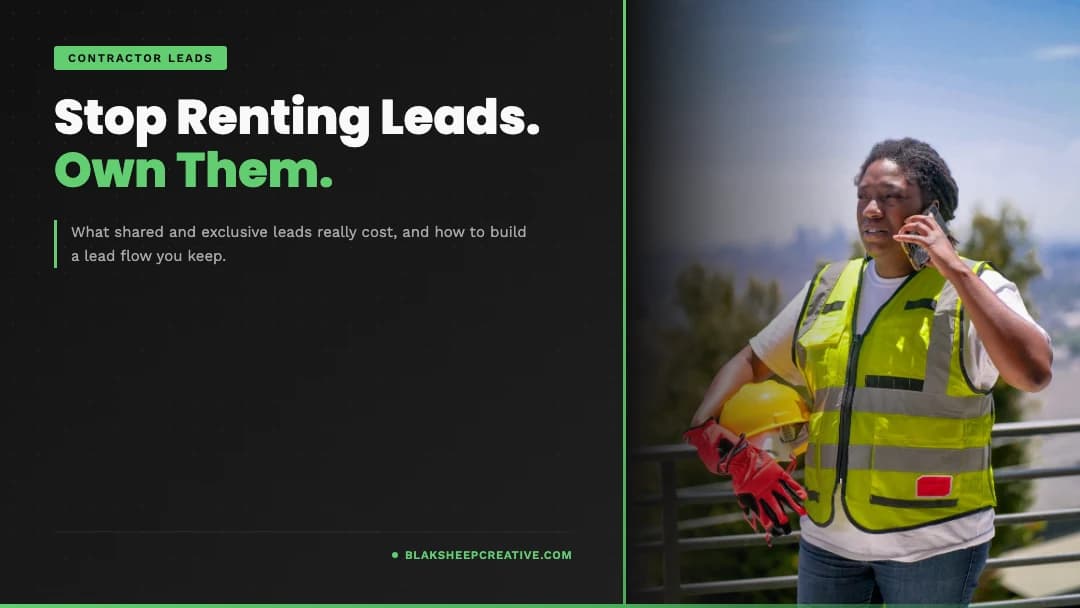
Angi says a single service request can result in multiple leads, and Thumbtack lets a customer contact up to five pros in the first four hours.
When Buying Leads Still Makes Sense
Buying leads is not a mistake. Relying on bought leads as your only source is. There are times when paying per lead is the right call.
- You are brand new. With no reviews and no site, a marketplace can bring the first jobs while you build the owned side.
- You are entering a new service or area. Paid leads can test demand before you build pages for it.
- You have a gap in the calendar. A short burst of paid leads can fill a slow month.
- Your numbers say it pays. If the math above shows a cost per won job well under your profit per job, keep the channel.
The goal is a mix that shifts over time. Each month, a little more of your work should come from sources you own, and a little less from sources you rent. Track the source of every job so you can see that shift happen, or see that it is not happening.
Stop Renting Every Lead
Paid leads will always have a place, but a business that only rents its customers is one price increase away from a bad month. Run the math with your own numbers, keep the marketplaces that pay, and put the rest of that budget into a Business Profile, a site, reviews and follow-up you own.
If you want help with the owned side, we can look at your Business Profile, your website and how your calls get answered, and tell you plainly what we would fix first. Book a free discovery call and bring your lead invoices.

We build this for contractors.
Fixed quote before we start, and you talk to the people who do the work.
About the author

Founder & Lead Developer · Denham Springs, LA
Clint has built and marketed websites for 26 years, since founding BlakSheep Creative in 2000. He is also a 29-year firefighter and a 23-year member of IAFF Local 557, which is where the bias toward plain answers over sales copy comes from.
- Veteran-owned
- Firefighter-owned
- IAFF Local 557
Contractors Ask About Buying and Owning Leads
These are the questions owners ask most when they are deciding to keep paying for leads or build their own.
Are Angi leads worth it for contractors?
What is the difference between shared and exclusive contractor leads?
How much do contractor leads cost?
Do you pay for a lead if you do not get the job?
How can contractors get leads without paying for each one?
How fast should a contractor respond to a new lead?

Your next step, without the guesswork
No surprises, clear next steps, and a fixed price before anything starts.