
By Clint Sanchez · Published · Updated · 3 min read
Quick answer
The main purpose of a website is to turn visitors into customers. Every marketing channel a business uses, from search to social media to ads, is built to send people to the website, and the website's job is to convert them. In marketing terms that is a conversion. A badly designed site wastes the money spent on every channel feeding it, which is why design starts with goals, audience, and purpose before any code.
Key takeaways
- A website is the core of online marketing; every other channel exists to bring visitors to it.
- The measure of a website is conversions, not how much information or how many photos it holds.
- Basic coding knowledge does not make someone a web designer; a site built without planning rarely converts.
- A real web design process runs seven phases: analysis, planning, design, content, development, testing, and deployment.
- Content is the most important phase, because a site that looks good but does not express the message satisfies neither visitors nor search engines.
- Wireframes and mockups built to UX and UI best practices improve satisfaction and increase conversions.
- Launch is not the end: monitoring, maintenance, and hosting keep the site doing its job.
What is a website’s purpose?
Perhaps you’re thinking about having your first website made or maybe your existing one is outdated and not helping you reach your business goals.
Either way, you should know a little about web design.
First off, it’s important to go into things realizing that a website is the core of your online marketing activities.
No matter what marketing channels or techniques they use, they all are geared to bring visitors to your website.
And, the main purpose of a website is to turn these visitors into customers.
In marketing terms, that’s called a conversion. A badly designed website will basically cause you to waste money on marketing methods.
Want this handled for you? We build and market websites for Louisiana businesses, and we will tell you honestly if you do not need us.
Watch our video and continue reading to learn more about our proven methods to have your website work for you and convert visitors into customers.
Just because they say they are a web designer doesn’t make it so.
Many people in the industry call themselves web designers but they really are just a bunch of geeks with some basic coding knowledge.
Of course, without much planning, they will pretty quickly create a Web site for you with lots of information, photos, and contacts.
But the question is, “is that the way to turn the visitors into your customers?
Is that what you need?”
And the answer is simple – No.
What you have to do is look for someone serious about web design.
Well, that’s where we come in. This is how we make Web sites by following this seven-phase web design process.
7 steps we use to creating a website.
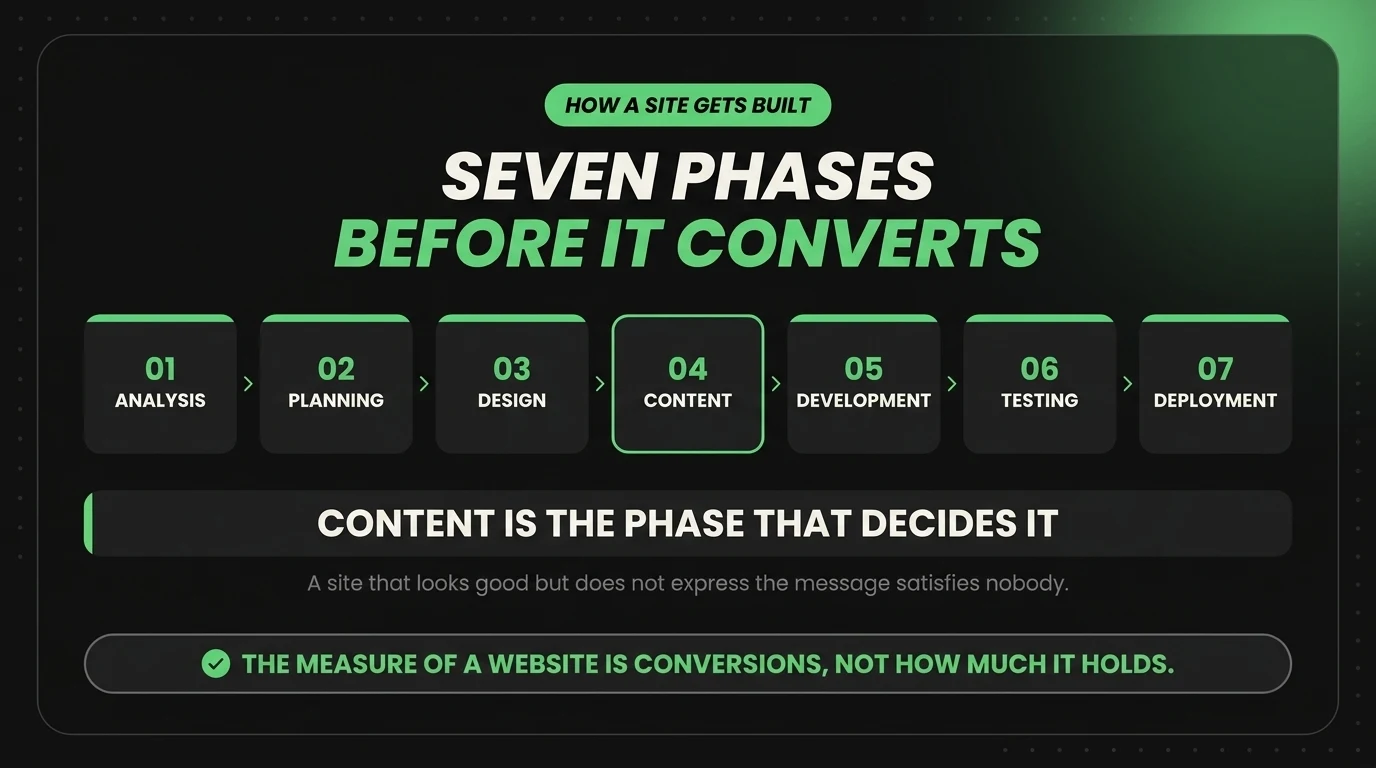
- Analysis
Information Gathering
We discuss with you to determine exactly what your website needs to do for you. What goals do you want it to reach? What’s the site’s purpose? Who is your target audience? - Planning
Getting everything ready.
We define the site map, structure, and technologies that will be implemented on your site. - Design
The fun part.
We create wireframe models and mockups of the site to make sure that it matches design best practices and the UX/UI (User Experience / User Interface.) It’s proven that the UX/UI Design of the application improves the user experience and customer satisfaction that ultimately helps increase the number of conversions. - Content
Crafting your message.
This is perhaps the most important of the process. While a site may look pretty, if it doesn’t express your message, you (and search engines) won’t be very happy. In this process we choose the right text, photos, and videos all optimized not only for your visitors, but also for search engines. This is called Search Engine Optimization (SEO). - Development
Let the coding begin.
Here, we actually create your website using html, css, java, and whatever other technologies that it may require to achieve your goals. Our experienced web developers actually know code, they don’t simply drag and drop like other so called “developers.” - Testing
Check, double check, repeat.
We test all of the technical features like code and scripts’ compatibility with major browsers. We also ask ourselves if your website really fulfills its’ purpose. - Deployment
3-2-1 Takeoff
After we launch the site, our job is definitely not complete.
We monitor the site for any unexpected hiccups or modifications that need to be made.
We offer affordable maintenance and hosting plans and take care of all the technical aspects of your website, allowing you to rest easy knowing that your site is fulfilling its’ purpose.
Website Design is complex, but we make it simple.
Web design is a very complex process, but we believe this is how websites should be done.
We take care of the heavy lifting so that you don’t have to. Our customers agree.
And if you share our passion for high-quality websites, get in touch with us and let us do what we do best. Design awesome websites.
Thinking about a new website, redesign, or rebuild? Talk through the project before you spend a dollar — 15 minutes, no sales pitch.
About the author
Founder & Lead Developer · Denham Springs, LA
Clint has built and marketed websites for 26 years, since founding BlakSheep Creative in 2000. He is also a 29-year firefighter and a 23-year member of IAFF Local 557, which is where the bias toward plain answers over sales copy comes from.
- Veteran-owned
- Firefighter-owned
- IAFF Local 557
Common Questions About What a Website Is For
Short answers to the questions that come up most on this topic.
What is a website conversion?
What should I know before hiring a web designer?
What happens in the analysis phase of a web design project?
Why is content the most important part of a website?
What does a web designer do after the website launches?

Your next step, without the guesswork
No surprises, clear next steps, and a fixed price before anything starts.