
Digital Marketing for Softball and Club Sports Teams
Tournament fees, travel, and uniforms are climbing every season, and most teams are still funding them with a letter that asks for a favor. We build the site, the sponsorship material, and the player pages that turn the ask into something a business can say yes to.
Up 46 percent in five years.
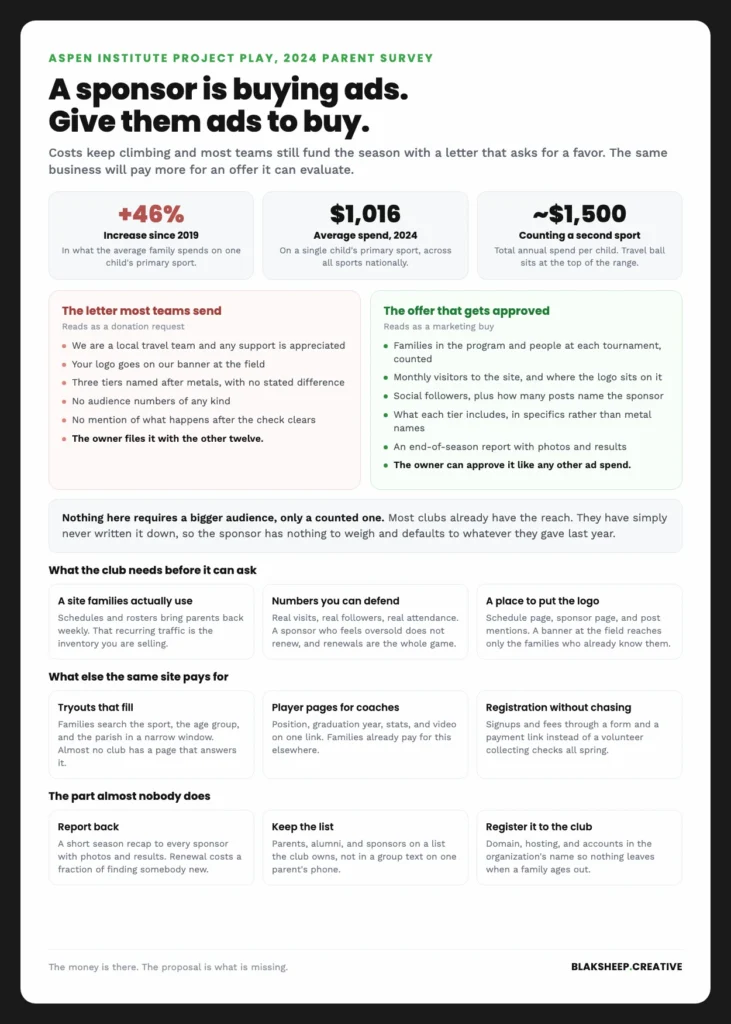
Youth sports got expensive. The Aspen Institute’s Project Play 2024 national parent survey found the average U.S. sports family spent $1,016 on one child’s primary sport, a 46 percent increase since 2019. Counting a second sport, total spending approached $1,500 per child. The survey covered 1,848 parents across every state.
Travel ball sits at the top of that range, not the middle. Tournament entries, hotel blocks, uniforms, and facility time add up long before anybody buys a bat.
So every club is running a fundraising operation alongside a sports program, and most of them do it with a letter that asks a local business for a favor. The business owner reads it as a donation request, files it with the others, and gives whatever they were going to give. A team that can show what a sponsor actually gets is having a completely different conversation.
Where teams leave money on the table
The gaps that cost you sponsors and players
- The sponsorship ask is a favor, not an offer. No audience numbers, no placement details, no proof anybody will ever see the logo. The business has nothing to evaluate.
- Sponsor logos go on a banner and nowhere else. The banner is seen by the families who already know the sponsor. Nothing reaches anybody new.
- Nothing exists for college coaches. Player video and stats live in a parent’s phone or a paid recruiting profile, not on a page the club controls.
- Tryout information is impossible to find. Families searching for a team in your age group land on a Facebook post from two seasons ago.
- Registration and payment are manual. A volunteer chasing checks and texting reminders, when a form and a payment link would do it.
- Everything lives in one person’s phone. The schedule, the roster, and the sponsor contacts leave when that parent’s kid ages out.
- No list, so every announcement is a scramble. Group texts and a Facebook group nobody sees, instead of an email list the club owns.
- Sponsors never hear what happened. No report, no photos, no thank you at season end, so renewal starts from zero every year.
What actually works
Give a sponsor something to buy
The whole strategy comes down to making the invisible visible.
Start with a real sponsorship package. Tiers with actual placement, what each one includes, and honest numbers behind them. Website traffic, social following and reach, tournament attendance, families in the program. A local business can approve a few hundred dollars against real numbers far more easily than against a plea.
Then give sponsors something that works year round. A logo on a banner reaches the people who already know them. A logo on a site that families actually visit for the schedule, plus a mention when the club posts results, is advertising they can point at.
Next, build player pages the club owns. A page per athlete with position, graduation year, stats, and video is what a college coach can be sent directly. Families are already paying for recruiting services. Much of that value can live on the club’s own site.
Then make tryouts findable. Families search for the sport, the age group, and the parish or city in the weeks before tryouts. Very few clubs have a page that answers it, so this is unusually easy to win.
Finally, close the loop. A short end-of-season report to every sponsor with photos, results, and what their money paid for. Renewal is a fraction of the work of finding somebody new, and almost nobody does it.
The work
What we run for a club
Nine pieces of work. A single team usually needs three or four.
Why clubs call us
We have written this playbook already
- We have already written on this. Our published guides cover softball team websites, sponsorship through a website, recruiting exposure, and what paid recruiting services actually deliver.
- Built for volunteers. A coach or team parent can post a schedule change, add a sponsor, or update a roster from a phone between innings.
- The club owns everything. Domain, hosting, content, and the family list stay with the organization, not with whichever parent set it up.
- We will tell you when to spend less. A single ten-and-under team does not need what a fifteen-team club needs, and we will say so.
- Honest about recruiting. A good website helps a player get seen. It does not replace coach contact, tournament exposure, or the work the athlete has to do.
- Veteran owned and local. We understand Louisiana travel ball, the tournament circuit, and how much of this runs on volunteer hours.
Straight answers
What coaches and club directors ask us first
These come up on nearly every call, and a few of the answers are reasons to spend less than you were planning to.
Stop asking for donations and start selling advertising. Build tiers with real placement and back them with numbers you can defend: site visits, social reach, families in the program, tournament attendance. A business owner can approve a marketing spend far more easily than a charitable one, and the same amount of money changes hands.
Whatever the placement is genuinely worth in your market, which is usually more than clubs think and structured differently than they expect. We help you build the tiers and the supporting numbers. We do not invent reach figures, because a sponsor who feels oversold does not renew.
It helps, and we will not overstate it. A page with position, graduation year, stats, and video gives a coach one link instead of a folder of attachments. It does not replace tournament exposure, camps, or the athlete emailing coaches directly. It makes those efforts land better.
That depends on the family and the level they are targeting, and it is a decision for the parents rather than for us. What we can say is that a lot of what those services provide is a profile page and a way to send it, and a club site can do that part for the whole roster at once.
You do, and we build accordingly. Schedule changes, scores, sponsor logos, and roster updates are all editable from a phone. If maintaining a site requires a call to an agency, it goes stale by mid-season and families stop checking it.
This is the single most common failure we see. Domain, hosting, the family list, and the sponsor contacts should be registered to the organization, not to an individual. We set it up that way from the start so an aging-out family does not take the club’s infrastructure with them.
Probably, for most of it. A single team usually needs a simple site, online registration, and a sponsorship one-pager. Skip the rest until you have multiple age groups. We would rather build you the small version than sell you a system you cannot keep up.
We build the pages and the payment flow. Forming a booster organization, tax status, and how contributions have to be handled are questions for an accountant or attorney. Get that structure right first, then we will build the public side around it.
Build it before sponsorship season
A short call. Tell us how many teams you run and what the season costs, and we will tell you what is worth building and what a volunteer board can realistically maintain.